
Imagine sending your most sensitive client contracts or patient records to a third-party server just to summarize them. For many enterprises, this is already happening with Large Language Models (LLMs). But if you operate in finance, healthcare, or legal services, that simple action could trigger a regulatory nightmare. The core problem isn't the AI itself-it's the lack of control over where your data goes and who sees it. As we move through 2026, the gap between innovative AI adoption and strict regulatory compliance has become the biggest hurdle for leaders in regulated industries.
The Black Box Problem in Regulated Industries
Why do auditors lose sleep over AI? It comes down to transparency. When you use a public cloud-based LLM, you are essentially handing your data to a "black box." You send an input, get an output, but you have little visibility into how that output was generated or what happened to your data in between. In unregulated spaces, this might be acceptable. In regulated sectors, it’s a dealbreaker.
Consider the architecture of these systems. Most enterprise-grade LLMs run on massive cloud infrastructure. When your application sends a prompt containing Personally Identifiable Information (PII) or Protected Health Information (PHI), that data travels across networks to external endpoints. This creates three immediate vulnerabilities:
- Data Exposure: Sending raw PII to third-party vendors often violates internal policies and external regulations.
- Unclear Retention: Many vendors retain logs or anonymized usage data for model improvement, meaning your proprietary insights might end up training their next version.
- Auditability Gaps: If a regulator asks why a specific decision was made, explaining the internal weights of a billion-parameter model is nearly impossible without specialized tools.
This opacity clashes directly with the fundamental principles of major regulations. Take the General Data Protection Regulation (GDPR). Its core tenets-data minimization, purpose limitation, and the right to erasure-are notoriously difficult to enforce when your data is embedded in a static model trained on billions of tokens. How do you delete a user’s data from a model that has already learned from it?
Navigating Sector-Specific Compliance Landmines
Not all regulated sectors face the same rules, but they share a common demand: proof. You can’t just tell a regulator your data is safe; you have to show them exactly how.
In Healthcare, the Health Insurance Portability and Accountability Act (HIPAA) mandates strict controls over Protected Health Information (PHI). Sending PHI to a generic cloud LLM without a Business Associate Agreement (BAA) is risky enough, but many providers don’t offer BAAs that cover AI inference specifically. Worse, once that data leaves your secured environment, proving it wasn’t used for other purposes becomes a forensic challenge.
Financial Services faces its own hurdles under PCI DSS (Payment Card Industry Data Security Standard) and local banking regulations. These frameworks require rigid data residency. If a bank processes customer transactions using an LLM hosted in a different jurisdiction than the customer, they may violate data localization laws. Furthermore, financial audits require immutable trails. Every interaction must be logged, hashed, and mapped to compliance metadata so auditors can verify integrity without seeing the actual sensitive content.
The Legal Sector deals with attorney-client privilege, which is arguably the strictest confidentiality standard there is. Law firms are moving fastest toward private deployments because a single leak of privileged information can destroy a case. For them, the risk isn’t just a fine; it’s malpractice.

Private Deployments and Small Language Models
So, what’s the solution? The trend in 2026 is clear: ownership. Organizations are shifting away from renting AI capabilities via API calls and toward owning the infrastructure. This doesn’t always mean running massive LLMs on-premise, which can be prohibitively expensive. Instead, many are turning to Small Language Models (SLMs) deployed within their own secure environments.
Why switch to SLMs? They offer a sweet spot of performance and control. An SLM is a type of language model with fewer parameters, making it faster and cheaper to run locally. While it might not match the creative breadth of a giant cloud LLM, it excels at specific tasks like summarizing documents, extracting entities, or classifying support tickets.
| Feature | Cloud-Based LLM | On-Premise SLM |
|---|---|---|
| Data Sovereignty | Data leaves the organization; shared residency with vendor. | Data never leaves the organization’s network. |
| Compliance Control | Shared responsibility; relies on vendor attestations. | Full control; direct alignment with internal policies. |
| Auditability | Limited visibility into model behavior and logging. | Complete audit trails and access to model weights/logs. |
| Cost Structure | Predictable per-token API costs; potential for surprise spikes. | Higher upfront hardware costs; lower long-term operational variance. |
| Latency | Dependent on network speed and provider load. | Consistently low latency due to local processing. |
This shift isn’t just about fear; it’s about practicality. A European healthcare provider, for instance, might run an on-premise SLM to extract structured insights from patient records. By keeping the model inside their firewall, they ensure no sensitive information ever crosses borders, satisfying GDPR data residency requirements effortlessly. Similarly, a law firm can fine-tune an SLM on their own precedent library, ensuring the model understands their specific jargon without exposing those precedents to a public vendor.
Engineering Privacy: From Checkbox to Architecture
Leading organizations are moving beyond "privacy compliance" as a legal checkbox. They are adopting "privacy engineering," where protection is baked into the technical architecture. This means implementing controls that prove data safety rather than just promising it.
One key strategy is data masking and tokenization. Before any text reaches the model layer-whether cloud or local-sensitive identifiers like names, account numbers, or SSNs are replaced with pseudonyms. This preserves the semantic context needed for the AI to do its job while stripping away linkable personal data. For example, a large healthcare network might process thousands of clinical notes by applying real-time PHI masking, transforming "John Doe" into "Patient_12345" before ingestion. The model still understands the medical context, but the identity remains protected.
Another critical component is regional inference endpoints. If you must use cloud APIs, you need to ensure the processing happens in the correct legal jurisdiction. Using features like AWS Local Zones or Azure Confidential Regions allows companies to lock processing paths geographically. This prevents extraterritorial access by foreign regulators or cloud providers operating outside your home country.
Encryption with key locality is another pillar. Storing encryption keys within the originating region ensures that even if a cloud provider holds the data, they cannot decrypt it without keys that remain under your control. This separation of duties is vital for meeting strict security standards.
Building a Robust Review Framework
How do you actually conduct these reviews? It’s not a one-time event. It’s a continuous cycle involving multiple stakeholders.
- Discovery: Start by mapping every point where GenAI interacts with your data. Use automated discovery tools to identify shadow AI usage-those unsanctioned chatbots employees might be pasting data into.
- Data Classification: Not all data is equal. Classify inputs based on sensitivity. Public marketing copy needs different protections than a merger agreement. Apply dynamic policy enforcement so that high-sensitivity data triggers stricter controls, such as blocking transmission to public clouds entirely.
- Vendor Assessment: Scrutinize your LLM providers. Do they offer BAAs? Where are their servers located? What is their retention policy for prompts and outputs? Demand contractual guarantees that your data won’t be used to train future models unless explicitly agreed upon.
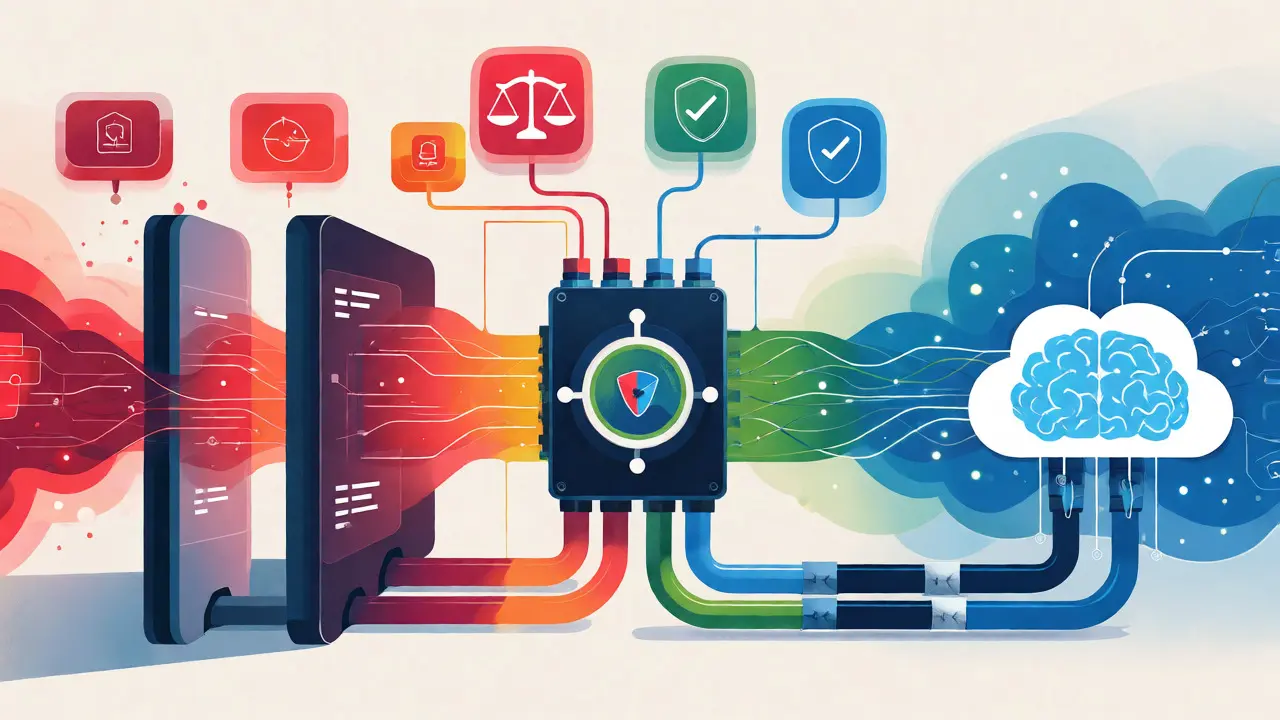
- Technical Controls Implementation: Deploy gateways that sit between your applications and the LLM. These gateways should handle masking, logging, and routing. Ensure every prompt and response is logged with metadata for audit trails.
- Ongoing Monitoring: Use runtime compliance automation to enforce policies continuously. If a new regulation emerges or a model update changes behavior, your system should flag deviations automatically.
This framework turns abstract compliance requirements into concrete technical actions. It moves the conversation from "Are we compliant?" to "Here is the evidence of our compliance."
The Hybrid Future
Is it an either/or choice between cloud LLMs and private SLMs? Rarely. The most successful strategies in 2026 are hybrid. Think of it as a tiered approach.
Use powerful cloud LLMs for general-purpose tasks where data sensitivity is low-like drafting blog posts, brainstorming ideas, or summarizing public news. These tasks benefit from the vast knowledge base of large models and don’t carry significant regulatory risk.
Reserve private, on-premise SLMs for mission-critical workflows involving confidential data. Whether it’s analyzing a contract clause, summarizing a patient chart, or reviewing a financial transaction, keep these interactions within your controlled environment. This hybrid model balances innovation with security, allowing you to harness the best of both worlds without compromising your regulatory standing.
Ultimately, the goal isn’t to slow down AI adoption. It’s to make it sustainable. By integrating security and privacy reviews early and often, regulated sectors can unlock the transformative power of LLMs while sleeping soundly at night, knowing their data-and their reputation-is protected.
Can I use public LLMs for regulated data if I sign a BAA?
A Business Associate Agreement (BAA) is necessary but often insufficient for full compliance. While it covers HIPAA basics, it may not address specific concerns like data retention for model training, cross-border data transfers, or detailed audit logging required by other regulations like GDPR or PCI DSS. Technical controls like masking and regional routing are still recommended.
What is the main advantage of Small Language Models (SLMs) over large cloud LLMs?
The primary advantage is data sovereignty and control. SLMs can be deployed on-premise or in private clouds, ensuring sensitive data never leaves the organization’s secure environment. This simplifies compliance with data residency laws and provides full auditability, unlike opaque cloud APIs.
How does GDPR conflict with LLM operations?
GDPR principles like data minimization and the right to erasure conflict with LLMs because these models are trained on massive datasets where individual data points are embedded in complex weight structures. Removing a specific user’s data from a trained model is technically difficult, and cloud vendors may retain usage logs longer than permitted.
Do I need to mask data before sending it to a private LLM?
Yes, even with private LLMs, data masking is a best practice. It reduces the attack surface by limiting the amount of sensitive PII exposed to the model layer. If the model is compromised or logs are accessed improperly, masked data is less valuable to attackers, providing defense-in-depth.
What are the risks of "Shadow AI" in regulated sectors?
Shadow AI refers to employees using unauthorized AI tools, like consumer chatbots, for work tasks. The risks include accidental leakage of confidential data to public models, lack of audit trails, and violation of company policies. Discovery tools and employee training are essential to mitigate this.