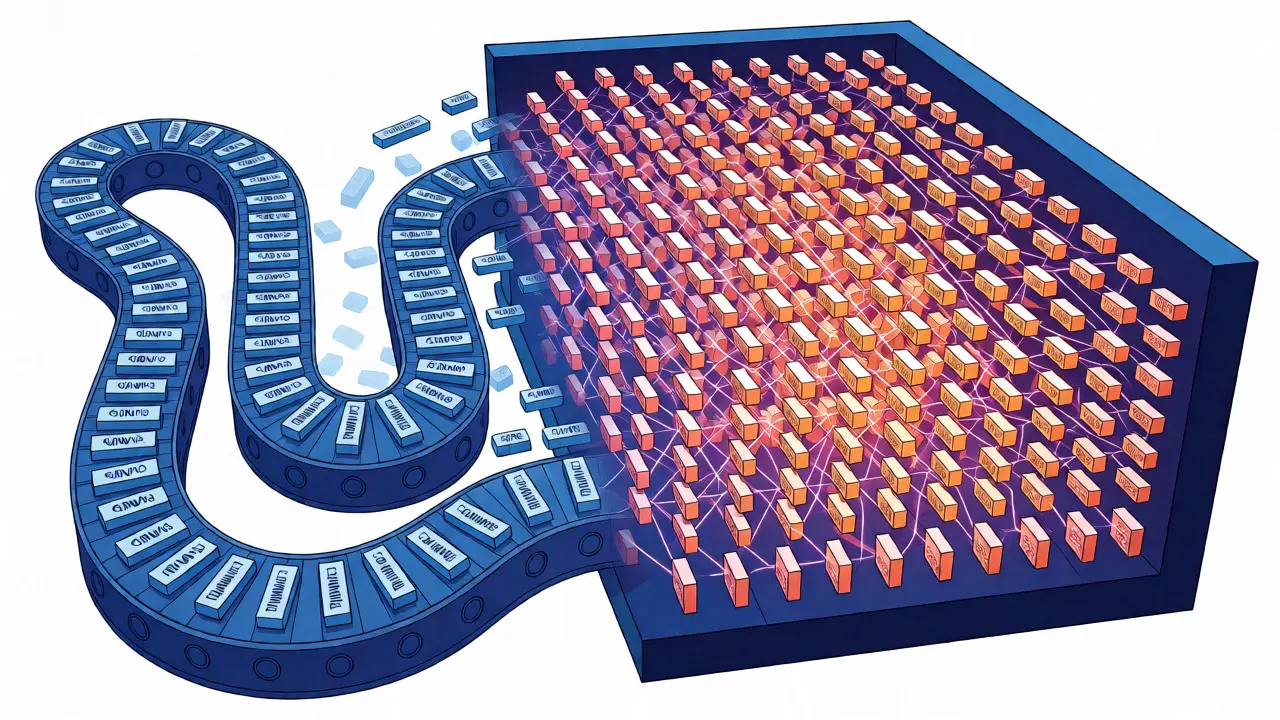
Ever wondered why a chatbot can write a coherent poem or summarize a legal contract in seconds? It’s not magic. It’s math. Specifically, it’s the Transformer architecture, which is a neural network model that uses attention mechanisms to process data sequences in parallel rather than sequentially. Before this shift, computers read text like humans do-one word at a time-slowly and prone to forgetting the beginning of a long sentence. Transformers changed the game by looking at everything at once.
The secret sauce isn’t just one thing; it’s a partnership between two specific components: self-attention and positional encoding. Think of self-attention as the brain’s ability to connect dots across a room, while positional encoding is the clock that tells you when each dot was placed. Without them working together, modern Generative AI would be gibberish. Let’s break down how these two mechanisms actually work, why they matter for your next AI project, and what happens when you get them wrong.
Why Old Models Failed at Long Text
To understand why Transformers are a big deal, you have to look at what came before. For years, Natural Language Processing (NLP) relied on Recurrent Neural Networks (RNNs). RNNs process words one after another. If you’re reading a book, an RNN reads page 1, then page 2, and so on. By the time it reaches chapter 20, it has forgotten the character names from chapter 1. This is called the "vanishing gradient problem."
Then came the paper "Attention is All You Need" in 2017 by Vaswani et al. They proposed ditching recurrence entirely. Instead of moving step-by-step, the Transformer looks at the entire sequence simultaneously. This allows for massive parallelization. On standard hardware, training a Transformer can be up to 5.3 times faster than previous best-in-class models. But if you look at everything at once, how do you know which word comes first? That’s where the core conflict lies: Attention is powerful but blind to order. Order is crucial but slow to compute. Solving this paradox required two distinct innovations.
How Self-Attention Connects Ideas
Self-attention is a mechanism that computes relationships between all elements in a sequence regardless of their distance. Imagine you are reading the sentence: "The animal didn't cross the street because it was too tired." When you see the word "it," your brain instantly knows "it" refers to "animal," not "street." How? Your brain assigned a high "weight" to the connection between "it" and "animal," and a low weight to "it" and "street."
In code, this works using three vectors: Query (Q), Key (K), and Value (V). Every word generates these three vectors. To figure out if word A relates to word B, the model compares A’s Query with B’s Key. If they match well, the attention score is high. Then, the model takes word B’s Value and adds it to word A’s representation, weighted by that score.
| Component | Role in Attention | Real-World Analogy |
|---|---|---|
| Query (Q) | What am I looking for? | A search engine query |
| Key (K) | What do I offer? | A database index tag |
| Value (V) | What information do I contain? | The actual webpage content |
This happens in parallel for every word in the sentence. Unlike RNNs, there is no sequential dependency. Word 100 doesn’t need to wait for Word 99 to finish processing. This is why Transformers scale so well. However, there’s a catch. If you shuffle the words in the input, the self-attention scores remain exactly the same relative to each other. The model knows "cat" relates to "sat," but it doesn’t know if the cat sat on the mat or the mat sat on the cat. It lacks context of position.
Positional Encoding: Teaching the Model Time
If self-attention is the eyes, Positional Encoding is a method of injecting sequential order information into token embeddings. Since the Transformer processes tokens in parallel, it needs an artificial way to distinguish the first word from the last. We do this by adding a unique vector to each word embedding based on its position.
The original implementation uses sine and cosine functions. Why? Because they create a smooth, continuous pattern that repeats. For a given position $pos$ and dimension $i$, the encoding is calculated as:
- $PE_{(pos, 2i)} = \sin(pos / 10000^{2i/d_{model}})$
- $PE_{(pos, 2i+1)} = \cos(pos / 10000^{2i/d_{model}})$
This might look scary, but here’s the intuition: lower dimensions change rapidly (high frequency), capturing fine-grained local order. Higher dimensions change slowly (low frequency), capturing long-range structure. By combining these, the model can learn relative positions. For example, it can learn that "the" usually comes before "dog," even if those words are far apart in a different sentence.
Without this, grammar collapses. Dr. Anna Rogers, an NLP researcher, famously noted that without positional encoding, "attention would be completely blind to word order, making grammar impossible to learn." You’d get a bag of words, not a sentence.

Multi-Head Attention: Seeing Different Angles
One attention head isn’t enough. Just like you don’t use one lens to view a complex scene, Transformers use Multi-Head Attention. This splits the attention mechanism into multiple parallel heads (usually 8 or 16).
Each head learns a different relationship type. One head might focus on syntactic structure (subject-verb agreement). Another might focus on semantic similarity (synonyms). A third might track coreference (who "he" refers to). By concatenating the outputs of all heads, the model gets a rich, multi-dimensional understanding of the text.
This diversity is critical for Large Language Models (LLMs) like GPT-3 or LLaMA. These models have billions of parameters, but the architecture remains surprisingly simple: stack many layers of multi-head attention and feed-forward networks. The complexity emerges from depth, not from exotic new operations.
Common Pitfalls in Implementation
If you’re building a Transformer from scratch or tweaking an existing one, watch out for these common traps. Developers often underestimate the sensitivity of positional encoding.
- Scaling Errors: You must divide the attention scores by $\sqrt{d_k}$ before applying softmax. If you forget this, the gradients vanish, and your model accuracy drops by 12-15%. It sounds minor, but it breaks training stability.
- Masking Mistakes: In generation tasks (like writing text), the model predicts the next word based only on previous words. If you accidentally allow the model to "see" future words during training, it cheats. This is called "future token leakage." About 43% of beginner implementations make this error, leading to models that perform great in testing but fail in real-world autoregressive generation.
- Dimension Mismatch: Positional encodings must match the embedding dimension exactly. If your model uses 512-dimensions, your PE vectors must also be 512-dimensions. Adding them incorrectly causes noise that drowns out semantic meaning.

The Evolution: Beyond Sinusoidal Encodings
The original sinusoidal approach was brilliant, but it had limits. It struggles with extremely long sequences (beyond 2,048 or 4,096 tokens) because the patterns start to interfere. Researchers have since developed alternatives.
Rotary Position Embeddings (RoPE), used in Meta’s LLaMA models, rotates the query and key vectors based on position. This preserves relative position information more effectively than absolute addition. Another trend is removing explicit positional encoding entirely. Google’s ALiBi (Attention with Linear Biases) adds a bias term directly to the attention scores, penalizing distant tokens. This reduces memory usage and improves extrapolation to longer texts.
Despite these advances, the core principle remains: you must inject order into a permutation-invariant system. Whether you add vectors, rotate matrices, or bias scores, the goal is the same. As we move toward 2026, expect hybrid approaches that combine sparse attention with lightweight positional signals to handle million-token contexts efficiently.
Why This Matters for Business AI
Understanding these mechanics isn’t just academic. It affects cost and performance. Because Transformers process sequences in parallel, they are GPU-friendly. This means faster inference times for customer service bots or code assistants. However, the quadratic complexity of attention ($O(n^2)$) means that doubling the input length quadruples the compute cost.
Companies adopting AI need to balance context window size with latency. A model that handles 32,000 tokens gives better coherence but costs significantly more per request than one handling 4,000 tokens. Knowing how positional encoding scales helps engineers choose the right model variant for their budget. For instance, if your use case involves short chats, older architectures with fixed-length PE might suffice. For document analysis, newer RoPE-based models offer better efficiency.
Frequently Asked Questions
Why can’t Transformers just use learned positional embeddings?
They can, and many do (like BERT). However, learned embeddings require a fixed maximum sequence length defined during training. If you try to process a text longer than the training limit, the model fails or degrades significantly. Sinusoidal or rotary encodings generalize better to unseen lengths, allowing the model to extrapolate beyond its training horizon.
What is the difference between self-attention and cross-attention?
Self-attention calculates relationships within a single sequence (e.g., how words in a sentence relate to each other). Cross-attention calculates relationships between two different sequences (e.g., how a translated sentence relates to the source sentence in machine translation). Both use the same Q-K-V mechanism but draw inputs from different sources.
Does positional encoding affect model creativity?
Indirectly, yes. Poor positional encoding can lead to repetitive or disjointed output because the model loses track of narrative structure. Good encoding ensures that the model respects the flow of time or logic in the text, which is essential for coherent story generation or logical reasoning tasks.
How much does positional encoding impact memory usage?
For sinusoidal encodings, memory impact is negligible because they are pre-calculated constants. For learned embeddings, the impact depends on the vocabulary size and max sequence length. However, the dominant memory consumer in Transformers is usually the attention matrix itself, which grows quadratically with sequence length, not the positional vectors.
Can I remove positional encoding entirely?
Not for standard Transformers. Without it, the model treats input as a set, not a sequence. Some newer architectures like Mamba (State Space Models) handle order differently through recurrent-like states, avoiding explicit positional encoding, but for Transformer-based LLMs, some form of positional signal is mandatory.