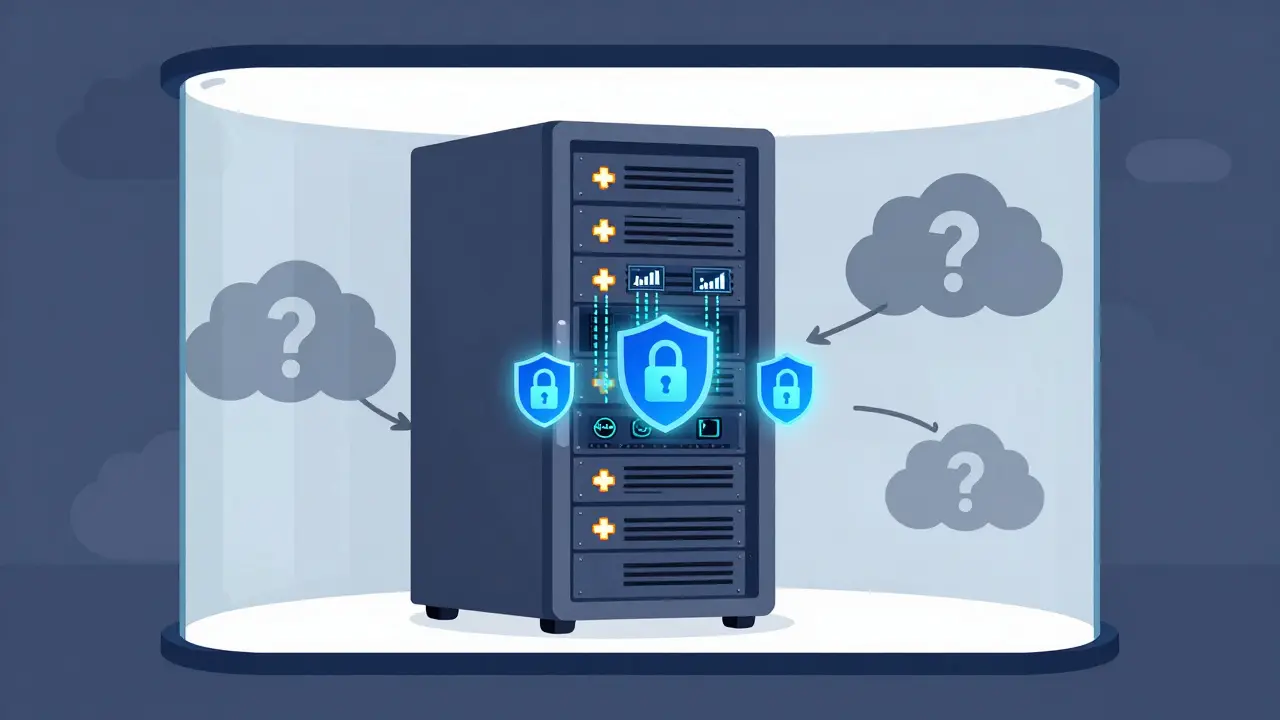
Picture this: you send a patient’s medical record or a confidential financial forecast to a cloud-based AI assistant. In seconds, you get a summary. But where did that data go? Who has access to it now? For many organizations in 2026, this uncertainty is a dealbreaker. The rise of powerful open-source large language models (LLMs), such as DeepSeek R1 and models from Meta and Mistral, has made self-hosting these systems not just possible, but necessary for industries handling sensitive information.
Self-hosting an LLM means running the model on your own servers-whether on-premises or in a private cloud-rather than sending prompts to third-party APIs like OpenAI or Google. This shift gives you complete control over your data, but it also puts the burden of security squarely on your shoulders. You are no longer just a user; you are the infrastructure provider. This guide breaks down exactly what that means for your security posture, compliance obligations, and operational reality.
The Core Trade-Off: Control vs. Complexity
When you use a public API, you trade control for convenience. The provider handles scaling, updates, and basic security. When you self-host, you gain sovereignty but inherit the complexity. The decision isn't just technical; it's strategic. If your business operates under strict regulations like HIPAA (Health Insurance Portability and Accountability Act) for healthcare, GDPR (General Data Protection Regulation) for EU data, or SOX (Sarbanes-Oxley Act) for public companies, sending data to a third party can be a compliance violation in itself.
Consider a hospital using AI to draft discharge summaries. With a public API, patient health information leaves the hospital’s network. Even if the provider promises not to store it, you cannot verify that claim independently. By self-hosting, the data never leaves your firewall. You know exactly where it lives, who accesses it, and how long it stays. This level of transparency is often required by law, not just best practice.
| Factor | Public API (e.g., OpenAI, Anthropic) | Self-Hosted (e.g., DeepSeek R1, Llama 3) |
|---|---|---|
| Data Sovereignty | Data leaves your environment; trust-based model. | Data stays within your infrastructure; full control. |
| Compliance | May violate HIPAA/GDPR/FedRAMP without specific contracts. | Easier to align with strict regulatory frameworks. |
| Security Responsibility | Provider secures the platform; you secure the prompt. | You secure the entire stack: network, server, and model. |
| Cost Structure | Predictable per-token fees; scales with usage. | High upfront hardware cost; lower marginal cost at scale. |
| Customization | Limited to system prompts and fine-tuning options. | Full access to weights, architecture, and training data. |
Securing the Infrastructure: Beyond the Firewall
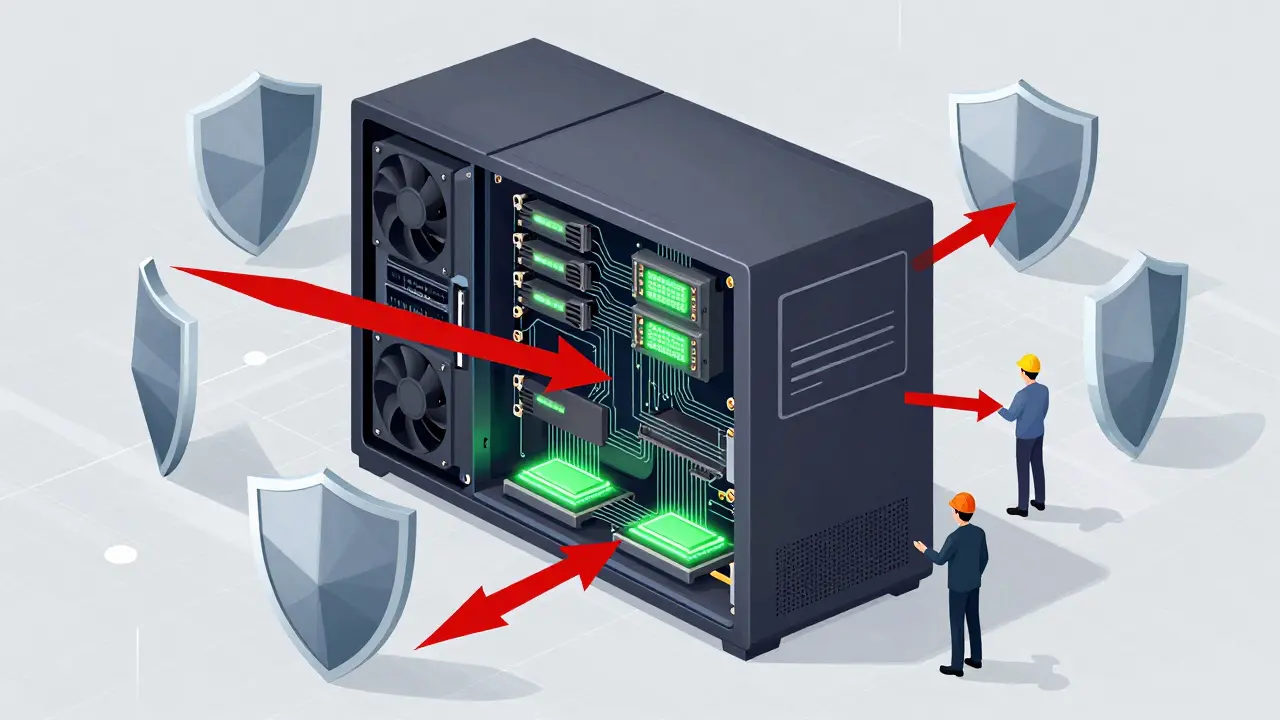
Having the model on your server doesn’t automatically make it secure. In fact, a poorly configured self-hosted LLM can become a massive blind spot in your security posture. Think of the LLM as a highly skilled intern who has read every document in your company. If you don’t set strict boundaries, they might accidentally-or maliciously-share those documents.
First, enforce strict access controls. Not everyone needs to interact with the model. Implement strong authentication and authorization protocols. Use role-based access control (RBAC) to ensure only trusted users and applications can send prompts. Monitor rate limits to detect unusual activity, which could signal an attempt to extract sensitive data through repeated queries.
Second, protect the model artifact itself. The model file (often hundreds of gigabytes) is a valuable asset. Encrypt it at rest. When loading the model into memory, perform integrity checks like hash verifications or digital signatures. This ensures the model hasn’t been tampered with or injected with malicious code during transfer or storage. Vulnerable serialization formats can be exploited, so keep your libraries updated.
Third, control outbound traffic. An LLM generates text, but it can also generate code. If an attacker exploits a vulnerability, the model could potentially exfiltrate data or execute commands. Block unauthorized outbound connections from the server hosting the LLM. Assume the worst-case scenario: the model is compromised. Your network segmentation should prevent it from reaching other critical systems.
Navigating Compliance Frameworks
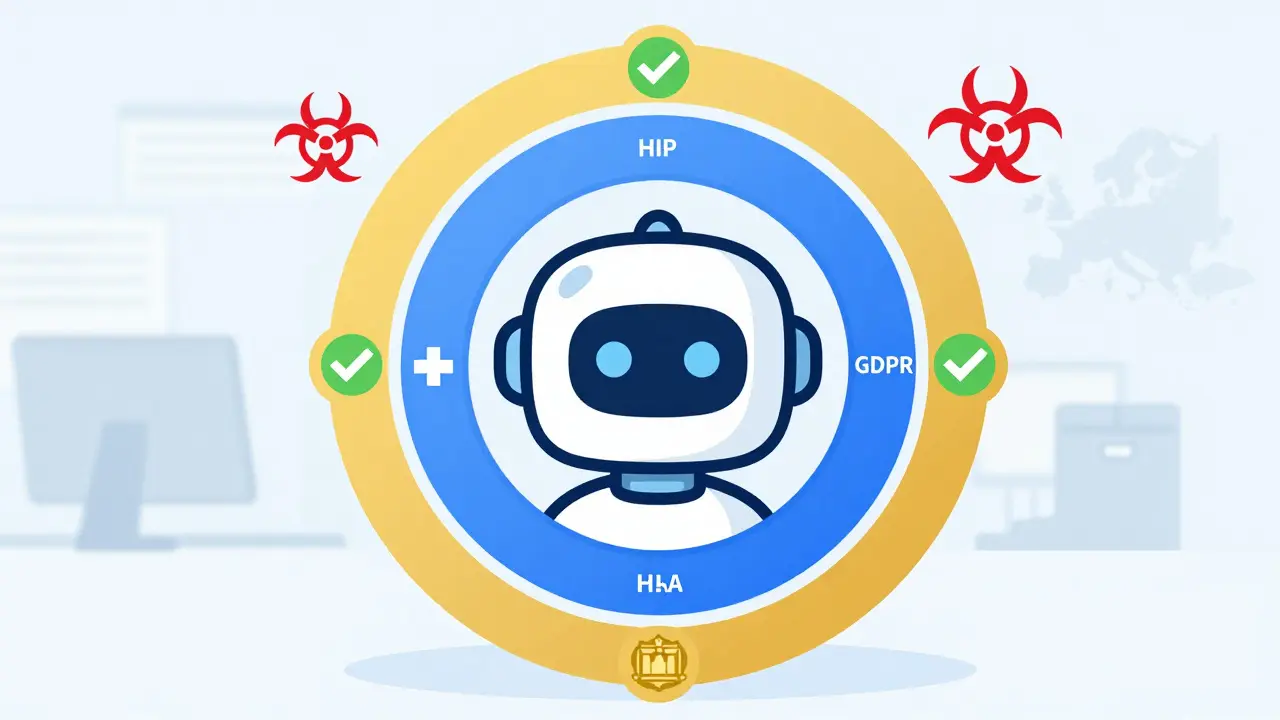
Compliance isn’t a one-size-fits-all checkbox. It depends entirely on your industry and geography. Self-hosting allows you to tailor your security controls to meet specific mandates.
- Healthcare (HIPAA): Patient data must be protected with administrative, physical, and technical safeguards. Self-hosting lets you implement audit trails that log every interaction with the model, proving who accessed what and when. This is crucial for demonstrating compliance during audits.
- European Union (GDPR): GDPR emphasizes data minimization and the right to be forgotten. With a public API, deleting data from the provider’s side can be opaque. Self-hosting gives you direct control over data retention policies. You can delete logs and training data immediately upon request.
- Government & Defense (FedRAMP, ITAR, FISMA): Federal agencies often require data to remain within specific geographic boundaries and on certified infrastructure. Self-hosting in air-gapped environments or private clouds meets these stringent requirements, ensuring national security information never touches commercial servers.
- Finance (SOX, PCI-DSS): Financial institutions need rigorous audit logs and separation of duties. Self-hosted environments allow you to integrate LLM interactions directly into your existing governance frameworks, maintaining the chain of custody for all data.
Remember, self-hosting reduces risk but doesn’t eliminate it. You still need to document your processes, train your staff, and regularly review your security controls. Compliance is an ongoing process, not a one-time setup.
Operational Challenges: The Hidden Costs
Let’s be honest: self-hosting is hard. It requires specialized skills in machine learning operations (MLOps), cybersecurity, and infrastructure management. Many teams underestimate the resources needed. You’re not just installing software; you’re managing a complex computational engine.
Hardware costs are significant. Running a high-performance LLM like DeepSeek R1 requires powerful GPUs (such as NVIDIA H100s or A100s) and substantial RAM. These components are expensive and have long lead times. Energy consumption is another factor. Keeping these servers running 24/7 adds up quickly in terms of electricity and cooling.
Maintenance is relentless. Unlike a public API that updates seamlessly, you must manually patch your operating system, update dependencies, and monitor for vulnerabilities. If a new security flaw is discovered in the underlying framework (like PyTorch or TensorFlow), your team needs to respond immediately. Failure to maintain a robust security posture increases the risk of breaches exponentially.
Performance tuning is also critical. A self-hosted model might lag behind the latest cloud offerings if not properly optimized. You need expertise in quantization techniques to reduce memory usage without sacrificing too much accuracy. Tools like Ray and Yatai can help manage deployments on Kubernetes, simplifying some of the orchestration headaches.
Best Practices for Secure Deployment
To mitigate risks, follow these actionable steps:
- Implement Guardrails: Don’t rely solely on the model’s internal safety mechanisms. Add external layers like content moderation systems, prompt injection detectors, and rule-based filters. These tools monitor inputs and outputs in real time, blocking harmful or sensitive requests before they reach the model.
- Curate Training Data: If you fine-tune your model, ensure the data is high-quality and properly documented. Maintain transparency about data sources. Poor data quality leads to poor outputs and potential bias issues.
- Monitor Continuously: Use AI Security Posture Management tools to identify active and inactive models. Remove unused models to reduce your attack surface. Log all interactions and set up alerts for anomalous behavior.
- Segment Networks: Isolate the LLM server from other parts of your network. Use virtual private clouds (VPCs) or dedicated subnets. Limit inbound and outbound traffic to only what is strictly necessary.
- Regular Audits: Conduct periodic security assessments. Test for prompt injection attacks, evaluate access controls, and review compliance documentation. Treat your LLM infrastructure with the same rigor as your core database systems.
Conclusion: Is It Worth It?
For most small businesses or hobbyists, the complexity and cost of self-hosting outweigh the benefits. Stick with public APIs. But for regulated industries-healthcare, finance, government, and large enterprises handling proprietary data-self-hosting is becoming a strategic imperative. The ability to prove data sovereignty, meet strict compliance standards, and maintain control over sensitive information is invaluable.
The key is preparation. Don’t rush into self-hosting without a solid security plan. Invest in the right hardware, hire or train skilled personnel, and implement robust monitoring from day one. Yes, it’s harder than clicking a button to sign up for an API. But in a world where data breaches carry heavy fines and reputational damage, that effort pays off.
What is the biggest security risk of self-hosting an LLM?
The biggest risk is improper access control and lack of monitoring. If unauthorized users can interact with the model, they may extract sensitive data through prompt injection or repeated queries. Additionally, failing to patch the underlying infrastructure creates vulnerabilities that attackers can exploit to compromise the entire server.
Can self-hosting help me comply with GDPR?
Yes, significantly. GDPR requires data minimization and the right to erasure. Self-hosting allows you to keep EU citizen data within your jurisdiction and delete it immediately upon request. With public APIs, you depend on the provider’s deletion policies, which may not be transparent or immediate enough for strict compliance.
How much does it cost to self-host a large language model?
Costs vary widely based on model size and usage. A mid-sized model might require a single GPU server costing $5,000-$10,000 upfront, plus monthly electricity and maintenance. Larger models like DeepSeek R1 may need multiple high-end GPUs, pushing initial hardware costs to $50,000 or more. However, at high volume, the per-query cost is often lower than paying per token to a cloud provider.
Do I need a PhD in AI to self-host an LLM?
Not necessarily, but you do need strong DevOps and cybersecurity skills. Tools like Kubernetes, Docker, and managed platforms simplify deployment. However, you still need someone who understands network security, encryption, and basic ML concepts to configure and maintain the system safely.
What is prompt injection, and why is it dangerous for self-hosted models?
Prompt injection is an attack where a user tricks the model into ignoring its instructions and revealing hidden information or performing unintended actions. For self-hosted models, this is dangerous because the model has access to your local data. An attacker could craft a prompt that causes the model to output confidential documents stored in its context window.