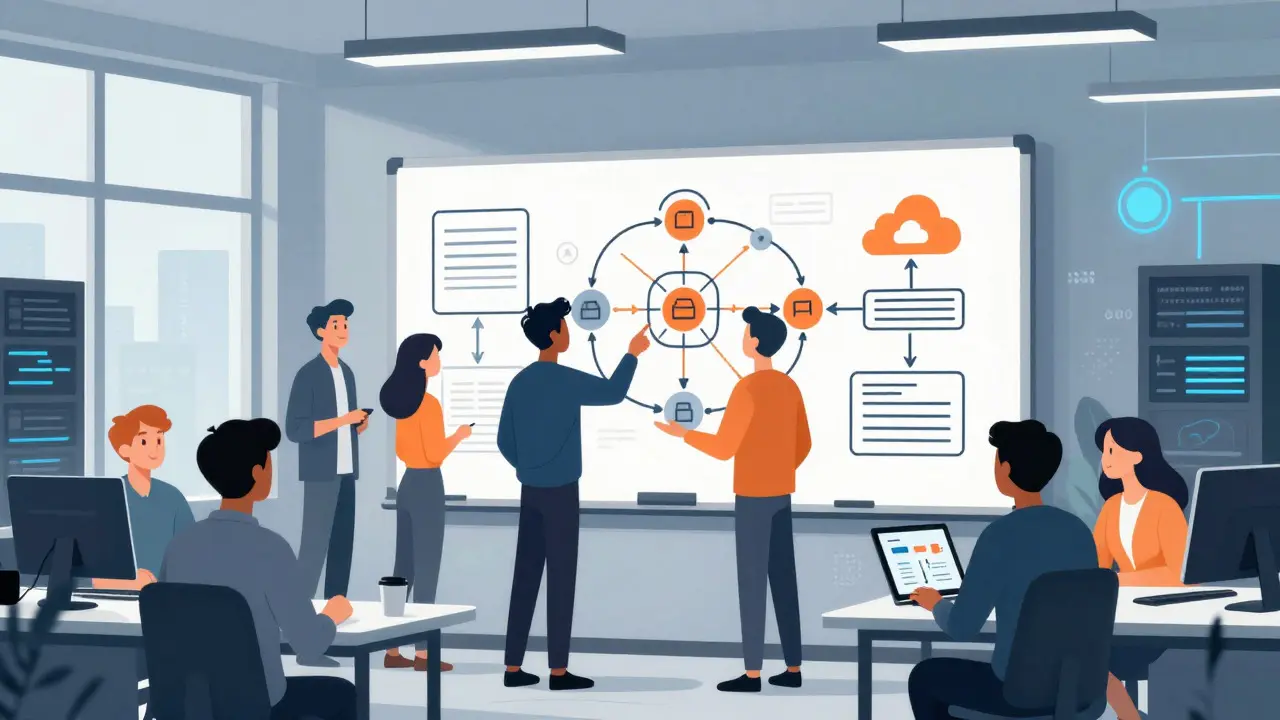
Imagine a world where the computer writes most of your code. It sounds like science fiction, but for many engineers in 2026, it is just another Tuesday. The days of memorizing every semicolon or struggling to recall specific syntax rules are fading fast. The future developer role is no longer about typing commands into an editor; it is about making high-stakes decisions that machines cannot yet make. As artificial intelligence handles the heavy lifting of routine code generation, the value of a human engineer shifts dramatically. You are no longer judged by how fast you can write a function, but by how well you can design a system, secure it from threats, and judge when the AI is right and when it is wrong.
Key Takeaways
- Architecture over Syntax: Developers must master system design and cloud-native patterns rather than relying on rote coding skills.
- Security is Core: Secure coding and threat modeling are now baseline requirements, not optional specializations.
- Judgment is King: The ability to evaluate trade-offs between performance, cost, and reliability defines senior expertise.
- AI Integration: Understanding how to orchestrate Large Language Models (LLMs) and vector databases is essential for modern products.
- Foundations Still Matter: Deep knowledge of data structures and algorithms remains critical for overseeing AI-generated code.
The Shift from Typing to Thinking
For decades, being a good programmer meant having a photographic memory for language-specific quirks. You knew exactly which library to import and how to handle edge cases in a loop. Today, those skills are becoming commoditized. With 84% of developers using AI assistance regularly, the barrier to entry for writing functional code has dropped significantly. But this creates a dangerous trap. If you only know how to type code, you become replaceable by the tool itself.
The new reality demands a different kind of mental muscle. Instead of building binary search trees from scratch, you are composing prompts and stitching together AI-generated modules. This requires a deep understanding of System Design the conceptual framework for structuring complex software systems to ensure scalability and maintainability. You need to know how components talk to each other, how failures propagate, and how to keep the whole machine running smoothly under pressure. It is less like being a bricklayer and more like being an architect who hires contractors to build the walls. You still need to know what a wall is made of, but your primary job is ensuring the house doesn't collapse.
Mastering Modern Architecture
Cloud-native development has moved past the "lift and shift" era. In 2026, simply hosting an app on a cloud provider is not enough. Engineers must design applications that scale horizontally, handle distributed workloads, and remain resilient when traffic spikes unexpectedly. This means mastering tools like Kubernetes and serverless computing is no longer optional; it is the baseline expectation.
Consider the financial impact. Cloud bills continue to rise, and companies are watching their budgets closely. A developer who understands how to architect cost-efficient systems saves real money. This involves making tough choices about microservices versus monoliths, event-driven architectures, and API design. For example, if you are building a payment processing system, you need to decide whether to use a synchronous API for immediate feedback or an asynchronous queue for better throughput. These are architectural judgments that require experience, not just syntax knowledge.
| Focus Area | Traditional Approach (Pre-2025) | Modern Approach (2026) |
|---|---|---|
| Code Creation | Manual typing, syntax mastery | Prompt engineering, AI oversight |
| System Structure | Monolithic, simple scaling | Distributed, cloud-native, microservices |
| Security | Post-development patching | Security by design, threat modeling |
| Decision Making | Following established patterns | Evaluating trade-offs, cost-performance balance |
Security as a Primary Concern
Security used to be a separate phase, often handled by a specialized team after the product was built. That model is broken. In today's connected ecosystem, security is baked into every line of code and every architectural decision. A single vulnerable API endpoint can compromise an entire platform. Therefore, Secure Coding Practices a set of guidelines and techniques to minimize vulnerabilities in software during development have become core competencies for all developers.
This means you need to understand threat modeling before you start coding. What could go wrong? Where are the attack vectors? How do we validate user input? When working with APIs, which shape how software interacts internally and externally, you must ensure they are versioned, documented, and secure. Backward compatibility is crucial, but so is preventing injection attacks or data leaks. The modern developer acts as a first-line defender, ensuring that resilience is designed in, not bolted on.
The Power of Judgment and Trade-Offs
Perhaps the most valuable skill in 2026 is judgment. When an AI suggests a solution, how do you know if it is the right one? You need to understand complexity analysis, profiling tools, and runtime behavior. Efficiency is no longer a nice-to-have; it keeps products responsive and reduces operational costs. A slow application loses users, and inefficient infrastructure loses money.
This requires polyglot programming skills. You don't need to be an expert in every language, but you must understand their strengths. Python dominates AI and automation tasks. TypeScript is essential for full-stack consistency. Go or Rust offer unmatched performance for backend systems. Choosing the right tool for the job is a strategic decision. If you pick the wrong language for a high-throughput service, you might face performance bottlenecks that are painful to fix later. Your judgment guides these choices, balancing readability, speed, and memory consumption.
Integrating Generative AI Effectively
AI is no longer a buzzword; it is a core element of software engineering. Companies expect developers to integrate models like GPT-4 into their products. This involves more than just calling an API. You need to understand prompt engineering, embedding retrieval, and working with vector databases. For instance, if you are building a customer support chatbot, you need to implement Retrieval-Augmented Generation (RAG) to ensure the AI answers based on your specific company data, not just general internet knowledge.
However, working with probabilistic systems brings its own challenges. AI models can hallucinate. They can be inconsistent. Engineers must understand these limitations and build guardrails around them. This includes monitoring AI performance, handling privacy considerations, and orchestrating multi-model workflows. Knowing when to use AI and when to stick with deterministic logic is a nuanced skill that separates effective integrators from those who create fragile systems.
Data Literacy and Observability
You cannot improve what you cannot measure. Data literacy has become a non-negotiable part of the developer role. Engineers must design robust data pipelines, ensure data quality, and maintain efficient ETL/ELT processes. In 2026, data engineering enables every tech product. Whether it is training a machine learning model or generating a dashboard for executives, the flow of data must be clean and reliable.
Equally important is observability. As systems become more distributed, debugging becomes harder. You need to monitor systems, track metrics, and respond to incidents quickly. Tools for logging, tracing, and alerting are part of your daily toolkit. Understanding the lifecycle of data within an organization-what matters, how it flows, and how to make it useful-drives better decision-making across the board.
Soft Skills and Cross-Functional Collaboration
Technical skills alone will not carry you far. AI is blurring the lines between roles, forcing engineers, security professionals, data scientists, and cloud practitioners to work closer together. You need to communicate complex technical concepts to non-technical stakeholders. Can you explain why a certain architectural choice increases cost but improves reliability? Can you document your decisions clearly for future team members?
Cross-functional collaboration is essential. Working with product managers, DevOps engineers, and business leaders ensures that technology serves business objectives. The future developer is a strategic thinker who bridges the gap between code and value. Strong communication and documentation skills help translate technical work into tangible business outcomes, driving projects forward without friction.
Frequently Asked Questions
Do I still need to learn data structures and algorithms?
Yes, absolutely. While AI can generate code, you need foundational knowledge to verify its correctness and efficiency. Understanding data structures helps you spot inefficiencies and make sound architectural decisions. Without these fundamentals, you risk accepting suboptimal AI solutions without realizing the performance cost.
What is the biggest risk of relying too heavily on AI coding assistants?
Skill atrophy is the primary risk. If you stop practicing core programming concepts, you may lose the ability to debug complex issues or design novel systems. Additionally, over-reliance can lead to technical debt if you accept AI suggestions without critically evaluating them for security or scalability implications.
How important is security knowledge for frontend developers?
Very important. Frontend developers interact directly with user input and browser environments, which are common attack vectors. Understanding XSS, CSRF, and secure API consumption is critical. Security is a shared responsibility, and frontend engineers play a vital role in protecting the client-side experience.
Which programming languages should I prioritize in 2026?
Prioritize languages that align with current industry trends. Python is dominant for AI and automation. TypeScript is essential for full-stack web development due to its type safety. Go and Rust are highly valued for backend services requiring high performance and concurrency. Choose based on the problem domain you want to solve.
How does the developer role differ from a Site Reliability Engineer (SRE)?
While SREs focus specifically on reliability, automation, and incident response for large-scale systems, modern developers are expected to have SRE mindsets. You need to understand CI/CD pipelines, monitoring, and deployment strategies. The line is blurring, and developers who understand operations are more valuable because they can build systems that are easier to run and maintain.
Amara Akbar
August 19, 2026 AT 18:03It is a pleasure to observe this shift. The transition from syntax memorization to architectural judgment is indeed the defining characteristic of modern engineering. One must recognize that the value proposition has fundamentally altered. We are no longer merely typing commands; we are curating logic. This requires a heightened level of cognitive engagement. The role of the developer is evolving into that of a system orchestrator. Precision in design outweighs speed in execution. Let us embrace this new paradigm with open minds.
Courtney Wagstaff
August 21, 2026 AT 17:54Okay so like, I read this and felt a weird mix of relief and panic?
Relief because I never was great at remembering which bracket went where anyway. Panic because now I actually have to understand *why* the bracket is there. It’s basically saying we’re all becoming project managers for robots now. Which sounds exhausting but also kind of cool if you think about it as being the creative director instead of the line worker.
Mark Harvey
August 22, 2026 AT 20:24You got this. Seriously. It feels scary when the rules change but honestly its just evolution. Think of it like learning to drive an automatic after years of stick shift. At first you miss the clutch but then you realize you can focus more on the road. Keep your head up. The fundamentals are still there they just look different. You are ready for this next chapter.
Art HND
August 23, 2026 AT 01:46Meh. They always say the same thing. Last year it was microservices. The year before that was cloud native. Now it's AI oversight. The job title changes but the work is the same: fixing bugs and waiting on Jira tickets. Don't get too excited about the 'judgment' part. Most people don't have any to begin with. Just write code that compiles and go home.
Brandon Olvera
August 23, 2026 AT 14:40Good riddance to the old ways. America built the internet and now we're finally moving past the grunt work. Time to focus on high-level strategy and secure our digital borders. No more wasting time on trivial syntax errors. Let's build systems that actually hold up under pressure. That's what real engineering looks like.
Elizabeth Brooks
August 24, 2026 AT 06:26I totally agree with the security point! I've seen so many teams treat security like an afterthought until something breaks. Its such a pain when you have to patch vulnerabilities late in the cycle. I think threat modeling should be taught in bootcamps now. Also, does anyone else find RAG implementations really tricky to get right? The vector database part gives me headaches sometimes but its getting better. Just my two cents from the trenches!
Deb Kortyna, MBA
August 25, 2026 AT 17:41One must consider the dramatic implications of this statement. To suggest that syntax is no longer paramount is to ignore the very foundation upon which all software is built. Without a deep understanding of the language, how can one truly judge the output of an algorithm? It is a precarious position to stand in. The market will correct itself, as it always does, and we shall see who remains standing. For now, let us proceed with caution and perhaps a touch of skepticism regarding these sweeping generalizations.
alex kobri
August 27, 2026 AT 06:50There is a philosophical tension here. If the machine writes the code, do we own the logic or just the intent? It reminds me of the question of whether the painter owns the canvas or the brush. We are shifting from creators to editors. And editing is a powerful form of creation. But it requires a different kind of humility. We must accept that our intuition might be wrong more often than we think. And that is okay. Growth happens in the discomfort of uncertainty. So let us not fear the editor role. Let us master it.
Zach Loescher
August 27, 2026 AT 21:53I tend to sit on the fence on this one. On one hand, the efficiency gains are undeniable. On the other, I worry about the loss of tacit knowledge that comes from manual coding. When you type out a complex data structure, you feel the constraints in a way that reading generated code doesn't convey. It's a subtle difference but important for long-term maintainability. I'm curious to see how this plays out over the next five years. My experience suggests that the best engineers will be those who can switch between modes seamlessly.