
You know that feeling when a student writes code that works but looks like a tangled ball of yarn? It runs, sure, but nobody can maintain it. For decades, we taught programming by forcing students to memorize syntax before they could understand structure. That era is ending. Vibe coding is changing the game. It shifts the focus from typing correct semicolons to designing logical systems using natural language and AI assistants.
This isn't just about laziness or shortcuts. It’s about cognitive load. When you remove the barrier of syntax, students can finally see the big picture. They can experiment with architectural patterns like dependency injection or microservices without getting stuck on a missing bracket. But here’s the catch: if you don’t guide them, they’ll build functional messes. This article breaks down how educators are using vibe coding to teach real software architecture, backed by data from Stanford, ASU, and industry leaders.
What Actually Is Vibe Coding in Education?
Let’s cut through the buzzwords. Vibe coding is an AI-assisted development approach where users describe intent in natural language, and AI generates the code. In an educational context, it means students act as architects rather than bricklayers. They define what the system should do and how components interact, while tools like Replit or Cursor handle the implementation details.
Google Cloud explains this operates on two levels. First, there’s the iterative loop: refining specific functions through conversation. Second, there’s the lifecycle: building entire applications from conceptual ideas. For teaching architecture, the second level matters most. Students aren’t just writing functions; they’re assembling systems. Think of it like playing with Lego blocks where the instructions are written in plain English. You say, "Make a user service that talks to the database," and the AI builds the interface. Your job is to ensure that interface makes sense within the larger design.
This method emerged around 2023-2024 with tools like Base44 and Lovable. By early 2024, universities caught on. Stanford launched a formal course titled "Vibe Coding: Building Software in Conversation with AI" for their Spring 2025 quarter. The goal wasn’t to teach Python syntax. It was to teach systematic problem decomposition. If you can explain your architecture clearly enough for an AI to build it, you actually understand it.
Why Traditional Methods Fail at Teaching Architecture
We’ve all seen the struggle. Students spend hours debugging a typo in a class definition. By the time they fix it, they’ve lost sight of why they needed that class in the first place. Traditional IDEs punish small errors harshly, which discourages experimentation. You hesitate to refactor because you’re afraid of breaking something trivial.
Data backs this up. Arizona State University’s W. P. Carey School of Business ran a program called AZNext. They compared traditional coding methods against vibe coding approaches. The results were stark. Students using vibe coding showed a 73% improvement in understanding system design concepts. Why? Because they spent their mental energy on structure, not syntax. They completed architectural exercises 2.3 times faster. More importantly, post-course assessments showed 41% deeper understanding of design patterns.
Compare this to tools like Scratch or Alice. Those are great for beginners, but they hit a ceiling. You can’t easily simulate complex enterprise architectures in Scratch. Vibe coding fills that gap. It lets students move beyond animation into real-world application development without the steep learning curve of full-code environments. Campus.edu’s evaluation of their Vibe Coding 101 program found a 68% reduction in syntax-related errors. That’s huge. It means less time fixing commas and more time discussing whether a singleton pattern is actually necessary.

The Pitfalls: When AI Builds a Monolith
Here’s the danger zone. Without guidance, AI tends to generate monolithic code. It creates one giant file because that’s often the easiest path to a working solution. Dr. Sarah Allen, Principal Engineer at Google, warned in late 2024 that vibe coding can produce students who build functional apps but lack fundamental understanding of why certain patterns exist. She’s right. If you just ask for a "login feature," the AI might dump everything into one controller.
Gartner positioned this educational approach in the "Innovation Trigger" phase of their 2025 Hype Cycle. Their analysis noted that 78% of current educational tools lack structured guidance for architectural decision-making. Students treat the AI as a magic box. They accept whatever comes out. Revature trainers reported that 68% of students needed remedial training on systematic decomposition before effective vibe coding could occur. They had to learn how to break problems down before they could prompt effectively.
To combat this, educators are developing specialized prompt libraries. Instead of asking for features, students learn to ask for structures. A good prompt isn’t "Make a shopping cart." It’s "Refactor this class to use dependency injection. Remove all direct instantiation of dependencies and accept them as constructor parameters." This forces the AI to adhere to architectural constraints. Synaptic Labs emphasizes "Composition over Inheritance" as a core principle in these guides. They describe systems as "assembling a magical artifact from interchangeable enchanted components" rather than rigid class hierarchies. This metaphor helps students visualize loose coupling.
Tools and Costs for Educators
If you’re thinking about implementing this, you need the right stack. The primary ecosystem includes Replit, Cursor, and v0. These platforms offer integrated code editors, package managers, and deployment tools. Stanford’s course documentation specifies that students need access to a cloud environment. Costs vary. Replit subscriptions range from $25 to $100 per month depending on usage tiers. DeepLearning.AI partnered with Replit to create specific courses, noting that infrastructure costs are a barrier for some institutions.
| Platform | Architectural Guidance Score | Best For | Cost Estimate |
|---|---|---|---|
| Replit | 4.2/5 | Cloud-based collaboration and deployment | $25-$100/mo |
| Cursor | High (Local IDE) | Students familiar with VS Code workflows | Free - $20/mo |
| Base44 | 2.8/5 | Rapid prototyping for non-coders | Varies |
| v0 | Moderate | UI-focused architectural components | Freemium |
Replit scores highest for architectural guidance in DeepLearning.AI evaluations because of its robust community examples. Newer tools like Base44 score lower simply because they lack sufficient examples of proper architectural patterns. Documentation quality matters. If the tool doesn’t show you how to modularize code, students won’t either.
How to Structure a Vibe Coding Architecture Course
You can’t just throw students at an AI and hope for the best. Stanford’s course requires 6-8 hours weekly. That’s 2 hours of live instruction and 4-6 hours of project work. Students typically need 15-20 hours to become proficient in architectural prompting techniques. For those with no prior coding experience, ASU found they need about 30 hours of guided practice to reliably produce architecturally sound systems. Compare that to 75 hours needed for similar understanding via traditional methods. That’s a massive efficiency gain.
The curriculum must emphasize meta-skills. Precision in shaping AI output is key. Judgment in assessing solutions is critical. Students need to learn "strategic prompting techniques." At Stanford, Dr. Michael Bernstein teaches modules on principles like "Tell, Don't Ask." After completing this module, 89% of students correctly applied these principles in their projects. This shows that explicit teaching of prompting strategies directly correlates with architectural quality.
Start with small components. Ask students to build a single service. Then, have them integrate it. Force them to write documentation. Campus.edu’s flagship milestone project requires "clean docs, version history, and prompt notes showing the full architectural process." This transparency is vital. You need to see the thought process, not just the final code. If a student asks for a "user profile page," you want to see prompts like "Create a React component for User Profile that fetches data from the API service defined in src/services/userService.ts." Specificity drives better architecture.
The Future: Guardrails and Enterprise Adoption
The market is moving fast. The global AI coding education market hit $1.2 billion in Q3 2024. Architectural-focused vibe coding courses make up 28% of that segment. Enterprises are noticing too. Gartner reports that 43 of the Fortune 100 companies now implement internal vibe coding training for software architects. They cite a 37% average reduction in architectural rework when teams use structured vibe coding approaches.
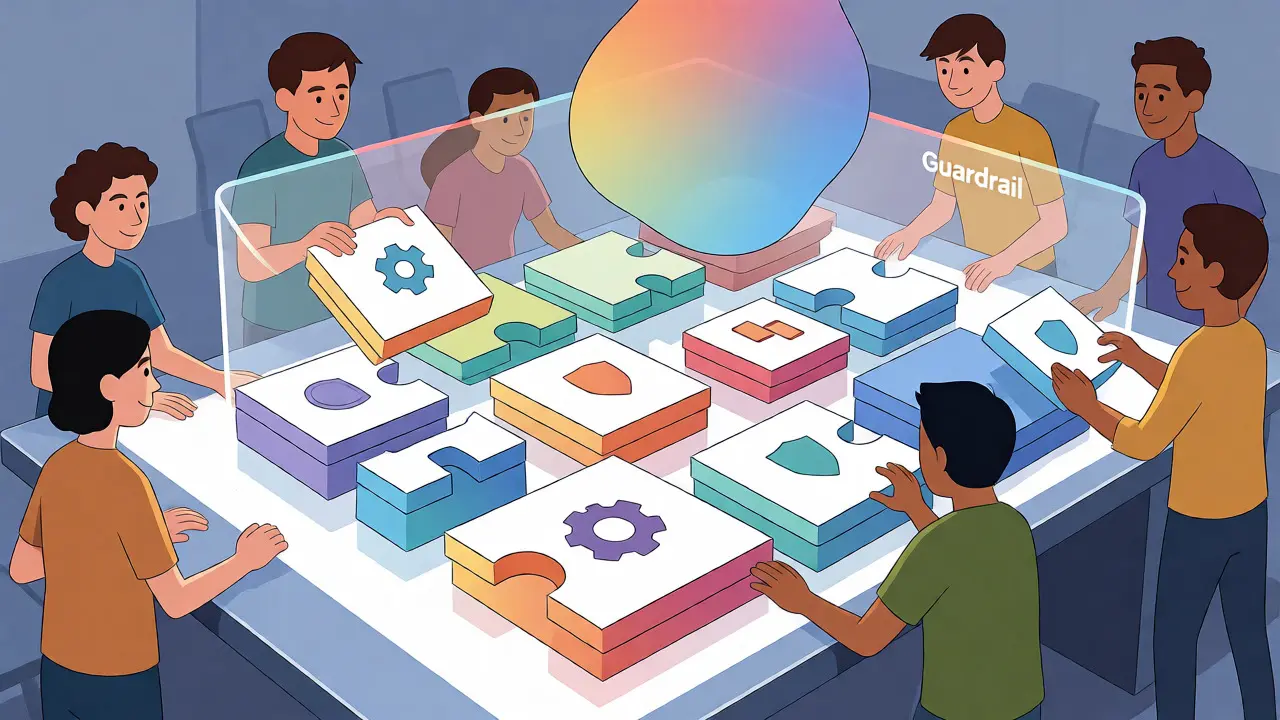
Tools are evolving to support this. Google Cloud introduced "Architecture Guardrails" in March 2025. These automatically flag deviations from specified architectural patterns with 89% accuracy. Stanford is integrating "architectural constraint prompts" into their curriculum, requiring students to specify design patterns before generating code. Preliminary data shows this improves pattern adherence by 53%. Forrester predicts that by 2026, 90% of enterprise-grade vibe coding tools will include built-in architectural pattern libraries.
But let’s stay grounded. The ACM Education Board notes that vibe coding is not a replacement for architectural understanding. It’s a vehicle for making concepts accessible. IEEE Computer Society surveys show 63% of CS department chairs worry that poor implementation could produce developers who can build apps but cannot design systems. The solution isn’t to ban AI. It’s to teach architecture explicitly, using AI as the hands that build what the brain designs.
Do students need prior coding knowledge to start vibe coding?
Not necessarily. ASU’s AZNext program found that humanities students with no prior coding background successfully mastered basic architectural concepts through vibe coding methods. In fact, 79% of these non-traditional learners grasped concepts that only 32% understood through traditional CS education approaches. However, they still need to understand logical flow and system interactions.
What is the biggest risk of using vibe coding in education?
The biggest risk is producing students who can build functional applications but lack fundamental understanding of why certain architectural patterns exist. Dr. Sarah Allen from Google warns that without explicit architectural teaching components, students may rely too heavily on AI outputs that work but are poorly designed. Additionally, Campus.edu data shows a 22% higher incidence of architectural misdesign when students lack proper guidance on system design principles.
How much does it cost to set up a vibe coding classroom?
Costs depend on the platform. Replit, a popular choice for its cloud environment, ranges from $25 to $100 per month per student depending on usage tiers. Other tools like Cursor may have free tiers or lower monthly fees ($0-$20). Institutions should budget for both licensing and potential training for instructors, as many tools lack built-in architectural guidance and require instructor intervention.
Can vibe coding replace traditional programming languages like Java or C++?
No, it complements them. Vibe coding changes how students learn and prototype. It allows them to focus on high-level architecture before diving into low-level syntax. Professor Mark Guzdial notes that it enables a more experimental, motivating approach. Students can rapidly prototype ideas and see immediate visual feedback. Eventually, understanding the underlying language remains important for debugging and optimization, but the entry barrier to creating complex systems is significantly lowered.
What specific skills should I assess in a vibe coding project?
Focus on the prompt history and architectural decisions, not just the final code. Assess the student's ability to decompose problems systematically. Look for evidence of strategic prompting, such as requesting dependency injection or modular design. Campus.edu evaluates projects based on clean docs, version history, and prompt notes that show the full architectural process. This reveals whether the student understands the 'why' behind the code generation.