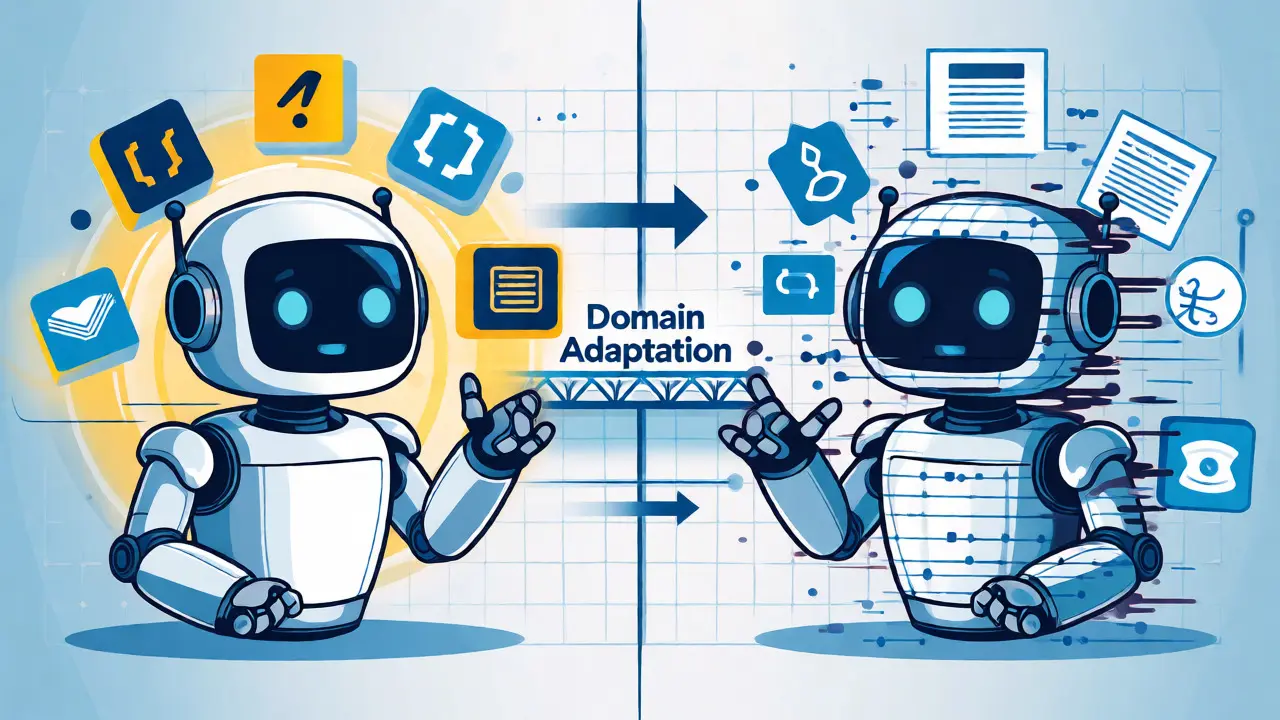
You built a chatbot using a massive model like GPT-3 or Llama 2. It writes poetry, summarizes news, and codes in Python. But ask it to interpret a dense legal contract or diagnose a rare medical condition, and it starts hallucinating. Why? Because general-purpose models are trained on the internet, not your specific industry data. This gap is where domain adaptation comes in. It’s the process of tweaking these pre-trained giants so they understand the jargon, structure, and logic of your specific field. If you’re trying to deploy AI in healthcare, finance, or law, ignoring this step is like hiring a brilliant intern who has never read a single case file.
The Performance Gap You Can’t Ignore
Let’s look at the numbers. According to Meta AI’s 2023 benchmarking, standard large language models (LLMs) hit an accuracy rate of 85-92% on general tasks. Drop them into a specialized domain, and that number plummets to 58-72%. That’s a massive drop-off. For a lawyer, missing 30% of relevant clauses isn’t just inefficient; it’s risky. Domain adaptation bridges this gap. Organizations leveraging techniques like Supervised Fine-Tuning (SFT) report performance improvements of 15-30%. The best part? You don’t need millions of examples. AWS documentation from 2024 suggests that as few as 500 to 2,000 high-quality, domain-specific examples can yield significant gains.
This isn’t just about getting better scores on a test. It’s about reliability. When a model understands that "apple" means fruit in one context but a tech giant in another, it stops making embarrassing mistakes. In specialized fields, precision is everything. A slight misunderstanding of terminology in a medical record could lead to incorrect treatment recommendations. Domain adaptation forces the model to align its internal representations with the reality of your industry.
Three Main Paths to Adaptation
There isn’t one way to adapt a model. You generally choose between three methodological pathways, each with different costs and benefits. Choosing the wrong one wastes time and compute resources.
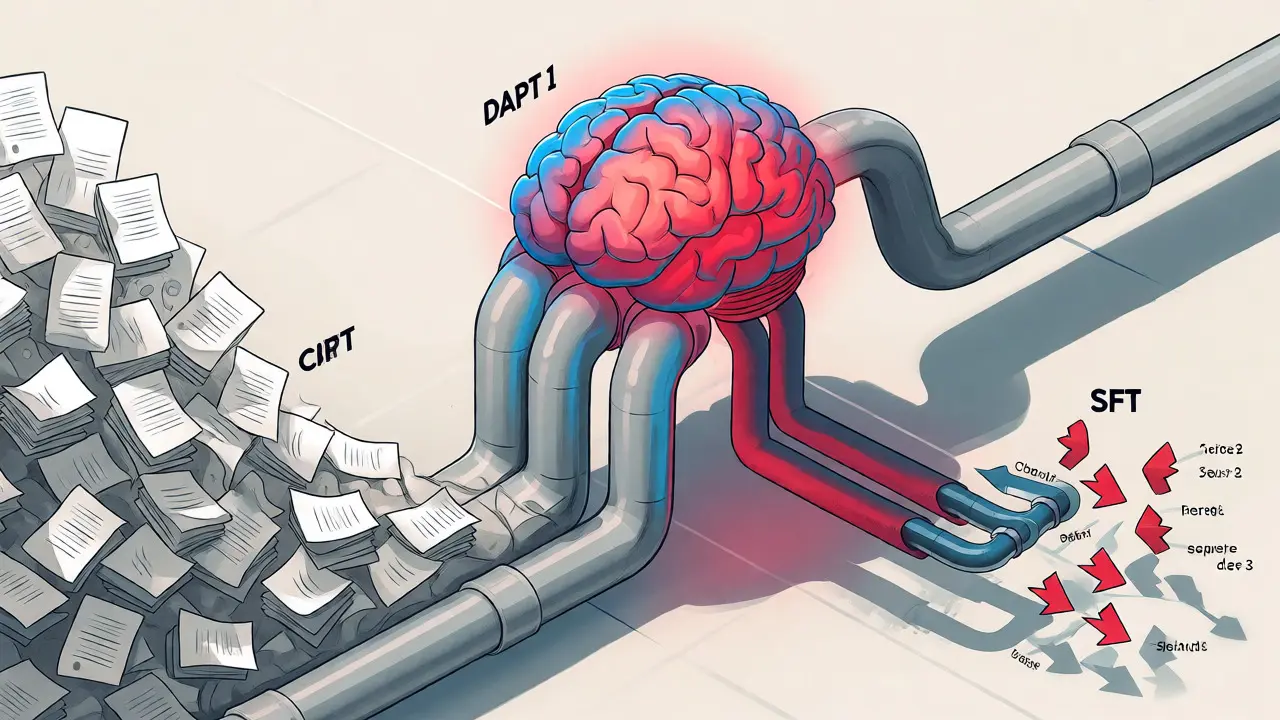
- Domain-Adaptive Pre-Training (DAPT): This involves taking a pre-trained model and continuing its pre-training phase on your domain-specific corpus. Think of it as sending the model back to school for a semester in law school before letting it practice law. It requires substantial unlabeled data-typically 5,000 to 50,000 documents-and significant compute power. DAPT outperforms standard fine-tuning by 7.3-12.8% in low-resource domains but demands 3-5x more computational resources.
- Continued Pretraining (CPT): Similar to DAPT, but smarter. CPT mixes 10-20% new domain data with the original pre-training data. Why mix them? To prevent catastrophic forgetting. A Nature study in 2025 found that without this mixing, 68% of fine-tuning scenarios suffer from catastrophic forgetting, where the model loses its general knowledge while learning new specifics. CPT balances specialization with versatility.
- Supervised Fine-Tuning (SFT): This is the most common approach for enterprises. You use labeled examples-input-output pairs-to teach the model specific tasks. SFT requires smaller datasets (500-5,000 labeled examples) but delivers impressive results, boosting accuracy by 22-35% in medical and legal domains. It’s faster and cheaper than DAPT, making it accessible for teams with limited GPU budgets.
| Method | Data Requirement | Compute Cost | Best Use Case |
|---|---|---|---|
| DAPT | 5k-50k unlabeled docs | High (3-5x) | Deep domain understanding needed |
| CPT | Mixed domain + general data | Medium-High | Preventing catastrophic forgetting |
| SFT | 500-5k labeled examples | Low-Medium | Specific task optimization |
| In-Context Learning | Prompts only | Very Low | Rapid prototyping, no training budget |
The Rise of Efficient Techniques Like DEAL and LoRA
Full fine-tuning updates every parameter in the model. For a 70-billion-parameter model like Llama 2 70B, that’s expensive. Enter parameter-efficient fine-tuning (PEFT). A Hacker News discussion in August 2024 revealed that 73% of practitioners prefer PEFT methods over full fine-tuning due to computational constraints. LoRA (Low-Rank Adaptation) is the star here. Instead of updating all weights, LoRA injects small trainable matrices into specific layers. It reduces memory usage dramatically, allowing you to fine-tune large models on consumer-grade GPUs.
Then there’s DEAL (Data Efficient Alignment for Language). Introduced by David Wu and Sanjiban Choudhury in September 2024, DEAL addresses alignment challenges when target labels are scarce. It transfers supervision across tasks with similar data distributions. On benchmarks like MT-Bench, DEAL improved performance by 18.7% when target labels were fewer than 100 examples. It’s particularly effective in cross-lingual scenarios, boosting performance by 24.6% when adapting from English to low-resource languages. If you’re working with limited data or multiple languages, DEAL offers a sophisticated alternative to brute-force fine-tuning.
Real-World Challenges and Pitfalls
It’s not all smooth sailing. Implementing domain adaptation comes with hurdles. Catastrophic forgetting remains the biggest enemy. As Dr. Antoine Bordes from Meta AI noted in June 2024, continued pre-training is 3.2x more effective than prompt engineering alone, but it requires careful balancing. If you train too aggressively on domain data, your model might forget how to write coherent sentences in plain English.
Another issue is domain drift. Financial jargon changes quarterly. Legal precedents shift. A model adapted to SEC filings from 2023 might struggle with 2025 regulations. One financial services data scientist reported on AWS forums that reaching acceptable performance required 15,000 labeled examples, far exceeding the typical 500-example guideline, because the financial landscape evolves so rapidly.
Bias amplification is another risk. A Nature study from January 2025 warned that preference-based optimization can amplify domain-specific biases by 15-22%. In legal domains, this meant models developed inappropriate adversarial tendencies, assuming every clause was a trap rather than a neutral statement. Monitoring these biases during evaluation is critical.

Implementation Workflow and Costs
So, how do you actually do it? The workflow is standardized but labor-intensive. First, prepare your data. Quality beats quantity. Clean, well-labeled examples are worth ten times more than noisy, ambiguous ones. Next, set up your fine-tuning job using frameworks like Hugging Face Transformers or AWS SageMaker JumpStart. Finally, evaluate using domain-specific metrics, not just generic perplexity scores.
Cost matters. AWS SageMaker charges $12.80 per training hour for domain adaptation on ml.g5.12xlarge instances, while Google Vertex AI charges $18.45 for equivalent compute. That’s a 44% cost differential favoring AWS. However, hidden costs lurk in data preparation. G2 reviews indicate that 52% of negative feedback cites hidden costs of data preparation. Cleaning and labeling data often takes longer than the actual training.
For enterprises, the investment pays off. IDC’s November 2024 survey found that 67% of Fortune 500 companies implement domain-adapted LLMs in at least one business function. Healthcare leads adoption at 42%, followed by financial services at 38%. Average implementation costs hover around $387,000 per domain, but the return on investment comes from reduced manual review time and higher accuracy.
Future Outlook: Automated and Multimodal
The field is moving fast. AWS launched automated domain adaptation pipelines in December 2024, reducing implementation time from weeks to hours. Gartner predicts that by 2027, 65% of enterprise LLM implementations will include automatic domain adaptation capabilities, up from 28% in 2024. We’re also seeing expansion into multimodal domains. DEAL’s November 2024 revision announced support for images and text, opening doors for medical imaging analysis combined with clinical notes.
Regulatory pressure is increasing too. The EU AI Act, implemented in February 2025, requires domain-adapted models in high-risk sectors to maintain audit trails of adaptation data. This increases compliance costs by 18-25%, according to PwC. But transparency builds trust. Knowing exactly which data shaped your model’s behavior is essential for regulated industries.
Domain adaptation isn’t just a technical tweak; it’s the bridge between generic AI and useful, specialized intelligence. Whether you choose DAPT for depth, SFT for speed, or DEAL for efficiency, the goal is the same: make the model speak your language. Start with a small dataset, monitor for bias, and iterate. The models are ready; they just need your guidance.
What is the difference between fine-tuning and domain adaptation?
Fine-tuning is a broader term for adjusting a pre-trained model's weights for a specific task. Domain adaptation is a specific type of fine-tuning focused on shifting the model's knowledge base from general language patterns to those of a specialized field, such as medicine or law. While all domain adaptation involves fine-tuning, not all fine-tuning is domain adaptation (e.g., fine-tuning for sentiment analysis is task-specific, not necessarily domain-specific).
How much data do I need for domain adaptation?
It depends on the method. Supervised Fine-Tuning (SFT) can show improvements with as few as 500-2,000 high-quality labeled examples. Domain-Adaptive Pre-Training (DAPT) typically requires 5,000-50,000 unlabeled documents. However, complex domains like finance may require significantly more data due to rapid terminology changes.
What is catastrophic forgetting in NLP?
Catastrophic forgetting occurs when a model learns new information so intensely that it erases previously learned general knowledge. For example, a model heavily fine-tuned on medical records might lose its ability to generate coherent casual conversation. Mixing 10-20% of original pre-training data with domain data helps mitigate this issue.
Is in-context learning better than fine-tuning for domain adaptation?
In-context learning (prompting) is faster and requires no training, but it achieves lower accuracy (around 62.4%) compared to fine-tuned models (83.4%) on specialized tasks. Fine-tuning is better for production environments where consistency and high accuracy are critical, while prompting is suitable for rapid prototyping or low-budget projects.
Which tools are popular for domain adaptation?
Hugging Face Transformers is the leading open-source framework. AWS SageMaker JumpStart supports 12 foundation models for domain adaptation. NVIDIA NeMo is another strong competitor, holding 28% market share. For specialized needs, John Snow Labs focuses on healthcare NLP adaptation.
Chandan Singh
September 23, 2026 AT 19:00Actually, the distinction between DAPT and CPT is often misunderstood in these threads.
DAPT is strictly continued pre-training on a new corpus without mixing original data, which leads to higher specialization but also higher risk of catastrophic forgetting. CPT explicitly mixes domain data with general pre-training data (usually 10-20% ratio) to maintain general capabilities.
The article correctly identifies this, but many practitioners skip the mixing step because it's computationally cheaper to just train on the new data. That's why you see such high variance in results when people claim they did 'domain adaptation' but actually just did aggressive fine-tuning. The compute cost difference mentioned here is accurate, but the real bottleneck is usually data cleaning, not the GPU hours.
tiffany King
September 24, 2026 AT 14:28This is such an exciting time to be working with LLMs! It feels like every week there's a new breakthrough that makes specialized AI more accessible for everyone. I love seeing how techniques like LoRA are democratizing access so small teams can compete with big tech. Keep up the great work sharing these insights!
Brenna Gonedrman
September 24, 2026 AT 23:13Honestly? This whole industry is a complete mess right now.
Everyone talks about "fine-tuning" like it's some magic bullet, but nobody wants to admit how hard it is to get clean data. You spend weeks labeling examples only to realize your model is still hallucinating basic facts because the training set was garbage.
And don't even get me started on the hype around DEAL. It sounds fancy, but in practice, if you don't have perfect label alignment, it's just another way to waste money. We tried adapting a legal model last year and spent more time debugging bias than actually using the tool. It’s frustrating because the potential is huge, but the execution is always broken.
Elisabeth Ballet
September 25, 2026 AT 11:52Listen, stop overcomplicating this!
If you are struggling with domain drift, you need to implement a continuous feedback loop immediately. Don't wait for quarterly updates. Set up automated evaluation pipelines that flag low-confidence outputs and route them to human experts for re-labeling.
Use SFT for quick wins and move to CPT only when you have a stable baseline. Most teams fail because they try to do everything at once. Pick one method, measure the ROI, and then iterate. You have the tools; now go execute.
Courtney Wagstaff
September 25, 2026 AT 19:27Yeah, totally vibe with Elisabeth's point about keeping it simple.
I've been messing around with some of these PEFT methods lately and honestly, the barrier to entry has dropped so much. It used to feel like you needed a supercomputer in your basement, but now I can tweak a model on my gaming rig and get surprisingly good results for niche stuff. It’s kinda magical watching the weights shift just by feeding it a few hundred good examples. Just gotta remember to chill out if the first run isn't perfect, data prep is half the battle anyway.
Brandon Olvera
September 27, 2026 AT 13:08American innovation leading the charge again while Europe buries itself in red tape with that AI Act compliance cost. If we let regulations stifle development, we'll lose the lead to competitors who aren't wasting money on audit trails. Focus on performance, not paperwork.