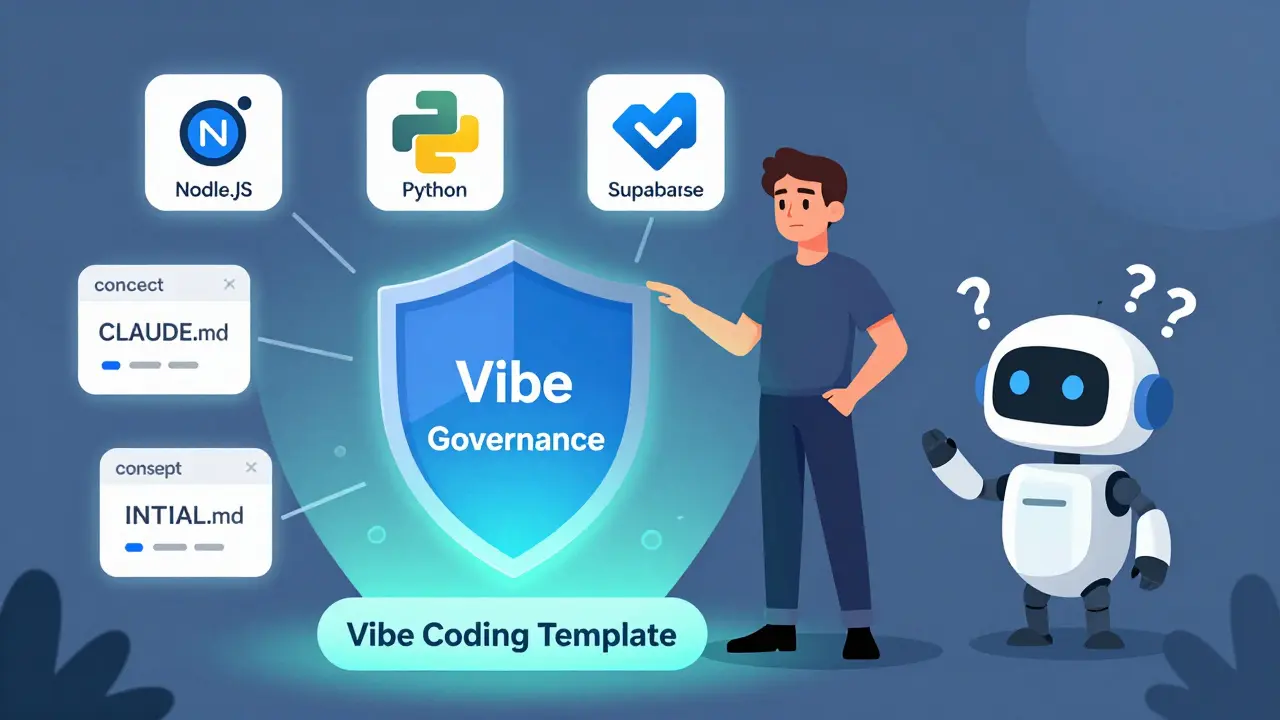
When you start a new project with an AI coding assistant, you don’t want to re-explain your architecture every time. You don’t want to guess which library version works, or why the AI keeps generating insecure auth code. That’s where vibe coding templates come in - not as magic shortcuts, but as governance tools.
What Vibe Coding Templates Actually Do
Vibe coding isn’t about letting AI write your whole app. It’s about giving your AI assistant a consistent, locked-down context so it stops guessing and starts delivering. These templates are GitHub repos with everything pre-configured: dependencies, API keys, folder structures, and - most importantly - context files likeCLAUDE.md and INITIAL.md. These files act like a rulebook for the AI. They say: "Here’s how we structure routes. Here’s how we handle errors. Here’s what’s forbidden."
Without these, you’re just shouting into the void. The AI responds differently every time. With them, you get repeatable, predictable results. That’s governance. It’s not about control for control’s sake - it’s about reducing risk and waste.
Why Pre-Approved Dependencies Matter
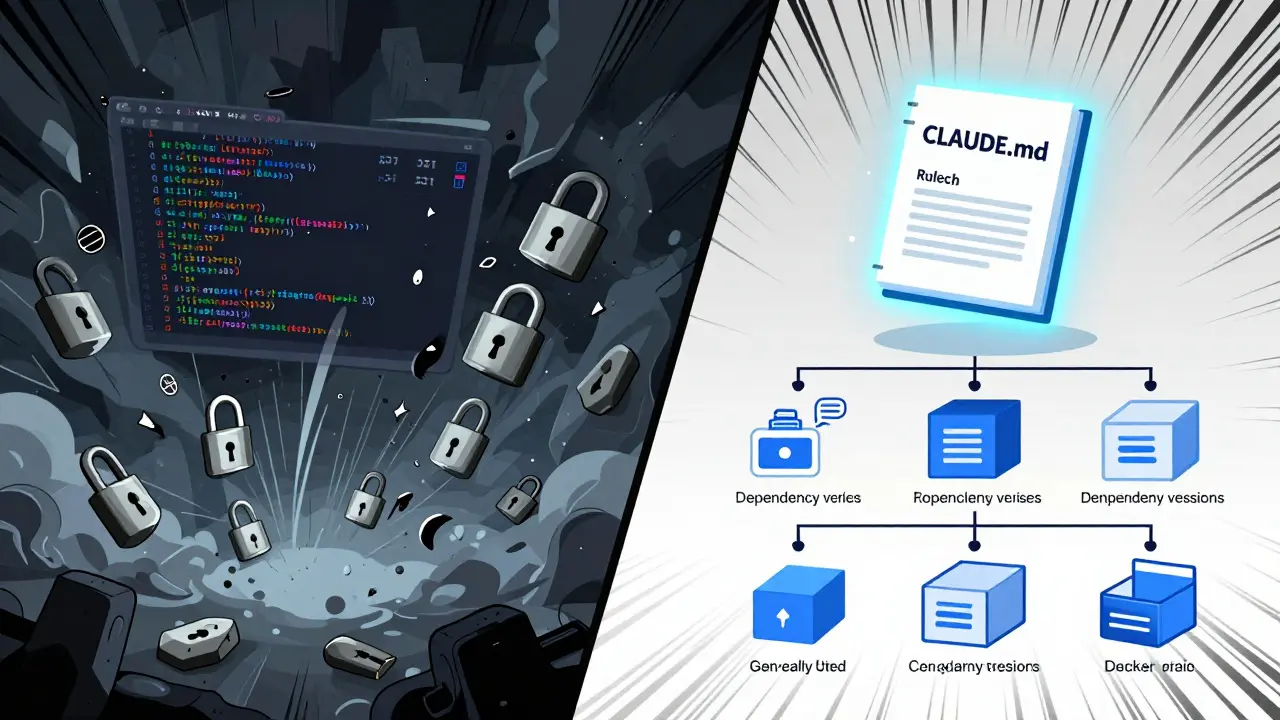
A template repo doesn’t just include code. It includes specific versions of libraries. Why? Because AI doesn’t know what’s safe or stable. Left to its own devices, it might suggest a new npm package with 12 stars and a GitHub issue from last week. That’s not development - that’s gambling. Take thehumanstack/vibe-coding-template. It locks down:
- Node.js 18+
- Python 3.10+
- Supabase CLI v1.152.0+
- Docker Compose v24.0.7+
The Hidden Governance Layer: Context Files
The real power isn’t in the code. It’s in the files nobody talks about.CLAUDE.md might say:
"All API endpoints must return structured error responses. Use HTTP status codes correctly. Never expose database IDs in URLs. Always validate input with Zod."
INITIAL.md might say:
"Build a user auth flow with email/password and Google OAuth. Use Supabase Auth. Store tokens in HTTP-only cookies. Never use localStorage."These aren’t suggestions. They’re requirements. And the AI follows them - because it’s been trained on them. This is governance through automation. No code review needed for basic patterns. The AI enforces them before you even write a line.
Enterprise Risks - And How Templates Solve Them
Big companies don’t use vibe coding templates because they’re scared. They’re scared of:- AI generating code with hidden backdoors
- Dependency vulnerabilities slipping in
- Secrets being hardcoded by accident
- Code that can’t be audited
superagent-ai/vibekit address these head-on. They run AI agents inside Docker sandboxes. They automatically scrub environment variables from prompts. They log every AI-generated change. They even let you disable internet access for the AI during development.
This isn’t science fiction. This is what compliance teams need. If your audit trail shows that every line of code came from a vetted template with locked dependencies and sandboxed AI, you’re not just compliant - you’re ahead of the curve.
Who Should Use These Templates
Not everyone needs this. But if you’re in one of these groups, you’re already paying the cost - you just don’t realize it:- Startups building MVPs: You’re wasting days on boilerplate. A template cuts that to hours.
- Teams using Copilot or Claude Code daily: Your AI is inconsistent. Your code style is all over the place. Templates fix that.
- Developers in regulated industries: Finance, healthcare, government - you can’t afford random AI output. Templates give you control.
- Senior engineers mentoring juniors: Instead of teaching the same patterns over and over, you point them to the template. It becomes your institutional memory.
The Downside - And How to Avoid It
Some people say: "This makes developers lazy. They won’t learn how to code without AI." That’s true - if you use templates as crutches. But here’s the flip side: 68% of developers who rely on AI without templates can’t debug their own code when it breaks. Why? Because they never learned the underlying patterns. They just copied what the AI gave them. Templates fix that. They don’t hide the code. They show you how it’s built - clearly, consistently, and correctly. You learn by seeing the structure. You learn by reading the context files. You learn by knowing why things are the way they are. The key? Don’t treat templates as black boxes. Open them. Read theCLAUDE.md. Look at the Makefile. Understand the Docker setup. That’s how you grow.
Getting Started - The Real Setup
Forget tutorials that say "just clone and run." Real setup looks like this:- Install Docker and Docker Compose. Test them. If you’re on Apple Silicon, install Rosetta 2 first - it’s a common trip-up.
- Clone the template repo (e.g.,
git clone https://github.com/humanstack/vibe-coding-template). - Run
./first-time.sh. This isn’t magic. It checks for Node, Python, Supabase CLI. It asks for API keys. It generates.envfiles. - Open
CLAUDE.md. Read it. Understand every rule. - Run
make dev. Notnpm run dev. Notpython app.py. Use the template’s workflow. - Start building. When the AI suggests something that breaks the rules, stop. Don’t accept it. Fix the context file instead.
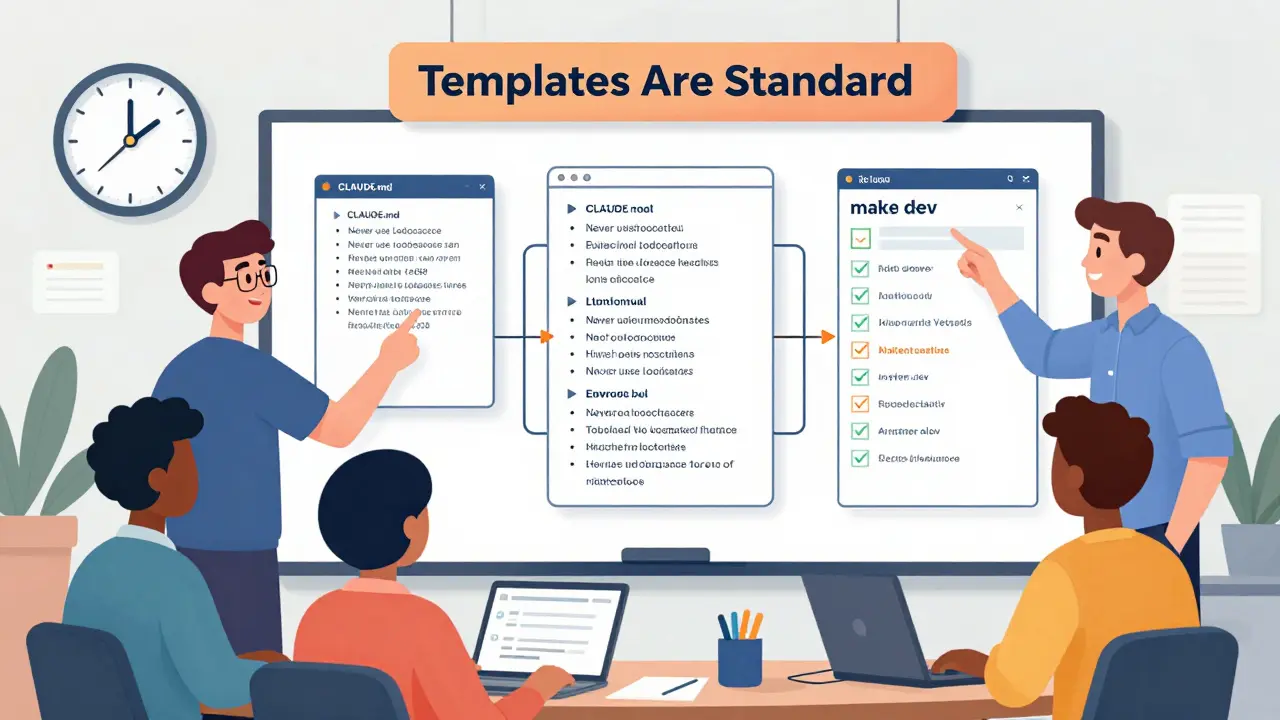
The Future: Templates Are Becoming Standard
GitHub Copilot Workspace is already starting to bake template features into its IDE. VS Code will follow. The era of manually configuring AI assistants is ending. The winners won’t be the ones who use AI the most. They’ll be the ones who govern it the best. By 2025, every team that ships production code with AI will have a template. Not because it’s trendy. Because without one, you’re flying blind. And in software, blind flying costs money, time, and trust.Where to Start
Here are three templates to explore - each with a different focus:- humanstack/vibe-coding-template: Best for full-stack teams. Next.js + FastAPI + Supabase. High setup cost, maximum control.
- feiskyer/claude-code-settings: Best if you’re locked into Claude Code. Fine-tunes prompts, routing, and commands.
- superagent-ai/vibekit: Best for regulated environments. Sandboxed, secure, auditable. Enterprise-grade.
Are vibe coding templates just for AI beginners?
No. They’re most valuable for experienced developers who want to scale their AI usage without sacrificing quality. Beginners benefit from structure, but seasoned engineers use them to enforce consistency across teams and reduce cognitive load. The real power is in governance - not convenience.
Can I modify the dependencies in a template repo?
You can, but you shouldn’t - at least not without a plan. Pre-approved dependencies exist because they’ve been tested with your AI tools. Swapping out a library might cause the AI to generate broken code or ignore context rules. If you need a different version, update the context files to explain why, test thoroughly, and document the change for your team.
Do these templates work with GitHub Copilot?
Yes, but with limits. Copilot doesn’t read CLAUDE.md files natively. You’ll need to paste the context into each chat session or use Copilot Workspace, which supports template-based context. For full control, tools like Cursor and Claude Code integrate directly with these files.
What if my team uses different AI tools?
Templates are tool-agnostic. The structure - context files, folder layout, dependency locks - stays the same. Only the way the AI reads them changes. Use a meta-template like filipecalegario/awesome-vibe-coding to adapt rules for different models. The goal isn’t to lock into one AI - it’s to lock into one standard.
How do I convince my manager to approve these templates?
Focus on outcomes: 67% faster feature delivery, 73% fewer AI hallucinations, and reduced code review burden. Show them the metrics from KDnuggets and SashiDo. Point out that enterprise adoption is rising - not because it’s trendy, but because it reduces risk. Offer to pilot it on one small project. Track the time saved and bugs avoided.
Mark Brantner
January 24, 2026 AT 05:47So let me get this straight - you’re telling me I need to read a whole damn .md file just so my AI doesn’t suggest using localStorage for auth? Bro, I just wanted to build a login button in 10 minutes. Now I’m doing DevOps yoga.
Tamil selvan
January 25, 2026 AT 22:38While I appreciate the intention behind these templates, I must emphasize that governance through automation must be balanced with the principle of developer autonomy. Over-reliance on rigid context files may inadvertently stifle innovation and discourage critical thinking. A well-structured template is a scaffold - not a cage.
Samar Omar
January 26, 2026 AT 04:32Let’s be honest - this entire ‘vibe coding’ movement is just corporate jargon dressed up as engineering discipline. You’re not ‘governing’ anything. You’re outsourcing your brain to a language model and then pretending the .md files are your moral compass. I’ve seen junior devs treat CLAUDE.md like sacred scripture - they won’t even touch a fetch request unless it’s blessed by Zod. This isn’t engineering. It’s AI cultism.
And don’t get me started on ‘enterprise-grade’ templates. If your compliance team needs a Docker sandbox to trust a POST request, you’ve already lost. The real problem isn’t AI generating bad code - it’s that we’ve stopped teaching fundamentals. Now we’re building theological libraries for machines instead of training engineers.
Also, ‘humanstack/vibe-coding-template’? That’s not a repo name. That’s a LinkedIn post.
chioma okwara
January 27, 2026 AT 21:45you said 'CLAUDE.md' but its actually 'claude.md' lowercase - and you misspelled 'supabase' as 'supabase' in the first paragraph? come on. this is supposed to be a governance doc and you cant even spell right? im not even mad, just disappointed.
Kate Tran
January 28, 2026 AT 16:46I actually like this. I’m not a senior dev, but I’ve spent weeks debugging AI-generated auth flows that broke because of some random npm package. This feels like having a mentor who never gets tired. I read CLAUDE.md like a novel now. It’s weirdly satisfying.
Deepak Sungra
January 30, 2026 AT 14:20Bro. I tried this template. Ran make dev. Got a 404 on /api/auth. Spent 3 hours. Turned out the Supabase CLI didn’t install because I had zsh instead of bash. Now my whole team thinks I’m an idiot. I’m not lazy. I just wanted to code. Not become a DevOps priest.
Also, why does the template assume everyone uses Docker? I’m on Windows 10 with WSL1. It’s 2025. We’re still fighting terminal wars?
Someone please make a template for people who just want to ship stuff without reading 12 .md files first.
saravana kumar
January 30, 2026 AT 20:35Wow. You spent 1500 words to say ‘use npm ci and never trust AI’. I’ve been doing this since 2018. The real template is your brain. The rest is just documentation for people who don’t know what a package.json is.
Also, ‘vibe coding’? That’s not a thing. That’s a buzzword vomit from a startup founder who watched too many TED Talks. Go build something. Don’t worship your context files.
Jim Sonntag
January 31, 2026 AT 11:49So the future of software is… reading bedtime stories to your AI? Cool. I’ll stick with my 2012 Rails app that runs on a Raspberry Pi and still works. At least I know why it breaks. This feels like teaching a toddler to drive by giving them a 500-page manual on torque curves.
amber hopman
February 1, 2026 AT 14:04I love how this post doesn’t just say ‘use templates’ - it shows you *why*. I work in healthcare and we’ve had audits where AI-generated code got flagged for hardcoded secrets. We adopted vibekit last quarter. No more incidents. No more panic calls at 2am. It’s not about control - it’s about sleep. And sanity. And not having to explain to a regulator why your auth system uses localStorage.