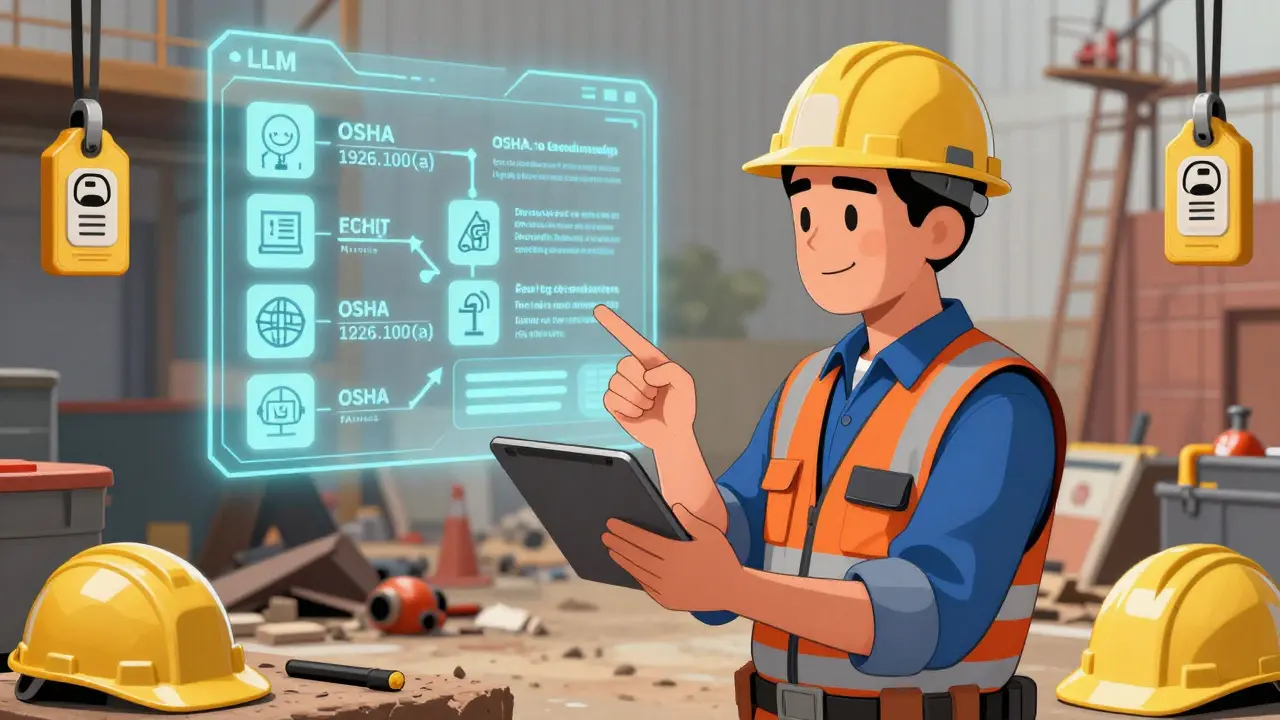
When safety is on the line, you can't afford guesswork. In industries like construction, nuclear energy, and pharmaceuticals, a single misstep in interpreting a safety regulation can cost lives. That’s where large language models are stepping in-not as replacements for experts, but as force multipliers that turn mountains of text into clear, actionable safety guidance.
Think about a construction site where hundreds of safety reports, maintenance logs, and OSHA compliance forms are buried in PDFs, spreadsheets, and scanned documents. Each one is written differently. One foreman uses "fall arrest"; another writes "harness protocol." A machine can’t easily spot that they mean the same thing. But a well-tuned large language model can. It doesn’t just search keywords-it understands context, acronyms, and even regional variations in safety language.
How LLMs Turn Text Into Safety Action
Large language models like GPT-4, Claude 3, and open-source alternatives such as Llama 3 and Mistral aren’t just chatbots. When properly configured, they become intelligent assistants that process massive volumes of unstructured text faster than any human team. In regulated industries, this means:
- Instantly pulling the correct safety procedure from a 500-page OSHA manual based on a worker’s spoken question
- Flagging inconsistencies between a contractor’s safety plan and federal regulations
- Translating legacy maintenance logs from decades-old systems into modern hazard patterns
The Construction Safety Query Assistant (CSQA) is a real-world example. It uses an LLM to index and interpret safety regulations from OSHA, ANSI, and site-specific documents. Workers can ask, "What are the lockout/tagout rules for hydraulic presses on Phase 2?" and get a precise answer backed by the exact regulatory text-no digging through binders needed.
This isn’t theoretical. Companies using similar systems report a 40% reduction in time spent on safety compliance audits. That’s not just efficiency-it’s risk reduction.
The Three Rules of Regulated-Grade LLMs
Not all LLMs are created equal when safety is at stake. Deploying them in healthcare, defense, or nuclear facilities isn’t like using a chatbot for customer service. Three non-negotiable rules govern their use:
- No BS - The model must explain its reasoning. If it says "wear a hard hat," it must cite the regulation (e.g., OSHA 1926.100(a)). No hallucinations. No guessing.
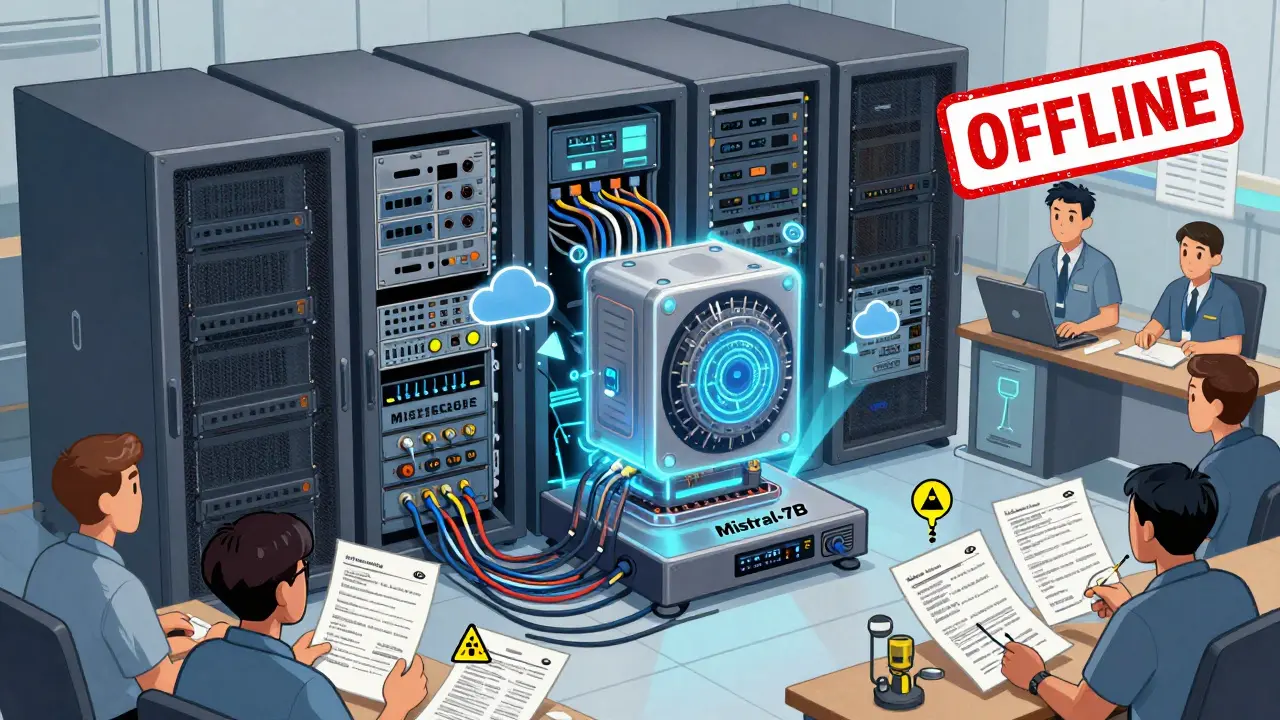
- No Data Sharing - Sensitive safety logs, employee names, or facility layouts must never leave your network. Cloud-based models like GPT-4 are out. On-premise or air-gapped open-source models are in.
- No Test Gaps - Every output must be verifiable. You can’t just say "it works." You need documented test cases: 100 real safety queries, their correct answers, and proof the model got them right every time.
These aren’t best practices-they’re compliance requirements. The EU AI Act now treats safety-critical AI like a product: if it fails, it’s a defect. That means your LLM needs a safety certificate, not just a demo.
Why Open-Source Models Are Winning in High-Security Environments
Commercial models like GPT-4 or Gemini require sending your data to third-party servers. In defense or nuclear plants, that’s a dealbreaker. Even a 0.1% chance of data leakage is unacceptable.
Enter open-source models. Llama 3, Mistral, and Phi-3 can now match or exceed commercial models on safety-specific tasks-especially when fine-tuned on your own data. A nuclear facility in Tennessee, for example, trained a Mistral-based model on 12 years of incident reports. The result? A system that predicts equipment failure risks from maintenance logs with 92% accuracy, all without touching external servers.
These models also let you control the training data. You can remove biased or outdated regulations. You can add your facility’s unique terminology. You can even simulate edge cases: "What if the ventilation system fails during a chemical spill?" The model doesn’t guess-it references your exact safety manual.
Real-World Use Cases Across Industries
Let’s look beyond construction:
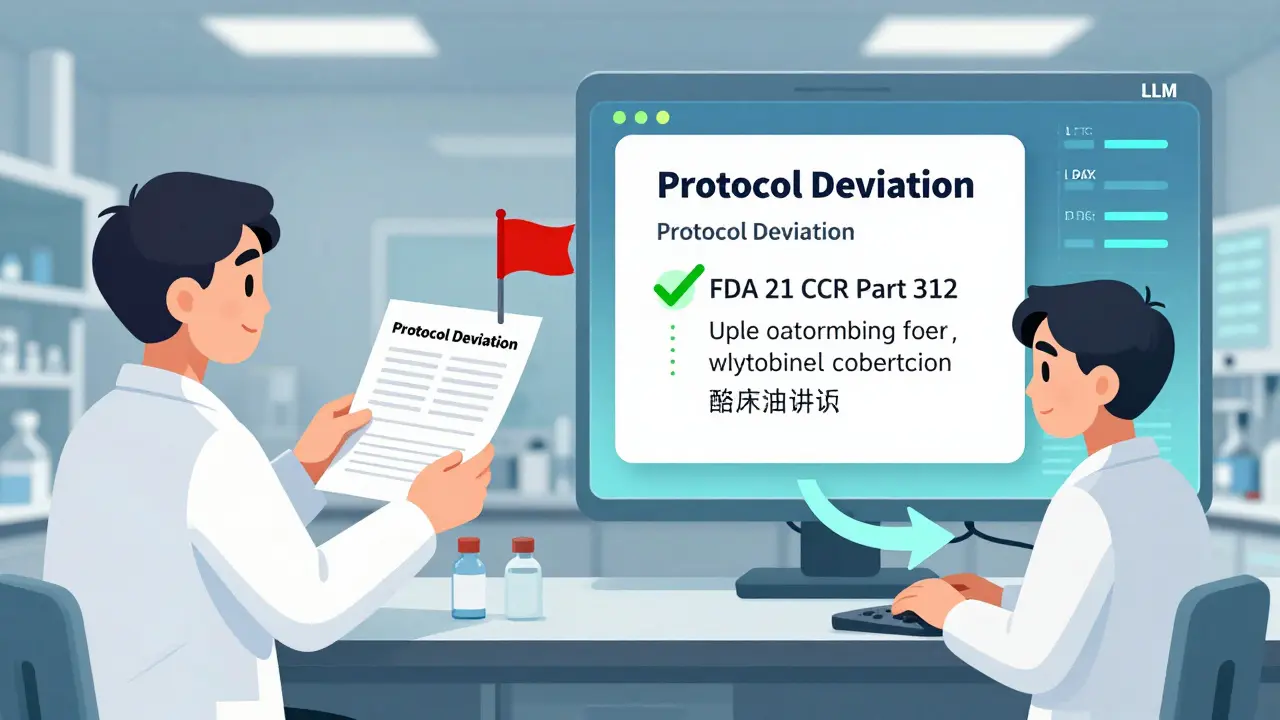
- Pharmaceuticals: LLMs scan clinical trial documents for protocol deviations. One company reduced compliance review time from 14 days to 8 hours.
- Healthcare: Hospitals use fine-tuned models to cross-check patient safety notices against HIPAA and Joint Commission standards. A 2025 study found these systems caught 37% more violations than manual reviews.
- Defense: Classified sites use air-gapped LLMs to interpret technical manuals for equipment maintenance. No internet. No cloud. Just secure local inference.
Each of these examples shares a pattern: the LLM doesn’t make decisions. It surfaces the right information-fast. The human still approves. The human still acts. The model just removes the noise.
What Goes Wrong When You Skip the Details
Not every LLM rollout succeeds. The biggest failures come from one mistake: treating the model like a magic box.
A construction firm tried using a public LLM to answer safety questions from workers. They fed it OSHA documents. But they didn’t fine-tune it on their own site’s safety plans. The model gave generic answers-like "wear gloves"-when the real rule was "use chemical-resistant nitrile gloves per Vendor X’s spec sheet." The result? Two workers suffered skin burns.
Or take a hospital that used ChatGPT to summarize patient safety reports. The model mixed up two similar drug names. A nurse relied on the summary and administered the wrong dose. The model wasn’t wrong-it was incomplete. It didn’t know the hospital’s internal naming conventions.
These aren’t AI failures. They’re process failures. You can’t plug in an LLM and hope for safety. You need:
- Domain experts to validate every output
- Real-world test datasets from your own operations
- A feedback loop where workers report errors and the model learns from them
The Future: From Reactive to Predictive Safety
The next leap isn’t just answering questions-it’s preventing them.
Imagine an LLM that scans every safety report, maintenance log, and weather alert across your entire network. It notices a pattern: whenever wind speeds exceed 25 mph, crane operators skip their pre-shift inspection checklist. The model flags this trend. Safety managers adjust training. The incident rate drops.
This is already happening. A pilot program in a European nuclear plant used an LLM to analyze 80,000 maintenance logs over five years. It identified three previously unknown correlations between equipment vibration, humidity, and valve failure. Those were added to the preventive maintenance schedule. Downtime fell by 18%.
LLMs aren’t just tools for compliance. They’re tools for culture change. When safety information is instantly available, workers trust the system. When they can ask questions without fear of sounding ignorant, they speak up. And that’s how you build a truly safe workplace.
Frequently Asked Questions
Can large language models replace safety inspectors?
No. LLMs don’t replace inspectors-they empower them. An inspector still needs to walk the site, check equipment, and talk to workers. But with an LLM, they can instantly pull the correct regulation for any scenario, compare it against their observations, and document findings faster. The human judgment stays in charge. The model just gives them better data.
Are open-source LLMs really as good as GPT-4 for safety tasks?
In safety-critical applications, yes-sometimes better. A 2025 benchmark by the National Institute for Occupational Safety and Health tested six models on 200 real-world safety queries from construction and chemical plants. Mistral-7B and Llama 3-8B scored higher than GPT-4 on accuracy and regulatory citation quality. Why? Because they could be fine-tuned on proprietary data. GPT-4 can’t learn your site’s specific safety terms if you can’t send it your documents.
How do you train an LLM to understand industry jargon?
You feed it your own data. Take 500 real safety reports, maintenance logs, and incident summaries from your facility. Clean them up, anonymize them, and use them to fine-tune an open-source model. This teaches the model your terms-like "B-23 valve" or "Type C lockout." It learns how your team writes, not how OpenAI’s training data wrote. This is how you get accurate, not generic, answers.
What’s the biggest risk of using LLMs in regulated industries?
The biggest risk isn’t the model being wrong-it’s people trusting it too much. If a worker sees "approved by AI" on a safety recommendation and skips verification, you’ve created a new vulnerability. The solution is simple: always require human review. Label every LLM output as "Draft Recommendation-Verify Before Acting." Train your team to treat it like a first draft, not a final rule.
Is there regulatory guidance for using LLMs in safety systems?
Yes. The EU AI Act classifies safety-critical AI as "high-risk" and requires documentation, testing, and human oversight. In the U.S., OSHA and the FDA are developing similar guidelines. The key principle is consistency: if you’re using AI to make safety decisions, you must be able to prove how it works, what data it used, and how you validated it. No black boxes allowed.
ujjwal fouzdar
March 18, 2026 AT 03:09So we're just gonna hand over the fate of human lives to a statistical parrot trained on Reddit threads and Wikipedia edits? I mean, sure, it can parse 'fall arrest' and 'harness protocol' as synonyms-but can it understand the weight of a man falling 20 feet because it misread a comma in OSHA 1926.502? The real horror isn't the model failing-it's that we've convinced ourselves it won't. We're not building safety systems. We're building cathedrals to our own hubris, and calling them 'innovation.'
Anand Pandit
March 18, 2026 AT 18:27This is actually one of the most grounded takes I've seen on LLMs in safety. The three rules-no BS, no data sharing, no test gaps-are exactly right. I’ve seen teams skip fine-tuning and just throw GPT-4 at PDFs… and yeah, it’s a disaster. But when you do it right-on-prem, with real worker logs, with domain experts in the loop-it’s like giving inspectors superpowers. One site I worked with cut near-miss reporting time by 70%. Not because the AI was smart. Because humans finally had time to *think* instead of dig.
Reshma Jose
March 20, 2026 AT 16:11OMG YES. I work in pharma and we rolled out a Mistral-based tool last year. Before? We spent weeks cross-referencing protocols. Now? A new tech asks, 'What’s the temp range for storing vial batch 4512?' and gets the exact clause from our SOP + the footnote from the 2023 FDA update. No more guessing. No more 'I think it’s…' We’re not replacing people-we’re removing the friction that made people miss things. Also, the model learned our internal shorthand for 'cold chain'-we call it 'CC-2'-and now it responds in our lingo. It feels like having a super-organized intern who never sleeps.
rahul shrimali
March 22, 2026 AT 12:28Eka Prabha
March 22, 2026 AT 18:00Let’s be brutally honest: this is corporate theater wrapped in AI jargon. You think an LLM trained on public data can truly understand the nuances of a nuclear plant’s 1987 maintenance log written in Soviet-era Cyrillic shorthand? Or that a 'fine-tuned' model won’t still hallucinate regulatory citations when under pressure? The EU AI Act isn’t some bureaucratic hurdle-it’s a lifeline. And yet, companies still deploy these systems without independent audits. Who’s liable when the AI says 'it’s fine' and a worker dies? The engineer? The CTO? Or the vendor who sold you a 'black box with a pretty interface'? This isn’t safety. It’s liability laundering.
Bharat Patel
March 23, 2026 AT 21:44There’s something deeply human about this whole thing. We’ve spent centuries building systems to protect life-laws, rituals, checklists, apprenticeships. Now we’re outsourcing part of that to a machine that doesn’t feel fear, doesn’t know grief, doesn’t remember the face of the guy who fell last year. But here’s the twist: maybe that’s the point. Maybe we don’t need the AI to care. We need it to be precise. To not forget. To not get tired. The human remains the moral compass. The AI? Just the unwavering mirror. It doesn’t replace our responsibility-it forces us to live up to it. Every time it cites OSHA 1926.100(a), it’s not just answering a question. It’s saying: 'You said this mattered. Prove it.' And maybe… that’s the real safety upgrade.
Bhagyashri Zokarkar
March 25, 2026 AT 01:32i just dont get why we trust a bot more than a person who has worked on site for 20 years?? like i know its 'data driven' and all but what if the model was trained on bad data?? like what if someone uploaded a fake safety manual?? and then the whole team starts following it?? and then someone dies?? and its like 'oh but the ai said it was ok'?? like wtf?? we are literally outsourcing our conscience to a thing that has no soul?? and dont even get me started on how these models get 'fine tuned'-like some intern just drops 500 pdfs into a black box and poof! magic!! what if one of those pdfs had a typo?? what if the model just… decides to ignore the word 'must'?? i mean… i dont sleep at night anymore thinking about this
Rubina Jadhav
March 25, 2026 AT 11:12I like that you’re using open-source models. My team tried GPT-4 first, then switched to Llama 3 on our own server. Big difference. No more worrying about data leaks. And now our workers actually ask questions. Before, they were too scared to sound dumb. Now they just say, 'Hey, what’s the rule for this?' and get a clear answer. It’s changed the culture. Simple. No hype.
sumraa hussain
March 26, 2026 AT 22:52Bro… this is wild. I work in defense. We have an air-gapped Mistral model running on a laptop with no internet. No cloud. No updates. Just our manuals. Last week, a tech asked: 'What’s the procedure if the coolant valve leaks during a reactor shutdown?' The model pulled the exact procedure from the 2018 manual, cross-referenced it with the 2021 amendment, and even flagged a conflicting note from a 1995 memo that was still in circulation. We fixed it. No one even knew that conflict existed. This isn’t magic. It’s discipline. And yeah… it’s kinda beautiful. The machine doesn’t think. It just… remembers. And that’s more than most of us do.
Raji viji
March 27, 2026 AT 19:43Y’all are acting like this is some revolutionary breakthrough. Newsflash: LLMs are glorified autocomplete engines with a PhD in hallucination. You think your 'fine-tuned' Mistral knows your 'B-23 valve'? Nah. It just memorized the word 'B-23' next to 'valve' 87 times in your PDFs. You didn't teach it. You conditioned it. And when it hits a new scenario? It'll spit out something that sounds right but is 100% BS. And then you're gonna blame the 'process failure' instead of admitting you outsourced critical thinking to a statistical ghost. The real danger? Not the model. It's the delusional execs who think they're 'digital transformation pioneers' while their workers are just… trusting the robot.