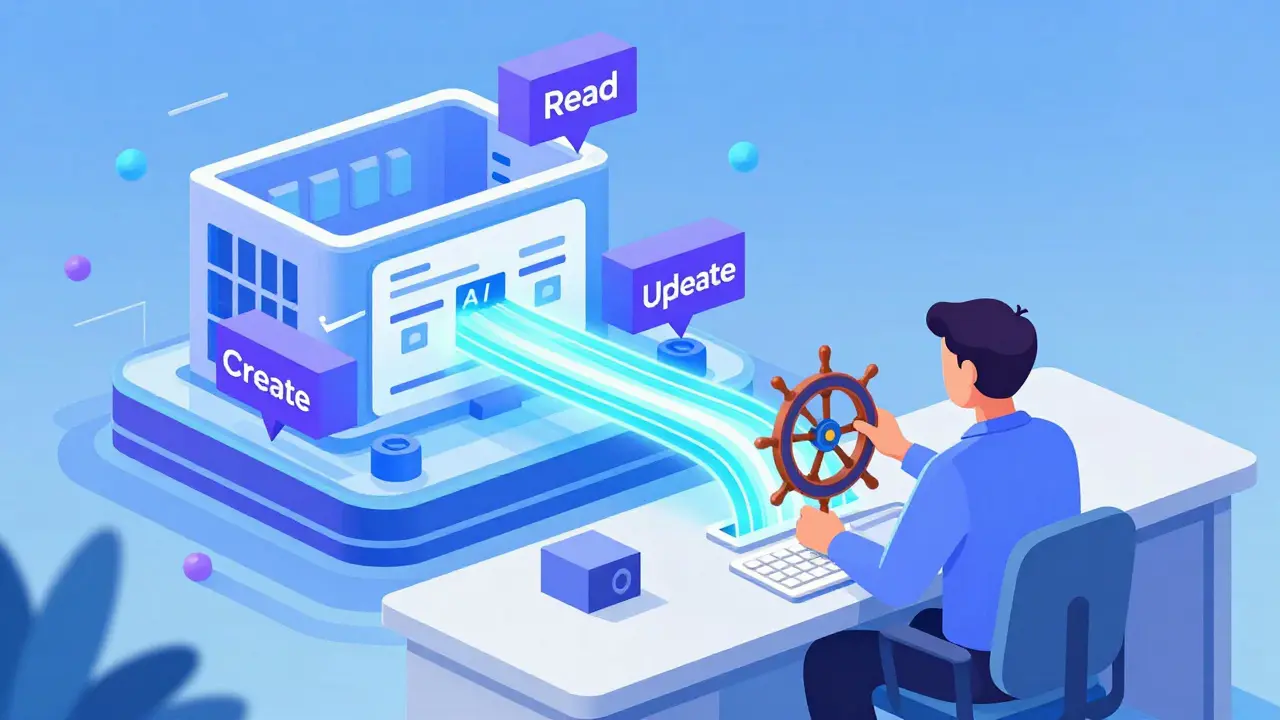
Imagine building a fully functional data management tool in twenty minutes. No more spending hours writing repetitive boilerplate or fighting with database schemas. This is the promise of vibe coding is a development approach where AI tools generate code rapidly based on natural language prompts and high-level specifications. It turns the traditional coding process on its head: instead of meticulous line-by-line implementation, you're steering a powerful AI toward a specific "vibe" or outcome. While it feels like magic, using it to build CRUD applications (Create, Read, Update, Delete) is where this method truly hits its stride-and where it can lead to a total architectural collapse if you aren't careful.
Why CRUD is the Perfect Match for Vibe Coding
Most software isn't a complex algorithm; it's just a way to move data from a database to a screen and back. This repetitive nature makes CRUD apps the ideal playground for AI. Since REST APIs follow such standardized patterns, AI models can predict the next block of code with staggering accuracy. You aren't inventing a new way to handle HTTP requests; you're just asking the AI to implement a well-known pattern.
When you're in "vibe mode," the speed is intoxicating. You can scaffold a complete backend based on a database schema in seconds. If you need to translate a logic block from Python to TypeScript, you don't need a manual-you just prompt it. This acceleration is a game-changer for internal tools, prototypes, or small team workflows where the priority is getting a working version in front of users immediately rather than achieving academic perfection.
The Hidden Cost of Speed: The House of Cards Effect
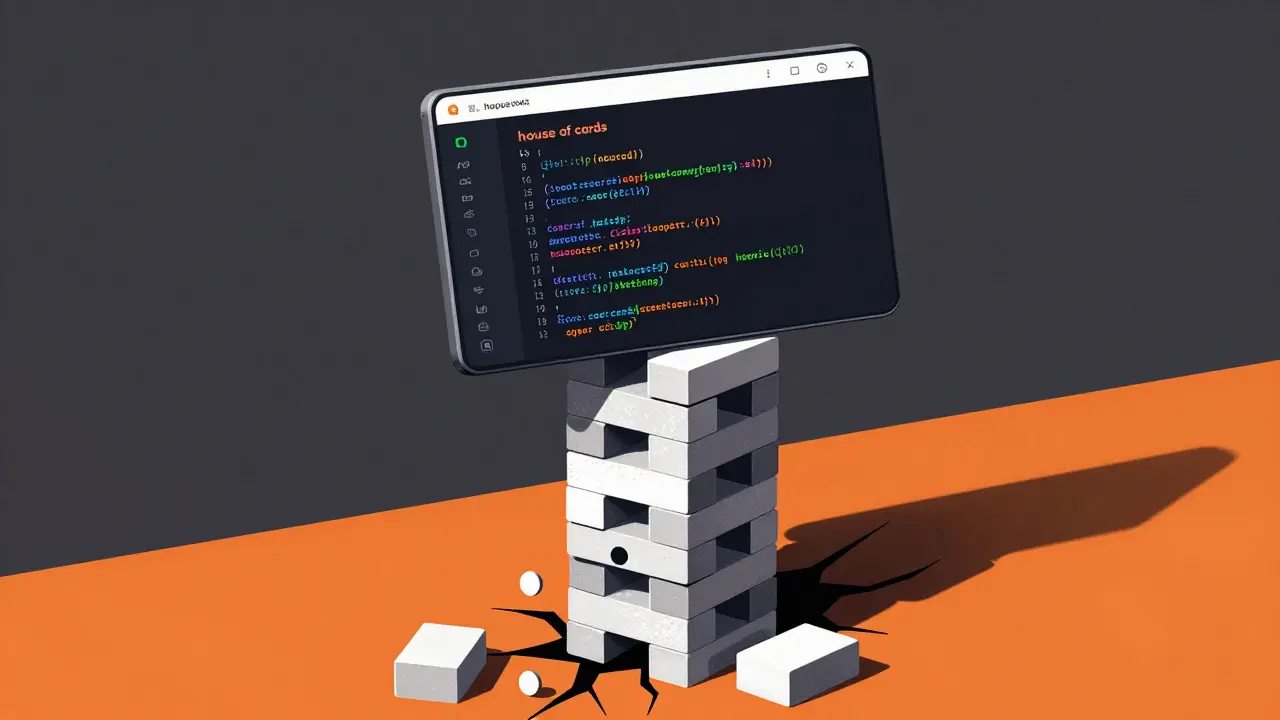
There is a dark side to this efficiency. Experienced engineers often joke that two developers can now create the technical debt of fifty. This isn't just a joke; it's a warning about technical debt, the long-term cost of choosing a quick, messy solution over a well-architected one. AI-generated code often looks perfect at first glance. It compiles, the buttons work, and the data saves. But beneath the surface, it's often a "house of cards."
The AI might skip critical error handling, ignore edge cases, or implement a security flaw that only appears under heavy load. Because the AI doesn't actually "understand" your business constraints, it makes assumptions. If you don't explicitly tell it how to handle a database timeout or a malformed JSON input, it might simply omit those checks. In a production environment, these omissions manifest as brittle code that crashes the moment a real user does something unexpected.
Where to Use AI and Where to Step In
To keep your project from collapsing, you have to distinguish between "grunt work" and "brain work." AI is an elite assistant for the former but a dangerous lead for the latter. You should never ask an AI to design a scalable microservice architecture from scratch and then blindly ship it. High-level system design requires an understanding of the business goals, budget, and future growth-things an LLM doesn't know.
| Task Type | AI Role | Human Role | Risk Level |
|---|---|---|---|
| Boilerplate/Scaffolding | Primary Generator | Reviewer | Low |
| REST API Endpoints | Implementation | Validation/Testing | Medium |
| Data Modeling | Suggester | Decision Maker | High |
| Security/Auth Logic | Helper | Architect/Auditor | Critical |
The most successful vibe coding happens when the implementation space is constrained. For example, creating a basic admin panel for a PostgreSQL database is a textbook success. The requirements are clear, the patterns are standard, and a human can quickly verify if the result is correct. However, if you're building a fintech app that handles millions of dollars in transactions, the "vibe" isn't enough. You need rigorous security protocols and concurrency management that current AI cannot reliably guarantee.
Managing the Three Layers of the App
Every app consists of three layers: the data layer, the logic layer (controllers), and the view layer (UI). Vibe coding often creates a misalignment between these three. An AI might generate a beautiful UI (view) that assumes the data layer is returning a specific format, but the logic layer it generated actually returns something else. These tiny discrepancies compound over time.
As you build, you'll notice consistency problems. If one developer prompts the AI for a "clean controller" and another asks for a "fast implementation," you end up with a codebase that looks like a patchwork quilt. Different modules will follow different patterns, making the project a nightmare for any new developer to join. To avoid this, you must establish a consistent framework and set of rules *before* you let the AI start typing.
Switching from Vibe Mode to Engineering Mode
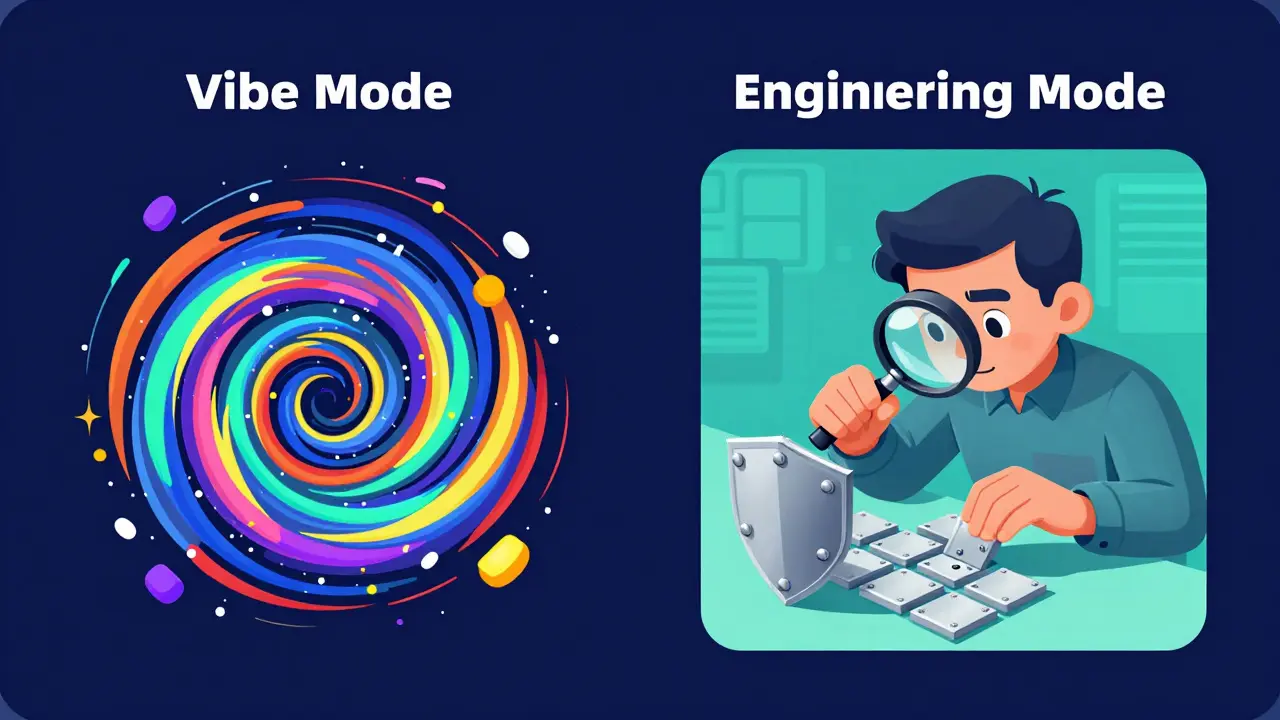
The secret to shipping vibe-coded apps that actually last is the "Mode Switch." Vibe mode is for exploration and speed; engineering mode is for hardening and stability. Once you have a working prototype, you must stop prompting and start auditing. This is where the real work begins.
- Tighten Error Handling: Go through every AI-generated function and ask, "What happens if this fails?" Add the try-catch blocks the AI forgot.
- Hardening Security: Check for SQL injection vulnerabilities or missing authentication checks on sensitive endpoints.
- Performance Tuning: AI often writes inefficient loops or makes too many database calls (the N+1 problem). Refactor these for production scale.
- Edge Case Testing: Write tests for the weird stuff-empty strings, massive uploads, and simultaneous requests.
By treating AI as a powerful accelerator rather than a silver bullet, you can focus your energy on the hard problems: complex algorithms, security hardening, and actual business value. The goal isn't to stop coding; it's to stop doing the boring parts so you can do the important ones.
Is vibe coding just a fancy term for using Copilot?
Not exactly. While tools like Copilot enable it, vibe coding is more of a philosophy. It's the shift from writing code to describing outcomes. Instead of thinking in syntax, you're thinking in intents, relying on the AI to handle the translation into a working application.
Can I use vibe coding for enterprise-grade software?
You can use it to speed up components, but never as the primary driver for architecture. Enterprise software requires strict compliance, regulatory standards, and extreme reliability. AI can help write the boilerplate, but human experts must design the system and verify every critical line of code.
How do I prevent my AI-generated code from becoming a mess?
The best way is to define your architectural standards upfront. Use a consistent set of prompts, enforce a specific design pattern (like MVC), and conduct rigorous human code reviews. Don't let the AI decide the structure; tell the AI which structure to follow.
What is the biggest risk of a 'house of cards' codebase?
The biggest risk is hidden failure. The app works perfectly during a demo with three users, but crashes instantly when hit with 1,000 users or a slightly unexpected input because the AI omitted the necessary guards, validation, and optimization logic.
Which parts of a CRUD app are safest to vibe-code?
Standard REST API endpoints, basic form validations, and simple UI components are the safest. These are well-documented patterns that AI models have seen millions of times, making them less likely to introduce hallucinations or bizarre logic errors.
Jason Townsend
April 22, 2026 AT 09:24its not just technical debt its a backdoor for whatever agency is training these models they want us to stop thinking so they can ship code that has baked in vulnerabilities we cant even see because we're too busy vibing to actually read the logic
Jeroen Post
April 24, 2026 AT 04:01the whole concept of a vibe is just a distraction from the fact that we are outsourcing human cognition to a black box owned by three companies in california who decide what a clean controller looks like based on an average of a billion mediocre github repos its a digital panopticon where the developer is the first prisoner
Honey Jonson
April 24, 2026 AT 04:43love the idea of a mode switch!! i tried this last week with a side project and totally forgot the error handlng part... basically just hoped for the best lol. its so easy to get carried away when the ui looks pretty right away even if the backend is kinda a mess behind the scenes
Paul Timms
April 24, 2026 AT 06:35The distinction between grunt work and brain work is essential. Many junior developers may mistake the former for the latter.