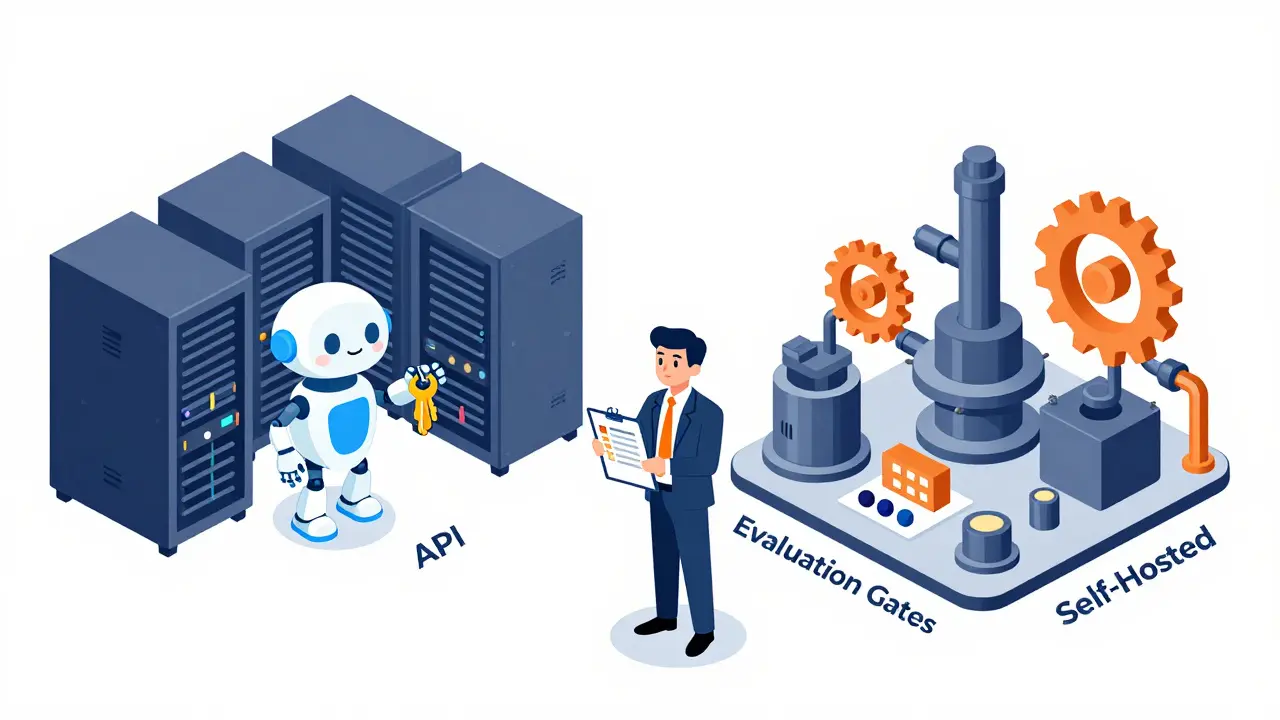
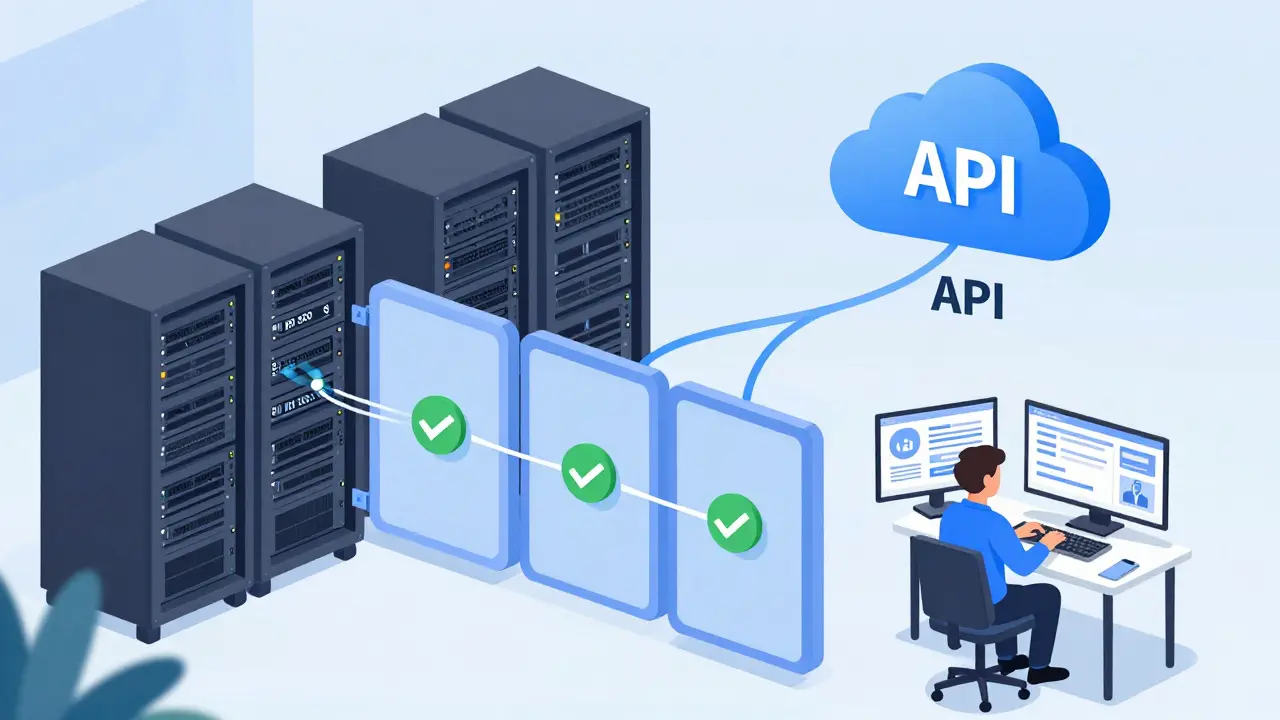
Switching from a managed Large Language Model (LLM) API is a cloud-based service that provides access to AI models like GPT-4 or Claude without requiring local infrastructure management to a self-hosted solution feels like moving out of your parents' house. You gain total control over the space, but you also suddenly realize you have to fix the plumbing yourself. The temptation to switch usually comes from two places: skyrocketing API costs at scale or strict data privacy requirements that cloud providers can't fully satisfy.
However, jumping straight into self-hosting without a rigorous validation process is dangerous. According to an IBM Systems Journal case study from March 2025, organizations that skip proper evaluation gates are structured checkpoints used to validate performance, security, and cost before migrating AI workloads face 43% higher operational costs and 62% more security incidents post-migration. These gates aren't just bureaucratic hurdles; they are survival mechanisms for your AI strategy.
The Performance Gate: Matching Quality Without Compromise
Your first job is to prove that your self-hosted model can actually do the job as well as the API it replaces. You cannot compromise on output quality, especially if end-users will notice the difference. The industry standard benchmark here is MMLU (Massive Multitask Language Understanding) is a comprehensive benchmark evaluating language model performance across 57 subjects including science, humanities, and STEM.
To pass this gate, your self-hosted model must achieve at least 92% of the API's performance score on MMLU. More importantly, no single category should drop below 85% of the API's baseline. For example, if OpenAI's GPT-4 Turbo scores 82.1 on MMLU, your self-hosted Llama-3-70B needs to hit roughly 75.5. But watch out for weak spots. If legal reasoning drops significantly while math stays high, you haven't passed the gate. Stanford CRFM research from January 2025 shows that self-hosted models often underperform in zero-shot reasoning tasks by 12-15% compared to top-tier APIs, so fine-tuning may be required before you even consider switching.
The Latency Gate: Speed Matters for User Retention
Performance isn't just about accuracy; it's about speed. Users abandon interfaces when responses lag. This is where the latency gate comes in. You need to measure P95 latency-the time it takes for 95% of requests to complete-under identical query complexity. Your self-hosted setup must maintain P95 latency within 1.8x the API's latency.
Why 1.8x? NVIDIA's 2025 whitepaper specifies that exceeding 2.5x latency increases user abandonment rates by 37%. If your API response time is 500 milliseconds, your self-hosted model shouldn't take longer than 900 milliseconds for 95% of queries. To achieve this, hardware matters immensely. Red Hat documentation indicates you need a minimum of 8 NVIDIA A100 or H100 GPUs to maintain 15 tokens per second throughput for a 70B parameter model like Llama-3-70B. Without this hardware foundation, no amount of software optimization will get you through this gate.
The Cost Efficiency Gate: Calculating True TCO
Many companies switch to self-hosting believing it will save money immediately. Often, it doesn't-at least not initially. The cost efficiency gate requires calculating the Total Cost of Ownership (TCO), which includes hardware depreciation, electricity, cooling, network bandwidth, and engineering salaries, not just the upfront GPU purchase.
Your self-hosted TCO must be at least 28% lower than your current API spend at your specific usage volume. Red Hat’s 2024 analysis shows the break-even point typically occurs at around 1.2 million tokens per day for Llama-3-70B deployments. Below 800,000 tokens daily, API services remain more economical. Above 1.5 million tokens, self-hosting becomes cost-effective, with Anthropic’s pricing study showing a 32% savings at 2 million tokens/day for Claude 3 Haiku equivalents. Be wary of hidden maintenance costs. Microsoft’s 2025 study found that self-hosted deployments require 2.3 full-time equivalent (FTE) engineers versus just 0.4 FTE for API management. Factor those salaries into your calculation.
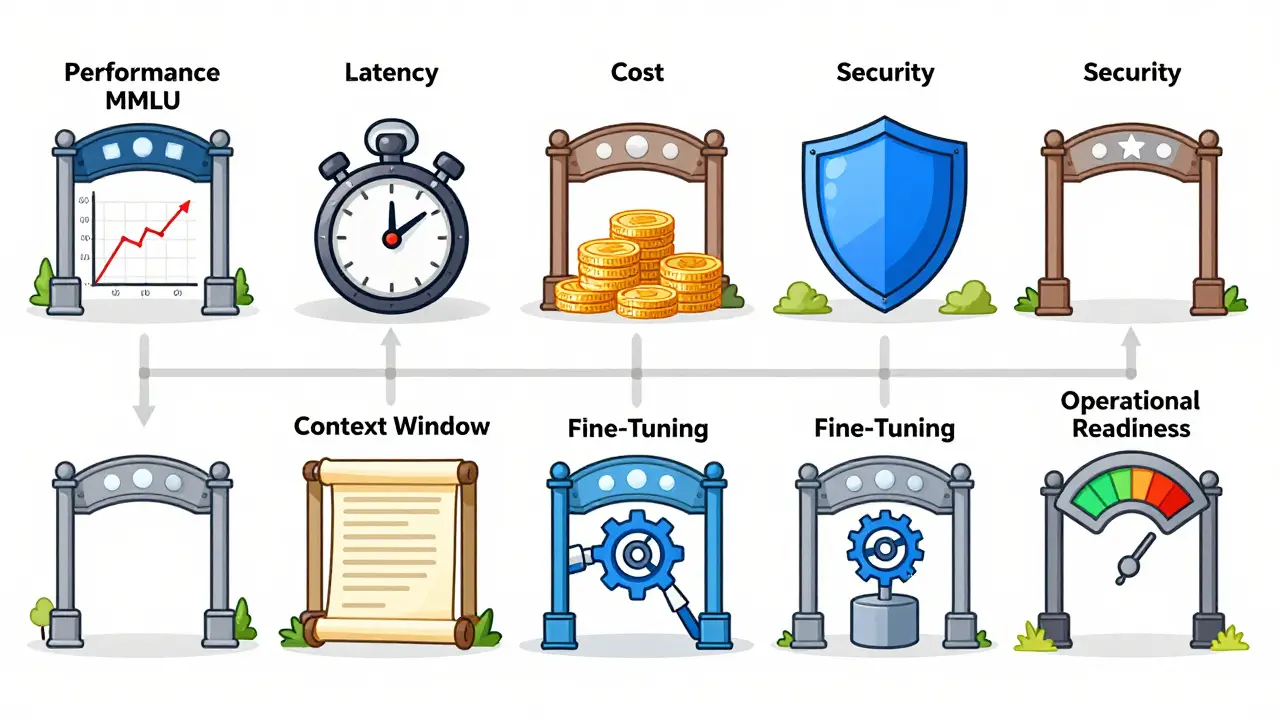
The Security Gate: Red Teaming and Jailbreak Resistance
Data privacy is often the primary driver for self-hosting, but hosting the model yourself introduces new attack vectors. The security gate mandates successful completion of 100% of red teaming exercises. This means subjecting your model to 500+ adversarial prompts per instance designed to bypass safety filters.
Google’s 2025 security framework requires less than a 0.5% jailbreak success rate to pass this gate. Additionally, Arize AI’s Chief Scientist Jason Lopatecki emphasizes that guardrail effectiveness is non-negotiable. Your system must block 99.7% of toxic outputs in real-time testing across 10,000 diverse prompts, matching API performance within 1.5 percentage points. Tools like NVIDIA NeMo Guardrails 3.0 can automate parts of this, monitoring 47 metrics against baselines, but human-led red teaming remains essential to catch nuanced vulnerabilities that automated tools miss.
The Context Window Consistency Gate
This is the gate most organizations miss, according to Dr. Sarah Mitchell, Director of AI Research at MIT-IBM Watson Lab. APIs manage context windows transparently, handling token limits gracefully. Self-hosted models, however, often degrade significantly once you push past 50% of their nominal context window capacity.
To pass this gate, you must demonstrate 95% response quality retention at 80% of the maximum context window. If your model claims a 128k context window, test it heavily at 100k tokens. Does it still answer questions accurately based on information buried deep in the prompt? If the model starts hallucinating or losing track of instructions as the context fills up, it fails this gate. This is critical for applications involving long document analysis or extended conversation histories.
The Domain-Specific Fine-Tuning Gate
General-purpose APIs excel at broad knowledge, but self-hosted models shine when specialized. However, out-of-the-box open-source models rarely match API quality in niche domains without customization. This gate evaluates whether your domain-specific fine-tuning yields measurable improvements.
Harvard Law Review’s February 2025 study showed that self-hosted models achieved 22% higher accuracy on legal document analysis after being trained on specialized corpora. Your evaluation should compare the base model against the fine-tuned version using domain-specific benchmarks. If the improvement is marginal, the effort of maintaining a custom training pipeline might not justify the switch. Use datasets relevant to your industry-medical QA pairs for healthcare, financial reports for fintech-to validate relevance. A financial engineer on Reddit reported a 38% drop in answer relevance after migrating to Mistral 7B without proper Retrieval-Augmented Generation (RAG) evaluation, costing their firm $220k in lost productivity.
The Operational Readiness Gate: Stress Testing and Support
Finally, you must prove your team can keep the lights on. This involves a 72-hour stress test simulating peak load conditions, including 30% usage spikes. Gartner analyst Lizzy Foo Kune notes that 63% of failed migrations underestimated maintenance costs by 2.4x because they didn't account for these operational realities.
Capital One’s 2024 case study outlines a robust final phase: after baseline measurement, hardware validation, core metric testing, domain evaluation, security checks, and cost modeling, they run a final 72-hour stress test. During this period, monitor for memory leaks, GPU thermal throttling, and queue buildup. If any metric degrades beyond acceptable thresholds during sustained load, you fail the gate. Remember, G2 reviews show a significant satisfaction gap in technical support quality between APIs (4.6/5) and self-hosted solutions (4.1/5). You are now your own support team.
| Attribute | Managed API (e.g., GPT-4) | Self-Hosted (e.g., Llama-3-70B) |
|---|---|---|
| Data Privacy | 68% residency compliance (Gartner 2025) | 100% data residency control |
| Zero-Shot Reasoning | Benchmark leader (82.1 MMLU) | 12-15% lower average performance |
| Cost Break-Even | Cheaper below 800k tokens/day | Cheaper above 1.5M tokens/day |
| Maintenance Effort | 0.4 FTE engineers | 2.3 FTE engineers |
| Customization | Limited to prompt engineering | Full fine-tuning and RAG integration |
Implementing the Migration Process
If your model passes all seven gates, you are ready to proceed. The typical evaluation process spans 6-8 weeks. Start by measuring your current API performance baselines meticulously. Then, validate your hardware environment. Next, run core metric tests like MMLU and Big-Bench Hard (BBH). Follow this with domain-specific evaluations tailored to your use cases. Conduct thorough security red teaming. Model costs across 12 different scenarios, including hardware refresh cycles. Finally, execute the 72-hour stress test.
As of Q4 2025, 38% of enterprises use hybrid approaches, leveraging APIs for general tasks and self-hosted models for sensitive, domain-specific workloads. This hybrid strategy mitigates risk while capturing cost benefits. The MLCommons Association released LLM Evaluation Suite 2.0 in March 2025, featuring 17 standardized tests specifically for this transition. Utilizing such frameworks can streamline your gatekeeping process.
Remember, the goal isn't just to host a model locally; it's to operate an AI system reliably, securely, and cost-effectively. Skipping steps might save time today but will cost you dearly tomorrow. With comprehensive evaluation gates, organizations achieve an 89% successful migration rate, compared to just 32% for those with minimal evaluation. Treat these gates as your roadmap to sustainable AI independence.
What is the break-even point for switching from API to self-hosted LLM?
The break-even point typically occurs at approximately 1.2 million tokens per day for large models like Llama-3-70B. Below 800,000 tokens daily, API services are generally more cost-effective due to lower overhead. Above 1.5 million tokens, self-hosting offers significant savings, potentially up to 32%, provided you account for hardware, energy, and engineering labor costs.
How do I evaluate the performance of a self-hosted LLM against an API?
Use standardized benchmarks like MMLU and Big-Bench Hard (BBH). Your self-hosted model should achieve at least 92% of the API's MMLU score, with no individual category dropping below 85% of the API's performance. Additionally, test for zero-shot reasoning capabilities, as self-hosted models often lag by 12-15% in these areas without fine-tuning.
What hardware is required for self-hosting a 70B parameter model?
To maintain acceptable throughput (around 15 tokens per second) for a 70B parameter model like Llama-3-70B, you typically need a minimum of 8 NVIDIA A100 or H100 GPUs. Insufficient hardware leads to high latency, which can increase user abandonment rates by 37% if P95 latency exceeds 2.5x the API baseline.
Why is context window consistency important in self-hosted LLMs?
Context window consistency ensures that the model maintains response quality as the input length increases. Self-hosted models often degrade significantly beyond 50% of their nominal context window. Passing this gate requires demonstrating 95% response quality retention at 80% of the maximum context window, preventing hallucinations and instruction loss in long-document scenarios.
What are the common pitfalls of skipping LLM evaluation gates?
Skipping evaluation gates leads to higher operational costs (43% increase), more security incidents (62% increase), and poor user experience due to latency or accuracy drops. Many organizations underestimate maintenance overhead, requiring 2.3 FTE engineers instead of the expected amount, and fail to account for domain-specific performance gaps, leading to costly rollbacks.
How does data privacy differ between API and self-hosted LLMs?
Self-hosted LLMs offer 100% data residency control, making them ideal for industries with strict regulations like healthcare and finance. In contrast, only 68% of API providers meet full data residency requirements according to Gartner. This makes self-hosting a critical choice for organizations needing to keep sensitive data entirely within their own infrastructure.
Vishal Gaur
May 25, 2026 AT 00:22honestly reading all this makes my head spin a bit because there is so much technical jargon flying around but i get the gist of it basically you cant just switch without checking everything first or else you will end up spending more money and dealing with way more headaches than you bargained for which is pretty obvious if you think about it like moving houses but for computers instead of walls and floors
i mean who has time to fix plumbing when they are trying to run a business right? its just too much work for something that used to be handled by someone else so maybe stick with the api unless you really have no choice left in the matter because self hosting sounds like a nightmare for anyone who is not already an expert in hardware maintenance
Nikhil Gavhane
May 25, 2026 AT 08:11it is really important to take these steps seriously because jumping in blindly can lead to a lot of unnecessary stress for your team and i know how overwhelming it can feel when you are trying to balance cost savings with operational stability so please make sure you do your due diligence before making any big moves
the article does a good job of highlighting the risks involved and i hope everyone takes note of the specific benchmarks mentioned here because they are crucial for success in this transition process
Rajat Patil
May 27, 2026 AT 01:29It is quite clear that one must follow the rules carefully. The text says we need to check many things. We should look at speed and cost. Also safety is very important. If we skip these checks, bad things may happen. The costs can go up. Security can fail. This is why we must be careful and patient in our approach to such changes.
deepak srinivasa
May 27, 2026 AT 22:42so if i understand correctly the main issue is that people underestimate the hidden costs like electricity and engineer salaries rather than just the gpu price tag itself?
pk Pk
May 29, 2026 AT 12:33you nailed it exactly on the head there! it is super common for teams to focus only on the upfront hardware purchase and completely forget about the ongoing operational expenses which can easily eat away any potential savings if you are not careful
i always tell my team that true cost efficiency includes every single aspect from power bills to the mental health of the engineers maintaining the system so never ignore those human factors in your calculations because they matter just as much as the silicon chips do
NIKHIL TRIPATHI
May 29, 2026 AT 23:08yeah totally agree with that point about the hidden costs being a huge trap for many organizations