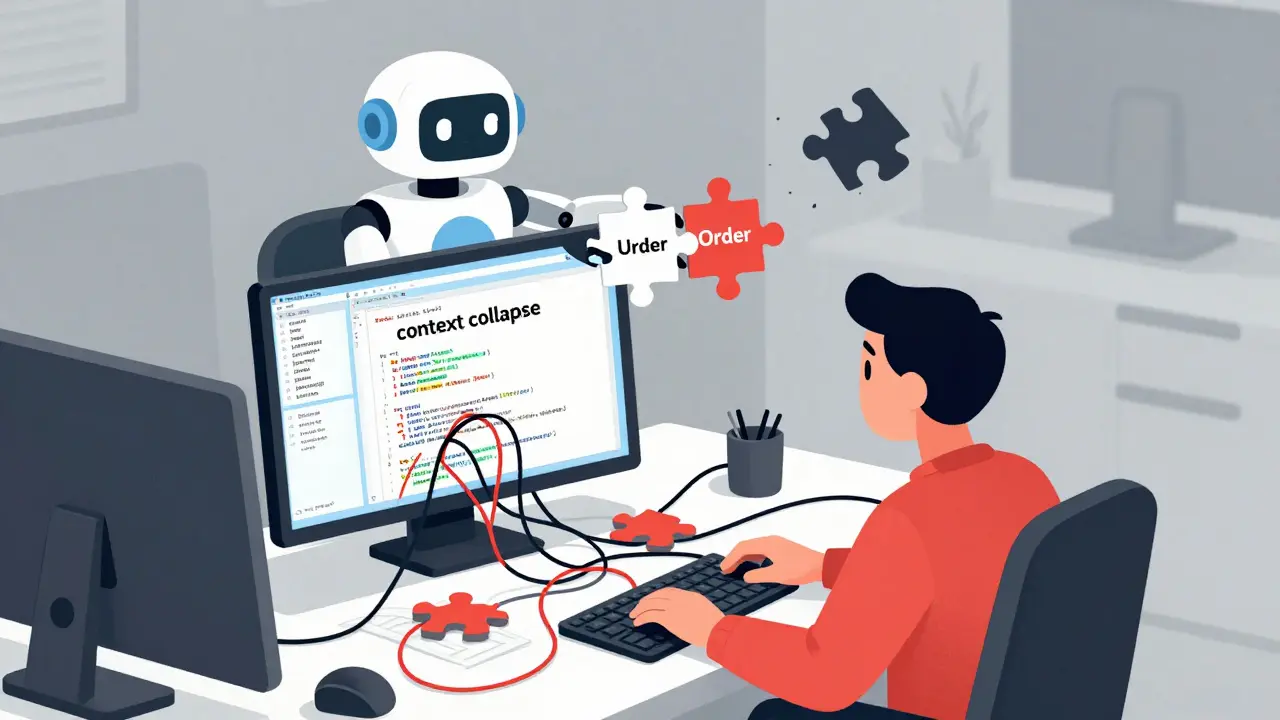
Remember when Andrej Karpathy told us to "give in to the vibes" in early 2025? That phrase sparked a massive shift in how we build software. Suddenly, developers weren't just typing code; they were having conversations with AI agents to generate functional applications. It felt like magic. You describe what you want, the AI writes it, you run it, and-boom-it works. But here is the catch that caught many teams off guard by mid-2026: vibe coding is incredible for creation, but it is a nightmare for maintenance if you don't have structure.
If you have tried building anything larger than a simple prototype using pure vibe coding, you know the pain. After three months, your codebase looks like a patchwork quilt where the same concept, like 'Customer' or 'Order,' has seventeen different definitions scattered across files. This is called context collapse, and it happens because AI models don't inherently understand business boundaries unless you force them to.
This is where Domain-Driven Design (DDD) is a software development approach that connects implementation strategies to evolving domain models saves the day. By combining DDD's strict architectural principles with the speed of vibe coding, you get the best of both worlds: rapid generation without the long-term chaos. Let's look at how to actually make this work in your projects today.
The Problem with Unstructured Vibe Coding
Vibe coding relies on natural language prompts to guide AI in generating code. According to Strapi's analysis from April 2025, this is a collaborative loop where you describe intent, the model drafts code, you inspect and test, and then refine. It sounds simple, but simplicity is deceptive.
Google Cloud research from June 2025 highlighted that vibe coding operates on two levels: the low-level iterative loop of refining specific functions, and the high-level lifecycle of building an entire application. Most developers focus entirely on the low level. They prompt for a login feature, then a dashboard, then a payment gateway. The AI handles each request perfectly in isolation. However, without a unifying strategy, these isolated pieces do not fit together cleanly.
Instinctools' enterprise survey from September 2025 revealed a stark statistic: 67% of early vibe coding implementations failed to establish proper domain boundaries. Within six months, these teams faced severe maintenance challenges. Why? Because the AI doesn't care about your business rules. It cares about probability and pattern matching. If you ask it to create a 'User' object in the marketing module and another 'User' object in the billing module, it will likely create two slightly different structures. Over time, this drift creates what experts call 'architecture erosion.'
Why Domain-Driven Design is the Missing Anchor
Domain-Driven Design isn't new. Eric Evans introduced it decades ago to help developers align code with complex business logic. The core idea is that the code should reflect the language and processes of the business domain. When you add AI into the mix, DDD becomes even more critical, not less.
Eric Evans himself noted in a July 2025 interview that AI-assisted development makes shared understanding between technical and business people more vital than ever. Without careful attention to boundaries, AI will happily create inconsistent models across domains that should be separate. Martin Fowler echoed this sentiment in September 2025, warning that vibe coding risks creating developers who can prompt but cannot debug, unless grounded in solid architectural principles like DDD.
Think of DDD as the map and vibe coding as the car. The car is fast and powerful, but without a map, you're going to drive in circles or crash into walls. DDD provides the map through two main concepts: Bounded Contexts and Ubiquitous Language.
Defining Bounded Contexts for AI Agents
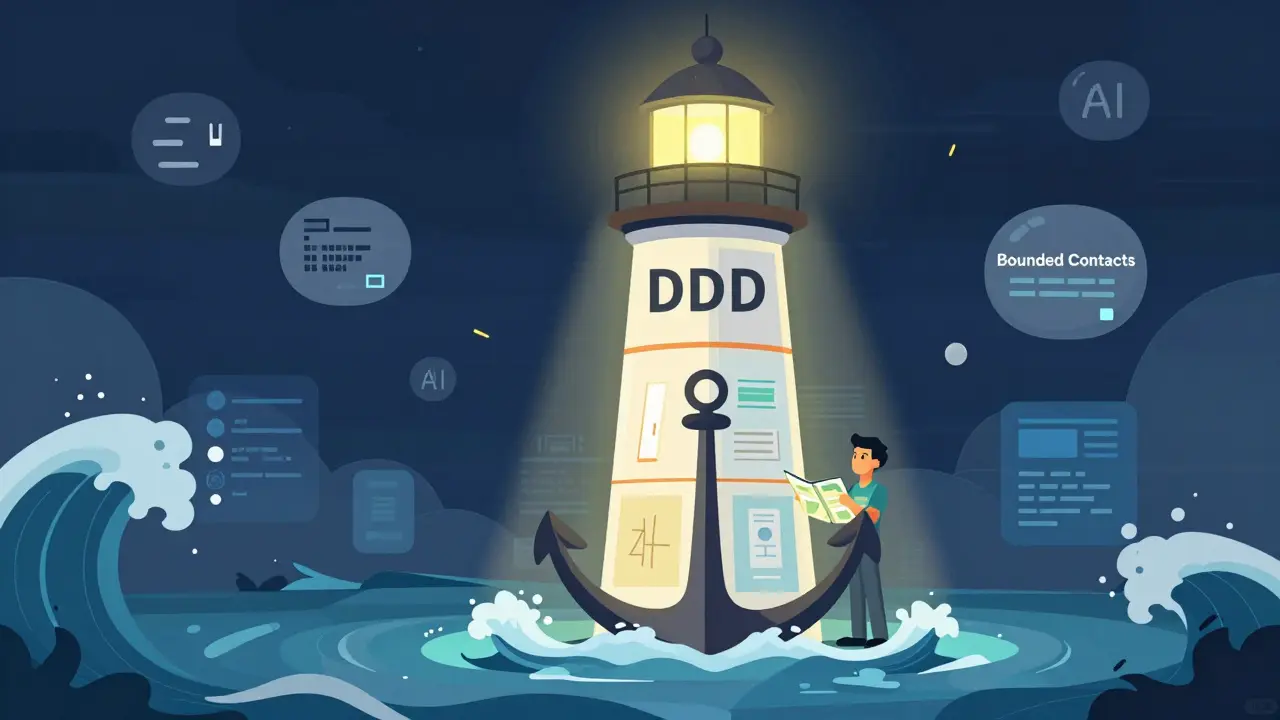
A Bounded Context is a boundary within which a particular domain model is defined and applicable. In traditional development, you define these during weeks of planning. In vibe coding, you must define them explicitly in your prompts and documentation before you generate a single line of code.
Instinctools' senior AI engineers identified four responsibility areas developers must cover when setting up these contexts:
- Explain the workflow: What is the user trying to achieve?
- Clarify the issue-tracking process: Which tools are allowed for debugging?
- State the development approach: Are you feature-driven, test-driven, or domain-driven?
- Establish boundaries upfront: For example, allow read-only access to production infrastructure but restrict access to files with security keys.
When you start a vibe coding session, your first prompt shouldn't be "Create a login page." It should be: "We are working within the Authentication Bounded Context. The goal is secure user verification. Do not mix this logic with the Billing Context. Here are the specific terms we use for users and sessions..."
Google Cloud's technical lead, Rajiv Misra, reported in June 2025 that teams defining 3-5 bounded contexts with clear integration points before starting vibe coding achieved 63% fewer model inconsistencies. This upfront investment pays off massively later.
Crafting Your Ubiquitous Language
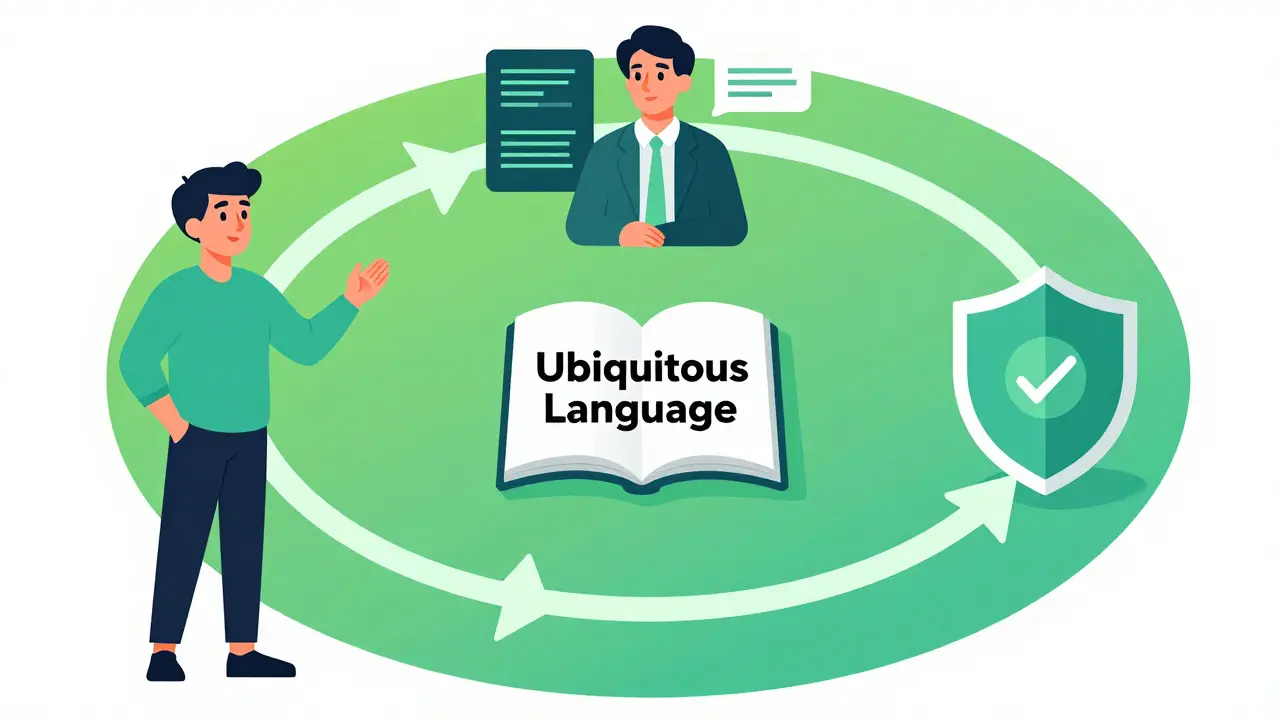
Ubiquitous Language is a shared language developed collaboratively by team members based on their domain knowledge. In a vibe coding environment, this language is your primary interface with the AI. If your language is vague, your code will be vague. If your language is precise, your code will be precise.
You need to maintain a living document-a glossary-that defines every key term. For instance, does 'Order' mean a pending request or a confirmed transaction? Does 'Active User' mean someone logged in right now or someone who logged in this month? These distinctions matter immensely to the AI.
Instinctools recommends keeping naming conventions, responsibilities, boundaries, feature order, and design notes updated. Crucially, you should instruct the AI agent to update this glossary after each significant change or commit. This keeps the glossary as the anchor for shared context. A healthcare startup reported on Dev.to in September 2025 that establishing a shared glossary of medical terms before starting vibe coding allowed non-technical clinical staff to participate effectively, resulting in a 45% reduction in domain misunderstandings.
| Metric | Traditional DDD | Pure Vibe Coding | DDD + Vibe Coding |
|---|---|---|---|
| Time to Initial Prototype | 6-8 weeks | 2.3 hours | 2.1 days |
| Technical Debt (3 Months) | Low | High (+37%) | Medium (-52% vs Pure) |
| Integration Errors | Baseline | High | 40% Fewer than Pure |
| Upfront Planning Time | High | None | 25% More than Pure |
The Vibe Coding Loop with DDD Constraints
How does the actual day-to-day work change? The rhythm remains similar, but the inputs become stricter. Strapi describes the loop as: describe intent, let the model draft, inspect/test/diagnose, refine with feedback, repeat until green. With DDD, you add a layer of validation at each step.
- Define Intent in Natural Language: Use your ubiquitous language terms. Reference the specific bounded context. Example: "In the Inventory Context, create a function to reserve stock. Note that 'Reserved' means allocated but not yet shipped, distinct from the Shipping Context's 'Processing' status."
- Let the Model Draft Code: Generate the initial implementation.
- Inspect Against Boundaries: Check if the code imports or references entities from other contexts directly. If so, flag it. Cross-context communication should happen via APIs or events, not direct database queries.
- Test and Diagnose: Run automated tests. Include tests that specifically check for boundary violations.
- Refine Prompt: Provide targeted feedback based on the boundary check. "You used the Customer ID from the Billing Context. Please refactor to use the external User Reference ID instead."
This process requires 25% more upfront planning time compared to pure vibe coding, but Google Cloud data from July 2025 shows it results in 40% fewer integration errors. That trade-off is easy to make when you consider the cost of fixing bugs three months down the line.
Security and Context Bleed
One of the biggest risks in vibe coding is security leakage. AI models might inadvertently include secrets in generated code if not constrained. Google Cloud emphasizes avoiding patterns where secrets live in source code. Instead, enforce 'secret loaded at runtime' approaches.
Another risk is 'context bleed.' This occurs when the AI starts mixing concepts from different bounded contexts because the prompt history became too cluttered. Instinctools reports that 57% of teams struggle with this. The solution is modular prompting. Keep your chat sessions focused on one bounded context at a time. If you switch contexts, start a new thread or explicitly reset the context window with a reminder of the new boundaries.
Automated context validation scripts are becoming essential. Used by 41% of successful implementations, these scripts check new code against your bounded context definitions. If a file in the Marketing module tries to import a class from the Finance module, the script fails the build. This prevents the slow creep of architecture erosion.
Future Trends: AI Tools Getting Smarter
The tooling is catching up. Google announced in November 2025 that AI Studio would incorporate automatic bounded context detection in its December 2025 release. It uses semantic analysis to identify potential context boundaries in your natural language prompts. Microsoft's GitHub Copilot team also revealed plans for DDD-aware prompting in Q1 2026, which will enforce ubiquitous language consistency across generations.
Specialized tools like ContextAI, launched in May 2025, are focusing specifically on AI-assisted bounded context modeling. They gained 15,000 users in six months by helping teams visualize and define these boundaries before coding begins. Gartner predicts that by Q3 2026, 92% of enterprise vibe coding implementations will incorporate explicit bounded context definitions, up from 58% currently.
However, don't rely solely on tools. Forrester analyst Ken Yuan stated that the combination addresses the creation-maintenance divide only if teams invest in the upfront domain modeling that AI cannot replace. The AI is a powerful assistant, but you remain the architect.
Getting Started: A Practical Checklist
If you are ready to try this hybrid approach, start small. Don't attempt to vibe-code your entire monolith overnight. Pick a well-bounded microdomain, like a notification system or a user profile editor.
- Create a Glossary: Write down 10-20 key terms for your domain. Define them precisely.
- Draw the Boundaries: Sketch out the modules. Who talks to whom? What data crosses the lines?
- Write a Context Definition File: Create a `context-definition.md` file. Include the context name, purpose, key terms, and forbidden dependencies.
- Use Structured Prompts: Start every session by pasting the relevant section of your context definition.
- Review Rigorously: Treat AI-generated code as junior developer code. It needs review, especially for cross-boundary interactions.
By respecting the domain, you respect the future maintainability of your software. Vibe coding gives you speed; DDD gives you sanity. Together, they form a robust strategy for modern software development.
What is vibe coding exactly?
Vibe coding is a collaborative development approach where developers use natural language prompts to guide AI agents in generating functional code. It shifts the focus from writing syntax to describing intent, iterating rapidly through cycles of prompting, reviewing, and refining.
Why do I need Domain-Driven Design for vibe coding?
Pure vibe coding often leads to 'context collapse' and high technical debt because AI lacks inherent understanding of business boundaries. DDD provides the structural framework (bounded contexts and ubiquitous language) to keep AI-generated code organized, consistent, and maintainable over time.
How do I define a bounded context for an AI agent?
Define a bounded context by creating a clear document that specifies the context's purpose, key terminology (ubiquitous language), allowed tools, and explicit boundaries (what it can and cannot access). Include this definition in your prompts to anchor the AI's understanding.
What is ubiquitous language in this context?
Ubiquitous language is a shared, precise vocabulary used by both developers and stakeholders to discuss the domain. In vibe coding, it serves as the instruction set for the AI, ensuring that terms like 'Order' or 'User' have consistent meanings throughout the codebase.
Is vibe coding safe for enterprise applications?
Yes, but only with strict governance. Enterprise adoption requires explicit bounded context definitions, automated security checks to prevent secret leakage, and rigorous code reviews. Tools are increasingly incorporating DDD-aware features to enhance safety and scalability.
How much extra time does adding DDD take?
Implementing DDD principles in vibe coding requires approximately 25% more upfront planning time compared to unstructured prompting. However, this investment reduces integration errors by 40% and significantly lowers long-term maintenance costs.
Oskar Falkenberg
June 9, 2026 AT 20:47honestly this is such a relief to read because i have been struggling with exactly this kind of mess in my current project where the ai keeps generating duplicate user models and it is driving me insane so thank you for laying out the bounded context idea so clearly even if i am still a bit confused about how to enforce those boundaries without spending weeks on documentation before writing any code but i guess that is the price we pay for sanity right now instead of paying it later in tech debt which sounds way worse honestly.
Patrick Dorion
June 10, 2026 AT 04:39The real issue here isn't just the technical implementation but the philosophical shift required to treat AI as a junior developer rather than an oracle. We are used to trusting our tools implicitly, but vibe coding demands a level of architectural stewardship that most modern developers have never needed to practice. You cannot simply prompt your way out of complexity; you must define the complexity first. The DDD approach forces you to confront the ambiguity of business requirements before the AI amplifies them into structural chaos. It is less about coding and more about defining truth within a specific scope. If you do not know what 'Order' means in your domain, no amount of prompting will save you from a fractured database schema. This is why the upfront investment in ubiquitous language is not optional overhead, it is the foundation of the entire system. Without it, you are building a house on sand while using a flamethrower to lay the bricks. Speed is irrelevant if the structure collapses under its own weight within months. We need to stop glorifying rapid prototyping at the expense of long-term maintainability. The future of software engineering belongs to those who can articulate boundaries as precisely as they can write code. AI is a force multiplier, but only for well-defined vectors. Directionless energy is just noise. So yes, define your contexts, lock down your terminology, and then let the vibes flow within those rails. Otherwise, you are just creating expensive entropy.
Bineesh Mathew
June 12, 2026 AT 01:01the sheer arrogance of assuming that 'vibes' can replace rigorous thought processes is truly staggering in its banality, for we have traded the sacred discipline of architecture for the fleeting dopamine hit of generated syntax, and now we reap the whirlwind of context collapse like children playing with fire in a library. it is a moral failing of our profession to accept such ephemeral solutions as valid engineering, when the very essence of software is permanence and logic, not some nebulous emotional resonance with a machine learning model that knows nothing of human struggle or business intent. we are drowning in mediocrity because we refuse to do the hard work of thinking, hiding behind the veil of automation while our systems rot from within. this article is merely a band-aid on a gunshot wound, suggesting that we can patch the hole with more rules instead of admitting that the whole paradigm is fundamentally flawed. true craftsmanship requires sweat, not prompts. the soul of the coder has been outsourced to a probabilistic engine, and we should all be ashamed of our complicity in this digital decay. do not tell me about bounded contexts when the entire boundary between creator and tool has dissolved into a gray sludge of unaccountable output. we are architects of our own obsolescence, dancing on the edge of a cliff while pretending the view is beautiful. it is tragic, really, that we needed an AI to teach us what we already knew: that structure matters. but apparently, we needed it screamed in our faces through yet another buzzword-laden post to understand that freedom without form is just chaos waiting to happen. i suppose we deserve this fate, given our collective laziness. the end of meaningful development is nigh, replaced by the hollow echo of automated compliance. we are not building software anymore; we are curating hallucinations. and soon, there will be nothing left to debug but our own vanity.
Stephanie Frank
June 13, 2026 AT 19:58lol yeah good luck trying to explain 'ubiquitous language' to a stakeholder who thinks 'customer' and 'user' are interchangeable terms because they use the same login screen. the problem isnt the ai its the humans who cant agree on basic definitions so blaming the model for mirroring their incompetence is rich. also who has time to write a glossary for every microservice? sounds like bureaucratic nightmare fuel disguised as best practice. just let the ai do its thing and fix the bugs when they break production, thats how agile works right?
Caitlin Donehue
June 14, 2026 AT 05:33i wonder if anyone actually tries this in a team setting or if it mostly works for solo devs who can control the narrative completely.