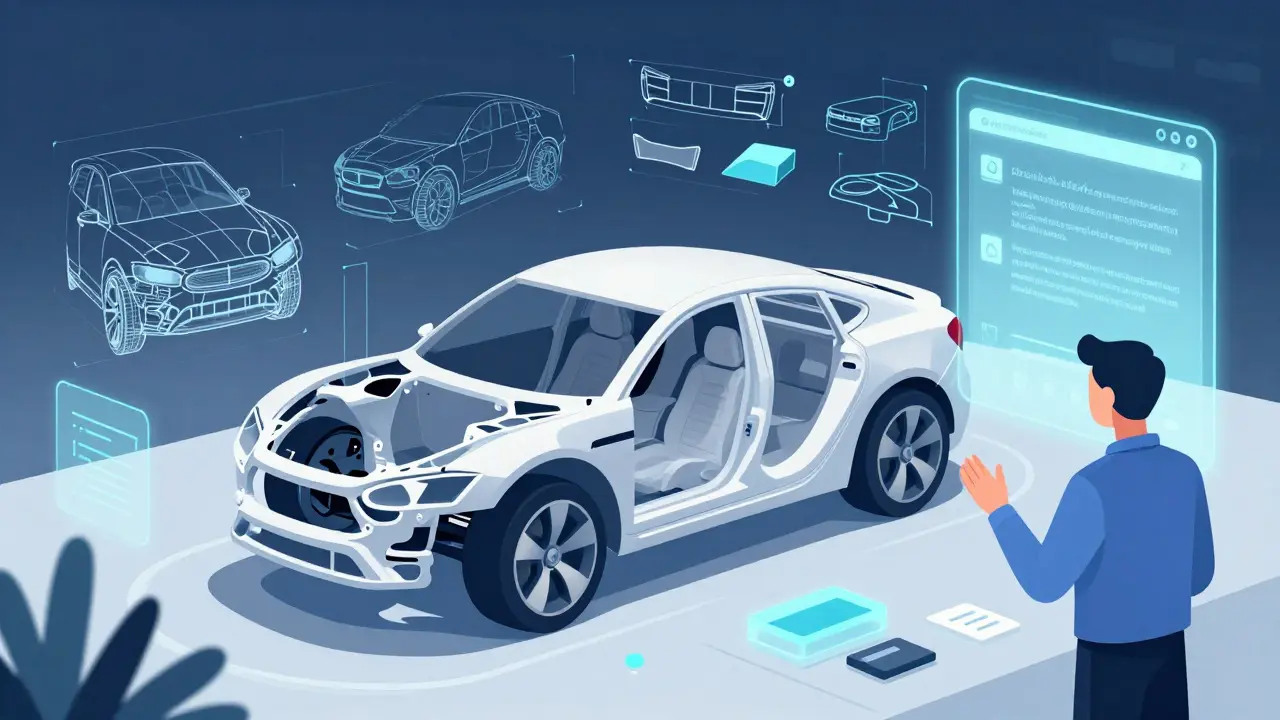
Imagine a world where your car doesn't just drive you-it understands you. Where the design of the next family sedan is optimized by algorithms before a single sketch is drawn, and where a mechanic diagnoses a complex engine fault in minutes using an AI assistant that has read every technical manual ever written for that model. This isn't science fiction anymore. It’s happening right now in the automotive industry, driven by generative AI.
We are moving past the era of simple rule-based systems. The old way involved rigid programming: if sensor A reads X, then do Y. Today, we are entering the age of foundation models-massive AI systems trained on vast amounts of data that can generate new designs, write code, create diagnostic reports, and hold natural conversations with drivers. For automakers, this shift represents a chance to cut development time from years to months and transform the daily experience of driving.
Redefining Automotive Design with Generative Models
Traditionally, designing a new vehicle was a slow, iterative process. Engineers would sketch concepts, build physical clay models, run crash tests, and tweak aerodynamics. This cycle could take 36 to 60 months from concept to production. Generative AI is compressing this timeline dramatically.
How does it work? Instead of manually drawing every curve, engineers use text prompts combined with CAD constraints to generate hundreds of design variants instantly. For example, an engineer might input a request for a bumper that meets specific safety regulations while minimizing weight. The AI generates dozens of 3D options, which are then automatically checked against simulation tools for crash performance and manufacturability.
NVIDIA describes this as treating the entire factory as a compute platform. By integrating generative models with legacy Product Lifecycle Management (PLM) systems, companies like L&T Technology Services report that teams can evaluate hundreds of virtual designs instead of fewer than ten physical prototypes. This doesn't just save money; it allows for radical innovation. Designers can explore shapes and structures that human intuition might overlook, leading to more efficient and safer vehicles.
The technology relies on advanced mechanisms like text-conditioned diffusion models and 3D reconstruction networks. These tools translate textual specifications into detailed 3D representations compatible with standard engineering workflows. The result is a design loop that is faster, cheaper, and far more comprehensive than anything possible in the previous decade.
Revolutionizing Vehicle Diagnostics and Maintenance
If design is about creation, diagnostics is about understanding. For years, vehicle fault diagnosis relied on machine learning classifiers that could identify known patterns in sensor data. If a vibration matched a known bearing failure, the system flagged it. But these systems struggled with novel issues or complex, multi-system failures.
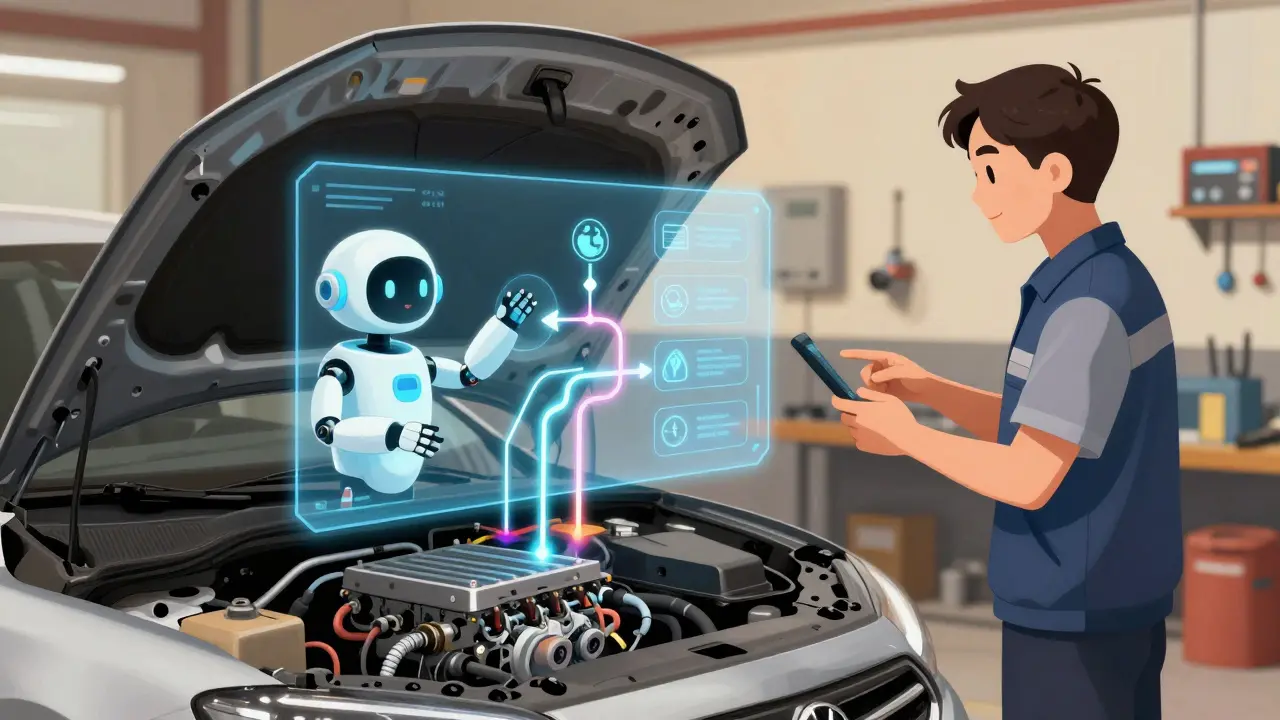
Generative AI changes the game by adding explanation and synthesis. Imagine a technician looking at a dashboard light. Instead of searching through thousands of pages of PDF manuals, they ask an AI assistant: "Why is the battery voltage fluctuating under load?" The AI, powered by Retrieval-Augmented Generation (RAG), scans the specific vehicle's service history, current sensor data, and the entire technical documentation library. It then generates a clear, step-by-step diagnostic path.
IBM highlights how these copilots assist engineers and service staff by answering technical questions over product manuals and warranty data spanning millions of records. In a workshop scenario described by NVIDIA, multiple AI agents work together: one computer vision agent detects visible damage, while a diagnostic agent reasons over documentation to suggest repairs, all while a safety agent ensures the recommendations comply with protocols.
This approach reduces time-to-diagnose from hours to minutes. However, it’s not without risks. Generative models can hallucinate-making up facts that sound plausible but are incorrect. Therefore, in the automotive context, these AI recommendations are treated as high-confidence suggestions, not autonomous decisions. Human technicians verify the output, ensuring safety remains paramount.
Connected Experiences: The Rise of In-Car Assistants
The most visible impact of generative AI for consumers is inside the cabin. We’ve all used basic voice commands: "Navigate home" or "Play jazz." These were intent-based systems with limited vocabulary. They couldn’t handle nuance, context, or open-ended conversation.
Enter the next generation of in-car assistants. Companies like Cerence have launched solutions such as CaLLM, which uses large language models to provide natural, context-aware dialogue. You can tell the car, "I’m feeling tired," and it might suggest a rest stop, adjust the climate control to be cooler, and play upbeat music-all based on understanding your state rather than matching keywords.
These systems run on embedded System-on-Chips (SoCs) in the vehicle, connecting to cloud-based models when necessary for heavier processing. They act as personal companions, helping with trip planning, proactive suggestions based on driver preferences, and multi-domain control of vehicle functions via speech. AWS supports this ecosystem by providing the cloud backbone for data lakes and ML services, managing petabytes of telemetry from fleets of hundreds of thousands of vehicles.
This creates a hyper-personalized experience. The car learns your habits over time. It knows you prefer heated seats on rainy mornings and suggests alternative routes when traffic builds up, explaining its reasoning in plain language. This level of interaction transforms the car from a tool into an intelligent partner.
Technical Architecture: Cloud, Edge, and Vehicle
To make all this happen, automotive companies are building complex hybrid architectures. There is no single place where this AI lives. It spans three domains:
- On-Vehicle Embedded Compute: Flagship ADAS or cockpit SoCs now offer hundreds of TOPS (trillions of operations per second). This allows real-time inference for voice assistants and immediate diagnostic checks without relying on internet connectivity.
- Edge/On-Premise Compute: Dealerships and manufacturing plants use local servers to process sensitive data quickly, optimizing logistics and robot programming in factories.
- Cloud/Data Center GPU Clusters: Massive GPU clusters train the foundation models and handle large-scale simulations. This is where the heavy lifting of generating design variants and updating global software happens.
NVIDIA positions its GPUs and software frameworks as the standard hardware foundation for this stack. Meanwhile, IBM emphasizes the need for a governed data foundation using platforms like watsonx to manage model lifecycle and enforce access controls over sensitive data like driver behavior and location.
This distributed approach ensures that critical functions remain available even if the network drops, while leveraging the infinite scale of the cloud for continuous improvement and updates.

Challenges and Safety Considerations
Despite the excitement, adopting generative AI in automotive is not plug-and-play. The stakes are incredibly high because cars are safety-critical systems. A bug in a website is annoying; a bug in a braking algorithm can be fatal.
One major challenge is data quality and availability. Training large generative models specific to automotive requires massive datasets that many individual OEMs cannot assemble alone. There are also significant computational costs. As noted in recent academic surveys, training these models demands GPU-hours and resources beyond what smaller suppliers can afford.
Safety and reliability are paramount. Regulatory bodies across North America, Europe, and Asia require rigorous validation. Standards like ISO 26262 dictate strict evidence trails for safety-related software. Integrating generative AI into this framework means ensuring that every line of code generated by AI is verified, tested, and traceable to requirements. KPIT emphasizes the need for human-in-the-loop review, code scanning, and unit testing to meet these standards.
There are also organizational hurdles. Engineering teams that have used traditional tools for decades need to adapt to working alongside AI. This requires new skills in prompt engineering, data management, and ML workflow integration. Change management is as important as the technology itself.
| Application Area | Key Benefit | Primary Technology | Major Challenge |
|---|---|---|---|
| Design & Engineering | Reduces prototype cycles from months to days | Diffusion models, 3D reconstruction | Integration with legacy CAD/PLM systems |
| Diagnostics & Maintenance | Cuts diagnosis time from hours to minutes | Retrieval-Augmented Generation (RAG) | Model hallucination and verification needs |
| Connected Experiences | Enables natural, contextual voice interaction | Large Language Models (LLMs) | Latency and offline functionality |
| Software Development | Accelerates code and test case generation | Code-generation LLMs | Compliance with ISO 26262 safety standards |
The Future Roadmap: Agentic AI and Beyond
Looking ahead to the late 2020s and early 2030s, the trend is moving toward agentic AI. Instead of a single model responding to a prompt, we will see multiple specialized agents collaborating. One agent might handle navigation, another manages energy efficiency, and a third monitors driver health. They will communicate with each other to optimize the overall driving experience.
Multimodal models will become standard, combining text, images, 3D geometry, and sensor data into unified pipelines. An engineer could propose a design change, simulate its impact on performance, and explain the rationale in natural language, all within a single interface. Continuous feedback loops from real-world usage data will refine these models, making them smarter with every mile driven.
However, full autonomy for generative systems in safety-critical contexts will remain constrained by regulation. The focus will stay on augmentation-empowering humans with better insights and tools rather than replacing them entirely. As the industry matures, we can expect stricter guardrails, better domain adaptation, and continuous monitoring to ensure that these powerful technologies serve us safely and effectively.
What is generative AI in the automotive industry?
Generative AI in automotive refers to advanced AI systems, particularly large language models and generative networks, that create new content such as vehicle designs, software code, diagnostic explanations, and personalized in-car experiences. Unlike traditional AI that only recognizes patterns, generative AI can produce novel outputs, accelerating development cycles and enhancing user interactions.
How does generative AI improve vehicle diagnostics?
It improves diagnostics by using Retrieval-Augmented Generation (RAG) to scan vast technical manuals and service histories instantly. Technicians can ask natural language questions, and the AI provides step-by-step repair guidance, reducing diagnosis time from hours to minutes. It synthesizes complex sensor data into understandable insights.
Is generative AI safe for use in safety-critical automotive systems?
Safety is a primary concern. While generative AI offers immense benefits, it is currently used as an assistive tool rather than an autonomous decision-maker in safety-critical areas. Rigorous validation, human-in-the-loop review, and compliance with standards like ISO 26262 are required to mitigate risks such as model hallucination.
Which companies are leading in automotive generative AI?
Key players include NVIDIA for hardware and compute platforms, IBM for enterprise governance and watsonx, AWS for cloud infrastructure and data lakes, and Cerence for specialized in-car voice assistants like CaLLM. Engineering firms like KPIT and L&T Technology Services also play crucial roles in integrating these technologies into OEM workflows.
How does generative AI change the car design process?
It drastically speeds up design by allowing engineers to generate hundreds of virtual design variants from text prompts and CAD constraints. These designs are automatically simulated for safety and performance, reducing the need for physical prototypes and cutting development time from years to months.
Edward Gilbreath
June 14, 2026 AT 08:23they want you to trust a black box with your life because it saves them money on clay models its just another way to collect data and sell it back to you while the cars break down faster than ever before
Lisa Nally
June 16, 2026 AT 05:51Edward, your lack of understanding regarding Retrieval-Augmented Generation (RAG) is palpable. The integration of LLMs with proprietary technical documentation libraries does not constitute a 'black box' in the traditional sense, but rather a sophisticated semantic search mechanism that mitigates hallucination through grounded context windows. Furthermore, the acceleration of the design lifecycle via diffusion models allows for iterative optimization that human intuition simply cannot match in terms of computational throughput and variant exploration.
Edward Nigma
June 17, 2026 AT 17:56actually the whole premise is flawed because if the AI generates the code who takes responsibility when the brakes fail during a software update? ISO 26262 compliance is a joke if the training data itself is biased or incomplete which it always is so we are just moving the liability from the engineer to the algorithm designer who will claim it was an edge case
Francis Laquerre
June 18, 2026 AT 01:25The shift towards agentic AI represents a profound transformation in how we interact with our vehicles, transcending mere utility to become a symbiotic relationship between driver and machine. In many cultures, the car is seen as an extension of personal identity, and these new systems allow for a level of personalization that respects individual preferences while maintaining safety protocols. It is fascinating to observe how technology bridges the gap between cold engineering and human comfort, creating an environment where the vehicle anticipates needs before they are explicitly articulated.
Laura Davis
June 19, 2026 AT 15:58I am tired of people acting like this is some magical solution that fixes everything without any downsides. You need to respect the fact that mechanics are humans too and they have jobs to lose if dealerships start using AI to diagnose everything instantly. Stop pushing this narrative that efficiency is the only thing that matters when real people are getting pushed out of the industry. We need boundaries here.
Andrea Alonzo
June 21, 2026 AT 05:30Laura, I completely understand where you are coming from, and it is incredibly important to acknowledge the anxiety that technological displacement can cause within established professions, particularly among skilled tradespeople who have dedicated years to mastering their craft. However, it might be beneficial to view these AI tools not as replacements, but as powerful assistants that handle the tedious, repetitive aspects of diagnostics, thereby allowing technicians to focus on complex mechanical repairs and customer relationships, which ultimately elevates the status of their work rather than diminishing it, provided there is adequate retraining support.
kimberly de Bruin
June 22, 2026 AT 17:55we are building gods in silicon and calling it convenience the car knows us better than we know ourselves soon it will decide what we should eat and where we should go based on algorithms we do not understand existence becomes a series of predicted outcomes rather than choices made by free will
Saranya M.L.
June 23, 2026 AT 04:22While the Western perspective often focuses heavily on the novelty of generative AI, it is crucial to recognize that India has been at the forefront of automotive software development and IT services for decades. Companies like KPIT and TCS are integral to this ecosystem, providing the robust backend infrastructure and rigorous testing frameworks necessary for global OEMs. The jargon-heavy discourse here often overlooks the immense contribution of Indian engineering talent in ensuring that these complex AI models meet international safety standards and function reliably across diverse operational environments.
michael rome
June 23, 2026 AT 04:55It is truly inspiring to see how these technologies are evolving to create safer and more efficient transportation networks. The collaborative effort between hardware manufacturers like NVIDIA and software providers is commendable, and it sets a high standard for future innovations. Let us continue to support advancements that prioritize user safety and environmental sustainability.