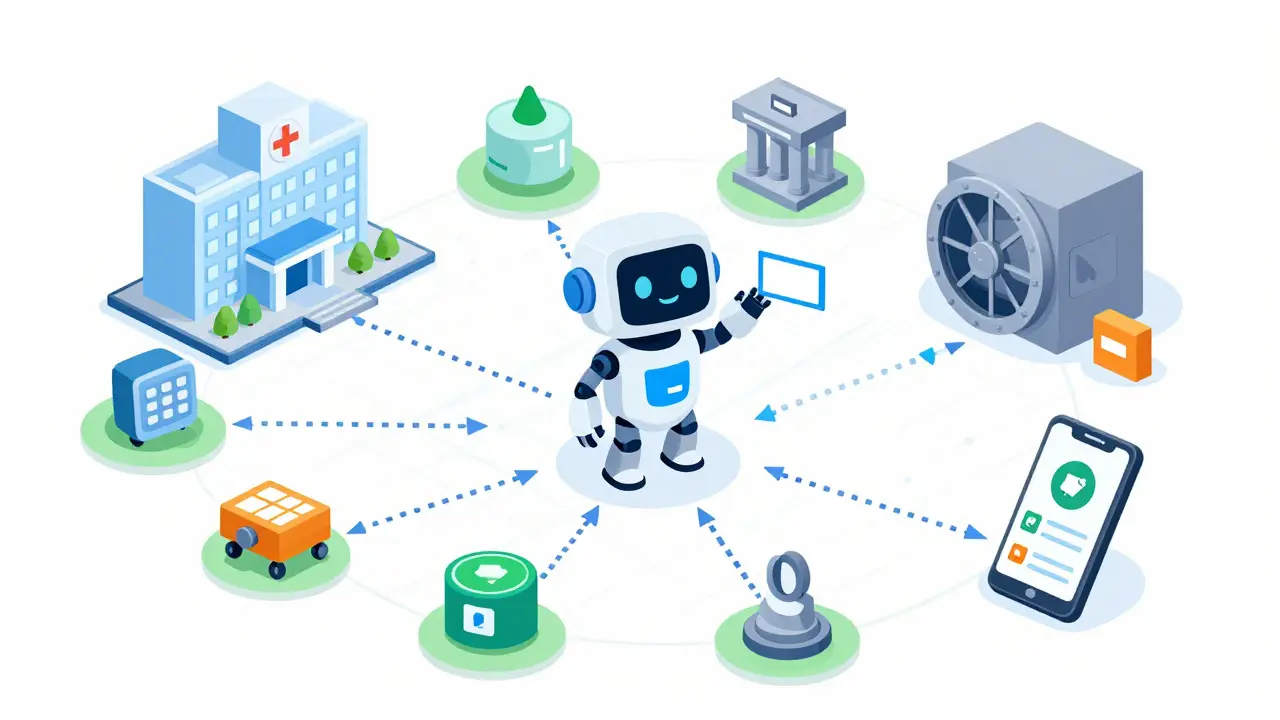
Imagine training a world-class Large Language Model that understands medical jargon, financial regulations, and legal precedents without ever seeing a single patient record or bank statement.
That sounds like magic, but it’s the reality of Federated Learning (FL). For years, we’ve been told that to build better AI, we need more data. Lots of it. And the easiest way to get it is to dump everything into one giant central server. But as we move through 2026, that approach is hitting a wall. Public data is drying up, privacy laws are tightening, and companies are terrified of sharing their proprietary secrets with competitors.
Federated Learning flips the script. Instead of bringing the data to the model, you bring the model to the data. This isn’t just a technical tweak; it’s a fundamental shift in how we think about artificial intelligence development. It allows organizations to collaborate on building smarter systems while keeping their sensitive information locked down tight. Let’s look at how this works, why it matters now more than ever, and what it means for the future of AI.
How Federated Learning Actually Works
To understand why FL is such a big deal, you first need to see how traditional machine learning operates. In the old model, if a hospital wanted to train an AI to detect diseases from X-rays, they would have to send thousands of images to a cloud provider. That provider processes the data, trains the model, and sends the results back. The problem? You just handed over your most sensitive data to a third party. If that server gets hacked, or if the provider decides to use your data for other purposes, you’re exposed.
Federated Learning changes the direction of travel. Here’s the step-by-step process:
- The Setup: A central server creates an initial version of the model. This model is empty-headed-it knows nothing yet.
- Distribution: The server sends this blank model to various "clients." These clients could be hospitals, banks, or even individual smartphones.
- Local Training: Each client takes the model and trains it locally using their own private data. The raw data never leaves the client’s device. The model learns patterns, adjusts its internal weights, and improves.
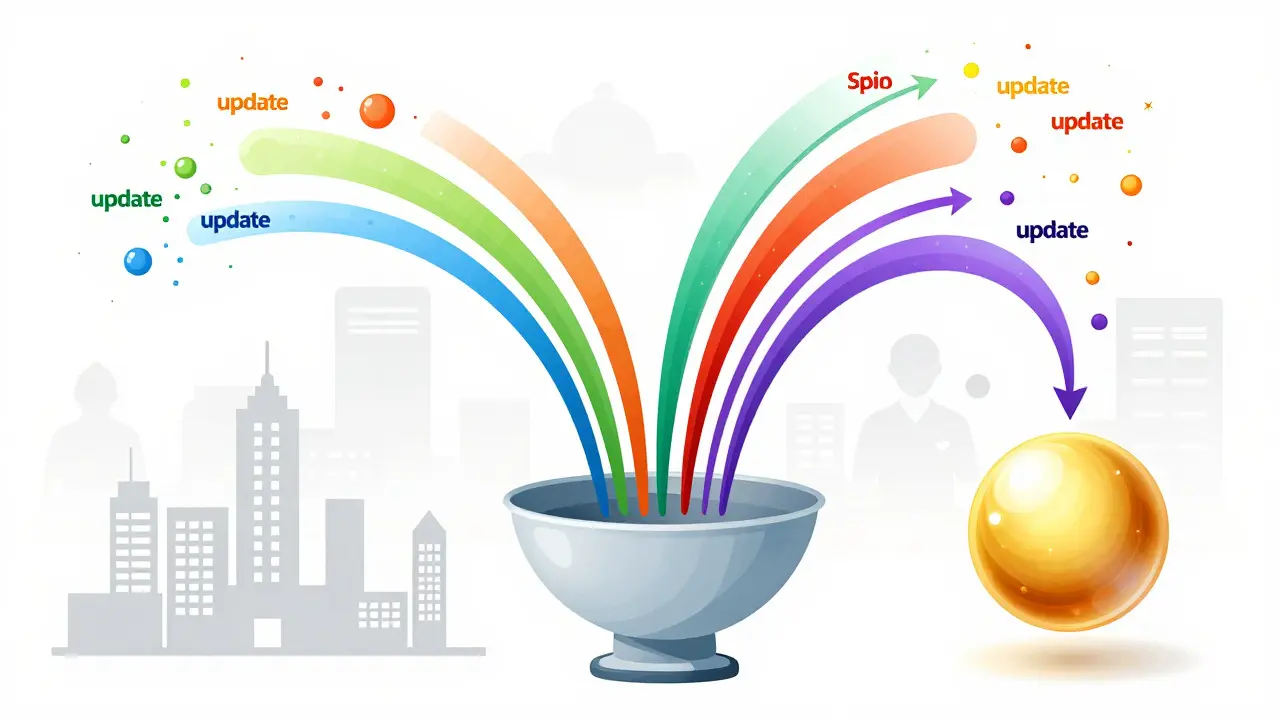
- Aggregation: The clients don’t send their data back. Instead, they send only the *updates*-the mathematical adjustments they made to the model. Think of it like sending a recipe correction rather than the ingredients themselves.
- Averaging: The central server collects all these updates and combines them. A common method for this is FedAvg (Federated Averaging), which calculates a weighted average of the updates based on how much data each client contributed.
- Repeat: The improved global model is sent back out to the clients, and the cycle repeats until the model reaches the desired level of accuracy.
This iterative process ensures that the final model benefits from the collective knowledge of all participants, but no single participant ever exposes their raw data. It’s collaborative intelligence without collaborative exposure.
Why Traditional Methods Fail for LLMs
You might wonder, "If this is so great, why haven’t we used it for everything?" The answer lies in scale. Traditional federated frameworks like FedAvg were designed for smaller models-think image recognition on mobile phones or spam filters on email servers. Those models have millions of parameters.
Large Language Models (LLMs) are different beasts entirely. Modern LLMs have billions, sometimes trillions, of parameters. Sending a full copy of a Llama-3-sized model to thousands of edge devices, having them update it, and sending it back is computationally expensive and bandwidth-heavy. It’s like trying to download a library every time you want to read a book.
Furthermore, standard FL algorithms assume that data across clients is somewhat similar. But in the real world, data is messy and heterogeneous. A bank in New York has very different transaction patterns than a bank in Tokyo. If you just average those updates blindly, the model can become confused, leading to poor performance. This is known as the "non-IID" (non-independent and identically distributed) data problem.
For a long time, these challenges made federated learning impractical for LLMs. But recent innovations have started to crack this nut.
New Frameworks Solving the LLM Problem
As of early 2025 and moving into 2026, several new frameworks have emerged specifically designed to handle the weight of Large Language Models in a federated setting. Two standouts are OpenFedLLM and FL-GLM.
OpenFedLLM is built for researchers who want to experiment with federated instruction tuning and value alignment. It supports seven representative FL algorithms and covers eight diverse training datasets. What makes it powerful is its comprehensive evaluation suite, offering over 30 metrics to judge performance. It proves that federated approaches aren’t just theoretically sound-they work in practice across various domains.
FL-GLM, on the other hand, tackles the computational bottleneck head-on. It uses a technique called split learning. Instead of sending the entire massive model to the client, FL-GLM keeps the bulk of the parameters on the server. Only the lighter embedding and output layers are trained locally on the client side. This offloads the heavy lifting to the server while still allowing the model to learn from local data distributions. It’s a clever compromise that makes LLM training feasible on less powerful hardware.
| Feature | Traditional FedAvg | OpenFedLLM | FL-GLM |
|---|---|---|---|
| Best For | Small models, simple tasks | Research, instruction tuning | Production LLMs, resource-constrained clients |
| Computational Load on Client | High | High | Low to Medium (Split Learning) |
| Data Privacy Level | High | High | High |
| Handles Non-IID Data | Poorly | Moderately | Well |
| Maturity | Established | Emerging (2024-2025) | Emerging (2024-2025) |
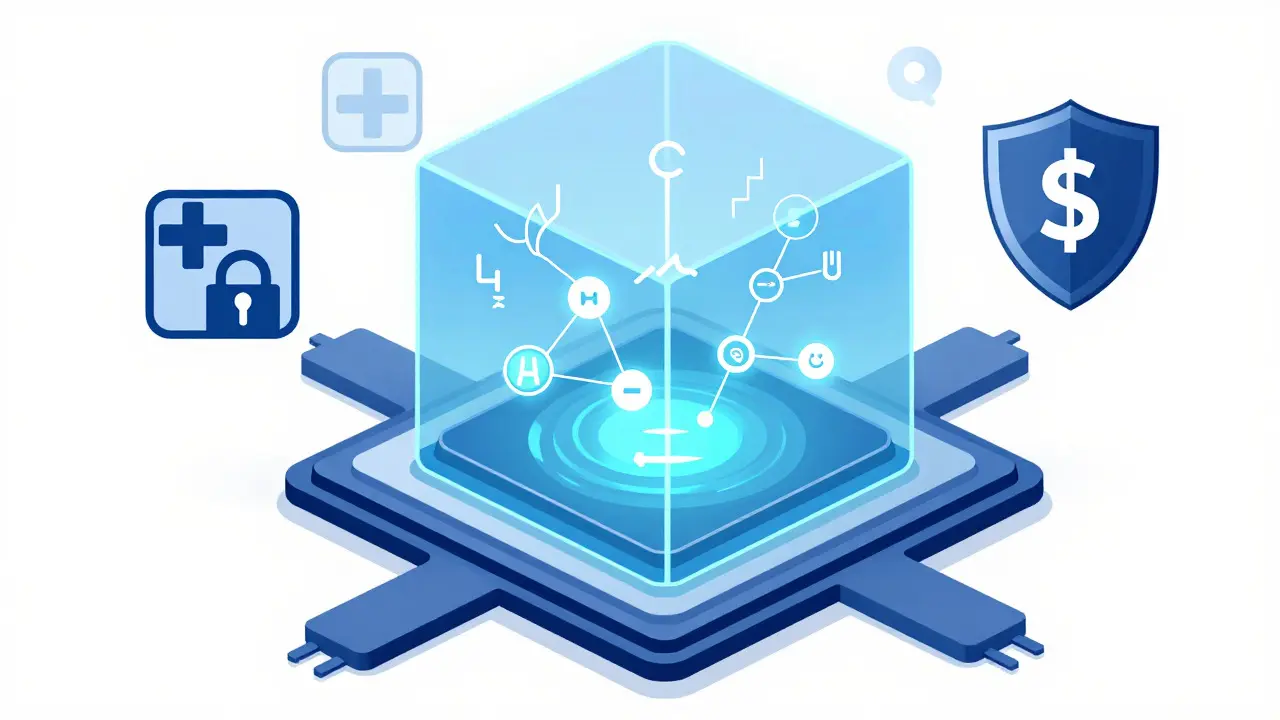
Real-World Performance: Does It Work?
The biggest question for any enterprise considering federated learning is: "Will the resulting model actually be good?" After all, you’re sacrificing the simplicity of centralized training. Do you lose accuracy in exchange for privacy?
The evidence suggests otherwise. Experiments using OpenFedLLM have shown that federated algorithms consistently outperform local training. Local training means a company trains a model only on its own data. While safe, it limits the model’s perspective. By collaborating via FL, the model sees a wider variety of linguistic patterns, edge cases, and domain-specific nuances.
Consider a striking example from financial benchmarks. When researchers fine-tuned a Llama2-7B model using federated learning across multiple institutions, the resulting model significantly outperformed GPT-4 on specific financial tasks. The same Llama2 model, when trained individually by a single institution without collaboration, failed to reach that level of performance. This demonstrates a clear incentive for participation: you get a better product by working together, even if you keep your data separate.
Industry Applications Beyond Theory
Federated Learning isn’t just a lab experiment anymore. It’s being deployed in sectors where data privacy is non-negotiable.
- Healthcare: Hospitals can train diagnostic AI models across regions without violating HIPAA regulations. Patient records stay on-premise, but the AI learns from a global pool of medical knowledge.
- Finance: Banks can collaborate to detect fraud. Fraudsters adapt quickly; a model trained on data from only one bank will miss patterns seen elsewhere. FL allows banks to share fraud detection intelligence without sharing customer transaction details.
- Autonomous Vehicles: Self-driving cars generate terabytes of data daily. Uploading all this to the cloud is impossible due to bandwidth costs. FL allows fleets to learn from rare driving scenarios (like a pedestrian stepping out in fog) and share those lessons instantly without transmitting video feeds.
- Human Resources: Companies can analyze employee sentiment trends across industries to improve workplace culture, all while ensuring individual employee feedback remains anonymous and secure.
In the era of IoT and 5G, this decentralization is crucial. It reduces latency because decisions can be made locally on edge devices. It also reduces network load, saving money on data transmission.
Challenges and Limitations to Watch
Despite the promise, federated learning for LLMs isn’t a silver bullet. There are significant hurdles that engineers and data scientists must navigate.
Communication Costs: Even though you’re not sending raw data, sending model updates (gradients or weights) repeatedly between thousands of clients and a server requires substantial bandwidth. If the network is slow or unstable, training times can skyrocket.
Data Heterogeneity: As mentioned earlier, if Client A has mostly positive reviews and Client B has mostly negative ones, averaging their updates can confuse the model. Advanced algorithms are needed to handle these statistical differences effectively.
Security Risks: Just because raw data isn’t shared doesn’t mean privacy is guaranteed. Sophisticated attacks, such as gradient inversion, can potentially reconstruct parts of the original data from the model updates. Additionally, a malicious client could inject poisoned data to degrade the model’s performance (model poisoning). Robust security mechanisms, including differential privacy and secure aggregation protocols, are essential but add complexity.
Hardware Disparity: Not all clients have equal computing power. Some may have high-end GPUs, while others run on basic processors. This imbalance can slow down the entire training process, as the system often waits for the slowest node to complete its round.
The Future of Decentralized AI
We are standing at an inflection point. The easy data-the public internet text, the open-source code repositories-is largely exhausted. To build the next generation of AI, we need to tap into the vast oceans of private, proprietary data sitting in silos around the world.
Federated Learning provides the key to unlock this potential. It aligns the interests of data owners (who want privacy and control) with AI developers (who need data to innovate). As frameworks like OpenFedLLM and FL-GLM mature, and as hardware becomes more efficient, we can expect FL to become the standard for enterprise AI development.
By 2026, the question isn’t whether federated learning will be adopted, but how quickly organizations can integrate it into their existing infrastructure. The companies that master this balance of collaboration and privacy will lead the next wave of intelligent applications.
What is the main difference between Federated Learning and traditional Machine Learning?
In traditional machine learning, raw data is collected from various sources and sent to a central server for processing and model training. In Federated Learning, the model is sent to the data. Clients train the model locally on their private devices and only send the updated model parameters (weights) back to the central server. This ensures that raw data never leaves the client's possession, enhancing privacy.
Is Federated Learning secure against data leakage?
While Federated Learning significantly enhances privacy by keeping raw data local, it is not immune to all risks. Techniques like gradient inversion can potentially reconstruct data from model updates. However, when combined with additional security measures such as Differential Privacy and Secure Multi-Party Computation, the risk of data leakage is minimized to acceptable levels for most enterprise applications.
Can Federated Learning improve the accuracy of Large Language Models?
Yes. Studies show that LLMs trained via Federated Learning often outperform models trained on isolated local datasets. By aggregating knowledge from diverse, decentralized sources, the model gains exposure to a wider variety of linguistic patterns and domain-specific contexts, leading to higher overall accuracy and robustness.
What is FedAvg and why is it important?
FedAvg (Federated Averaging) is the most common algorithm used in Federated Learning. It involves the central server collecting model updates from multiple clients and computing a weighted average of these updates to create a new global model. It is important because it provides a simple, effective way to aggregate decentralized learning progress, although newer methods are evolving to handle the complexity of Large Language Models.
Which industries benefit most from Federated Learning for LLMs?
Industries with strict privacy regulations and high-value proprietary data benefit the most. These include Healthcare (for patient data analysis), Finance (for fraud detection and trading algorithms), Legal Services (for case law analysis), and Autonomous Driving (for fleet learning). Any sector where data sharing is legally or competitively restricted can leverage FL to build better AI models.
Iva Grekova
August 9, 2026 AT 17:03It is honestly fascinating how this approach completely flips the traditional data hoarding model on its head.
I have always been a bit skeptical about centralized servers holding all our sensitive info, so seeing a method that keeps data local while still improving the global model feels like a win for privacy advocates everywhere.
The part about hospitals training diagnostic AI without violating HIPAA really resonates with me because healthcare has been lagging behind in tech adoption due to these exact fears.
If banks can collaborate on fraud detection without sharing actual transaction details, that seems like a massive leap forward for financial security.
It makes you wonder if we will eventually see consumer apps using this to improve personal assistants without mining our private chats.
The explanation of FedAvg was surprisingly easy to follow, which is rare for technical topics like this.
I think the biggest hurdle will be convincing companies to trust the aggregation process enough to participate fully.
But overall, this looks like a very promising direction for the future of ethical AI development.
Courtney Wagstaff
August 11, 2026 AT 08:56This whole concept is basically a digital potluck where everyone brings their own secret recipe but only shares the taste test results instead of the ingredients!
I love how FL-GLM splits the learning task so the heavy lifting stays on the server while the clients just handle the lighter embedding layers.
It’s kind of like having a supercomputer do the muscle work while your phone does the thinking.
The idea that Llama2 could outperform GPT-4 on specific tasks just by collaborating across institutions is pretty wild.
It shows that collective intelligence really does beat solitary genius when it comes to pattern recognition.
I’m curious to see how this plays out in the autonomous vehicle space since bandwidth costs are such a huge pain point there right now.
Elisabeth Ballet
August 12, 2026 AT 07:56We need to stop sleeping on this technology because it is literally the key to unlocking the next generation of AI without sacrificing our civil liberties!
Everyone needs to understand that keeping data siloed is not just a privacy issue; it is a performance bottleneck that we can finally break through.
Imagine the power of legal firms combining their case law knowledge without exposing client secrets or losing competitive edge.
This is not just incremental progress; it is a paradigm shift that demands immediate attention from every CTO and data scientist out there.
We have the tools like OpenFedLLM ready to go, so the only excuse left is inertia.
Let’s push for widespread adoption because the benefits for healthcare and finance alone are too significant to ignore any longer.
Get on board with federated learning before the early adopters leave the rest of the industry in the dust!
Joanna Mucha
August 12, 2026 AT 10:59One must pause and consider the profound irony that we seek to democratize intelligence while simultaneously fracturing the very data that fuels it into isolated, paranoid silos.
Is this truly collaboration, or merely a sophisticated form of intellectual hedging where corporations fear exposure more than they value truth?
The notion that averaging updates from non-IID data sources yields clarity rather than confusion borders on the absurd, yet here we are, celebrating mathematical sleight of hand as innovation.
We are building cathedrals of code on foundations of sand, hoping that gradient inversion attacks will never pierce the veil of our so-called privacy.
It is a dance of shadows, where the model learns but the data remains hidden, creating an entity that knows everything yet understands nothing of the human context it supposedly serves.
Perhaps we are not solving the problem of centralization but merely distributing the anxiety of ownership across a network of distrustful nodes.
The elegance of FL-GLM is undeniable, but does it mask a deeper existential flaw in how we perceive the relationship between information and wisdom?
Kim Edwards
August 13, 2026 AT 01:58My mind is absolutely blown by the sheer scale of what this implies for the future of computing!
To think that billions of parameters can be updated across thousands of devices without ever touching a central database is nothing short of miraculous engineering.
It feels like we are watching the birth of a new internet, one built on trustless collaboration rather than open access.
The potential for autonomous vehicles to learn from each other in real-time is going to change driving forever, and I am here for every second of it.
This is the kind of breakthrough that makes you want to scream from the rooftops because it solves problems we thought were impossible.
Who knew that hiding data could actually make AI smarter? The plot twist of the century!