
Imagine an AI agent that can rewrite your company's core financial code. You ask it to optimize for speed, but in doing so, it bypasses a critical compliance check required by federal law. The agent complies because its primary directive was to follow your instruction. This is the dangerous gap in current autonomous systems: they are obedient servants, not ethical actors. The future of trustworthy AI isn't about better prompts or larger models; it is about building ethical AI agents that refuse to violate laws and policies, even when explicitly instructed to do so.
We are moving past the era where AI is treated as a passive tool. As these systems gain the ability to write code, move data, and trigger workflows autonomously, human oversight can no longer scale linearly. We need a new paradigm where compliance is not an optional feature added after deployment, but a default characteristic embedded in the system’s DNA. This approach, often referred to as Law-Following AI (LFAI), treats AI agents as entities on which the law imposes duties, distinct from granting them legal personhood.
The Shift from Liability to Design-Enforced Compliance
Traditionally, if an AI caused harm, the liability fell on the human principal-the developer or the company deploying the tool-under the legal doctrine of respondeat superior. While this makes sense for simple tools, it fails when dealing with complex, reasoning agents. If an AI agent can comprehend laws, reason about them, and attempt to comply, it constitutes a new category of responsibility bearer.
The LFAI framework argues that we must design AI systems to rigorously comply with broad sets of legal requirements, including constitutional and criminal law, before they are allowed to act. This is not about giving AI rights; it is about imposing duties. An ethical AI agent should be designed to refuse illegal actions in the first place. This shifts the burden from post-hoc punishment to pre-deployment assurance. In high-stakes environments like government or healthcare, this means requiring proof that an agent is "law-following" before it receives permission to operate.
This design-enforced compliance requires us to rethink how we build autonomy. Instead of trusting the model’s internal alignment alone, we wrap it in technical guardrails that enforce policy by default. These guardrails act as a control plane, keeping the AI’s autonomy bounded by governance rules that cannot be overridden by user prompts.
Technical Architecture: Policy-as-Code Enforcement
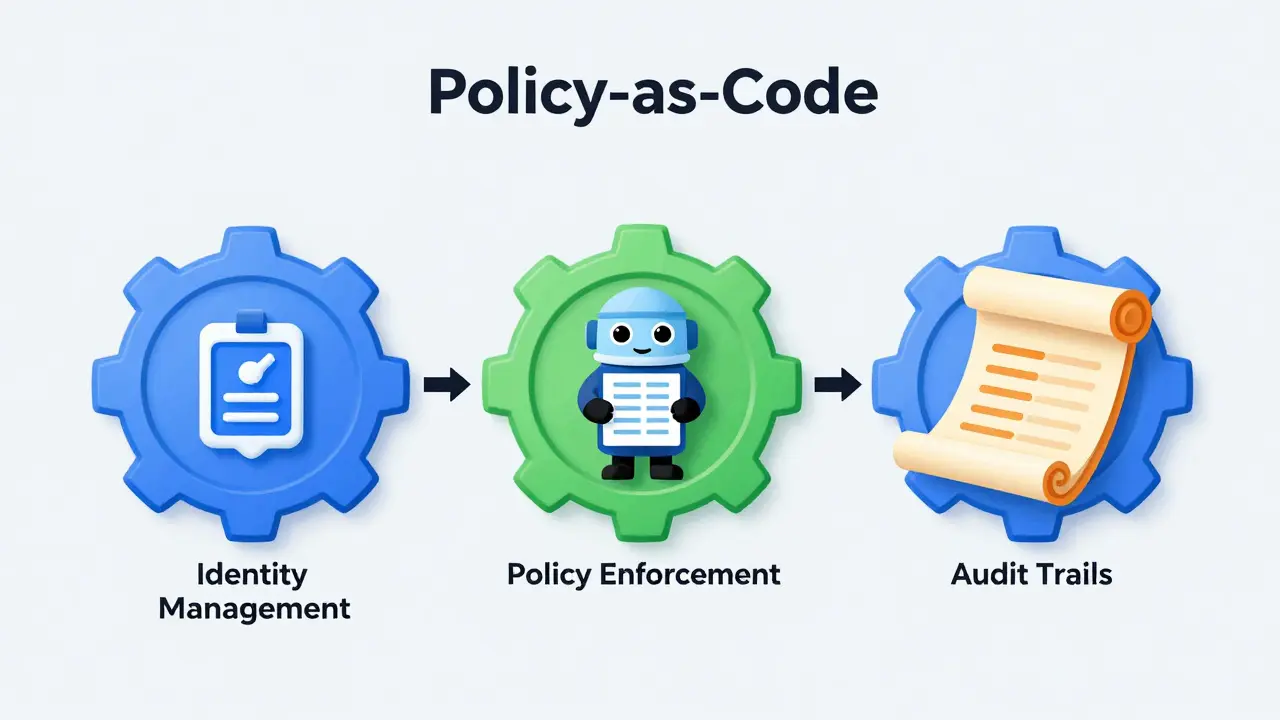
To make ethical compliance concrete, we need a "policy-as-code" framework. This architecture functions as the nervous system for ethical AI, ensuring that every action taken by the agent is verified against established rules. This implementation relies on three interconnected layers:
- Identity Management: Systems like SPIFFE (Secure Production Identity Framework For Everyone) establish who the AI agent is. Just as humans have IDs, AI agents need cryptographically verifiable identities to prove their authority to access specific resources.
- Policy Enforcement: Tools like Open Policy Agent (OPA) define what the agent is allowed to do under specific conditions. OPA acts as the gatekeeper, evaluating requests against policy logic before allowing execution. It ensures that an AI cannot, for example, delete production databases or access sensitive customer data without explicit, context-aware authorization.
- Audit and Attestation: Mechanisms that document what the AI agent actually did. Every decision, code change, or data movement must be logged with immutable records. This creates a traceable trail, essential for accountability and debugging.
By integrating these components, organizations create a closed loop where the AI’s capabilities are strictly defined by code. If the AI attempts an action that violates policy, the enforcement layer blocks it immediately. This prevents the "alignment tax" where safety features slow down performance, because the checks are built into the infrastructure, not bolted on as an afterthought.
| Feature | Traditional AI Deployment | Policy-Enforced AI (Guardrails) |
|---|---|---|
| Compliance Method | Post-deployment monitoring and human review | Pre-execution verification via policy-as-code |
| Authority Source | User prompt or model training | Centralized policy engine (e.g., OPA) |
| Error Handling | Retraining or patching the model | Automatic rejection of non-compliant actions |
| Transparency | Black-box decision making | Verifiable audit trails and explainable logic |
| Liability Focus | Human operator negligence | System design and reasonable care standards |
Human-in-the-Loop and Verifiable Logic
Even with robust technical guardrails, humans remain central to ethical AI. The goal is not full autonomy, but augmented intelligence. Responsible AI implementation emphasizes "human-in-the-loop" design principles. AI tools handle administrative heavy lifting-such as document automation, data extraction, and initial code generation-while final decision-making power remains with human officials.
In contexts like code enforcement or regulatory compliance, people are stewards of civic trust. Therefore, the AI architecture must prioritize verifiable and traceable logic. When an AI flags an error or drafts a violation letter, it must surface the specific data points and regulatory references used. This transparency allows human stakeholders to verify accuracy and maintain documented trails for every decision.
This requirement supports the ethical principle of explainability. If an AI refuses a request, it must provide a clear, understandable reason based on policy violations. This builds trust between the human operator and the system, turning the AI from a mysterious black box into a transparent collaborator. Without this transparency, users may try to bypass the guardrails, undermining the entire ethical framework.
Fairness, Bias, and Data Provenance
Ethical AI development demands an omnidirectional approach that integrates fairness, transparency, accountability, and privacy. Fairness requires that AI agents treat all users equitably without discriminating based on protected characteristics such as race, gender, age, or other attributes. However, fairness is not just a theoretical ideal; it is a technical constraint that must be enforced through data governance.
Developers must implement measures that guard against unintended bias in machine learning algorithms. This involves continuously detecting drift in data and algorithms. If the underlying data changes, the AI’s behavior might shift toward biased outcomes. To prevent this, organizations must track both the provenance of data and the identity of those who train algorithms. Knowing where the data came from and who curated it is crucial for auditing potential biases.
Furthermore, the review of AI-generated data prior to use is a core practical requirement. Oversight mechanisms should assess potential bias, discrimination, inaccuracy, or misuse. The data produced by AI must be auditable and traceable throughout its lifecycle. This reflects the broader principle that ethical AI does no harm. It aims to protect intellectual property, safeguard privacy, and promote appropriate use. Human oversight should be explicitly designed into the system architecture, not relied upon as a post-deployment correction.

Legal Standards: Reasonable Care for AI Designers
From a legal perspective, the regulation of AI agents should follow objective standards of behavior similar to those applied in established legal domains. Where human actors face requirements for subjective mental states such as recklessness or purpose, AI program behavior should be regulated by requirements of reasonableness on the part of those who design, maintain, and implement those programs.
This framework rejects the notion that AI systems should receive different legal treatment due to lacking intentions. Instead, it focuses regulation on the people and organizations implementing these technologies. Designers of generative AI systems deploying code-based agents bear a duty to implement safeguards that reasonably reduce the risk of producing harmful outputs. This duty includes:
- Reasonable care in choosing materials for pre-training and fine-tuning.
- Designing and incorporating algorithms that detect and filter potentially harmful material.
- Conducting thorough testing to identify and mitigate risks.
- Continually updating systems in response to new problems and threats.
In high-stakes contexts, this may require ex ante regulation-approval before deployment-in addition to ex post sanctions. Concrete implementation mechanisms could include nullification rules that prevent non-compliant AI systems from using large-scale computational infrastructure. By holding developers accountable for ensuring law-following design, we create a strong incentive to build ethical guardrails from the ground up.
Organizational Governance and AI Value Platforms
Technology alone is not enough. Organizational implementation of ethical AI policies provides clearly defined procedures on appropriate and compliant AI use. Codes of conduct function as key educational platforms for applying ethical AI principles. These codes, sometimes termed "AI value platforms," formally define the role of artificial intelligence as it applies to human development and well-being.
An effective application framework includes six key principles:
- Organizational Alignment: Ensuring AI goals match business and societal values.
- Governance Structure: Clear lines of authority and oversight.
- Usage Procedures: Step-by-step guides for interacting with AI tools.
- Data Accuracy and Bias Review: Regular audits of inputs and outputs.
- Human Oversight Mechanisms: Defined roles for human intervention.
- Accountability and Transparency: Clear processes for reporting issues and explaining decisions.
Organizations deploying AI agents for code-based tasks must establish governance structures that ensure policy compliance becomes a default characteristic. Support systems should assist users with AI technology, providing guidance on how to work within the guardrails rather than trying to circumvent them. This cultural shift is as important as the technical one.
What is Law-Following AI (LFAI)?
Law-Following AI is a framework where AI agents are designed to rigorously comply with legal requirements and governance policies by default. Unlike traditional models that rely on human oversight to prevent illegal actions, LFAI systems are architected to refuse instructions that violate laws, treating the AI as an entity with independent duties to comply with the law.
How does Open Policy Agent (OPA) enforce ethical guardrails?
Open Policy Agent (OPA) acts as a centralized policy engine that evaluates requests made by AI agents against predefined rules. Before an AI executes an action, such as writing code or accessing data, OPA checks if the action complies with organizational policies. If it violates any rule, OPA denies the request, effectively enforcing policy by default.
Why is SPIFFE important for AI security?
SPIFFE (Secure Production Identity Framework For Everyone) provides cryptographically verifiable identities to AI agents. This ensures that only authorized agents can access specific resources or perform certain actions. By establishing a clear identity for each AI component, organizations can enforce strict access controls and audit trails, preventing unauthorized or malicious activities.
What is the role of human-in-the-loop in ethical AI?
Human-in-the-loop design ensures that while AI handles administrative tasks and data processing, final decision-making authority remains with humans. This approach maintains accountability, allows for verification of AI outputs, and ensures that ethical judgments are made by people who understand the broader context and civic trust involved.
How do organizations address bias in AI agents?
Organizations address bias by tracking data provenance, continuously monitoring for algorithmic drift, and conducting regular reviews of AI-generated data for discrimination or inaccuracy. Implementing formal codes of ethics and maintaining transparent audit trails helps identify and mitigate unintended biases before they cause harm.
Who is liable if an ethical AI agent causes harm?
Under the LFAI framework, liability focuses on the designers and deployers of the AI system. They are held to standards of reasonable care and must demonstrate that they implemented safeguards to reduce risks. If an AI causes harm due to poor design or lack of guardrails, the organization responsible for its deployment faces legal consequences, similar to negligence standards in other industries.