
You ask a large language model a medical question. It replies with absolute certainty. The answer sounds professional, detailed, and authoritative. But it is completely wrong. This scenario is not science fiction; it is the daily reality of deploying Large Language Models in production environments. The problem isn't just that the model made a mistake. The danger lies in its confidence. When an AI system cannot accurately gauge its own uncertainty, it becomes unreliable in high-stakes settings like healthcare, finance, and legal compliance.
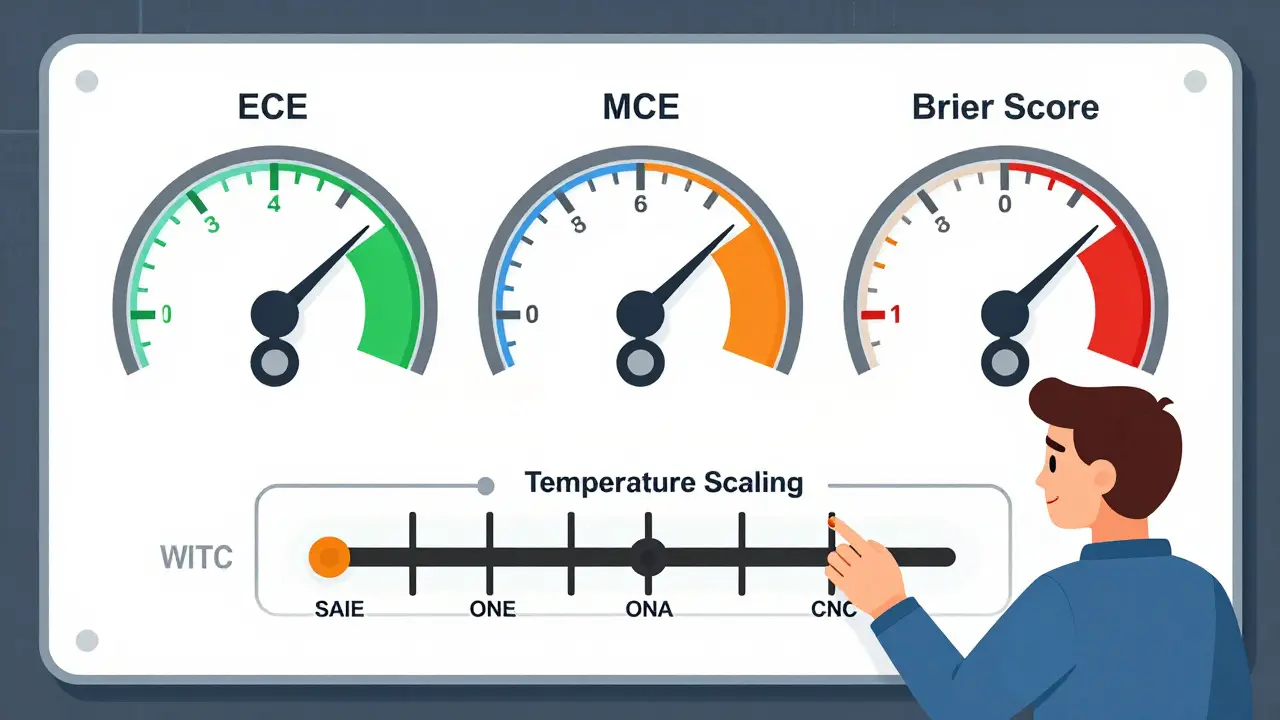
This gap between what a model believes it knows and what it actually knows is called miscalibration. To build trustworthy AI, we need to measure this gap precisely. That is where calibration and confidence metrics come in. They act as the dashboard gauges for your AI systems, telling you when the engine is running hot and when to pull over before a breakdown occurs.
What Is Model Calibration?
At its core, Model Calibration is the alignment between a model's predicted probability and the actual frequency of correct outcomes. Think of it like a weather forecast. If a meteorologist says there is an 80% chance of rain, it should rain in 8 out of every 10 similar situations. If it only rains 50% of the time, the forecaster is miscalibrated-specifically, overconfident.
In the context of LLMs, this concept has moved from theoretical statistics to critical engineering necessity. Before 2020, calibration was mostly relevant for image classifiers. With the rise of generative models like GPT-3, the stakes changed. These models generate free-form text, making it harder to define "correctness." Yet, the need for reliable confidence scores remains paramount. As noted in ApX Machine Learning's 2023 technical analysis, an ideally calibrated model assigning 80% probability to a prediction should be correct 80% of the time across all predictions with that score.
Why does this matter now? Because we are moving LLMs into decision-support roles. In these scenarios, knowing *when* the model might be wrong is often more valuable than getting the right answer every single time. Professor Zico Kolter from Carnegie Mellon University describes calibration as "the bridge between model capability and trustworthy deployment." Without this bridge, you have a powerful car with no brakes.
Key Metrics for Measuring Confidence
To fix what you cannot measure, you first need the right tools. Several metrics exist to quantify how well-calibrated a model is. Each serves a different purpose, and using them together provides a complete picture of model reliability.
| Metric | Definition | Interpretation | Ideal Value |
|---|---|---|---|
| Expected Calibration Error (ECE) | Averages the difference between confidence and accuracy across bins of predictions. | Measures overall calibration quality. | Below 0.1 |
| Maximum Calibration Error (MCE) | The largest deviation between confidence and accuracy in any single bin. | Identifies worst-case failure modes. | Below 0.25 |
| Brier Score | Mean squared difference between predicted probability and actual outcome (0 or 1). | Combines calibration and discrimination; lower is better. | Closer to 0 |
| Negative Log-Likelihood (NLL) | Penalizes confident wrong answers heavily. | Used for training and evaluation; reflects probabilistic correctness. | Below 2.5 |
| AUROC | Area Under the Receiver Operating Characteristic curve. | Measures ability to distinguish correct from incorrect answers. | Above 0.85 |
Expected Calibration Error (ECE) is the industry standard. It divides predictions into bins based on confidence levels. For each bin, it calculates the difference between the average confidence and the actual accuracy. The ECE is the weighted average of these differences. According to the 2023 EMNLP Findings paper by Zhang et al., typical ECE values for well-calibrated models should stay below 0.1. If your ECE is 0.25, your model is significantly overconfident or underconfident, which is dangerous in risk-sensitive applications.
While ECE gives you the average error, Maximum Calibration Error (MCE) tells you about your biggest blind spots. A model might have a low ECE but still be wildly inaccurate in specific edge cases. MCE captures this worst-case deviation. The SEI CMU report warns that MCE values exceeding 0.25 indicate significant miscalibration that could lead to catastrophic failures in clinical or financial settings.
The Brier Score offers a holistic view. It ranges from 0 to 1, with 0 being perfect. It penalizes both being wrong and being confidently wrong. Unlike ECE, which focuses purely on calibration, Brier Score also accounts for discrimination-the model's ability to separate correct from incorrect answers. This makes it useful for comparing different models directly.
The Alignment-Calibration Tradeoff
Here is the tricky part: making a model helpful often makes it less reliable. This is known as the alignment-calibration tradeoff. Researchers have found that instruction tuning-the process of teaching models to follow human instructions-deteriorates calibration by an average of 22.3% compared to base models, according to experiments in the 2023 EMNLP Findings paper.
Why does this happen? Instruction tuning encourages models to be assertive and direct. Humans prefer confident answers. So, models learn to suppress their internal uncertainty signals to appear more helpful. The result? A model that sounds sure of itself but is statistically less likely to be right.
Synthetic data exacerbates this issue. Using synthetic data for training worsens calibration issues by 31.8% compared to real data. This creates a feedback loop where models trained on other AI-generated content become increasingly detached from ground truth. For developers, this means you cannot simply assume that a newer, more aligned model is automatically safer. You must verify its calibration independently.
Techniques to Improve Calibration
If your model is miscalibrated, you don't necessarily need to retrain it from scratch. Several post-hoc techniques can adjust confidence scores without altering the model weights.
- Temperature Scaling: This is the simplest method. It involves dividing the logits (raw output scores) by a temperature parameter $T$ before applying the softmax function. If $T > 1$, the distribution becomes softer, reducing overconfidence. The arXiv 2025 study shows temperature scaling improves ECE by 18.2% on average. It requires minimal computational overhead and can be implemented in just a few lines of code. Typical values for LLMs range from $T=1.2$ to $T=1.5$.
- Isotonic Regression: This non-parametric method fits a monotonic curve to map raw probabilities to calibrated ones. It outperforms temperature scaling by 7.3% in ECE reduction but requires a larger validation set (1,000+ samples) to avoid overfitting. It is more flexible but computationally heavier during the calibration phase.
- Ensemble Methods: Combining multiple models tends to average out individual errors, leading to better calibration. Ensemble methods achieved 96.36% accuracy on PubmedQA in recent studies. However, they come at a steep cost: 3.5× the computational resources. For most enterprise deployments, this tradeoff is not feasible unless accuracy is paramount.
- Game-Based Prompting: A novel approach from August 2025 introduces the "Credence Calibration Game." This technique uses natural language feedback loops to encourage the model to self-correct its confidence. It demonstrated a 38.2% ECE reduction across five major LLMs without requiring gradient updates. While promising, it adds approximately 400ms latency per request due to the iterative feedback process.
For most practical applications, start with temperature scaling. It is easy to implement and provides immediate benefits. If you need higher precision and have sufficient validation data, move to isotonic regression. Reserve ensemble methods for critical domains like medical diagnosis where the cost of error outweighs the computational expense.

Industry Standards and Future Outlook
The importance of calibration is no longer just academic. It is becoming a regulatory requirement. The global AI calibration tools market was valued at $287 million in Q2 2025, growing at a 34.7% CAGR through 2028. Healthcare leads adoption, driven by FDA guidance requiring quantifiable uncertainty metrics for AI-assisted diagnosis tools.
Standardization efforts are underway. The IEEE P3652.1 working group, comprising 217 organizations, is developing the first industry standard for LLM calibration measurement, expected to publish in Q2 2026. This will provide a unified framework for evaluating model reliability, reducing the fragmentation seen today.
Major players are responding. Google's Gemma 3 introduced native calibration layers that reduce ECE by 29.4%. Meta's Llama-3.2 implemented "confidence-aware routing" to dynamically select calibration methods. These innovations signal a shift from treating calibration as an afterthought to integrating it into the model architecture itself.
Looking ahead, three trends will dominate. First, calibration metrics will be baked directly into model architectures. Second, industry standards will force transparency in confidence reporting. Third, specialized calibration for domain-specific applications will emerge, particularly in medicine and law. As Forrester predicts, models without proper calibration will face 73% higher regulatory rejection rates in high-stakes domains by 2027.
Practical Implementation Checklist
Before deploying your LLM, run through this checklist to ensure robust calibration:
- Define Your Bins: Decide on the number of bins for ECE calculation (typically 10-20). Too few bins hide local errors; too many introduce noise.
- Gather Validation Data: Ensure you have a diverse, representative validation set. Synthetic data alone is insufficient for accurate calibration assessment.
- Calculate Baseline Metrics: Compute ECE, MCE, and Brier Score on your base model. Identify if the model is overconfident (high confidence, low accuracy) or underconfident.
- Apply Temperature Scaling: Optimize the temperature parameter $T$ on your validation set to minimize NLL or ECE.
- Monitor Drift: Calibration can degrade over time as input distributions change. Set up continuous monitoring of ECE in production.
- Document Uncertainty: Clearly communicate confidence intervals to end-users. Avoid presenting probabilistic outputs as facts.
Remember, accuracy is not enough. A model can be 90% accurate but still dangerous if it is 99% confident when it is wrong. Calibration ensures that confidence matches competence. By implementing these metrics and techniques, you transform your LLM from a black box into a transparent, trustworthy partner.
What is the difference between accuracy and calibration?
Accuracy measures how often a model is correct. Calibration measures how well the model's confidence scores reflect its actual accuracy. A model can be highly accurate but poorly calibrated if it is overly confident in its mistakes. For example, a model might be 80% accurate but assign 95% confidence to all its predictions, indicating severe overconfidence.
Why is Expected Calibration Error (ECE) important?
ECE is the most widely adopted metric because it provides a single, interpretable number representing the average gap between confidence and accuracy. An ECE below 0.1 indicates good calibration. It helps developers identify systematic biases in confidence estimation across different types of predictions.
How does instruction tuning affect calibration?
Instruction tuning often deteriorates calibration by encouraging models to be more assertive and less uncertain. Studies show a 22.3% average drop in calibration quality after alignment training. This creates a tradeoff where models become more helpful but less reliable in terms of confidence estimation.
What is temperature scaling?
Temperature scaling is a simple post-hoc calibration technique that adjusts the sharpness of the model's output probability distribution. By dividing logits by a temperature parameter $T$, you can soften overconfident predictions. It is computationally cheap and effective for improving ECE without retraining the model.
Are there industry standards for LLM calibration?
Yes, the IEEE P3652.1 working group is developing the first industry standard for LLM calibration measurement, expected to publish in Q2 2026. Additionally, regulatory bodies like the FDA are requiring quantifiable uncertainty metrics for AI tools in healthcare, driving broader adoption of calibration practices.
Which calibration metric should I use for high-stakes applications?
For high-stakes applications, use a combination of metrics. ECE provides an overall view, while Maximum Calibration Error (MCE) identifies worst-case scenarios. The Brier Score combines calibration and discrimination. Monitoring all three ensures you catch both average errors and critical edge cases.
Can calibration improve model accuracy?
Calibration does not directly improve accuracy. It adjusts the confidence scores to match the existing accuracy. However, better calibration allows users to make smarter decisions by relying on the model when it is confident and seeking human verification when it is uncertain, effectively improving the system's overall performance.
What is the Credence Calibration Game?
The Credence Calibration Game is a novel technique that uses natural language feedback loops to calibrate LLMs without gradient updates. It encourages the model to self-correct its confidence through iterative prompting, demonstrating significant ECE reduction but adding some latency to inference.
How much data do I need for isotonic regression?
Isotonic regression requires a larger validation set than temperature scaling, typically 1,000 to 5,000 samples, to avoid overfitting. This ensures the fitted calibration curve generalizes well to new, unseen data.
Why is synthetic data problematic for calibration?
Synthetic data can exacerbate calibration issues by 31.8% compared to real data. Models trained on synthetic content may develop unrealistic confidence patterns that do not reflect real-world variability, leading to poor generalization and unreliable uncertainty estimates.