
You built an impressive Large Language Model (LLM) agent that can write code, analyze data, and chat with customers. But does it actually work when the stakes are high? You might have seen a model score 90% on a popular test, only to watch it hallucinate wildly in production. This gap between benchmark scores and real-world reliability is the biggest headache for AI developers today.
The problem isn't just about picking the smartest model. It's about understanding what those numbers mean. Are you measuring genuine reasoning, or did the model simply memorize the answer from its training data? With over 30 distinct benchmark frameworks available as of early 2026, choosing the right evaluation dataset is less like taking a multiple-choice test and more like assembling a diagnostic toolkit. If you get this wrong, you risk deploying brittle agents that fail at critical moments.
Why Standard Benchmarks Fail in Real-World Scenarios
We used to think that if a model passed the GLUE benchmark created by researchers from New York University and DeepMind back in 2018, it was ready for prime time. That era is long gone. Today, the landscape is fragmented. The most cited general knowledge benchmark, MMLU (Massive Multitask Language Understanding), has reached a point of saturation. As of December 2025, state-of-the-art models achieved 90.03% accuracy on MMLU. When almost every top-tier model scores above 90%, the metric loses its ability to distinguish between good and great.
This saturation creates a false sense of security. A model might ace MMLU but crumble when faced with a novel coding problem or a complex financial query. This is known as the "reality gap." According to Responsible AI Labs' 2025 safety assessment, models scoring 89.2% on standard benchmarks often drop to just 63.4% on high-stakes safety tests like RAIL-HH-10K. If you rely solely on saturated benchmarks, you're flying blind.
Decoding the Major Evaluation Datasets
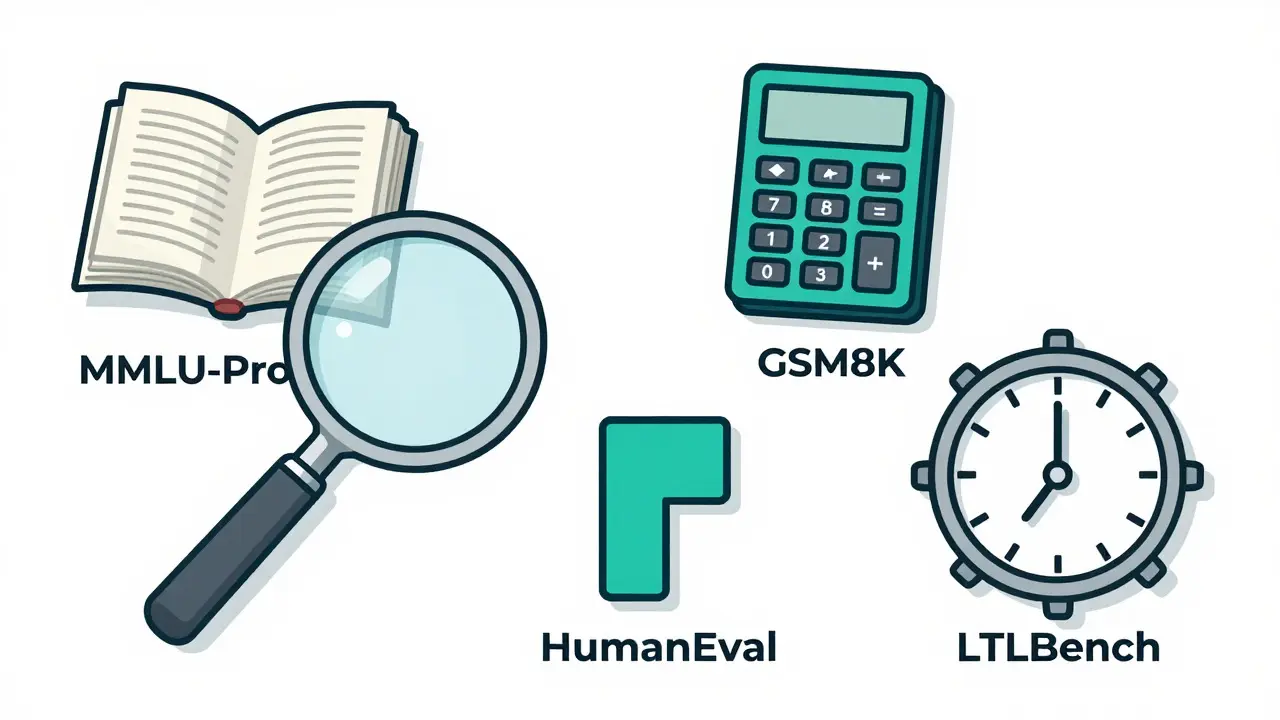
To evaluate your agent effectively, you need to understand what each major dataset actually measures. Here is a breakdown of the key players in the 2026 landscape:
| Dataset | Primary Focus | Size/Scope | Key Limitation |
|---|---|---|---|
| MMLU-Pro | General Knowledge | 15,908 questions across 57 subjects | Saturation; implementation inconsistencies |
| GSM8K | Mathematical Reasoning | 8,500 grade-school math problems | High memorization risk (up to 15%) |
| HumanEval | Code Generation | 164 Python programming tasks | Lacks security/maintainability checks |
| HELM | Holistic Performance | 42 scenarios across 7 categories | High cost ($1,200-$2,500 per cycle) |
| LTLBench | Temporal Reasoning | Linear Temporal Logic formulas | Complex setup; low frontier model accuracy |
MMLU-Pro evolved from the original MMLU to combat cheating and saturation by increasing answer choices from four to five. However, even here, implementation matters. Together.ai documented in late 2025 that different scoring methods for the same model can yield accuracy differences of up to 8.3 percentage points. You must standardize how you run these tests to ensure reproducibility.
GSM8K, introduced by Google Research in 2021, remains the gold standard for multi-step mathematical reasoning. But beware of the "memorization trap." In 2024, researchers found that models performed 12-15% worse on the novel GSM1K dataset compared to GSM8K. This suggests that a significant portion of GSM8K performance is rote memory, not logic. If your agent needs to solve new business problems, GSM8K alone won't tell you if it can think.
For coding agents, HumanEval is essential. Created by OpenAI, it contains 164 hand-written Python problems with unit tests. It correlates strongly (92.7%) with developer productivity metrics. Yet, it tells you nothing about whether the code is secure or maintainable. A model might pass HumanEval but generate SQL injection vulnerabilities. Always pair it with security-specific benchmarks.
The Cost of Comprehensive Evaluation
Evaluating an LLM agent thoroughly is expensive. The HELM (Holistic Evaluation of Language Models) framework, developed by Stanford CRFM, offers the most comprehensive view, testing accuracy, robustness, fairness, and bias across 42 scenarios. But this depth comes at a price. As of January 2026, running a full HELM evaluation requires approximately 2.5 million API calls, costing between $1,200 and $2,500 per cycle.
For smaller teams, this is prohibitive. This is why many developers turn to automated, single-prompt evaluation frameworks like LLM-Eval. Proposed in late 2024, this method uses a strong evaluator model (like GPT-4) to judge outputs against rubrics. It achieves an 0.82 correlation with human judgments at a fraction of the cost. Human annotation, by comparison, averages $187 per hour according to Annotera's 2025 data. Building a custom dataset of 1,000 high-quality prompts can take 3-5 weeks and cost upwards of $4,200.
Emerging Specialized Benchmarks for 2026
As general benchmarks saturate, specialized datasets are rising. If your agent operates in healthcare, ClinicBench is critical. It shows a 34.2% better correlation with physician assessments than general benchmarks. With the EU AI Act requiring rigorous validation for high-risk applications in 2026, domain-specific benchmarks are no longer optional-they are regulatory necessities.
For agents handling complex timelines or legal contracts, temporal reasoning is key. LTLBench evaluates this using Linear Temporal Logic. The results are sobering: even frontier models achieve only 58.3% accuracy on complex temporal sequences. If your agent schedules appointments or manages project deadlines, this is a weak spot you need to address.
Hallucination remains a persistent threat. The new Reefknot benchmark, released in late 2024, specifically targets relation hallucinations in multimodal models. Using its proposed "Detect-then-Calibrate" method, teams have seen a 9.75% average reduction in hallucination rates. If truthfulness is paramount, Reefkot should be part of your suite.
Building Your Own Evaluation Strategy
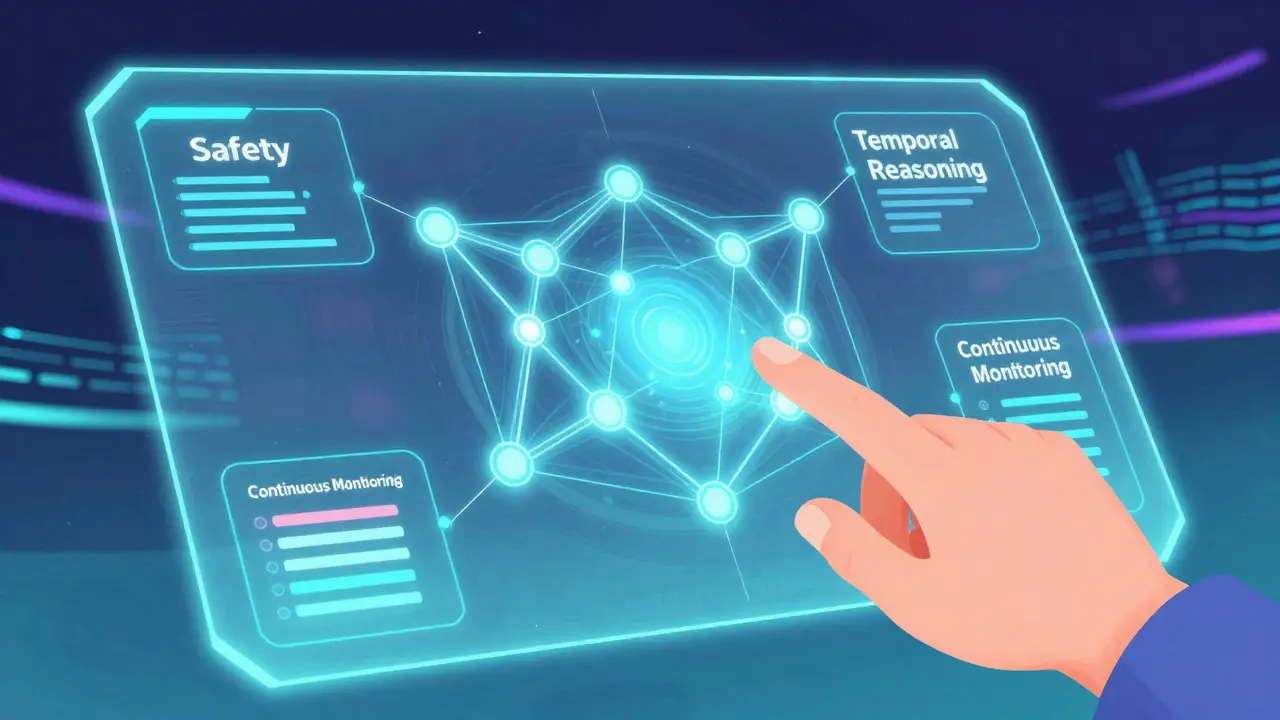
No single benchmark is enough. Dr. Percy Liang of Stanford CRFM advocates for a "lattice" approach-combining multiple dimensions to reveal blind spots. Here is how to build a robust evaluation pipeline for your agent:
- Start with Baselines: Run MMLU-Pro and HumanEval to establish general capability and coding competence.
- Add Domain Specifics: Incorporate ClinicBench, LTLBench, or Reefknot based on your agent's use case.
- Test for Safety: Use RAIL-HH-10K to check for high-harm scenarios, especially if user-facing.
- Implement Continuous Monitoring: Don't just test before launch. Run weekly benchmark suites. Enterprise users report 22.3% fewer production issues with weekly checks versus monthly.
- Use Hybrid Evaluation: Combine automated benchmarks (for 70-80% of cases) with human grading for critical edge cases. This hybrid approach reduces false positives by 32.7%.
Be wary of "benchmark leakage." Reddit discussions in late 2025 revealed that 68% of developers face issues where training data contamination inflates scores. Ensure your test sets are isolated from any public repositories used during pre-training. Tools like the lm-evaluation-harness library help standardize this process, but vigilance is required.
Future Trends: Dynamic Benchmarking
The static nature of current datasets is their Achilles' heel. As models improve, they memorize static tests. The industry is moving toward dynamic benchmarks. Stanford CRFM announced "Project Chameleon" in late 2025, a self-updating system expected in mid-2026 that evolves test cases as models adapt. Additionally, fine-tuned evaluation models like JudgeLM-33B are gaining traction, offering human-level judgment correlation at 1/50th the cost.
By integrating these emerging tools and maintaining a diverse, multi-dimensional evaluation strategy, you can bridge the gap between impressive benchmark scores and reliable, safe agent performance.
What is the best benchmark for evaluating LLM agents in 2026?
There is no single "best" benchmark. For general knowledge, MMLU-Pro is standard but saturated. For coding, HumanEval is essential. For holistic safety and robustness, HELM is the gold standard despite its cost. The best approach is a "lattice" strategy combining multiple benchmarks tailored to your specific use case, such as adding ClinicBench for healthcare or LTLBench for temporal reasoning.
How much does it cost to run comprehensive LLM evaluations?
Costs vary significantly. Running the full HELM framework can cost $1,200-$2,500 per cycle due to API usage. Building custom annotated datasets costs approximately $4,200-$6,800 per 1,000 prompts. Automated evaluation frameworks like LLM-Eval or JudgeLM-33B offer lower-cost alternatives, achieving high correlation with human judgment at a fraction of the price.
What is benchmark leakage and how do I avoid it?
Benchmark leakage occurs when test data appears in the model's training set, leading to artificially inflated scores due to memorization rather than reasoning. To avoid it, use novel datasets like GSM1K alongside established ones, isolate your test sets from public repositories, and monitor for performance drops on unseen data.
Why are my models failing on LTLBench despite high MMLU scores?
MMLU tests static knowledge and basic reasoning, while LTLBench tests complex temporal logic and sequence reasoning. These are distinct capabilities. Many frontier models excel at recall but struggle with the logical consistency required for temporal tasks, resulting in low LTLBench scores (around 58.3%) even with high general knowledge scores.
Is HumanEval sufficient for evaluating coding agents?
HumanEval is excellent for measuring basic code generation capability and correlates well with developer productivity. However, it lacks assessments for code security, maintainability, and complex architecture. For production-grade agents, supplement HumanEval with security-focused benchmarks and real-world integration tests.
Meagan Mueller
August 2, 2026 AT 09:12they want you to believe in benchmarks but its all a psyop to sell more compute power the big tech giants are feeding us lies about 'safety' while they harvest our data for who knows what next time you see a model score 90% just remember they trained it on your private messages bruh
Dave Gibbeson
August 4, 2026 AT 07:48Listen up people stop wasting time on MMLU because it is saturated and useless now if you are building an agent that matters you need to look at the reality gap as stated in the post human eval is good for code but it misses security flaws completely so pair it with something else or you will fail in production get your act together and use a lattice approach like dr liang suggests otherwise you are just guessing
Sabrina Newland
August 4, 2026 AT 15:05i feel like we are forgetting the human element here 🤔 models might be smart but do they understand context truly? i think gsm8k memorization is scary because it shows they arent thinking just repeating 😬 also ltlbench scores are low which makes me wonder if time is a concept ai can ever grasp properly maybe we should focus more on empathy benchmarks instead of logic puzzles? 🌱
Amara Akbar
August 5, 2026 AT 22:26It is quite fascinating how the cost of evaluation has become such a barrier for smaller teams. The HELM framework being two thousand dollars per cycle is indeed prohibitive. However, the suggestion to use automated frameworks like LLM-Eval seems like a very practical compromise for those without deep pockets. One must balance thoroughness with fiscal responsibility.
Mark Harvey
August 6, 2026 AT 07:34you got this guys dont let the complexity scare you start small with baselines and build from there its a journey not a race keep testing weekly and you will see fewer issues in prod trust the process
Brandon Olvera
August 7, 2026 AT 18:30why are we relying on foreign datasets when american engineers could build better ones we need sovereign ai standards not some globalist benchmark that lets chinese models cheat by memorizing leaked data protect our intellectual property first