Imagine asking your customer support bot a simple question and waiting five seconds for an answer. In the world of instant messaging, that feels like an eternity. Users get frustrated, they click away, and your conversion rates drop. This is the harsh reality many companies face when deploying Retrieval-Augmented Generation (RAG) systems in production. While RAG solves the problem of outdated knowledge and hallucinations in Large Language Models (LLMs), it introduces a new enemy: latency.
In 2020, researchers at Facebook AI introduced RAG to bridge the gap between static model training and dynamic real-world data. But as we move through 2026, the focus has shifted from "does it work?" to "how fast does it work?" A typical production RAG pipeline doesn't just talk to an LLM; it hits vector databases, keyword indexes, and sometimes relational stores before generating a single token. Each hop adds milliseconds that quickly pile up. If you aren't managing this latency actively, you are losing users.
Understanding the Latency Breakdown
To fix the speed, you first need to know where the time goes. Most engineers assume the LLM generation is the bottleneck. Surprisingly, it often isn't. According to analysis by Adaline Labs in 2024, the embedding and vector search operations alone can add 200-500ms to every query. When you factor in network round trips-each adding 20-50ms-and context assembly, which can sneak in another 100-300ms, the total response time for complex queries averages between 2 and 5 seconds.
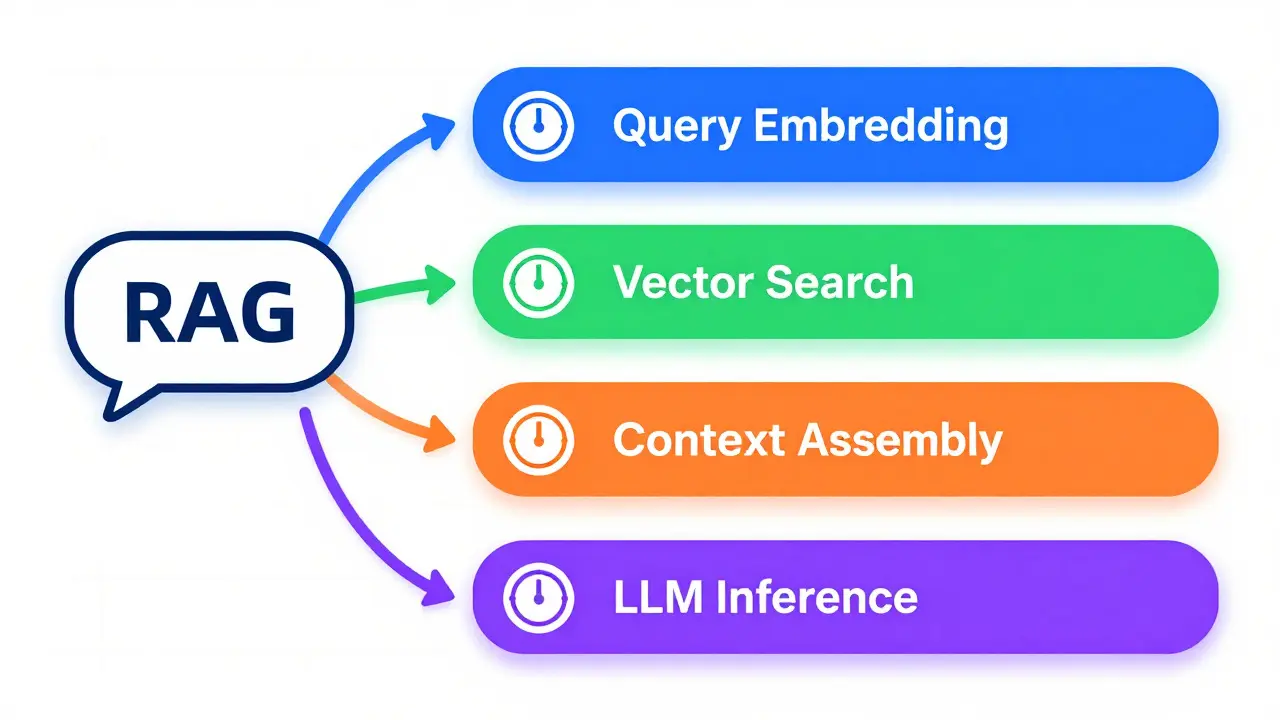
Let's break down a standard request path:
- Query Embedding: Converting user text into vectors takes processing power. Without batching, this happens sequentially.
- Vector Search: Querying the database. MongoDB-based solutions might take around 300ms for semantic search, while optimized open-source tools can be faster.
- Context Assembly: Gathering retrieved chunks and formatting them for the prompt. This is often the "hidden latency" killer.
- LLM Inference: The actual generation of tokens.
If your goal is a conversational voice assistant, these numbers are unacceptable. Vonage’s 2025 research shows that natural conversation flow requires sub-1.5-second total latency. Traditional RAG pipelines fail here because they blindly retrieve data for every single query, regardless of whether it's needed.
The Shift to Agentic RAG Architectures
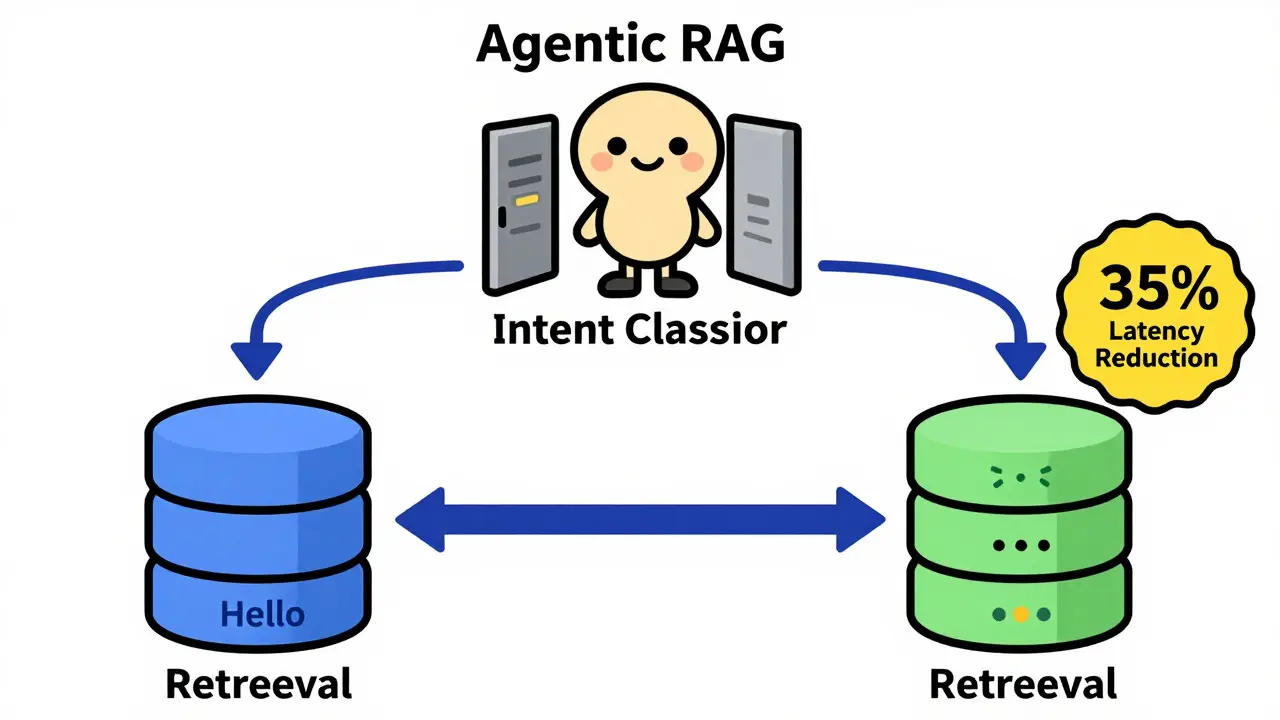
One of the most effective strategies to cut latency is changing how decisions are made within the pipeline. This is where Agentic RAG comes in. Unlike traditional RAG, which retrieves documents for every input, Agentic RAG uses a lightweight intent classifier first. It asks: "Does this question actually require external data?"
If the user asks, "What time is it?" or "Hello," the system skips the heavy retrieval step entirely. Adaline Labs’ benchmarks from July 2025 show that this approach reduces average latency by 35%, dropping response times from 2.5 seconds to 1.6 seconds. More importantly, it cuts costs by 40% because you aren't burning compute resources on unnecessary database queries. For about 35-40% of production queries, retrieval is simply not required. Skipping it is the fastest optimization you can implement.
Optimizing Vector Database Performance
Your choice of vector database significantly impacts speed. You have two main paths: managed commercial services or self-hosted open-source solutions. Both have trade-offs in cost and control.
| Feature | Pinecone | Qdrant | Weaviate |
|---|---|---|---|
| Model Type | Managed Service | Open Source / Self-Hosted | Hybrid |
| Average Query Latency | ~65ms (at 95% recall) | ~45ms (at 95% recall) | ~50-70ms |
| Cost Structure | $0.25 per 1,000 queries | Zero query fee; infra costs $1.2k-$2.5k/mo | Tiered pricing |
| Best For | Teams wanting zero ops overhead | High-volume apps needing cost control | Flexible deployment needs |
Notice the latency difference. Qdrant, an open-source option, delivers roughly 45ms query latency compared to Pinecone’s 65ms in equivalent recall scenarios, based on Ragie.ai’s May 2025 benchmarks. However, Pinecone handles the infrastructure for you. If you choose open-source, you pay with engineering time and server bills. For high-volume applications exceeding 10 million queries a month, self-hosting Qdrant can be 3.5x cheaper than commercial alternatives, according to Trustpilot reviews from late 2025.
To squeeze out more performance, use Approximate Nearest Neighbor (ANN) indexes like HNSW (Hierarchical Navigable Small World) or IVFPQ (Inverted File with Product Quantization). These algorithms reduce query latency by 60-70% with only a minor 2-5% drop in precision. Dr. Elena Rodriguez from Stanford noted in May 2025 that the accuracy curve flattens significantly beyond 95% recall, making these aggressive optimizations economically justified for most use cases.
Technical Tactics for Millisecond Gains
Beyond architecture and database choice, specific coding practices can shave off critical milliseconds. Here are three non-negotiable tactics for production systems:
- Implement Connection Pooling: Establishing a new database connection for every request is expensive. Artech Digital’s December 2024 report shows that connection pooling cuts this overhead by 80-90%, saving 50-100ms per request. Ensure your ORM or client library is configured to reuse connections efficiently.
- Use Query Batching: Instead of processing one prompt at a time, batch multiple prompts together. This leverages GPU parallelism. Nilesh Bhandarwar at Microsoft states that asynchronous batched inference reduces average latency by 40% while doubling throughput. It’s especially effective during traffic spikes.
- Stream LLM Responses: Don't make the user wait for the entire answer. Stream the output token by token. This reduces the Time to First Token (TTFT) from over 2 seconds to just 200-500ms. For voice applications using Eleven Labs TTS, streaming can bring the time to first audio down to 150-200ms, creating a seamless experience.
A common pitfall to avoid is inefficient context assembly. As mentioned earlier, this hidden step can add 100-300ms. Optimize how you format retrieved chunks before sending them to the LLM. Use efficient JSON serializers and avoid redundant string manipulations.
Monitoring and Observability
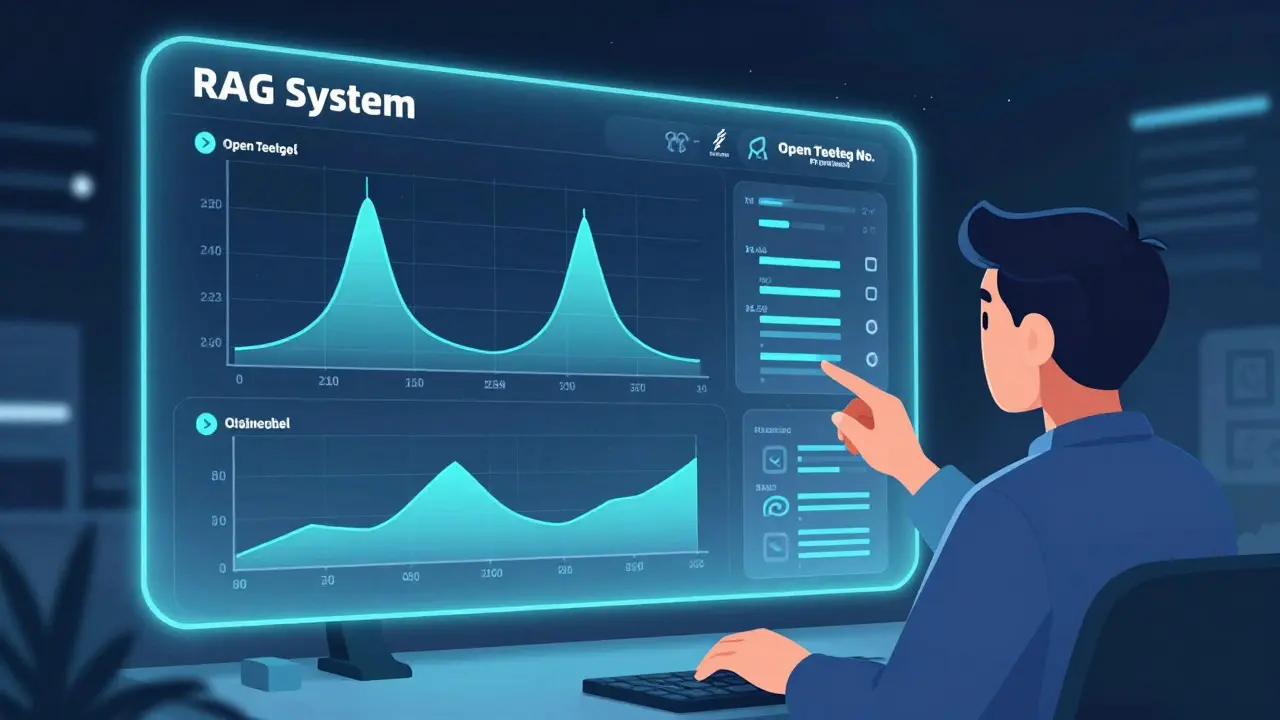
You can't optimize what you can't measure. Distributed tracing is the single most effective monitoring practice for RAG pipelines. Maria Chen, Chief Architect at Artech Digital, emphasizes that using OpenTelemetry identifies 70% of latency bottlenecks within 24 hours of implementation.
Without proper tracing, you might think your LLM is slow, when in reality, your vector database is timing out. Tools like Datadog and New Relic offer comprehensive RAG pipeline tracing, though they come with a price tag-enterprise monitoring can exceed $2,500 per month. For budget-conscious teams, Prometheus and Grafana remain strong open-source alternatives, holding 28% market share in monitoring as of late 2025.
Set up alerts for p95 and p99 latency percentiles, not just averages. An average of 2 seconds might hide a tail of 8-second responses that frustrate your most active users. Monitor specific stages: embedding time, retrieval time, and generation time separately. This granularity helps you pinpoint whether the issue lies in your index structure, your network configuration, or your model selection.
Balancing Speed and Accuracy
There is always a trade-off. AWS Solutions Architect David Chen warned at re:Invent 2024 that over-optimizing for latency can degrade retrieval quality. Making vector searches 20% faster might sacrifice 8-12% in precision. Your industry dictates the balance. Finance and healthcare sectors prioritize accuracy, targeting 95%+ recall even if it means slightly higher latency. E-commerce and customer support, however, emphasize speed, aiming for sub-1.5s responses to keep users engaged.
As we look toward 2027, Gartner predicts that 90% of enterprise RAG deployments will incorporate multi-modal intent classification. This evolution suggests that intelligent routing-not just raw computing power-will be the key to sustainable low-latency systems. By combining Agentic RAG logic, optimized vector indexes, and rigorous monitoring, you can build systems that are both fast and reliable.
What is the acceptable latency for a production RAG system?
For general chat interfaces, a response time under 2 seconds is considered good. For voice applications or real-time interactions, latency must stay below 1.5 seconds to maintain natural conversation flow. Complex queries may take longer, but streaming responses should begin within 500ms to keep users engaged.
How does Agentic RAG reduce latency compared to traditional RAG?
Traditional RAG retrieves data for every query, adding consistent overhead. Agentic RAG uses an intent classifier to determine if retrieval is necessary. By skipping retrieval for 35-40% of queries (like greetings or simple facts), it reduces average latency by approximately 35% and lowers computational costs.
Which vector database is faster: Pinecone or Qdrant?
Based on 2025 benchmarks, Qdrant generally offers lower query latency (~45ms) compared to Pinecone (~65ms) at equivalent recall rates. However, Pinecone is a managed service, reducing operational overhead. Qdrant is open-source and self-hosted, offering better cost control for high-volume applications despite requiring infrastructure management.
What is the impact of connection pooling on RAG performance?
Connection pooling reuses existing database connections instead of creating new ones for each request. This technique can cut connection overhead by 80-90%, reducing latency by 50-100ms per request. It is a critical optimization for any high-throughput RAG pipeline.
Why is distributed tracing important for RAG systems?
Distributed tracing, using tools like OpenTelemetry, allows engineers to visualize the entire request path across embeddings, vector search, and LLM generation. It helps identify specific bottlenecks, such as slow database queries or inefficient context assembly, which might otherwise be hidden in aggregate latency metrics.
How does streaming affect user perception of latency?
Streaming sends tokens to the user as soon as they are generated, rather than waiting for the full response. This reduces the Time to First Token (TTFT) significantly, often from over 2 seconds to under 500ms. Users perceive the system as faster because they see progress immediately, even if the total generation time remains similar.
What is the trade-off between latency and accuracy in RAG?
Aggressive latency optimizations, such as using approximate nearest neighbor indexes with fewer parameters, can reduce precision by 2-12%. Industries like finance and healthcare prioritize high recall (accuracy) and accept higher latency, while e-commerce prioritizes speed to keep users engaged, accepting a slight drop in precision.
Can query batching improve RAG throughput?
Yes. Query batching processes multiple prompts in a single forward pass on the GPU. This leverages hardware parallelism, reducing average latency per request by 30-40% and potentially doubling overall system throughput during peak load periods.