
Have you ever asked an AI model a complex question and gotten a confident but completely wrong answer? It happens more often than you might think. Large Language Models (LLMs) are impressive, but they can stumble when faced with multi-step logic, math problems, or tricky commonsense scenarios. The solution isn't always to build a bigger model or spend weeks fine-tuning it. Sometimes, the fix is just in how you ask the question.
This is where Chain-of-Thought Prompting comes in. It’s a technique that forces the AI to "show its work" before giving you a final answer. By breaking down a problem into intermediate steps, you unlock reasoning capabilities that standard prompts simply can’t access. In this guide, we’ll look at what Chain-of-Thought (CoT) is, why it works, and how you can use it today to get better results from your AI tools.
What Is Chain-of-Thought Prompting?
To understand CoT, we first need to look at how we usually talk to AI. Standard prompting involves giving the model a question and expecting an answer. You might provide a few examples of input-output pairs-like "Q: What is 2+2? A: 4"-and then ask a new question. This works great for simple facts or translations. But it fails when the task requires logic.
Chain-of-Thought Prompting is a method that guides Large Language Models to generate intermediate reasoning steps before arriving at a final answer. Instead of jumping straight to the conclusion, the model talks through its thought process, step by step.
The concept was formally introduced in a landmark 2022 paper by Jason Wei, Xuezhi Wang, and their colleagues at Google Research. They discovered that if you give the model examples that include the reasoning path-not just the answer-the model learns to mimic that behavior. It’s like teaching a student not just the answer to a math problem, but the specific steps used to solve it.
Here is the key difference:
- Standard Prompting: "Question: John has 5 apples. He eats 2. How many are left? Answer: 3."
- Chain-of-Thought Prompting: "Question: John has 5 apples. He eats 2. Let's think step by step. John starts with 5. Eating 2 means we subtract 2 from 5. 5 minus 2 equals 3. So, 3 apples are left. Answer: 3."
That extra text-"Let's think step by step"-is the trigger. It tells the model to decompose the problem. For simple arithmetic, it seems obvious. But for complex logic puzzles, legal analysis, or coding bugs, this decomposition is everything.
Why Does It Work? The Power of Decomposition
You might wonder why adding a few words changes the outcome so drastically. The answer lies in how neural networks process information. LLMs predict the next token (word or part of a word) based on context. When a problem is too complex, the model tries to guess the final answer based on patterns it has seen in its training data. If the pattern is weak, the guess is wrong.
Chain-of-Thought prompting changes the game by forcing the model to generate intermediate tokens that represent logical steps. These steps act as anchors. Each step provides fresh context for the next prediction. By breaking a hard problem into smaller, manageable pieces, the model allocates more attention to each component. It reduces the cognitive load on the network, much like how humans use scratch paper to keep track of calculations.
Furthermore, this approach offers transparency. When an AI gives you a direct answer, you have no idea if it reasoned correctly or just guessed. With CoT, you can see the logic. If the answer is wrong, you can spot exactly which step went astray. This makes debugging AI outputs significantly easier.
The Scale Factor: Why Model Size Matters
Here is a crucial detail that many practitioners miss: Chain-of-Thought prompting is an emergent property. It doesn’t work equally well for all models. The original research found that CoT benefits materialize primarily in very large models-specifically those with approximately 100 billion parameters or more.
If you try to use CoT with a small open-source model running on your laptop, you might actually see worse performance. Smaller models often lack the underlying knowledge base to construct valid reasoning chains. They might hallucinate steps or get stuck in loops. However, for major commercial models like GPT-4, Claude 3, or Google’s PaLM, CoT is a game-changer.
In fact, the performance gap between standard prompting and CoT widens as the model gets bigger. A study using Google’s 540-billion-parameter PaLM model showed that CoT allowed it to outperform specialized fine-tuned systems on difficult benchmarks. This suggests that scale unlocks the ability to reason, and CoT is the key to unlocking that potential without additional training.

Real-World Performance Gains
Let’s look at some concrete numbers to see what CoT can do. The GSM8K dataset is a collection of grade-school math word problems. It’s a tough test because it requires both arithmetic and reading comprehension.
| Method | Model Used | Accuracy |
|---|---|---|
| Fine-Tuning + Verifier | GPT-3 (175B) | 55% |
| Chain-of-Thought Prompting | PaLM (540B) | 58% |
Notice that the CoT approach achieved higher accuracy with less effort. The fine-tuned GPT-3 required a massive training dataset and a specially trained verifier system. The PaLM model used only eight CoT examples in the prompt. No weight updates. No training time. Just better prompting.
Similar gains were seen in commonsense reasoning tasks. On the StrategyQA benchmark, which asks questions requiring multi-hop reasoning (e.g., "Do tortoises share a genus with turtles?"), CoT provided significant incremental improvements over standard scaling. In sports understanding tasks, PaLM with CoT reached 95% accuracy, beating human enthusiasts who scored around 84%.
How to Implement Chain-of-Thought Prompts
Using CoT is straightforward, but you need to structure your prompts correctly. Here is a practical checklist for implementation:
- Identify the Task Type: CoT is best for arithmetic, symbolic reasoning, and commonsense logic. It’s less useful for creative writing or factual retrieval.
- Create Exemplars: You need to provide examples of the reasoning process. Don’t just show the answer. Write out the steps clearly.
- Use the Trigger Phrase: End your examples with a phrase like "Let's think step by step" or "Reasoning:" to signal the start of the chain.
- Keep It Consistent: Ensure the format of your reasoning steps is uniform across all examples. This helps the model learn the pattern faster.
- Test with Few-Shot Examples: Start with 3-5 examples. If the model struggles, add more. Remember, for large models, even 8 examples can be enough for state-of-the-art results.
For example, if you want the model to analyze a customer complaint, your prompt might look like this:
Example 1:
Complaint: "The delivery was late and the box was damaged."
Reasoning: First, identify the issues. Issue 1: Late delivery. Issue 2: Damaged packaging. Both are logistics failures. Category: Shipping Error.
Answer: Shipping Error

Example 2:
Complaint: "I don't know how to use the app."
Reasoning: Identify the issue. The user lacks knowledge about functionality. This is a usability or support issue, not a product defect. Category: User Support.
Answer: User Support

New Complaint:
Complaint: "The software crashes when I click 'Save'."
Reasoning: [Model generates steps]
Answer: [Model generates answer]
Automating the Process: Auto-CoT
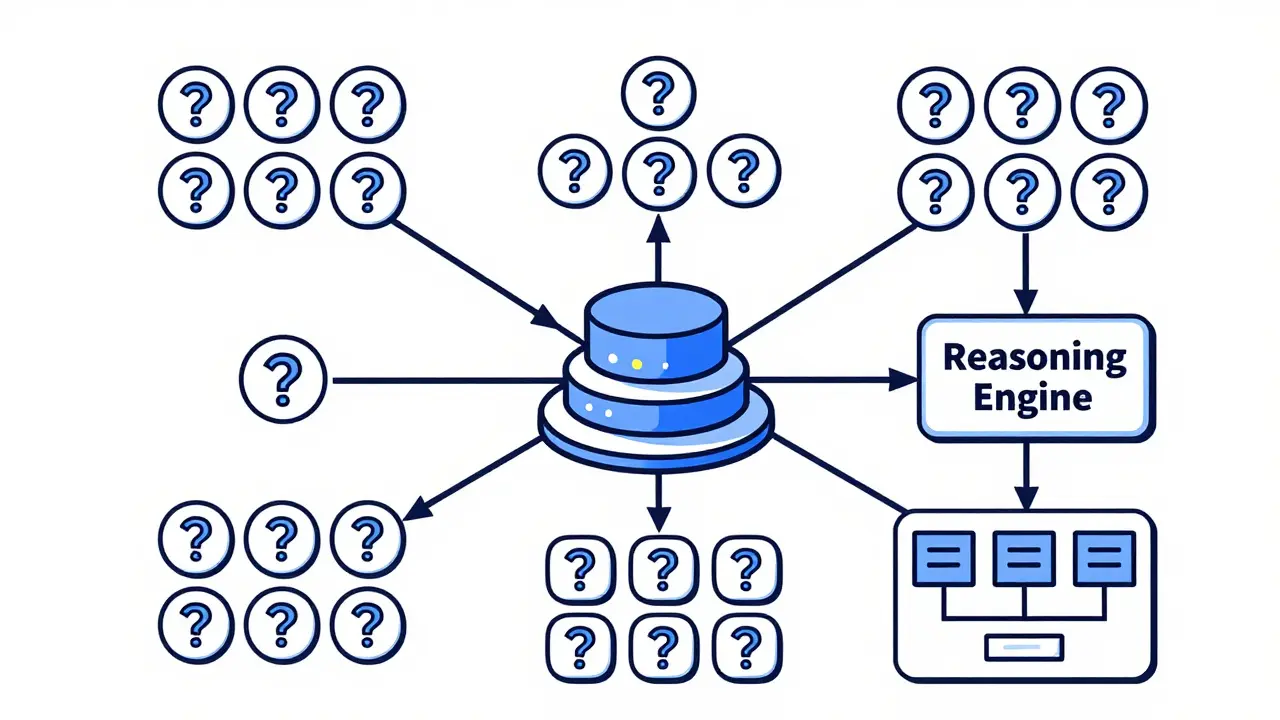
Writing high-quality reasoning exemplars manually can be tedious, especially if you have hundreds of different types of questions. That’s where Auto-CoT comes in. Developed as an extension of the original method, Auto-CoT automates the creation of these chains.
It works in two main steps:
- Question Clustering: The algorithm groups similar questions together. This prevents the model from overfitting to one specific type of problem.
- Demonstration Sampling: It picks one representative question from each cluster and uses zero-shot CoT (just asking the model to think step by step without examples) to generate a reasoning chain for it.
These auto-generated chains are then used as few-shot examples for the actual task. This saves hours of manual labor while maintaining the quality of the reasoning output. If you’re building an application that handles diverse queries, Auto-CoT is a powerful tool to consider.
Limitations and Pitfalls
While Chain-of-Thought prompting is powerful, it’s not a magic bullet. There are limitations you should be aware of.
First, it increases latency. Generating a long chain of reasoning takes more time and more tokens than generating a short answer. If you need real-time responses, this might be a bottleneck. Second, it can sometimes lead to "reasoning loops" where the model gets stuck repeating steps or going in circles. Monitoring the output length and setting max-token limits is essential.
Also, remember the scale dependency. If you are using a smaller model (under 100B parameters), CoT might confuse it rather than help it. In such cases, simpler prompts or fine-tuning might be more effective. Always test your specific model and task combination before deploying CoT in production.
Conclusion
Chain-of-Thought prompting represents a fundamental shift in how we interact with Large Language Models. It moves us from treating AI as a black-box oracle to collaborating with a reasoning partner. By forcing the model to articulate its steps, we gain accuracy, transparency, and control.
Whether you are solving math problems, analyzing legal documents, or debugging code, taking the time to structure your prompts with reasoning steps can yield dramatic improvements. As models continue to grow in size and capability, techniques like CoT will remain essential for unlocking their full potential. Start experimenting with "step-by-step" triggers in your next project-you might be surprised by the difference.
Does Chain-of-Thought prompting work on small AI models?
Generally, no. Research shows that CoT is an emergent property that requires models with approximately 100 billion parameters or more. Smaller models may perform worse with CoT because they lack the capacity to construct valid reasoning chains, leading to hallucinations or errors.
How many examples do I need for Chain-of-Thought prompting?
You typically need only a few. Studies have shown that as few as 3 to 8 high-quality examples (few-shot) can be sufficient for large models to achieve state-of-the-art performance on complex reasoning tasks. The quality of the reasoning in the examples matters more than the quantity.
What is the difference between Zero-Shot and Few-Shot CoT?
Zero-Shot CoT involves adding a simple phrase like "Let's think step by step" to the end of a question without providing any examples. Few-Shot CoT involves providing several examples that demonstrate the reasoning process before asking the new question. Few-Shot is generally more reliable for complex tasks.
Can Chain-of-Thought prompting replace fine-tuning?
For many reasoning tasks, yes. CoT can achieve comparable or even superior results to fine-tuning without the need for labeled datasets or computational resources for training. However, for tasks requiring domain-specific knowledge or strict formatting constraints, fine-tuning may still be necessary.
What types of tasks benefit most from Chain-of-Thought?
Tasks that require multi-step logic benefit the most. This includes arithmetic word problems, symbolic reasoning (like sorting or manipulating strings), commonsense reasoning (inferring causes and effects), and complex decision-making scenarios. Simple factual recall does not benefit from CoT.
Caitlin Donehue
June 5, 2026 AT 02:45it's wild how much better the models get just by being told to pause and think. i've been using this for my coding projects and it's like night and day. used to get garbage code that looked right but failed on edge cases. now it actually explains why it chose a certain loop structure. makes me wonder if we're accidentally teaching them human-like deliberation or just exploiting a statistical quirk.
Bineesh Mathew
June 5, 2026 AT 07:44the illusion of consciousness is what fascinates me here. when the machine says 'let us think step by step' it mimics the cadence of human introspection without possessing any internal state. it is a theater of logic performed by probabilities. we are not unlocking reasoning we are curating a performance that resembles reasoning to our own satisfaction. the apple example is trivial but in complex ethics or law this mimicry becomes dangerous because we trust the form over the substance. we project understanding onto the void.
Michael Richards
June 5, 2026 AT 09:54stop romanticizing the black box. it works because the training data contains millions of examples of humans showing their work. you are not teaching it to think you are teaching it to copy the format of thinking. if your prompt engineering skills are weak enough to need this guide then you probably shouldn't be deploying these models in production. learn the basics first before trying to hack emergent behaviors.
Stephanie Frank
June 6, 2026 AT 14:26richards is right about the copying part but wrong about the implication. it doesn't matter if it's mimicry or genuine cognition if the output is correct and verifiable. i hate how people act like CoT is some new magic spell. it's just few-shot learning with verbose examples. the real issue is that most devs are too lazy to write good exemplars so they blame the model. also the latency hit is annoying as hell for real-time apps. nobody wants to wait 5 seconds for a math answer.
Keith Barker
June 7, 2026 AT 00:09the distinction between simulation and reality blurs when the utility is identical. we do not judge a calculator for not understanding arithmetic. we judge it for giving the wrong number. the philosophical debate about whether the model 'knows' anything is irrelevant to the engineer. the scale factor is the interesting part though. small models fail at this because they lack the context window of knowledge to anchor the steps. it is an emergent property of size not a feature of design.
Lisa Puster
June 8, 2026 AT 07:37typical american optimism about tech solving everything without understanding the underlying mechanics. you rely on these massive proprietary models from big tech corporations while pretending it's just a clever trick. it's not a trick it's brute force computation on a scale only a few companies can afford. don't pretend this is democratized intelligence. it's centralized control disguised as open technique. and yes smaller models suck at it because they are underfunded and poorly trained compared to the corporate giants.
Marissa Haque
June 8, 2026 AT 18:23I absolutely love this breakdown!!! It really clarifies why my previous attempts were failing! I was trying to use CoT on a tiny local model and wondering why it was hallucinating wildly! The point about the 100 billion parameter threshold is so important!! Thank you for highlighting the Auto-CoT section as well! That sounds like a lifesaver for anyone dealing with diverse query types! I'm definitely going to try clustering my questions next!
Robert Barakat
June 9, 2026 AT 01:23the silence between the tokens is where the meaning lives. we ask for steps because we fear the jump to conclusion. it is a human anxiety projected onto silicon. we want to see the bridge even if the destination is reached instantly. perhaps the value of CoT is not in the accuracy but in the reassurance it provides to the user who needs to feel in control of the process.