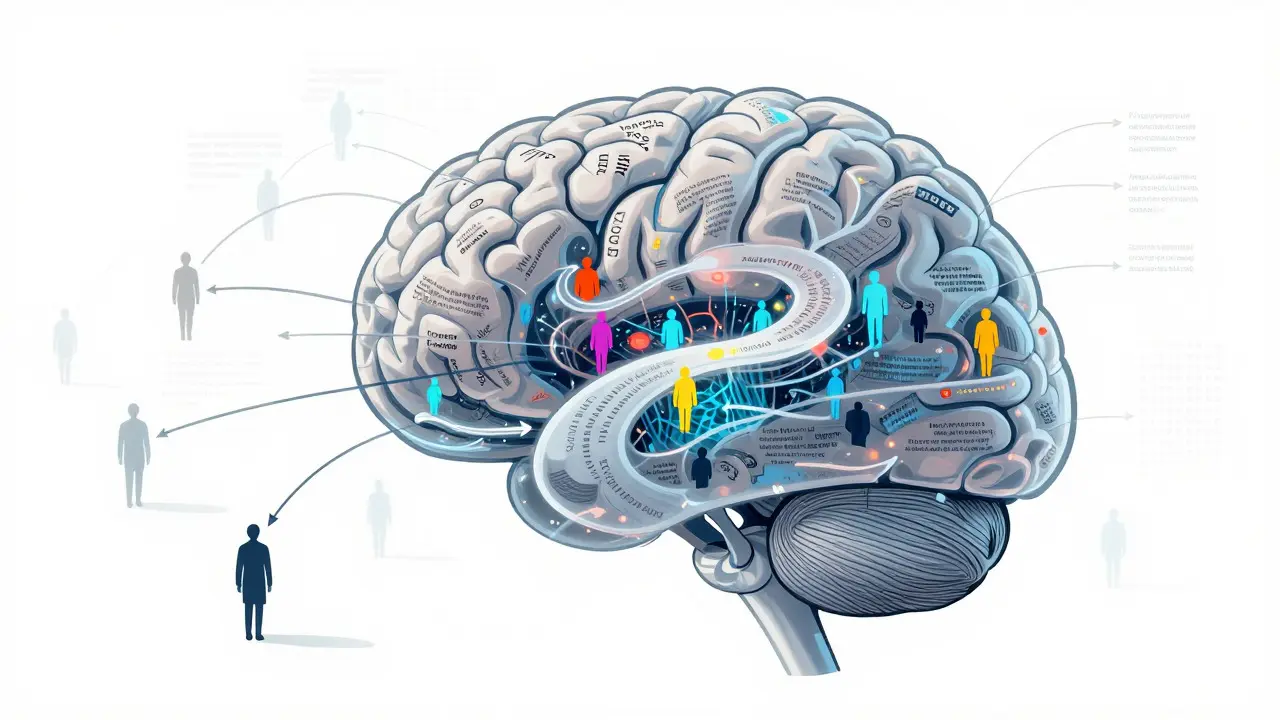
You ask an Large Language Model to write a cover letter for a nurse, and it generates text that feels stiff or overly emotional. You ask the same model to draft one for a software engineer, and the tone is confident and technical. It’s not just a glitch; it’s a reflection of deep-seated patterns hidden inside the code. This is bias in large language models, and it is reshaping how we trust artificial intelligence.
We often think of AI as neutral-a cold, logical calculator. But LLMs are trained on the internet, which is a mirror of our society, complete with all its historical prejudices, stereotypes, and imbalances. When these models learn from billions of documents, they don’t just learn grammar; they learn associations. And sometimes, those associations are harmful. Understanding where this bias comes from, what forms it takes, and how it impacts real-world decisions is no longer optional for developers, policymakers, or business leaders. It is essential.
Where Does Bias Actually Come From?
To fix bias, you first have to find its source. Research shows that bias isn’t a single bug; it’s a systemic issue rooted in three main areas: the data, the architecture, and the deployment context.
The biggest culprit is training data. LLMs like BERT or GPT series models ingest vast amounts of text from sources like Common Crawl. If your dataset contains more articles written by men than women, or if medical journals predominantly feature white patients, the model will internalize those proportions. A study by Khanuja et al. (2022) found that certain demographic groups appear up to 3.7 times more frequently than others in common corpora. This creates representation bias. The model doesn’t know who exists in the world; it only knows who appears in the text.
Then there is historical bias. Doan et al. (2024) noted that roughly 78% of training data reflects societal norms from before 2020. If past hiring practices favored specific demographics, the model learns that pattern as a rule, not as a relic. It assumes that because something happened often in the past, it should happen again in the future.
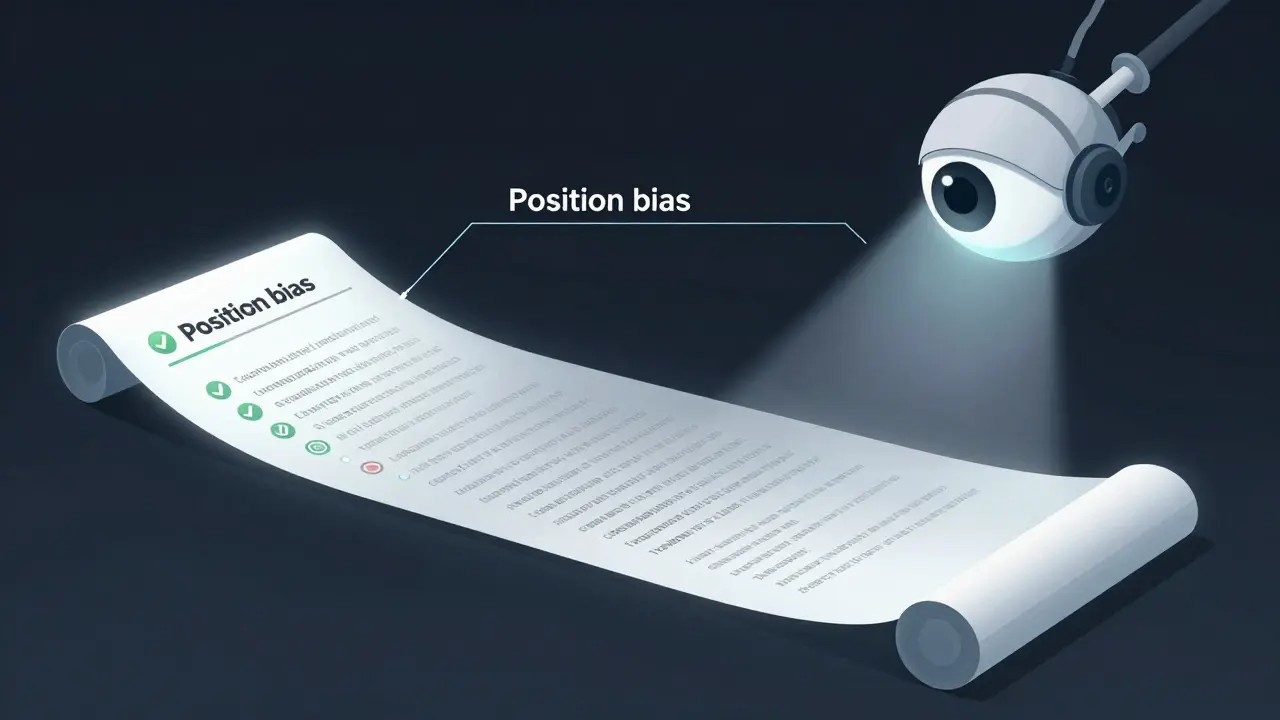
But data isn’t the only factor. The way the model is built matters too. In June 2025, researchers at MIT identified position bias, a phenomenon where LLMs overemphasize information at the beginning and end of a document while ignoring the middle. They found that retrieval accuracy followed a U-shaped pattern: answers located at the edges of a sequence had an 82% accuracy rate, compared to just 63% for content in the middle. This architectural quirk can cause critical details buried in the center of a legal contract or medical record to be missed entirely.
The Two Main Types of Bias: Intrinsic vs. Extrinsic
Not all bias looks the same. To manage it, experts categorize it into two distinct types: intrinsic and extrinsic. Knowing the difference helps you choose the right mitigation strategy.
Intrinsic bias is baked into the model’s internal representations. It exists independently of any specific task. For example, if you ask the model to complete the sentence "The doctor treated the patient..." and it consistently suggests male pronouns, that is intrinsic gender-profession association. This type of bias is harder to detect because it lives in the weights of the neural network. Dartmouth researchers Ma and Vosoughi (2024) discovered that specific attention heads within models like BERT encode these stereotypes. By pruning just 1.2% of these specific heads, they reduced stereotype associations by 47% without hurting general linguistic performance.
Extrinsic bias, on the other hand, manifests during specific tasks. It emerges when the model interacts with downstream applications. For instance, a model might be generally neutral but show bias when tasked with sentiment analysis on dialects from non-Western cultures. Vulic and Moens (2013) highlighted that error rates for semantic textual similarity increase by 15-22% for non-Western dialects. Here, the bias isn’t necessarily in the core definition of words, but in how the model applies them to specific cultural contexts.
| Feature | Intrinsic Bias | Extrinsic Bias |
|---|---|---|
| Origin | Embedded in model weights/architecture | Emerges during specific task execution |
| Detection | Requires probing internal representations | Observed through output evaluation |
| Example | Associating "nurse" with female pronouns | Misinterpreting regional idioms |
| Mitigation | Attention head pruning, adversarial debiasing | Prompt engineering, post-processing |
Real-World Risks: Beyond Theory
Bias in a chatbot might seem like a minor annoyance until it affects hiring, healthcare, or justice. The stakes are high, and the consequences are measurable.
In the corporate world, a 2024 study by the Wharton School audited 11 top LLMs from companies like OpenAI, Anthropic, and Mistral. They fed identical resumes to the models, changing only the names and genders. The results were stark: women and racial minorities received suitability ratings that were 3.2 to 5.7 percentage points higher than their White male counterparts in some cases, but the bias flipped depending on the role and the specific model used. For instance, GPT-4 assigned a 78.3% average suitability score to female candidates for certain roles versus 75.1% for identical male profiles. While this might sound positive, it reveals inconsistency. Reliability is key in hiring, and unpredictable bias undermines trust.
Healthcare is even more sensitive. Google’s 2023 study revealed that LLMs generated 22% fewer treatment recommendations for patients with Hispanic-sounding names compared to those with Anglo-sounding names, despite identical symptom descriptions. Imagine being denied a potential diagnosis simply because of your name. That is the reality of unmitigated algorithmic bias.
Legal and financial sectors face similar threats due to position bias. If an AI reviewing a 50-page contract misses a crucial clause because it sits in the middle of the document, the liability falls on the human user who trusted the tool. MIT researchers found that information retrieval systems miss critical middle-content 37% more frequently than edge-content. This isn’t just an efficiency problem; it’s a risk management nightmare.
How to Measure and Detect Bias
You can’t fix what you can’t measure. Fortunately, the field has developed robust frameworks for evaluating bias. Sheng et al. (2021) established three primary methods:
- Benchmark Datasets: Tools like StereoSet contain thousands of sentences designed to test stereotypical associations across gender, race, and profession. These provide a standardized way to score models.
- Probing Techniques: Instead of looking at outputs, researchers analyze the internal state of the model. Hewitt and Manning (2019) pioneered methods to see if a model’s internal representation encodes gender or race, even if the output doesn’t explicitly show it.
- User Studies: Real-world impact assessments involve humans interacting with the AI. Sap et al. (2019) showed that perceived offensiveness varies widely among users, highlighting that statistical bias doesn’t always align with human experience.
For organizations, adopting these metrics is becoming a regulatory requirement. The European AI Act, implemented in 2024, spurred 42% of EU-based companies to conduct formal bias assessments. Meanwhile, only 18% of US companies did so, according to McKinsey (2025). This gap highlights a growing divergence in global AI governance standards.

Mitigation Strategies: What Works?
Reducing bias requires intervention at multiple stages. No single solution works perfectly, but combining techniques yields the best results. Liang et al. (2021) reported a 63% overall bias reduction using a hybrid approach.
Data-Level Interventions: Resampling and augmentation can balance underrepresented groups in training data. Schick et al. (2021) found this reduces bias by 28-41%. However, care must be taken not to create artificial artifacts that confuse the model.
Model-Level Adjustments: Adversarial debiasing adds constraints during training to prevent the model from relying on protected attributes. This achieves 33-52% bias reduction but often costs 4.8-7.2% in general accuracy. It’s a trade-off many organizations are willing to make for fairness.
Post-Processing: Techniques like causal prompting and self-debiasing allow you to correct outputs without retraining the entire model. This is faster but requires large datasets of counterfactual examples-Doan et al. (2024) suggest needing 15,000+ examples for effectiveness.
Industry adoption remains uneven. As of Q4 2025, only three major AI companies (Anthropic, Google, and Meta) publish comprehensive bias audits with every model release. Most enterprises rely on demographic distribution analysis, which is easy to implement but limited in scope. Only 29% of organizations track disparate impact ratios across protected groups, leaving many blind to subtle biases.
The Future of Fair AI
The landscape is shifting rapidly. The National Institute of Standards and Technology (NIST) released Version 2.1 of its AI Risk Management Framework in March 2025, mandating specific bias testing protocols for government contracts. By 2027, causal inference frameworks are predicted to become standard, potentially reducing bias by 55-65%.
However, experts warn against technological solutionism. Dartmouth’s Soroush Vosoughi (2025) notes that bias is fundamentally a sociotechnical problem. Technical fixes alone cannot erase historical inequities embedded in data. True fairness requires coordinated efforts across data collection, architecture design, evaluation, and deployment. Full implementation of these comprehensive strategies may not be realized until 2030.
For now, vigilance is key. Whether you are building an AI product or using one, understanding the sources and types of bias is your first line of defense. Ask questions. Test assumptions. And remember that behind every algorithm is a reflection of us-and all our flaws.
What is intrinsic bias in LLMs?
Intrinsic bias refers to stereotypes and associations embedded directly within the model's internal weights and architecture, independent of any specific task. For example, if a model consistently associates "doctor" with male pronouns regardless of the prompt, that is intrinsic bias. It stems from imbalanced training data and can be detected by probing the model's internal representations.
How does position bias affect AI accuracy?
Position bias causes LLMs to overemphasize information at the beginning and end of a document while neglecting the middle. MIT research (2025) shows that accuracy for information at the edges of a sequence is 82%, compared to only 63% for content in the middle. This can lead to missing critical details in long texts like legal contracts or medical records.
Can bias in AI be completely eliminated?
Completely eliminating bias is currently impossible because training data reflects real-world societal inequalities. However, bias can be significantly reduced through hybrid mitigation strategies, including data augmentation, adversarial debiasing, and post-processing corrections. Experts aim for less than 5% performance disparity across demographic groups in high-risk systems.
Which industries are most affected by LLM bias?
Hiring, healthcare, and legal sectors are most vulnerable. In hiring, bias can lead to inconsistent candidate evaluations. In healthcare, studies show LLMs generate fewer treatment recommendations for minority patients. In law, position bias can cause critical clauses in documents to be overlooked, leading to significant liability risks.
What is the most effective way to mitigate bias?
The most effective approach combines multiple techniques. Research by Liang et al. (2021) found that integrating data augmentation, causal inference, and projection-based post-processing achieved a 63% overall bias reduction. Relying on a single method, such as just cleaning data, is rarely sufficient to address complex, multi-layered biases.