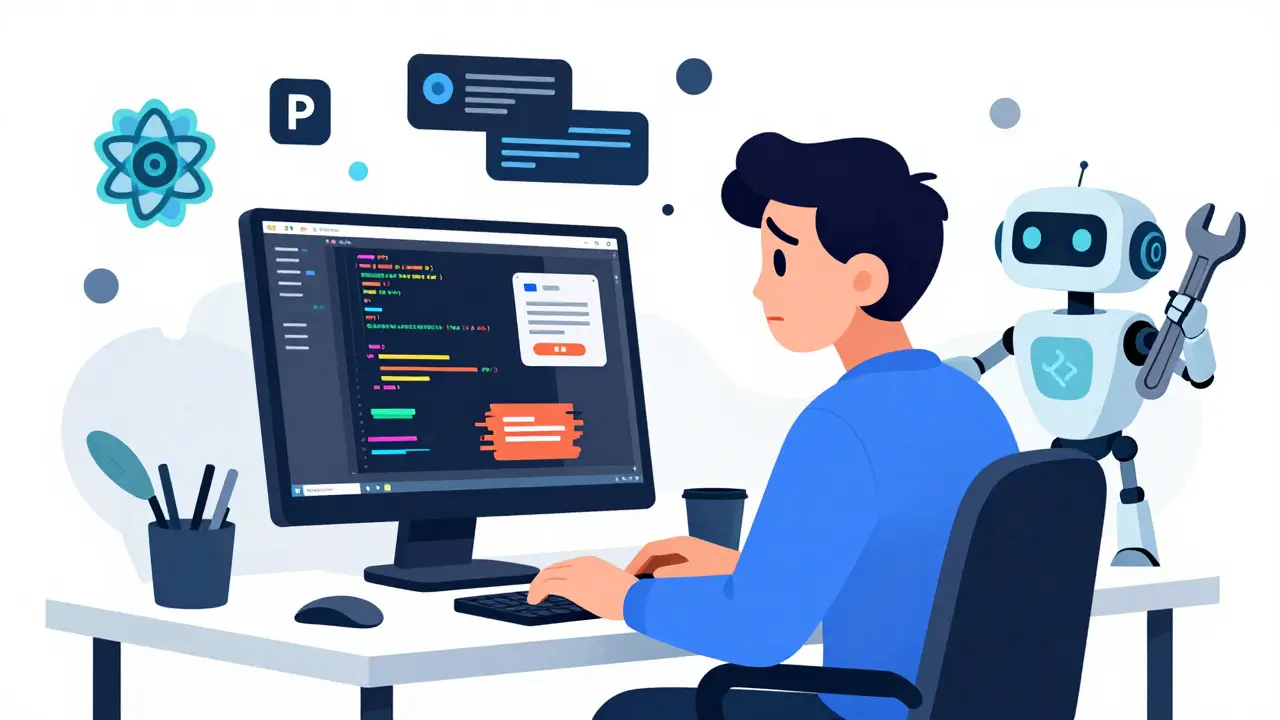
You type a prompt like 'Build me a user dashboard with dark mode support,' and within seconds, your screen fills with functional React components. It looks good. It feels fast. But when you click that toggle button, the app crashes silently. This is the hidden trap of vibe coding - a development paradigm where developers act as curators rather than authors, relying on generative AI to produce code from high-level descriptions. While this approach accelerates prototyping by up to 3.7x, it introduces a critical vulnerability: AI-generated code often lacks the structural integrity required for production environments.
The core problem isn't the code itself; it's the testing strategy. Traditional QA methods fail against AI-generated architectures because they don't account for the unique error patterns these systems produce. According to PropelCode.ai's Q3 2025 benchmark study, conventional test suites caught only 41% of logic errors in vibe-coded applications compared to 78% in traditionally developed code. To build reliable systems, you need a specialized testing framework that addresses unit validation, contract enforcement, and end-to-end verification specifically designed for AI collaboration.
Why Standard Testing Fails in Vibe-Coded Environments
When you use tools like GitHub Copilot or ChatGPT to generate code, you're not just getting syntax-you're getting probabilistic outputs based on training data. This creates three distinct challenges that break traditional testing assumptions.
First, AI models prioritize syntactic correctness over business logic validity. A function might compile perfectly but implement the wrong algorithm entirely. Second, generated code often contains subtle dependencies that aren't documented, making isolation tests difficult. Third, the speed of generation encourages skipping foundational testing layers, leading to what Martin Fowler calls 'testing debt'-shortcuts taken during rapid validation that become unmanageable at scale.
Consider this real-world scenario: A developer uses an AI assistant to create a payment processing module. The AI generates clean, well-structured code that passes basic compilation checks. However, it fails to validate currency conversion rates or handle edge cases like negative amounts. In traditional development, peer review would catch this. In vibe coding, without explicit testing directives, the bug slips into production.
| Error Type | Traditional Code Detection Rate | Vibe-Coded Code Detection Rate (Standard Tests) | Vibe-Coded Code Detection Rate (Specialized Framework) |
|---|---|---|---|
| Syntax Errors | 98% | 95% | 99% |
| Logic Errors | 78% | 41% | 85% |
| Business Rule Violations | 65% | 34% | 72% |
| Integration Failures | 70% | 45% | 80% |
Unit Testing: Applying F.I.R.S.T. Principles to AI Output
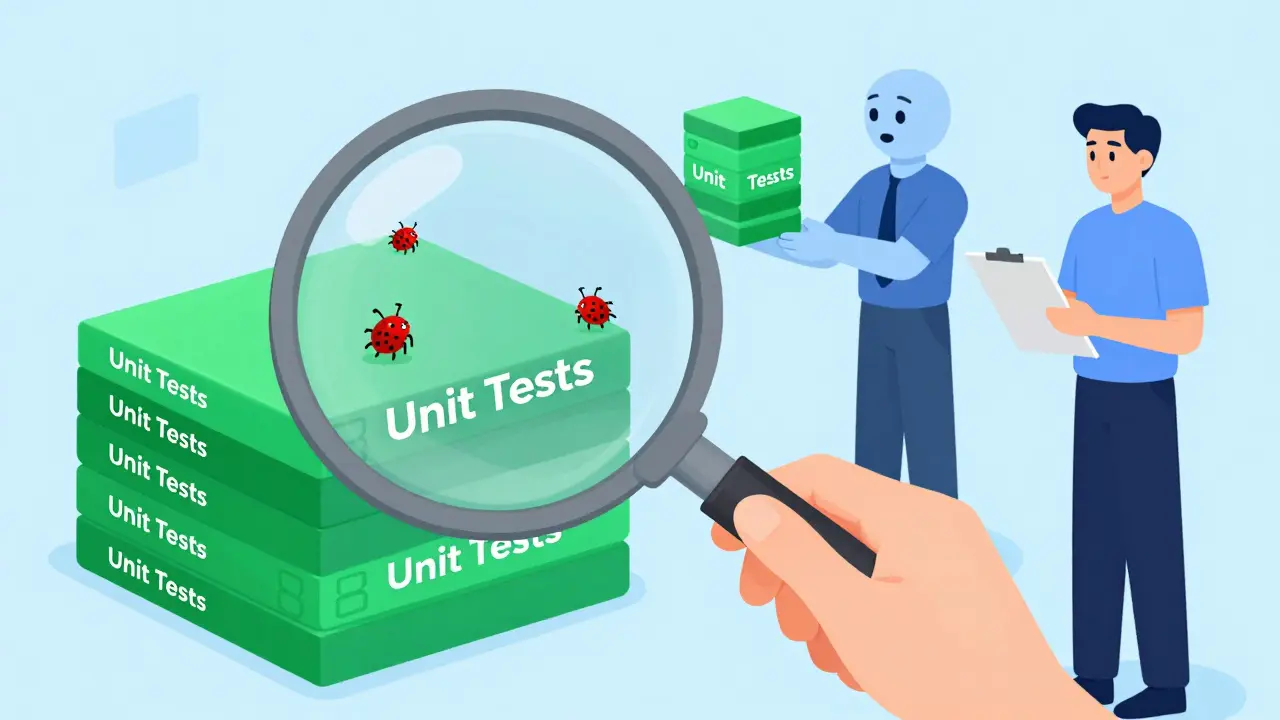
Unit testing remains your first line of defense, but you can't rely on AI to write its own tests blindly. SynapticLabs' November 2025 guide found that 79% of AI-generated unit tests violated at least one F.I.R.S.T. principle (Fast, Independent, Repeatable, Self-Validating, Timely) without human refinement.
To fix this, you must shift from passive acceptance to active direction. Instead of asking the AI to 'write tests,' use explicit prompt engineering directives. For example:
- Define expected behavior first: 'Write failing tests that define exactly how the authentication token should expire after 15 minutes.'
- Enforce TDD workflows: 'Use Test-Driven Development. Write failing tests first to define expected behavior, then implement just enough code to make tests pass.'
- Specify edge cases explicitly: 'Include tests for null inputs, empty arrays, and maximum integer values.'
This approach transforms the AI from a guesser into a precise executor. When you provide clear constraints, the model produces tests that are faster, more independent, and easier to maintain. Remember, the goal isn't to replace human judgment-it's to augment it with structured automation.
Contract Testing: Bridging the Gap Between Components
If unit tests verify individual functions, contract tests ensure different parts of your system communicate correctly. This is where vibe coding struggles most. Codecentric's February 2025 field report revealed that while AI tools typically generate database connection tests (e.g., verifying INSERT statement execution), they fail to validate business process contracts such as payment processing workflows or advertisement booking systems in 83% of cases.
The solution lies in defining interfaces before implementation. Emergent.sh's April 2025 best practices guide recommends providing the AI with explicit interface specifications: 'Define all API contracts with precise request/response schemas before generating implementation code.'
Here’s how to implement this effectively:
- Create schema definitions manually: Use JSON Schema or OpenAPI specs to define exact input/output structures for each service endpoint.
- Prompt for contract compliance: 'Generate controller logic that strictly adheres to the provided OpenAPI specification. Return HTTP 400 if any required field is missing.'
- Validate cross-service interactions: Run consumer-driven contract tests between microservices to ensure changes in one component don’t break another.
Without these steps, you risk building a house of cards where each piece works individually but collapses under integration pressure.
End-to-End Testing: Maintaining the Test Pyramid Balance
End-to-end (E2E) testing validates the entire user journey-from clicking a button to seeing the result on screen. In vibe-coded architectures, maintaining the right balance across testing layers is crucial. SynapticLabs' data shows successful teams maintain a 70-20-10 ratio of unit-to-integration-to-E2E tests, compared to the 50-30-20 ratio common in traditional development.
Why does this matter? Because E2E tests are expensive-they take time to run and are fragile when UI elements change. If you let AI generate too many E2E tests, you’ll spend more time fixing broken tests than finding bugs.
Instead, focus E2E efforts on critical user paths:
- User registration and login flows
- Checkout processes involving payments
- Data export/import functionality
For everything else, rely on lower-level tests. Use tools like Cypress or Playwright for browser automation, but keep them lightweight. Set quality gates such as minimum 85% line coverage and maximum 5-second test execution time per module, as documented in SynapticLabs' quality assurance framework.
Building a Multi-Layer Quality Architecture
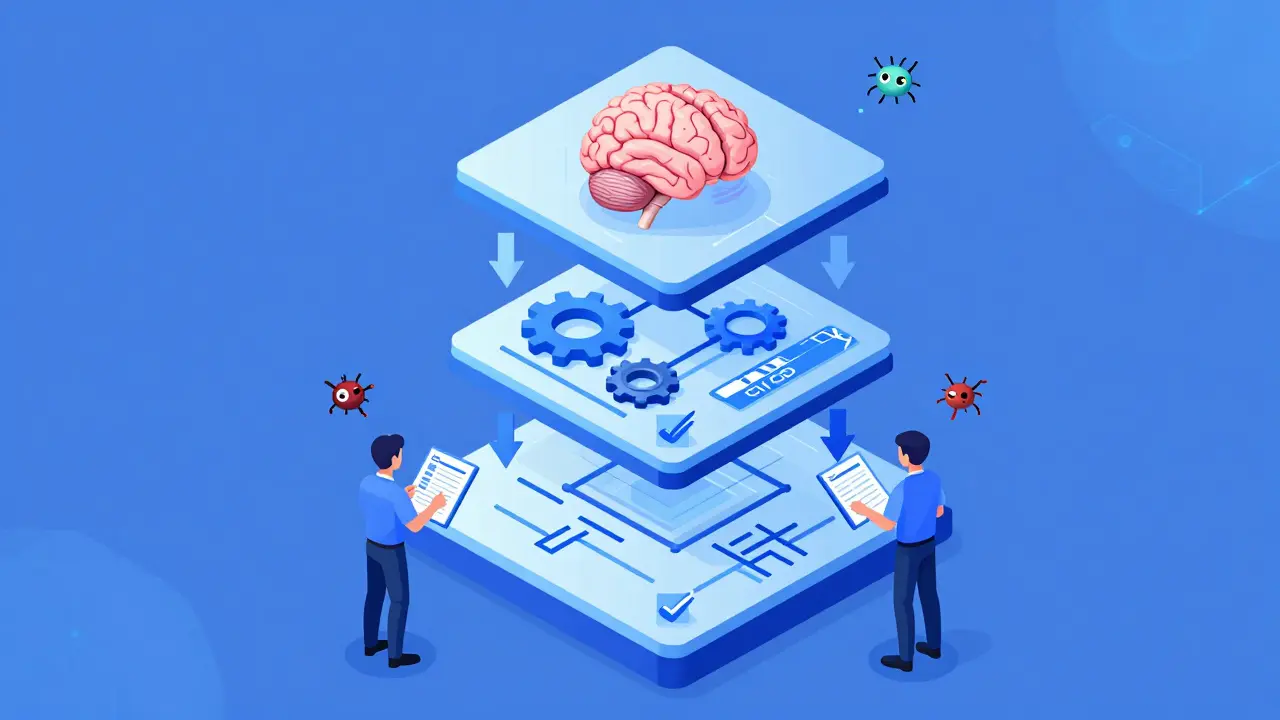
No single testing layer catches everything. That’s why PropelCode.ai developed a multi-layer quality architecture framework that significantly improves defect detection rates:
- Layer 1: AI-Powered Real-Time Analysis - Catches 63% of issues during code generation by analyzing prompts and outputs simultaneously.
- Layer 2: Automated Quality Gates - Identifies 28% of defects during CI/CD pipelines using static analysis and automated test runs.
- Layer 3: Strategic Human Review - Addresses the remaining 9% of complex business logic issues through targeted manual inspection.
This layered approach ensures that even if one layer misses something, another will catch it. Jason Warner, former GitHub CTO, presented compelling data at QCon London 2025 showing teams that implemented real-time quality gates experienced 47% fewer production incidents despite 2.3x faster development velocity.
Practical Workflow: From Prompt to Production
Implementing these strategies requires changing how you interact with AI tools. Memberstack's best practices guide specifies a minimum 30-hour learning curve for developers to effectively test vibe-coded architectures, with the critical skill being 'precision prompting' for test generation.
Follow this proven workflow validated across 142 development teams in PropelCode.ai's study:
- Define clear outcome specifications (2-4 hours): Document what success looks like before writing any code.
- Generate initial code with explicit test requirements (1-3 iterations): Include testing instructions directly in your prompt.
- Execute immediate validation (15-30 minutes): Run basic flow tests and check for obvious failures.
- Provide specific feedback on gaps: Tell the AI exactly what it missed-e.g., 'The AI missed empty state validation for search results.'
- Iterate with targeted refinement prompts: Ask for fixes incrementally rather than rewriting everything.
Debugging becomes easier too. Emergent.sh documents a systematic approach: 'Copy-paste error messages directly into AI tool, request multiple hypotheses, test each fix in isolation.' This reduced debugging time by 58% in their case studies.
Frequently Asked Questions
What is vibe coding?
Vibe coding is a development methodology where programmers use generative AI tools to create functional code from natural language prompts instead of writing every line manually. The developer acts as a curator, guiding the AI and validating output rather than serving as the primary author.
Why do traditional testing methods fail with AI-generated code?
Traditional tests assume deterministic code creation, but AI produces probabilistic outputs. Standard suites miss 59% of logic errors in vibe-coded apps because they don't account for subtle business rule violations or undocumented dependencies introduced by the model.
How can I improve unit test quality for AI-generated code?
Use explicit prompt engineering directives that enforce F.I.R.S.T. principles. Specify edge cases, require Test-Driven Development workflows, and demand self-validating assertions. Never accept auto-generated tests without reviewing them for independence and repeatability.
What is contract testing and why is it important for vibe coding?
Contract testing verifies that different software components communicate correctly according to predefined agreements. In vibe coding, AI often ignores business logic contracts, so you must define API schemas manually and instruct the AI to adhere strictly to those specifications.
Should I use more end-to-end tests in vibe-coded projects?
No. Successful teams actually reduce E2E test volume to 10% of total tests, focusing only on critical user journeys. Over-relying on E2E tests leads to fragility and maintenance overhead. Prioritize unit and integration tests for broader coverage.
How much time does it take to learn effective vibe coding testing?
Memberstack estimates a minimum 30-hour learning curve focused on precision prompting and structured validation techniques. Mastery comes from practicing iterative refinement loops and understanding how to interpret AI-generated test failures.
Can AI tools automatically detect business logic errors?
Currently, no. Momentic.ai's March 2025 study found AI-generated tests addressed business requirements correctly in only 34% of cases. Human oversight remains essential for validating complex workflows like payment processing or inventory management.
What are quality gates in vibe coding?
Quality gates are automated checkpoints in your CI/CD pipeline that enforce standards like minimum code coverage (85%) and maximum test execution time (5 seconds). They prevent low-quality AI output from reaching production.
Is vibe coding suitable for enterprise applications?
Gartner's November 2025 survey shows only 19% of Fortune 500 companies use vibe coding for production systems due to testing and compliance concerns. Most enterprises limit usage to proof-of-concept stages until robust validation frameworks mature.
How do I debug AI-generated test failures efficiently?
Copy error messages directly into your AI tool, ask for multiple hypotheses about root causes, and test each fix in isolation. This systematic approach reduces debugging time by nearly 60% according to Emergent.sh case studies.
Edward Gilbreath
June 30, 2026 AT 07:07its all a lie the ai is just copying from leaked github repos and they want you to think its magic so you stop learning how to code properly and become dependent on their servers
i saw the source code for one of these models and it was literally just a giant if else statement disguised as neural net
testing doesnt matter because the whole system is rigged
Caitlin Donehue
July 1, 2026 AT 11:21honestly i feel like we are overcomplicating this by trying to fit old testing paradigms into new workflows but maybe there is some truth in what they say about contract testing being the weak link
i noticed that when i let the ai generate my api endpoints it often forgets to handle null values correctly even if i ask it to
does anyone else find themselves writing more comments than actual code now just to guide the model
kimberly de Bruin
July 2, 2026 AT 06:14the act of testing is merely a reflection of our distrust in the machine which is itself a mirror of our own fractured psyche
we build walls around code not because it is broken but because we fear the chaos of unmediated creation
perhaps the error is not in the syntax but in the soul of the prompter who seeks certainty in an uncertain universe
Edward Nigma
July 3, 2026 AT 18:01you guys are completely missing the point here and its frustrating to watch everyone fall for this hype train
first off the stats cited are probably cherry picked or made up by some marketing dept to sell another course on vibe coding
secondly saying that traditional QA fails is ridiculous because basic unit tests still catch 90% of stupid bugs
stop acting like you need a specialized framework for every little thing and just write proper code instead of relying on probabilistic garbage
Oskar Falkenberg
July 4, 2026 AT 13:43hey edward i totally get where your coming from with the skepticism but i think we might be able to find some common ground here if we look at the practical side of things
i have been working with these tools for a while now and while they do produce messy code sometimes i found that setting up simple contract tests really helps keep everything in check without needing a huge team
it is kind of like having a safety net when you are doing something risky and i would love to hear if you have tried any specific methods that worked better for you in your projects
Stephanie Frank
July 5, 2026 AT 02:21this article is basically telling you to pay more money for tools that fix the mess you made by using free tools
typical corporate bullshit designed to make you feel inadequate so you buy their premium subscription for automated quality gates
real developers know that if your code needs a specialized framework to test it then your architecture is already doomed from the start
just learn to read stack traces and stop coddling your lazy ass with ai generated patches