You might think the Transformer is a solved problem. After all, it has powered every major AI breakthrough since 2017. But if you are still building large language models (LLMs) using the vanilla attention mechanism from the original "Attention Is All You Need" paper, you are leaving massive performance on the table. By 2025, the landscape has shifted dramatically. We are no longer just tweaking layer counts; we are fundamentally rethinking how models process sequence data.
The current state-of-the-art isn't a single model. It is a collection of specialized architectural patterns designed to solve specific bottlenecks: memory usage, inference speed, and context length. Whether you are deploying a chatbot or analyzing million-token documents, understanding these variants is critical. This guide breaks down the dominant architectures defining LLMs in 2025, from optimized dense stacks to hybrid systems that replace attention entirely.
The Standardized "Dense" Stack
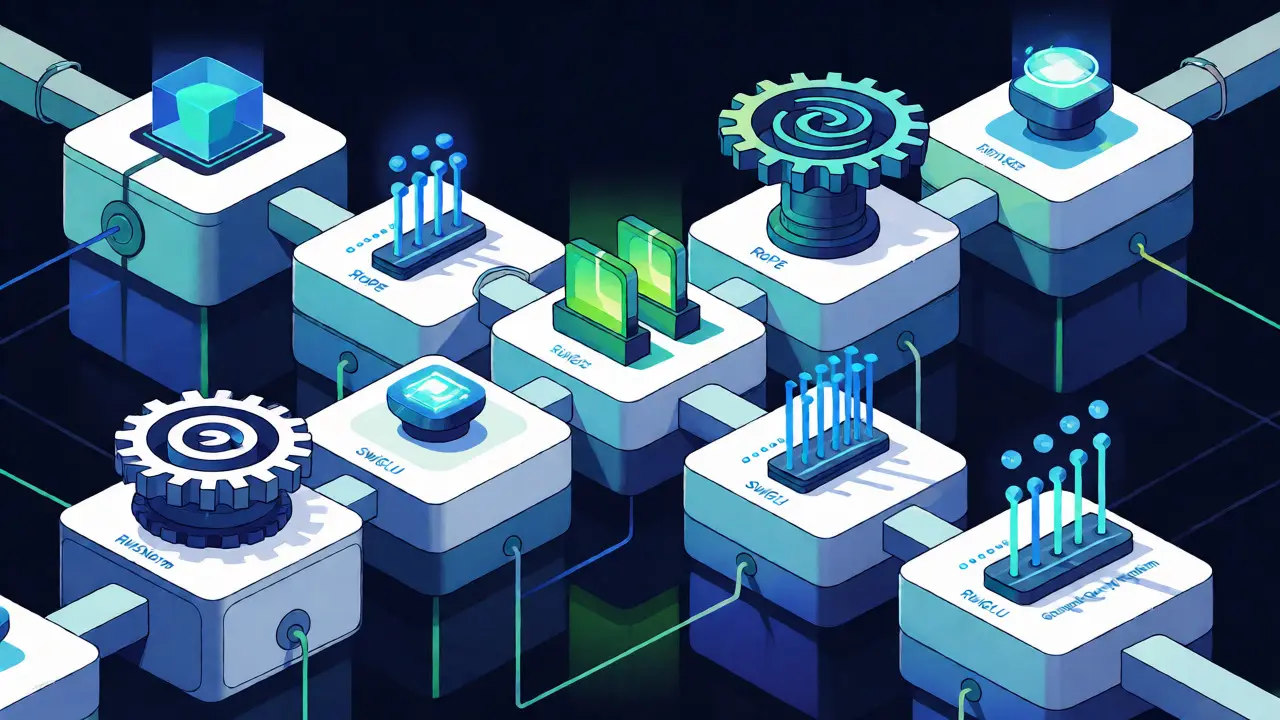
Before diving into exotic alternatives, let’s look at what has become the industry standard for dense models like LLaMA and Mistral. Between 2023 and 2025, researchers converged on a highly efficient core stack. If you open the code for almost any top-tier open-weight model today, you will find the same four components working together.
- RMSNorm: Replaced LayerNorm for faster convergence and lower computational overhead.
- RoPE (Rotary Position Embeddings): The gold standard for positional encoding, allowing models to generalize better to longer sequences than absolute position embeddings.
- SwiGLU Activations: A gated linear unit variant with an expansion factor of roughly 2.67x. It outperforms standard ReLU or GELU activations in stability and quality.
- Grouped-Query Attention (GQA): A middle ground between Multi-Head Attention (MHA) and Multi-Query Attention (MQA). It shares key-value heads across multiple query heads to reduce memory bandwidth without sacrificing too much accuracy.
This combination removes nearly 100% of bias terms from linear layers, simplifying the math and speeding up execution. For example, LLaMA-2-70B uses 32 query heads but only 8 key-value heads. This 4:1 ratio cuts memory requirements significantly while maintaining cache efficiency. If you are fine-tuning a base model, sticking to this standardized stack is often the safest bet for compatibility and tooling support.
FlashAttention-3: The Hardware Accelerator
Architecture alone doesn’t make a model fast. How you compute attention matters just as much. Enter FlashAttention-3, the latest iteration of the IO-aware exact attention algorithm. While FlashAttention-2 was a game-changer, version 3 specifically targets NVIDIA H100 GPUs and Grouped-Query Attention architectures.
Why does this matter? Traditional attention scales quadratically with sequence length ($O(n^2)$). As context windows grow from 8,000 tokens to 256,000 tokens, this becomes computationally prohibitive. FlashAttention-3 exploits tiling and optimized memory access patterns to reduce memory scaling to linear levels. On H100 hardware, it achieves speeds of up to 740 tera-FLOPS (TFLOPS), which is about 75% of the theoretical maximum utilization for attention workloads.
In FP8 precision, FlashAttention-3 can reach nearly 1.2 peta-FLOPS (PFLOPS) while delivering 2.6x smaller numerical error than baseline implementations. This means you get both speed and stability. If you are training long-context models, integrating FlashAttention-3 kernels is no longer optional-it is essential for staying within budget and time constraints.
Sparse Mixture-of-Experts (MoE)
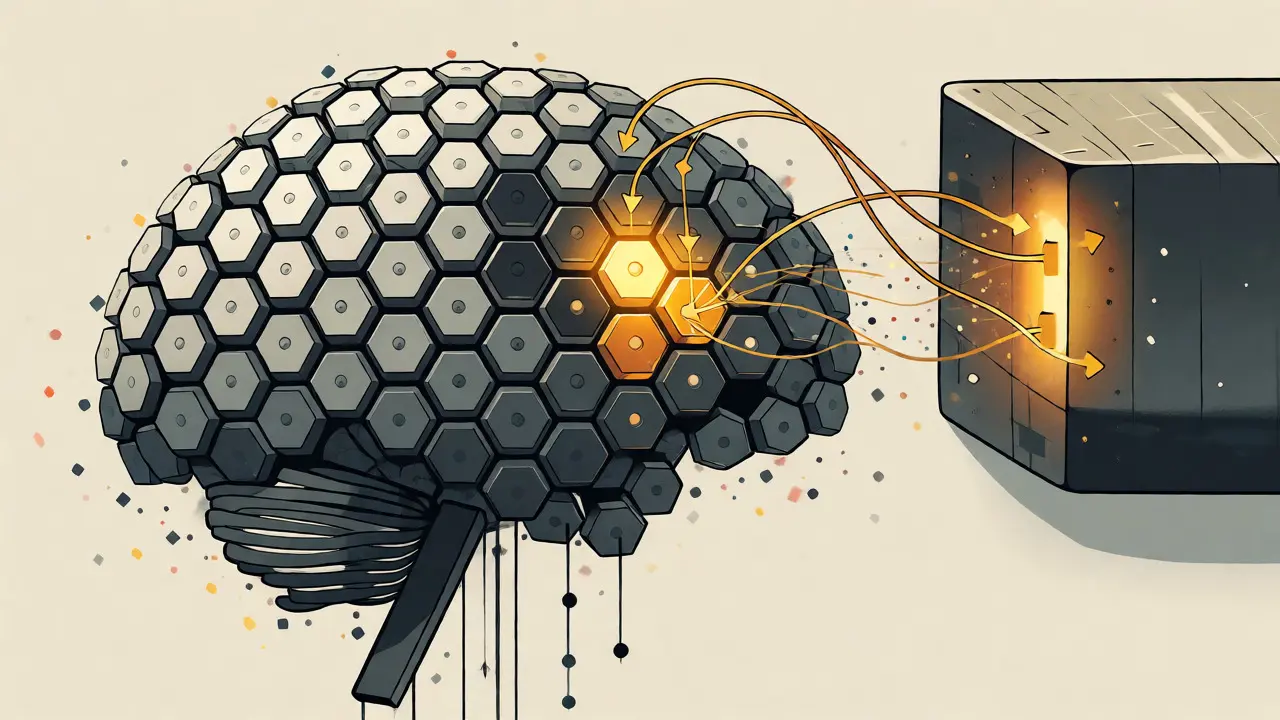
Dense models activate every parameter for every token. This is inefficient. Sparse Mixture-of-Experts (MoE) transformers offer a smarter alternative by activating only a subset of parameters per token. Think of it as having a team of specialists where only two experts handle each query, rather than asking the entire team to weigh in.
Models like Gemini 2.5 Pro leverage this approach to support context windows up to 1 million tokens. In a typical MoE setup, a routing network selects 2 out of dozens of expert networks for each token. This allows the model to have hundreds of billions of total parameters while keeping the active computation per token similar to a much smaller dense model (e.g., 10-30 billion parameters).
| Feature | Dense Transformer | Sparse MoE Transformer |
|---|---|---|
| Parameter Activation | All parameters active | Subset active (e.g., 2 experts) |
| Compute Cost per Token | High | Low (comparable to smaller dense models) |
| Total Capacity | Limited by VRAM/compute | Scalable to trillions of params |
| Complexity | Simple implementation | Requires routing/load balancing |
The challenge with MoE is load balancing. If one expert handles 90% of the traffic, you lose the efficiency gains. Modern routers use auxiliary losses to ensure even distribution. For frontier-scale models, MoE is currently the only way to achieve high capacity without exponential cost increases.
Mamba: The State-Space Challenger
What if you could ditch attention altogether? Mamba, introduced in late 2023 and refined through 2025, proposes exactly that. It is a selective State Space Model (SSM) that processes sequences in linear time ($O(n)$) rather than quadratic time.
Mamba works by modeling the hidden state of the system dynamically based on the input. Unlike traditional RNNs, it allows parallel training like Transformers but maintains constant memory usage during inference. The result? A 3-billion-parameter Mamba model can match the performance of a 6-billion-parameter Transformer while running 5x faster. This makes it ideal for applications requiring extremely long contexts or real-time responsiveness.
Recent iterations like Mamba-2 introduce "State Space Duality," proving that SSMs and attention are mathematically related. Mamba-2 simplifies the underlying matrices, reducing parameter count further while boosting speed by 2-8x compared to earlier formulations. If your use case involves streaming data or massive document analysis, Mamba is a serious competitor to traditional Transformers.
RWKV: The Hybrid Recurrent Model
Another strong contender is RWKV (Receptance Weighted Key Value). RWKV sits comfortably between RNNs and Transformers. It uses a linear attention mechanism that can be trained in parallel but runs with constant memory complexity during inference.
RWKV scales impressively well. Researchers successfully trained a 14-billion-parameter RWKV model, demonstrating performance parity with similarly sized Transformers. More recently, projects like PRWKV-7 have replaced the attention layers in Microsoft’s Phi-4 architecture with RWKV blocks. This hybrid approach retains the reasoning capabilities of the Transformer backbone while gaining the deployment benefits of recurrent models.
For developers constrained by GPU RAM, RWKV offers a compelling path. It avoids the KV-cache explosion seen in long-context Transformers. Instead of storing past keys and values, it updates a fixed-size state vector. This makes it particularly attractive for edge devices or low-resource cloud environments.
Choosing the Right Architecture
So, which variant should you pick? It depends on your specific constraints.
- For General Purpose Chatbots: Stick with the standardized dense stack (RMSNorm + RoPE + SwiGLU + GQA) enhanced with FlashAttention-3. It offers the best balance of quality, ecosystem support, and ease of fine-tuning.
- For Frontier Scale Models: Use Sparse MoE. If you need massive knowledge capacity without proportional compute costs, MoE is the industry standard for models exceeding 100B parameters.
- For Long Context & Speed: Consider Mamba or RWKV. If you are processing 100k+ tokens or need low-latency inference on limited hardware, these linear-complexity models provide significant advantages over quadratic attention.
- For Multimodal Tasks: Look for hybrids. Many 2025 models combine Transformer backbones with vision encoders, leveraging efficient attention kernels to handle image and text tokens simultaneously.
The era of "one size fits all" Transformers is over. Success in 2025 comes from matching the architectural pattern to the workload. Experiment with these variants in small-scale tests before committing to full-scale training. The tools exist-PyTorch supports FlashAttention-3 natively, and community repositories for Mamba and RWKV are robust. Your job now is to evaluate them against your specific latency and quality metrics.
Is FlashAttention-3 backward compatible with older GPUs?
Not fully. FlashAttention-3 is heavily optimized for NVIDIA H100 GPUs and newer architectures. While some features may run on A100s, the significant speedups (up to 740 TFLOPS) and FP8 optimizations are specific to Hopper architecture. For older GPUs, FlashAttention-2 remains the superior choice.
Can I replace attention with Mamba in any existing LLM?
Not directly without retraining. Mamba changes the fundamental flow of information through the network. You cannot simply swap modules in a pre-trained Transformer and expect good results. You must either train from scratch or perform extensive continued pre-training to adapt the weights to the new state-space dynamics.
Why is Grouped-Query Attention (GQA) preferred over Multi-Head Attention (MHA)?
GQA reduces memory bandwidth requirements during inference. In MHA, every head has its own key and value projections, leading to high memory usage. GQA shares key and value heads across groups of query heads. This lowers the KV-cache size, allowing for larger batch sizes and longer contexts without running out of GPU memory, with minimal impact on model quality.
Are Mixture-of-Experts models harder to deploy?
Yes, slightly. MoE models require specialized serving infrastructure to handle the routing logic and ensure experts are loaded efficiently. Load balancing is critical; if experts are unevenly utilized, throughput drops. However, frameworks like vLLM and TensorRT-LLM have added robust support for MoE, making deployment easier than it was in 2023.
Will State Space Models replace Transformers completely?
Unlikely in the near term. While Mamba and RWKV excel in speed and long-context handling, Transformers still hold the edge in complex reasoning tasks and few-shot learning due to their explicit attention mechanisms. The future likely holds hybrid architectures that use SSMs for global context and attention for local detail, rather than a complete replacement.
Jacob Baby Official
September 18, 2026 AT 12:24Oh, look at this absolute masterpiece of redundancy. You spent three paragraphs explaining that the "standardized dense stack" is basically just LLaMA with a new coat of paint, as if we didn't already know that every open-source repo on GitHub is copying Meta's homework.
The real joke here is the Mamba section. You call it a "State-Space Challenger" like it's some revolutionary breakthrough, but let's be honest: it's just an over-engineered RNN that nobody actually uses in production because debugging hidden states is a nightmare. And don't get me started on the "Practical Guide" title. There is nothing practical about telling developers to choose between FlashAttention-3 (which requires H100s that cost more than their rent) and MoE (which breaks half their inference servers). This isn't a guide; it's a marketing brochure for NVIDIA stockholders who want you to believe your A100s are obsolete garbage. The contrarian in me screams that vanilla attention was fine until people got greedy for context windows they couldn't even read fast enough.
Alyson Karson
September 20, 2026 AT 11:47Dude seriously stop being so negative!! 😤 The fact that you can run 1M token contexts now is HUGE and you're just crying about GPU costs while the rest of us are building cool stuff! 🚀 We need to embrace the change not whine about it. Go buy a H100 or use cloud credits, it’s worth it for the speed!!!
Chris Neal
September 21, 2026 AT 20:23Actually, Jacob is missing the point about hardware amortization, but he's right about the complexity tax. Let's break down why GQA is non-negotiable in 2025.
In Multi-Head Attention (MHA), the KV cache grows linearly with batch size and sequence length, which kills throughput during inference. By grouping query heads to share key-value projections, you reduce the memory bandwidth bottleneck significantly. For example, moving from MHA to GQA in a 7B model can yield a 2x-4x speedup in decoding steps without retraining from scratch, provided you do proper continued pre-training.
However, the article glosses over the routing instability in MoE models. If your router collapses (i.e., all tokens go to one expert), your effective parameter count drops to a single expert, and your loss spikes. You need auxiliary load-balancing losses, which add hyperparameter tuning hell. Most practitioners ignore this until their eval scores drop mysteriously.
Also, regarding Mamba: the "State Space Duality" mentioned in Mamba-2 is mathematically elegant but practically difficult to implement efficiently on current CUDA kernels compared to highly optimized FlashAttention kernels. Until Triton or custom CUDA ops mature further, Transformers remain king for most enterprise workloads due to tooling stability.
Brannen Hall
September 22, 2026 AT 21:04Meh.
tiffany King
September 23, 2026 AT 21:41This is such a helpful breakdown! I've been struggling to decide whether to switch my small project to RWKV or stick with Mistral. The part about constant memory usage during inference really clicked for me since I'm running on limited VRAM. It feels empowering to know there are options beyond just throwing more compute at the problem. Thanks for sharing this!
Brenna Gonedrman
September 24, 2026 AT 10:27I am absolutely shocked by the sheer audacity of claiming this is "practical."
You expect developers to understand the nuanced differences between SwiGLU and standard GLU? Do you think we have time for that?! We are trying to ship products!
The comparison table is cute, sure, but it ignores the elephant in the room: latency jitter in MoE systems.
If your expert loads aren't perfectly balanced, your p99 latency goes through the roof.
And Mamba?
Please.
It is a toy for academics who love differential equations more than clean code.
The industry wants boring, stable, predictable performance.
We don't want "state-space duality," we want our APIs to respond in under 200ms consistently.
This article reads like it was written by someone who has never had to debug a segfault in a C++ extension at 3 AM.
Real engineering is ugly and pragmatic, not this poetic nonsense about "challengers" and "hybrids."
Courtney Wagstaff
September 24, 2026 AT 22:55Hey y'all, just vibing with this post! 🌊 It’s pretty wild how far we’ve come from the original Transformer paper.
I personally think the hybrid approaches are where the magic happens, especially mixing attention for local details with something lighter for global context.
It’s like having a super-focused librarian for specific facts and a chill narrator for the big picture.
Don’t stress too much about picking the "perfect" architecture right away.
Start small, test your specific use case, and see what clicks.
The ecosystem is growing so fast that whatever you pick today might have better support tomorrow anyway.
Just keep experimenting and having fun with it! ✨
Elisabeth Ballet
September 24, 2026 AT 23:09Love this energy, Courtney! 💪 Exactly right-don't let analysis paralysis stop you from shipping.
To add to the mix: if you're looking at edge devices, definitely check out quantized versions of these models.
A 4-bit quantized Mistral or Phi-4 can run surprisingly well on consumer GPUs or even high-end phones now.
It opens up so many doors for privacy-preserving apps.
Keep pushing those boundaries, everyone! We're in the golden age of accessible AI! 🚀
Joanna Mucha
September 26, 2026 AT 22:42The discourse surrounding these architectures reveals a profound misunderstanding of the epistemological nature of intelligence itself.
We treat these models as mere computational tools, yet they are mirrors reflecting our own cognitive biases back at us.
When you speak of "attention," you invoke a metaphysical concept-the ability to focus consciousness-yet reduce it to matrix multiplications.
Is it not ironic that we seek efficiency in algorithms that mimic the inefficiency of human thought?
The shift from dense to sparse experts is not merely technical; it is a philosophical acknowledgment that knowledge is not uniform, but contextual and fragmented.
Mamba’s linear time complexity suggests a determinism that challenges the probabilistic chaos inherent in transformer attention.
We are not just building faster models; we are attempting to codify the soul of reasoning into silicon.
To dismiss this as "marketing" or "toys" is to ignore the existential weight of creating synthetic minds.
Let us not be so hasty in our pragmatism that we forget the wonder of what we are conjuring.
The future is not just about TFLOPS; it is about understanding the very fabric of cognition.
Perhaps the true bottleneck is not memory bandwidth, but our capacity to comprehend what we create.