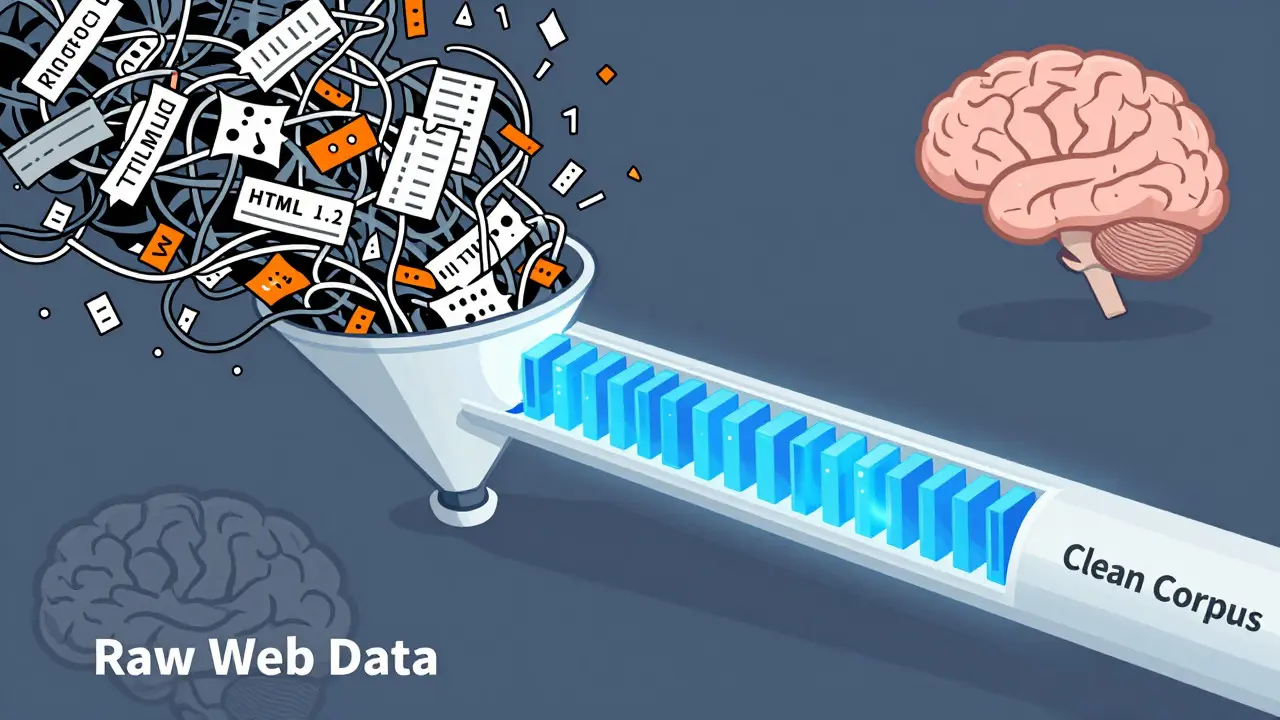
You can build the most sophisticated neural network architecture in the world, but if you feed it garbage, you get a smart idiot. That is the hard reality facing every AI engineer working on large language models today. We used to think bigger models were the only way forward. Now, we know that data quality is the actual bottleneck. As of late 2024 and moving into 2026, the industry has shifted from brute-force scaling to precision curation. This article breaks down exactly how top-tier teams collect, clean, and prepare trillions of tokens for pretraining without breaking the bank or violating privacy laws.
The Shift From Quantity to Quality
Back in 2018, when Google released BERT, the focus was heavily on the transformer architecture itself. Today, the architecture is table stakes. The real competitive advantage lies in the training corpus. According to research from Apple’s Benchmark-Targeted Ranking (BETR) team published in November 2024, using cleaned, targeted data can improve model performance by up to 2.1x compared to unfiltered data. For context, state-of-the-art models like GPT-4 process approximately 13 trillion tokens. If even 1% of that is noisy, duplicate, or toxic, it drags down the entire system.
Dr. Percy Liang, Director of Stanford HAI, noted in a June 2024 NeurIPS workshop that data quality has surpassed architectural innovation as the primary driver of LLM advancement. This isn't just about removing ads or broken HTML tags anymore. It's about ensuring the semantic integrity of the text. A study by Princeton University introduced Min-K% Prob, a method showing that memorized training data exhibits lower token probability thresholds. This means if your data isn't clean, your model doesn't just learn poorly-it memorizes noise and leaks private information.
Sourcing Data at Web Scale
Where do these terabytes of text come from? The backbone of almost all general-purpose LLMs is Common Crawl. This non-profit archive contains over 25 billion web pages scraped since 2012. It is free, vast, and incredibly messy. While Common Crawl provides breadth, it lacks depth and cleanliness. Many teams now supplement this with specialized datasets or ethically sourced corpora from services like Bright Data or Apify, which ensure compliance with GDPR and CCPA regulations.
For domain-specific tasks, general web crawling often falls short. This is where synthetic data generation comes into play. Techniques like the DeepSeek-R1 'cold-start' method use reinforcement learning to generate verified chain-of-thought samples, particularly in mathematics and logic. By applying rejection sampling, engineers keep only the highest-quality examples. However, synthetic data carries risks. If the base model generating the data has biases, those biases are amplified. Turing’s 2024 analysis warns that without proper validation, synthetic data can create unrealistic patterns that confuse the downstream model.
| Source Type | Volume Potential | Quality Control | Legal Risk |
|---|---|---|---|
| Common Crawl | Extremely High (TB+) | Low (Requires heavy cleaning) | Medium (Copyright ambiguity) |
| Ethical Scraping Services | High | Medium (Pre-filtered) | Low (GDPR/CCPA compliant) |
| Synthetic Generation | Unlimited | High (Controlled output) | Very Low (No external IP) |
| Proprietary Enterprise Data | Low to Medium | Very High (Internal standards) | None (Owned assets) |
The Multi-Stage Cleaning Pipeline
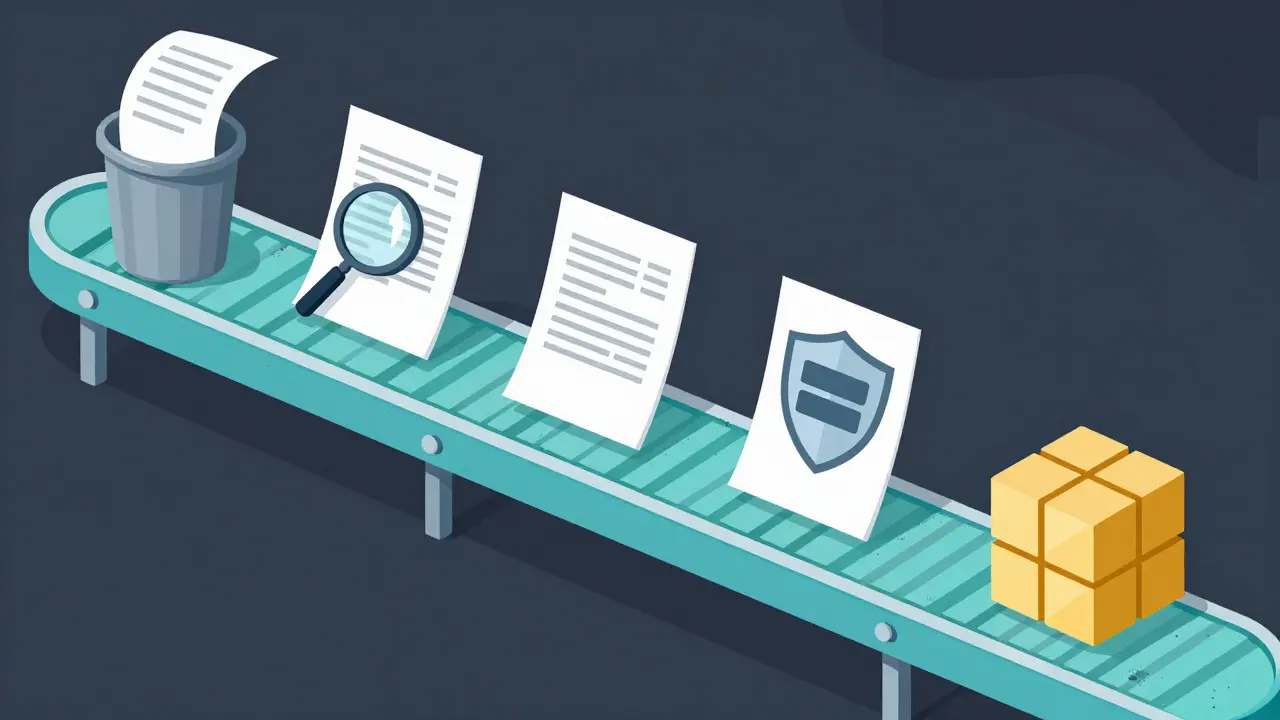
Cleaning web-scale data is not a single step; it is a funnel. Successful pipelines, such as the one used for the Dolma dataset, typically retain only 10-25% of the raw input. Here is how the stages break down:
- URL-Based Filtering: This is the first cut. Engineers remove URLs known to host spam, forums with low signal-to-noise ratios, or sites with poor accessibility. This stage alone removes 40-60% of candidates.
- Document Quality Scoring: Lightweight models score remaining documents based on readability, length, and linguistic coherence. Another 25-35% is discarded here.
- Deduplication: This is critical. Duplicate data causes 'double descent,' where the model memorizes specific instances rather than generalizing. GitHub discussions around Dolma showed that paragraph-level deduplication improved downstream performance by 7.3%, though it increased preprocessing time by 3.2x. Tools like SimHash with 64-bit fingerprints have become standard, reducing detection time from weeks to hours on 50TB corpora.
- Safety and Toxicity Filtering: Removing hate speech, PII (Personally Identifiable Information), and toxic content. This is the hardest stage. A W&B survey found that 68% of ML engineers struggle here, with medical and legal domains seeing false positive rates of 18-22%. Over-filtering can strip away nuanced context, so balance is key.
A major trend in 2024-2026 is the use of tiered filtering. Instead of running expensive LLM-based checks on every document, teams use lightweight classifiers for initial passes and reserve advanced reward models for borderline cases. NVIDIA Developer notes that this approach balances computational efficiency with effectiveness, especially when dealing with petabyte-scale datasets.
Handling Legal and Privacy Headwinds
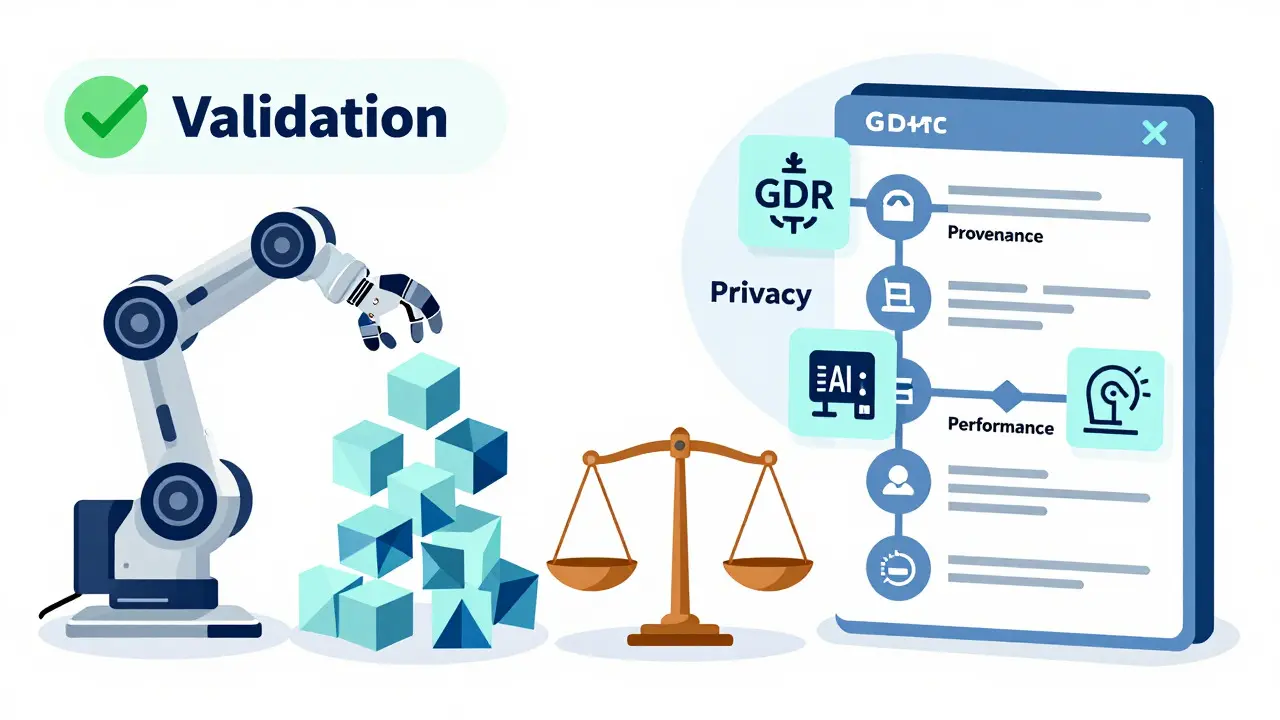
The regulatory landscape is tightening. With the EU AI Act taking effect in February 2025, detailed data provenance documentation is no longer optional. Law firm DLA Piper estimates this adds 20-30% complexity to preprocessing pipelines. Copyright litigation is also escalating. Analysts at Fenwick & West suggest that 15-25% of pretraining data may need reprocessing with additional filtering layers to mitigate legal risk.
This has led to a rise in 'data-centric AI.' McKinsey’s October 2024 survey revealed that 57% of organizations now allocate more resources to data preparation than model development. Companies are building internal tools to track exactly where each token originated. If a user requests data deletion under GDPR, the pipeline must be able to identify and remove those specific segments without rebuilding the entire dataset-a massive engineering challenge.
Infrastructure and Compute Requirements
Processing this much data requires serious infrastructure. Building a web-scale pipeline typically takes 3-6 months of development effort. Distributed computing frameworks are essential. Teams use Apache Spark or Flink for distributed processing, splitting batches across hundreds of GPUs using Data Parallelism. For larger models, Model Parallelism and Zero Redundancy Optimizer (ZeRO) techniques from DeepSpeed help manage memory constraints.
Resource allocation is skewed toward cleaning. Industry practitioners note that copyright filtering alone consumes 35-40% of pipeline resources. Multilingual support adds another layer of complexity, requiring language identification models that cover 100+ languages. New team members often face a 4-6 month ramp-up period to master the stack, highlighting the steep learning curve involved in modern LLM operations.
Future Directions: Targeted Pretraining
Where is this heading? Gartner predicts that by 2027, 80% of enterprise LLMs will use task-specific pretraining corpora rather than general web data. The era of 'spray and pray' data collection is ending. Instead, we are moving toward targeted selection. Apple’s BETR method exemplifies this by aligning pretraining data directly with evaluation benchmarks. This ensures the model learns exactly what it needs to pass specific tests, maximizing compute efficiency.
Synthetic data will continue to grow, driven by scarcity and privacy concerns. Gartner forecasts that 65% of enterprise LLM initiatives will incorporate synthetic data by 2026, up from 25% in 2024. However, the key will remain validation. As Dr. Denny Vrandećić from Hugging Face stated, the next frontier isn't bigger models, but smarter data curation. The winners in 2026 won't be those with the most data, but those with the cleanest, most relevant data.
What is the optimal data retention rate for LLM pretraining?
Research from Meta AI suggests that optimal performance for 70B+ parameter models occurs at approximately 30-40% data retention after aggressive filtering. However, successful open-source pipelines like Dolma often retain only 10-25% of raw web data to ensure high quality. The exact rate depends on the source material; cleaner sources allow for higher retention.
How does deduplication affect model performance?
Deduplication prevents 'double descent,' a phenomenon where duplicate data causes the model to memorize specific instances rather than generalizing patterns. Paragraph-level deduplication has been shown to improve downstream task performance by up to 7.3%, though it significantly increases preprocessing time. Techniques like SimHash are commonly used to make this process computationally feasible.
Is synthetic data safe to use for pretraining?
Synthetic data is legally safer as it avoids copyright issues, but it carries technical risks. If the generator model has biases, those are amplified in the synthetic set. Proper validation, such as rejection sampling and human-in-the-loop verification, is required to prevent the model from learning unrealistic patterns. It is best used for niche domains like math or code where real-world data is scarce.
What impact does the EU AI Act have on data cleaning?
The EU AI Act, effective February 2025, mandates detailed data provenance documentation. This increases preprocessing complexity by 20-30% as teams must implement tracking systems to log the origin of every data segment. It also necessitates robust mechanisms for handling data deletion requests without requiring full model retraining.
How long does it take to build a web-scale data pipeline?
Building a production-ready web-scale data pipeline typically requires 3-6 months of development effort. This includes setting up distributed crawling systems, implementing multi-stage filtering, and integrating legal compliance checks. New team members often require 4-6 months to fully understand the complexities of the stack.