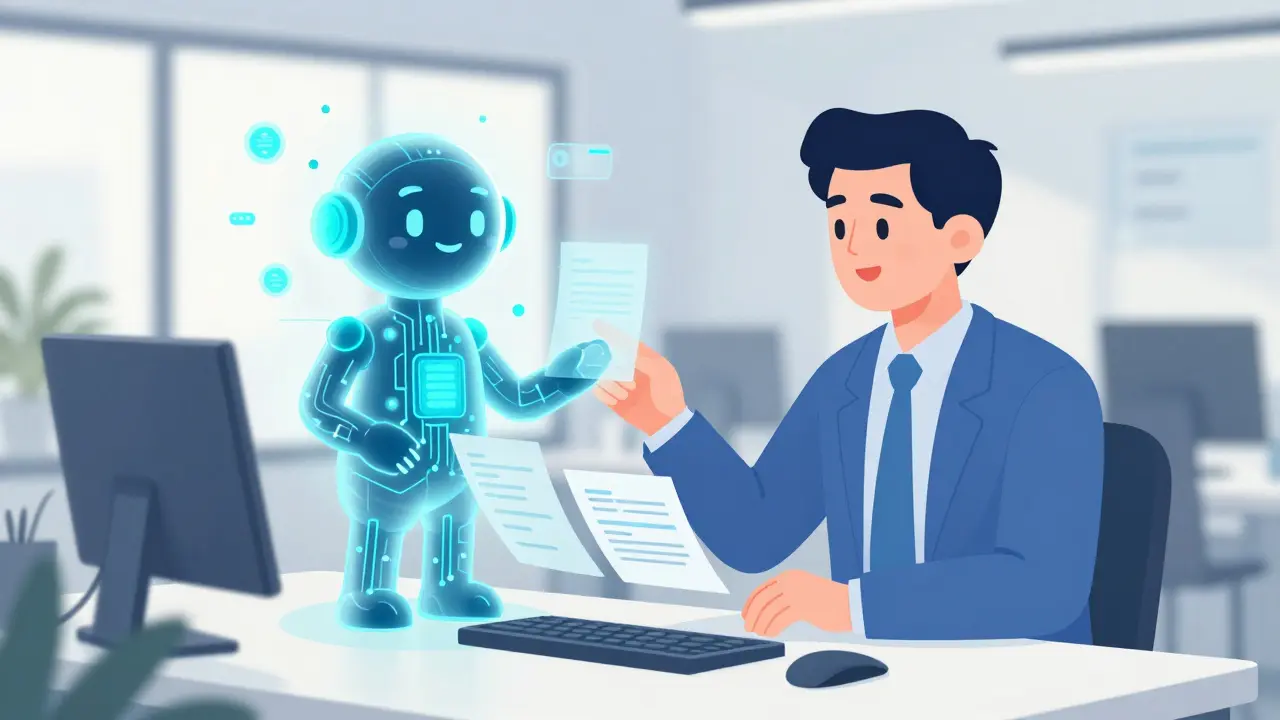
The shift is massive. We're talking about a market that hit $47.8 billion by early 2026. But the real story isn't the money; it's the move from AI as a tool to AI as a colleague. For most of us, this means our daily workflows are being rewritten. If you're managing a team, you're no longer just managing people; you're managing a hybrid blend of human intuition and machine precision.
What Exactly is a Digital Employee?
Before we get ahead of ourselves, let's define what we mean. A Digital Employee is an AI-driven agent capable of performing specialized, end-to-end business tasks with increasing autonomy, operating within a supervised framework. Unlike a standard bot that follows a rigid "if-this-then-that" script, these agents use Generative AI to handle ambiguity, make judgment calls based on company data, and learn from their mistakes.
Think of a digital employee in a finance department. It doesn't just flag an incorrect invoice; it cross-references the purchase order, checks the historical pricing from the vendor, emails the supplier for a correction, and notifies the human manager only when a high-level discrepancy occurs. It's the difference between a tool that helps you work and a worker that does the work.
The Engine Under the Hood: How it Actually Works
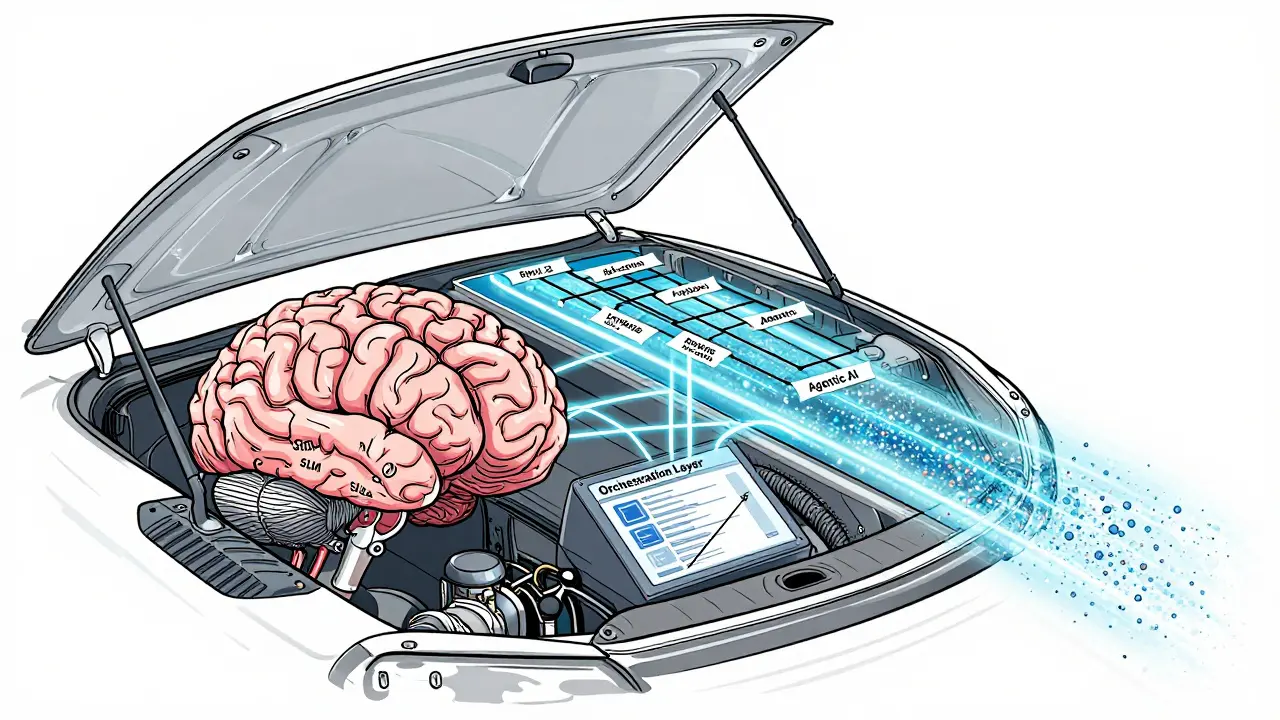
You can't just plug in a generic AI and call it an employee. To make this work, companies are using a three-part technical stack that balances power with precision.
- Small Language Models (SLMs): While the world obsessed over massive models, enterprises shifted to SLMs. These are smaller, leaner models trained on a company's own private data. They're not just cheaper-reducing infrastructure costs by about 62%-but they're far more accurate because they speak the "company language."
- Agentic AI Frameworks: This is the "brain" that allows the AI to plan. Instead of one prompt leading to one answer, Agentic AI can break a large goal (like "conduct a quarterly risk assessment") into smaller steps, execute them, and check its own work.
- Synthetic Data Pipelines: Sometimes real data is too scarce or too sensitive. Companies now use synthetic data to train their digital workers. For example, in healthcare, Aya Data created 10,000 simulated pathology cases from just 50 real ones, allowing AI to learn rare diseases without compromising patient privacy.
These components don't just float around; they live inside an Orchestration Layer. This is the manager's dashboard for AI. It handles task routing, decides which AI agent gets which job, and-most importantly-handles the "human handoff." When the AI hits a wall it can't climb, the orchestration layer slides the task back to a human seamlessly.
The Real-World Impact: Where AI Wins and Where It Fails
Is a synthetic workforce a magic bullet? Not exactly. Depending on the task, the results vary wildly. In high-volume, structured environments, the gains are staggering. Financial compliance tasks, for instance, see 25% higher accuracy when handled by synthetic workers compared to old-school rule-based automation.
| Capability | Rule-Based Automation | Digital Employees (GenAI) | Human Workers |
|---|---|---|---|
| Repetitive Data Entry | Excellent | Excellent | Slow/Prone to Error |
| Judgment-Based Tasks | Poor | Strong | Excellent |
| Emotional Intelligence | None | Low/Simulated | High |
| Operational Speed | Instant | Very Fast | Moderate |
However, there's a catch. The "human element" is where things get messy. We're seeing a trend where employees feel a disconnect. In customer service roles, researchers found that connections between humans and their AI colleagues are about 37% weaker than human-to-human bonds. If you replace a helpful teammate with a perfect-but-cold algorithm, you might gain efficiency but lose the culture that keeps people at the company.
The Human Cost: Job Evolution, Not Just Replacement
The big question is always: "Will I lose my job?" The answer is more nuanced than a simple yes or no. According to the World Economic Forum, nearly 39% of core worker skills will need to change by 2030. We aren't necessarily seeing a mass exodus of people, but we are seeing a mass evolution of roles.
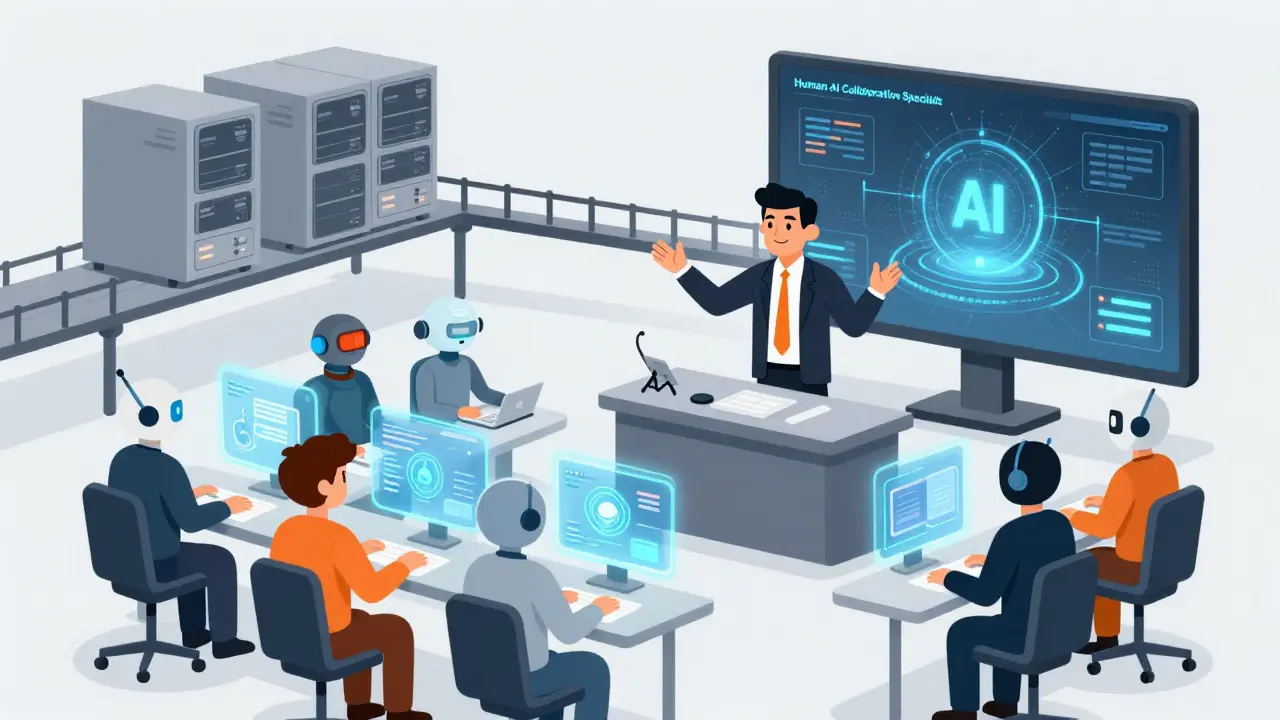
We're seeing entirely new career paths emerge. Who is going to make sure the AI isn't hallucinating financial data? We need AI Auditors. Who is going to design the workflow between a human manager and five digital agents? We need AI-Human Collaboration Specialists. The job isn't disappearing; it's moving up the value chain. You're moving from being the person who *does* the task to the person who *audits* and *directs* the task.
But this transition isn't free. It requires a serious investment in training. Technical staff usually need 8 to 12 weeks to master orchestration frameworks, while business users need about a month to get comfortable with these new workflows. The companies that treat this as a "software install" usually fail; the ones that treat it as a "cultural shift" are the ones winning.
Avoiding the Pitfalls of AI Integration
If you're looking to implement a synthetic workforce, don't just buy the flashiest tool on the market. Many early adopters found that the promised productivity gains didn't happen because they ignored the "plumbing." One of the biggest complaints on platforms like G2 is the complexity of integrating these new agents with legacy systems-those clunky, 20-year-old ERPs that your company refuses to replace.
Another trap is the "accountability gap." When a digital employee makes a mistake-like approving a fraudulent invoice-who is responsible? If you don't have a clear accountability protocol in place, you'll end up with a "blame game" between the human supervisor and the IT department. Successful organizations dedicate about 15-20% of their AI budget specifically to human oversight infrastructure and ethics review boards to prevent these disasters.
What's Next for the Synthetic Workforce?
We're already seeing the next evolution. The current focus is on "persistent memory." Right now, most AI agents forget who you are the moment the session ends. The next wave of digital employees will maintain long-term context across months of interactions, making them feel less like a tool and more like a partner who truly knows your business goals.
By 2027, experts predict half of the companies using GenAI will launch "agentic applications" that can handle complex work with almost no oversight. We're moving toward a world where the boundary between "software" and "employee" completely disappears. The goal isn't to build a machine that mimics a human, but to build a system where humans and machines together can do things that neither could do alone.
Will digital employees replace human workers entirely?
Unlikely. While they excel at data processing and structured judgment, they lack deep emotional intelligence and original conceptualization. The trend is toward augmentation-where AI handles the repetitive and analytical heavy lifting, and humans focus on strategy, empathy, and complex problem-solving.
How do SLMs differ from LLMs in a synthetic workforce?
Small Language Models (SLMs) are trained on more specific, smaller datasets-often a company's own internal records. This makes them more accurate for domain-specific tasks, faster to run, and significantly cheaper (up to 62% less in infrastructure costs) than Large Language Models (LLMs) which are general-purpose.
What is AI orchestration and why is it necessary?
Orchestration is the management layer that coordinates multiple AI agents. It handles task routing, priority setting, and the "human-in-the-loop" handoff. Without it, you just have a collection of disconnected tools; with it, you have a functional workforce that can execute multi-step business processes.
What are the risks of deploying a synthetic workforce?
The primary risks include "cultural resistance" from employees, integration failures with legacy software, and accountability gaps. There is also the risk of "social erosion," where employees feel less connected to their colleagues because a significant portion of their interactions are now with AI agents.
How long does it take to train humans to work with digital employees?
Training varies by role. Business users typically need 3-5 weeks to adapt to new collaborative workflows, while technical staff requiring deep knowledge of orchestration frameworks typically need 8-12 weeks of specialized training.
k arnold
April 11, 2026 AT 14:56Right, because calling a glorified script a "digital employee" is totally a thing now. I can't wait for the day the "orchestration layer" decides to delete the payroll database and the human manager just shrugs and says the AI hallucinated it.
Pure genius.
Fredda Freyer
April 12, 2026 AT 16:18The conceptual shift from AI as a tool to AI as a colleague touches on a deep ontological question about what it means to "work." If a machine handles the cognitive load of a task, we aren't just freeing up time, we are fundamentally altering the nature of professional expertise.
There is a risk that by outsourcing the "grunt work" of analysis, we lose the very foundation of tacit knowledge that allows humans to make those high-level judgment calls in the first place. You can't be an expert auditor if you've never felt the friction of the raw data. It's a precarious balance between efficiency and the erosion of human skill.
Tiffany Ho
April 13, 2026 AT 04:37this is so cool i think we can all do this together
lucia burton
April 13, 2026 AT 04:37We absolutely need to lean into the synergistic potential of agentic frameworks to optimize our KPIs across the entire vertical integration of the business process! By leveraging these SLMs to minimize our operational expenditure and maximizing the throughput of our synthetic data pipelines, we can fundamentally pivot our human capital toward high-impact strategic initiatives that drive exponential growth and market penetration in a way that legacy systems simply cannot facilitate without a complete paradigm shift in our organizational infrastructure!
Denise Young
April 14, 2026 AT 01:58Oh sure, because nothing says "culture shift" like replacing your favorite coworker with a lean SLM that doesn't need a coffee break. I'm just thrilled that we get to spend 12 weeks learning "orchestration frameworks" so we can basically become babysitters for a bunch of algorithms that might accidentally approve a million-dollar fraud because of a prompt glitch. It's just such a wonderful evolution of the workplace to move from actually doing things to just auditing a machine that's doing them slightly faster but without a soul.
Sam Rittenhouse
April 14, 2026 AT 22:24My heart truly breaks for the people feeling that 37% disconnect. Imagine the loneliness of a workplace where your only consistent interaction is with a cold, calculating agent. It's a tragedy of the modern era! We must ensure that as we climb this value chain, we don't leave our humanity in the basement of the legacy ERP system.
Peter Reynolds
April 15, 2026 AT 21:14makes sense i guess
michael Melanson
April 16, 2026 AT 23:01I agree with the point about the accountability gap. Setting up a clear protocol before deployment is the only way to make this sustainable.