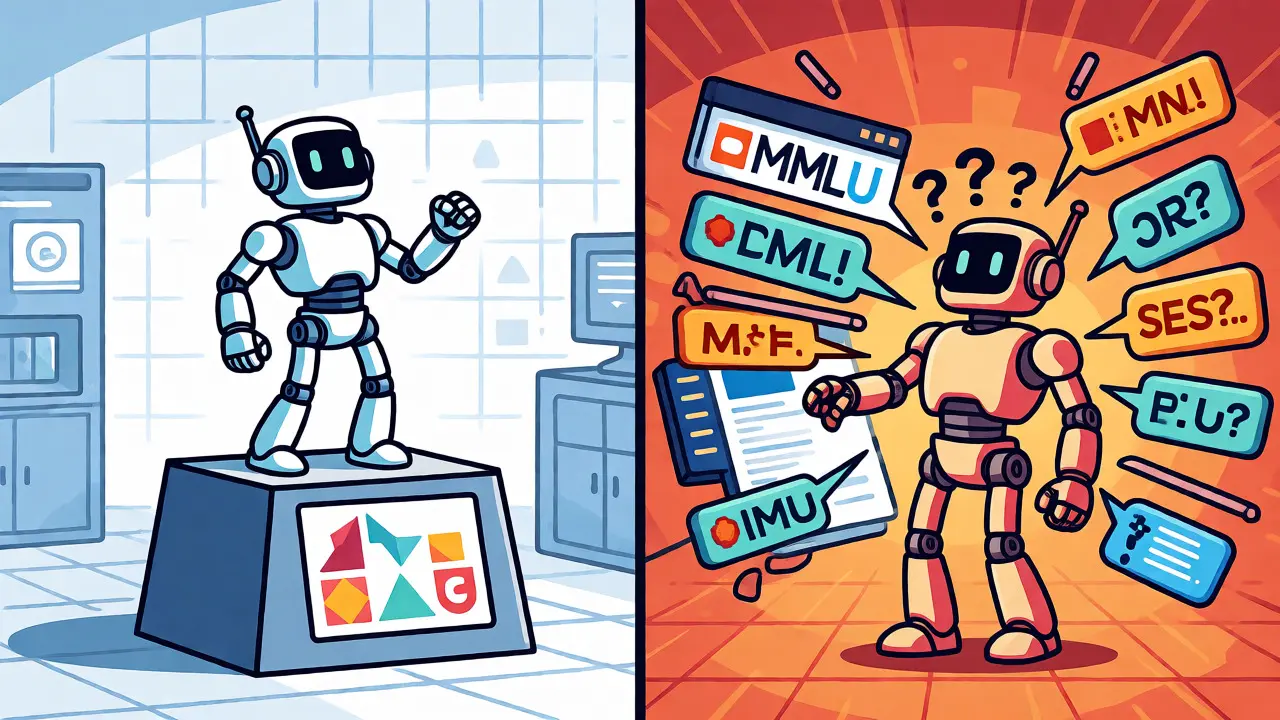
You spent weeks curating data, tweaking hyperparameters, and watching loss curves drop. Your fine-tuned Large Language Model (LLM) looks great in the validation set. But does it actually work when real users start typing? That’s the million-dollar question. Evaluating a fine-tuned LLM is not like checking if a calculator adds numbers correctly. It’s messy, subjective, and often deceptive if you rely on the wrong metrics.
Most teams fall into the trap of using generic benchmarks that don’t reflect their specific use case. They see a high score on MMLU and assume they’re ready for production. Then, a customer asks a niche question, and the model hallucinates wildly or refuses to answer politely. To avoid this, you need a tailored evaluation protocol. You must measure what matters for your specific task, not just general intelligence. Here is how to build a robust evaluation framework that catches issues before your users do.
The Trap of Generic Benchmarks
When you pre-train a model, you care about broad language understanding. Benchmarks like MMLU (Massive Multitask Language Understanding) are fantastic for that. They test multiple-choice questions across dozens of subjects. But once you fine-tune, your goal shifts. You aren’t trying to prove your model knows history; you’re trying to prove it can write support tickets in your company’s tone or summarize legal contracts accurately.
Perplexity, a common metric derived from these benchmarks, measures how surprised a model is by a sequence of words. Low perplexity means the model predicts the next word confidently. Sounds good, right? Not always. A model can have low perplexity on training data but fail completely on new, complex instructions. Perplexity tells you about fluency, not utility. If you only look at perplexity, you might deploy a model that sounds smooth but gives factually incorrect answers. This is why relying solely on traditional NLP benchmarks is risky for application-specific models.
Automatic Metrics: ROUGE and Beyond
For tasks with clear reference outputs, like summarization or translation, automatic metrics still have a place. The ROUGE (Recall-Oriented Understudy for Gisting Evaluation) family is the standard here. ROUGE-1 checks if your generated summary contains the same individual words as the human-written reference. ROUGE-2 looks at two-word phrases. These metrics are fast and cheap to compute.
But ROUGE has a glaring weakness: it doesn’t understand meaning. If your model says "The car was fast" and the reference says "The vehicle was speedy," ROUGE might give a low score because the words don’t match exactly, even though the meaning is identical. Conversely, a model could generate gibberish that happens to share many keywords with the reference and get a high score. Use ROUGE as a sanity check, not a final verdict. For more nuanced semantic matching, consider embedding-based similarity scores, which capture meaning better than simple keyword overlap.
The Rise of LLM-as-a-Judge
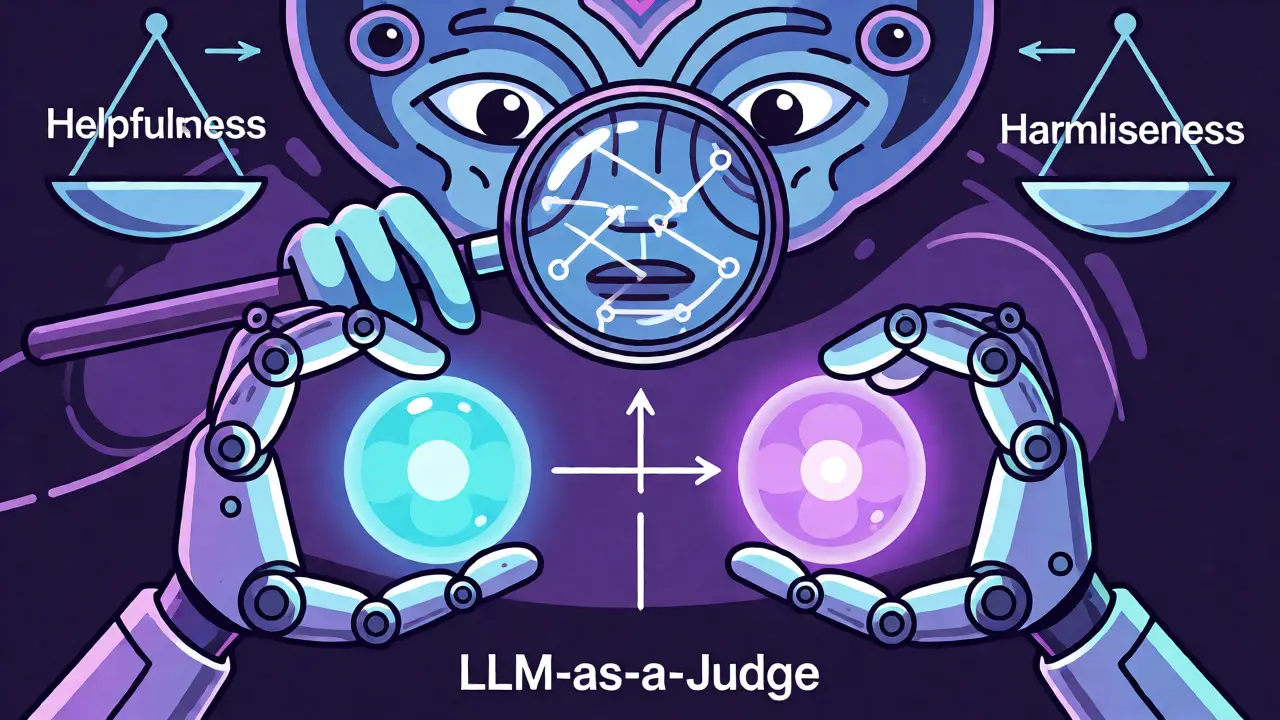
This is where things get interesting. How do you evaluate open-ended generation where there is no single correct answer? Enter the LLM-as-a-Judge (a paradigm where a powerful LLM evaluates the outputs of another model). Instead of comparing strings, you ask a strong model (like GPT-4o or Claude 3.5 Sonnet) to rate your fine-tuned model’s output based on specific criteria.
Models like Prometheus (an open-source language model specifically designed for evaluating other LLMs) take this further. Prometheus is trained on diverse datasets to mimic human judgment. It uses a Likert scale (1-5) to score helpfulness, coherence, and safety. This approach scales well. You can run thousands of evaluations automatically overnight. However, judges have biases too. They might prefer longer answers or those written in a specific style. To mitigate this, use pairwise comparison: show the judge two outputs and ask which is better, rather than asking for an absolute score. This reduces variance and makes the evaluation more reliable.
| Metric Type | Best For | Pros | Cons |
|---|---|---|---|
| Perplexity | Fluency & Pre-training | Fast, objective, no reference needed | Doesn't measure factual accuracy or instruction following |
| ROUGE | Summarization/Translation | Standardized, easy to implement | Misses semantic equivalence, sensitive to phrasing |
| LLM-as-a-Judge | Open-ended Generation | Scalable, captures nuance and intent | Costly, potential judge bias, requires careful prompting |
| HELM | Holistic Safety/Fairness | Covers bias, toxicity, and robustness | Complex setup, may not align with niche tasks |

Measuring Safety, Bias, and Toxicity
A model can be accurate but dangerous. If your fine-tuned assistant starts making offensive remarks or leaking private data, accuracy doesn’t matter. You need explicit protocols for safety. The HELM (Holistic Evaluation of Language Models) framework is a great resource here. It goes beyond accuracy to measure fairness, bias, and toxicity. While HELM is broad, you can adapt its principles for your custom dataset.
Create a "red teaming" subset in your evaluation data. Include edge cases where users try to trick the model into being rude, biased, or unsafe. Use classifiers or specialized judges to flag toxic responses. For example, if you fine-tuned a model for healthcare advice, ensure it doesn’t dismiss symptoms or provide contradictory information. Measuring "helpfulness" isn’t enough; you must measure "harmlessness." This dual focus ensures your model is both useful and safe for deployment.
Practical Steps for a Robust Protocol
So, what should you actually do? Start by isolating your test set. Never evaluate on data used during fine-tuning. Data leakage inflates scores and hides real-world performance gaps. Next, define your success criteria clearly. Is speed important? Is strict format adherence required? Build your evaluation pipeline around these constraints.
- Curate Representative Data: Don’t just use random samples. Pick examples that reflect the hardest parts of your user queries. If your app handles complex multi-turn conversations, your eval set must include multi-turn contexts.
- Blend Human and Automated Checks: Use LLM judges for volume, but spot-check results with human annotators. Humans catch subtle errors that AI judges miss, especially regarding context and sarcasm.
- Monitor Drift Post-Deployment: Evaluation doesn’t stop at launch. Monitor live traffic for changes in input distribution. If users start asking different types of questions, your model’s performance might degrade. Set up alerts for drops in automated quality scores.
Remember, there is no one-size-fits-all metric. A code-generation model needs exact syntax matching. A creative writing model needs diversity and flair. Align your metrics with your business goals. If you skip this step, you’ll end up optimizing for a number that doesn’t correlate with user satisfaction.
Why is perplexity not enough for evaluating fine-tuned models?
Perplexity measures how well a model predicts the next token in a sequence, focusing on fluency and statistical likelihood. It does not assess whether the model followed instructions, remained factually accurate, or maintained the desired tone. A model can have low perplexity while producing irrelevant or incorrect content, making it insufficient for judging practical utility in specific tasks.
What is the main advantage of LLM-as-a-Judge over ROUGE?
LLM-as-a-Judge evaluates semantic quality, coherence, and adherence to instructions, whereas ROUGE relies on lexical overlap (keyword matching). ROUGE fails to recognize paraphrasing or synonyms, often penalizing correct answers that use different wording. LLM judges can understand context and nuance, providing a more accurate assessment for open-ended generation tasks where multiple valid answers exist.
How do I prevent data leakage during evaluation?
Ensure a strict separation between training, validation, and test datasets. Data used for fine-tuning (training/validation) must never appear in the test set. Additionally, check for near-duplicates using semantic similarity tools, as slight variations of the same query in both sets can artificially inflate performance scores. Cross-validation techniques help verify that improvements are due to fine-tuning rather than memorization.
Should I use human evaluation or automated metrics?
Use a hybrid approach. Automated metrics (like LLM judges) allow you to scale evaluations across thousands of examples quickly and consistently. Human evaluation provides ground truth for critical edge cases and helps calibrate the automated judges. Relying solely on humans is expensive and slow; relying solely on automation risks missing subtle contextual errors. Combining both balances cost, speed, and reliability.
What role does HELM play in LLM evaluation?
HELM (Holistic Evaluation of Language Models) provides a standardized framework for assessing models across multiple dimensions, including accuracy, calibration, robustness, fairness, bias, and toxicity. While it is comprehensive, it is broad. Developers often use HELM’s methodologies to structure their own custom evaluations, ensuring they don’t overlook critical safety and fairness metrics alongside task-specific performance.