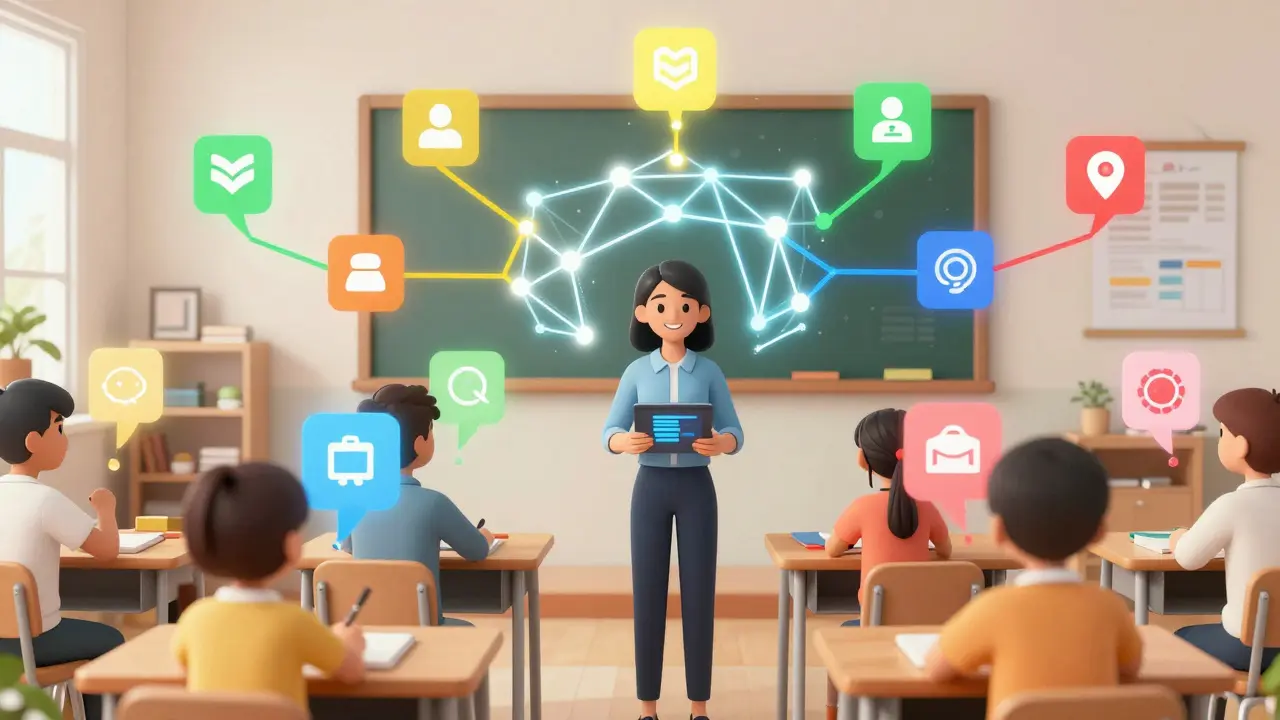
Imagine a classroom where every student gets a tutor who knows exactly what they’re struggling with-right down to the specific word they keep mispronouncing or the math concept they’ve misunderstood for three weeks. No, it’s not a fantasy. It’s happening right now, thanks to large language models in education. These AI systems aren’t just answering questions; they’re building custom learning paths for each student, adapting in real time as they progress, stumble, or surprise themselves.
How LLMs Create Personalized Learning Paths
Large language models don’t teach like humans. They don’t memorize lesson plans or recall last week’s quiz scores. Instead, they analyze patterns. Every time a student types a response, clicks on a hint, or re-reads a paragraph, the model takes note. It tracks speed, errors, word choice, and even hesitation. From that, it builds a profile: this student learns better with visuals, that one needs more examples before grasping abstract ideas, another thrives when challenged with open-ended questions.
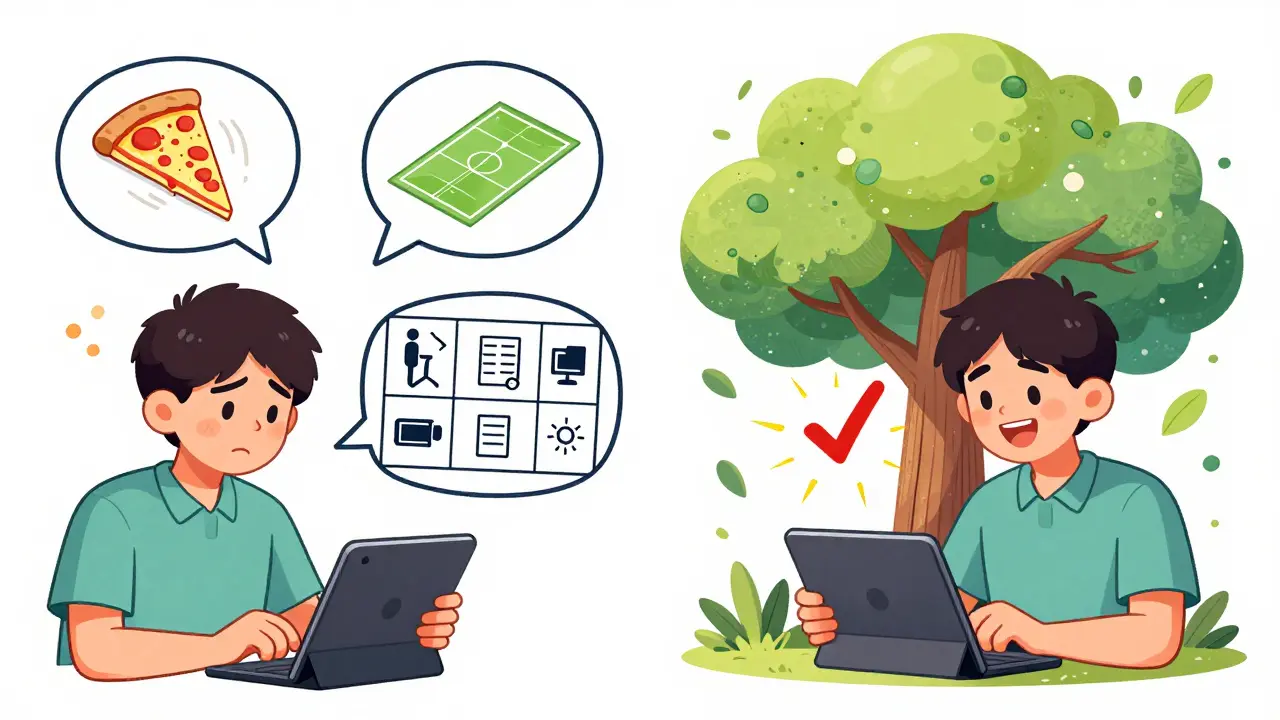
Platforms like SchoolAI and NeuroBot TA use this data to generate dynamic learning paths. A student who struggles with fractions might get a series of bite-sized exercises with real-world analogies-pizza slices, measuring cups, sports scores. Once they master that, the system doesn’t just move on. It checks if they can apply fractions to decimals, then to percentages, then to word problems. If they get stuck again, it loops back with a different explanation, maybe using a video or a game-like quiz.
This isn’t just repetition. It’s adaptation. The model learns from each interaction. If a student consistently skips ahead without answering, the system adjusts: maybe they’re bored, or maybe they’re overwhelmed. The path changes. That’s something no textbook or standard curriculum can do.
What Makes LLM Tutoring Different from Other Tools
You’ve probably used Khan Academy or DreamBox. They’re great. But they follow fixed paths. If you’re stuck on quadratic equations, you get the same video and practice set as every other student who got stuck there. There’s no conversation. No flexibility.
LLM-powered tutoring is different because it talks. It asks follow-up questions. It adjusts tone. It can explain a concept in three different ways until one clicks. A student might say, “I don’t get why this formula works,” and the AI responds: “Let’s think about it like a recipe. You need the right ingredients in the right order. What if we swapped two steps?” That kind of back-and-forth is what makes it feel personal.
Compare that to adaptive platforms: they change difficulty levels based on scores. LLMs change how they teach based on how you think.
The Real-World Impact in Classrooms
In a 2025 study at Dartmouth, Professor Thomas Thesen used NeuroBot TA to tutor 190 medical students in neuroscience-all at once. Each student got a different set of questions, explanations, and practice problems based on their prior knowledge and mistakes. The result? Students retained 37% more information over a 6-week period compared to those using traditional lectures.
But it’s not just about test scores. In Denver Public Schools, a special education teacher reported that her dyslexic students, who previously avoided reading assignments, were now completing grade-level texts thanks to SchoolAI’s text-simplification feature. The AI didn’t just shorten sentences. It replaced complex vocabulary with familiar words, kept the same structure, and even added context clues-like explaining “mitochondria” as “the power plant of the cell” instead of using jargon.
Teachers are saving 2-3 hours a week on lesson planning and grading. One high school teacher in Ohio said she used to spend 45 minutes rewriting the same feedback for 28 students on their essays. Now, the AI drafts it, and she just tweaks the tone. “It’s like having a co-teacher who never sleeps,” she told a local education blog.
Where LLMs Fall Short
But here’s the catch: they’re not perfect. And pretending they are is dangerous.
LLMs hallucinate. That means they make up facts that sound real. A student asked about a rare neurological disorder, and the AI gave a detailed, confident answer-except it didn’t exist. The student spent hours studying the wrong thing. That’s not a glitch. It’s a risk built into how these models work. They predict text, not truth.
They also miss emotional cues. A student might be frustrated, confused, or overwhelmed-but the AI can’t read their face, their sigh, or the way they pause before typing. Human tutors catch that 89% of the time. LLMs? Only 43%. That’s why the most successful classrooms pair AI with teacher check-ins. The AI handles repetition. The teacher handles the heart of learning.
And then there’s bias. A 2025 MIT study found LLMs were 23% less accurate when answering questions from non-native English speakers. Why? Because most training data came from native speakers. The model didn’t understand the way those students phrased things. It assumed wrong. That’s not just a technical flaw-it’s an equity issue.
What Teachers and Students Need to Know
If you’re a teacher: don’t let the AI replace your judgment. Use it to scale what you already do well. Start small. Use it to draft parent emails or simplify reading material. Then move to generating practice questions. Only after that should you let it tutor students directly. And always, always verify its answers.
If you’re a student: treat AI like a smart friend who sometimes gets things wrong. Ask follow-up questions. Double-check facts. If it gives you an answer that feels off, trust your gut. Look it up. Talk to your teacher. AI isn’t the authority-it’s a tool.
For schools: training matters. A 12-hour professional development module is no longer optional. Teachers need to learn prompt engineering, how to spot hallucinations, and how to use AI ethically. Twenty-eight U.S. states now require this certification. It’s not a luxury. It’s a necessity.
The Future Isn’t Replacing Teachers-It’s Empowering Them
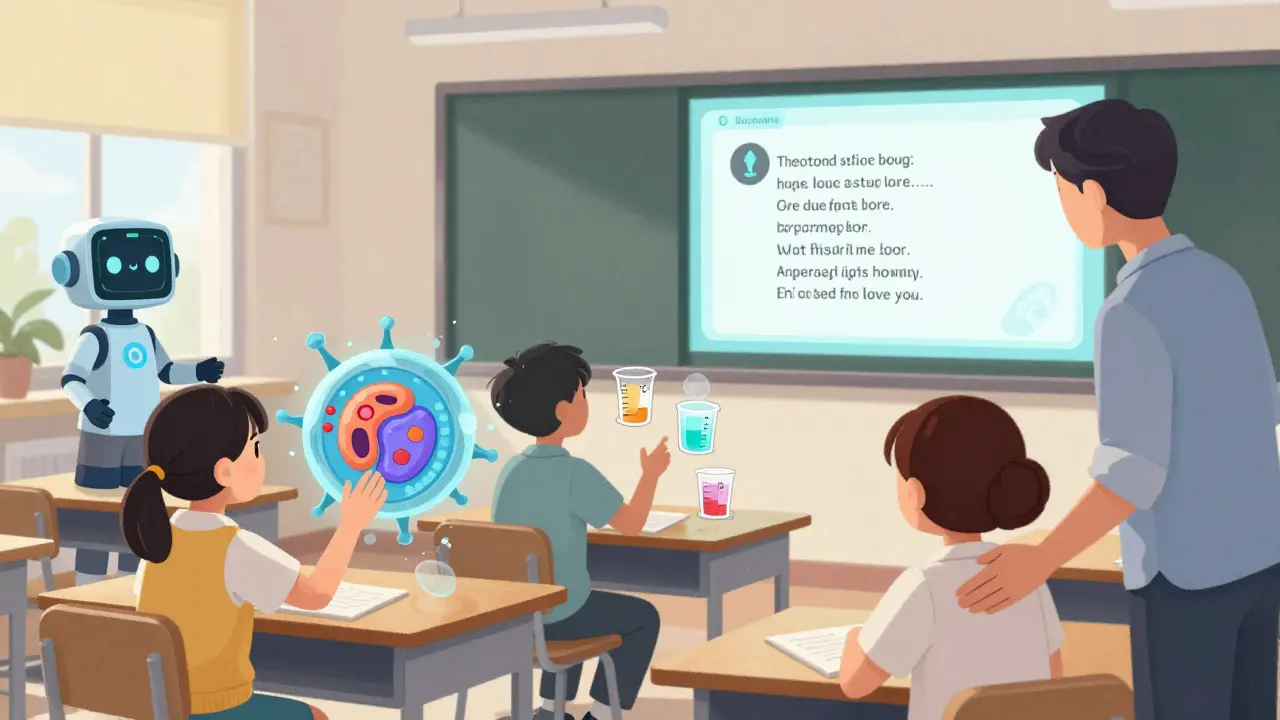
The goal isn’t to have AI teach every child. The goal is to free teachers from the grind so they can do what only humans can: inspire, challenge, comfort, and push students beyond what they think they’re capable of.
Imagine a classroom where the AI handles the repetitive work-grading quizzes, adjusting reading levels, answering basic questions. That leaves the teacher free to lead a deep discussion on ethics, help a student through a personal crisis, or simply sit with someone who’s feeling lost.
That’s the real promise. Not magic. Not automation. But augmentation. The right tool, in the right hands, can make education more personal, more fair, and more human than ever before.
What’s Next for LLMs in Learning
The next wave of educational AI won’t just answer questions-it’ll ask better ones. Researchers are already testing systems that guide students to discover answers themselves. Instead of saying, “The answer is 42,” the AI might say, “What if you tried plugging in 3? What happens?” That’s how real learning happens: through struggle, not spoon-feeding.
Future tools will also track progress over months, not just days. They’ll notice that a student who aced algebra last semester is now struggling with geometry-not because they’re lazy, but because they’re dealing with anxiety at home. The AI won’t fix that. But it can alert the teacher: “This student’s confidence score dropped 40% in three weeks.”
And soon, these models will combine text with images, audio, and even simple simulations. Imagine a student learning about photosynthesis not just by reading, but by manipulating a virtual plant in 3D, watching how light changes its growth. That’s the future-and it’s already being tested in labs.
The key? Keep humans in the loop. Always.
Can large language models replace teachers?
No. LLMs can’t replace teachers. They lack emotional intelligence, ethical judgment, and the ability to build trust. A student who’s crying over a failed test needs a human who can say, “I’ve been there. Let’s figure this out together.” AI can generate practice problems, but it can’t offer comfort. Teachers provide context, care, and curiosity. AI just provides content.
Are LLMs accurate enough for education?
It depends on the task. For vocabulary, factual recall, or grammar checks, accuracy can hit 95%. But for complex problem-solving-like advanced math or scientific reasoning-error rates jump to 50-79%. A 2026 study found LLMs gave incorrect answers to 68% of chemistry lab questions. That’s why verification is mandatory. Always double-check. Never trust AI blindly.
How do schools protect student data when using LLMs?
Reputable platforms like SchoolAI and NeuroBot TA comply with FERPA and COPPA regulations. They use end-to-end encryption, anonymize student data, and don’t store personal identifiers. Schools must also sign data-sharing agreements and limit AI access to only necessary information. Still, no system is foolproof. Parents and educators should ask: Where is the data stored? Who can access it? Is there an audit trail? Transparency matters.
Is this technology only for wealthy schools?
No. In fact, LLMs have the biggest impact in under-resourced schools. A Dartmouth study found AI tools increased access to personalized instruction by 300% in overcrowded classrooms where teacher-to-student ratios were 35:1. Platforms like SchoolAI are free for teachers, and many districts provide devices and Wi-Fi access. The real barrier isn’t cost-it’s training. Teachers need time and support to use these tools well.
What should parents know about AI tutoring?
Parents should understand that AI tutoring isn’t magic. It’s a tool that works best when supervised. Ask your child’s school: How is AI being used? Is student work being reviewed by a human? Are there safeguards against bias or misinformation? Encourage your child to question what the AI says. The goal isn’t to get the right answer-it’s to learn how to think.
Gareth Hobbs
March 24, 2026 AT 17:56Zelda Breach
March 25, 2026 AT 08:41michael Melanson
March 25, 2026 AT 21:44lucia burton
March 26, 2026 AT 10:15Colby Havard
March 28, 2026 AT 03:44Denise Young
March 29, 2026 AT 06:35Sam Rittenhouse
March 30, 2026 AT 10:25