
Most companies pick their Large Language Model (LLM) based on how well it answers trivia questions. They look at scores on general knowledge tests like ARC-e or MMLU. Then they deploy that model to handle sensitive customer support tickets, internal HR policies, or complex legal contracts. The result? Disappointment. The model that aced the quiz fails to find a conference room booking policy or misinterprets a software request.
This gap exists because standard benchmarks measure general intelligence, not business utility. An enterprise doesn't need a model that knows which factor causes a fever; it needs one that understands your specific organizational hierarchy and data silos. Creating custom benchmarks for enterprise large language model use cases bridges this divide. It shifts the focus from abstract capability to concrete business value.
Why Standard Benchmarks Fail in Business Contexts
Traditional LLM evaluations operate in a vacuum. They assume static inputs, controlled environments, and clear-cut right-or-wrong answers. Enterprise reality is messy. Your data changes daily. Regulatory requirements shift. User intent is often ambiguous. When you evaluate a model using only public datasets, you are measuring its ability to pass a test, not its ability to do your job.
The core problem is a lack of specificity. General benchmarks miss three critical dimensions of enterprise work:
- Domain Nuance: Internal jargon, specific product codes, and unique procedural steps aren't in training data.
- Multi-Step Reasoning: Business tasks rarely fit into a single prompt-response cycle. They require chaining tools, retrieving documents, and maintaining context over long conversations.
- Risk Tolerance: In a chatbot, a wrong fact is annoying. In a compliance report, it's a liability. Standard metrics don't capture the cost of failure.
Organizations like Moveworks have highlighted this disconnect by creating proprietary frameworks. Their research showed that models fine-tuned on enterprise-specific tasks could match the performance of much larger general-purpose models (like GPT-4) while running at a fraction of the computational cost. This isn't just about accuracy; it's about efficiency and relevance.
Defining Your Evaluation Dimensions
Before writing a single test case, you must define what "good" looks like for your specific use case. You can't rely on generic metrics like BLEU or ROUGE alone. These automated scores often reward robotic phrasing and fail to detect hallucinations or tone mismatches. Instead, build a multi-dimensional framework tailored to your operations.
Consider these five essential themes for enterprise evaluation:
- Generation Quality: Does the output sound like your brand? Is it helpful, concise, and free of fluff?
- Reasoning Accuracy: Can the model follow logical steps to solve a problem, such as troubleshooting a technical issue based on a knowledge base?
- Relevance & Grounding: If using Retrieval-Augmented Generation (RAG), does the answer stick strictly to the provided context? Does it cite sources correctly?
- Extraction Precision: For structured data tasks, does the model pull the correct fields (e.g., invoice numbers, dates) without error?
- Classification Consistency: Does it correctly categorize user intents (e.g., "refund request" vs. "technical support") across varied phrasings?
Each dimension requires different metrics. For extraction, you might use F1 scores. For generation, you need human judgment or advanced LLM-based scoring. Mixing these creates a holistic view of performance rather than a single misleading number.
Building the Dataset: From Raw Data to Test Cases
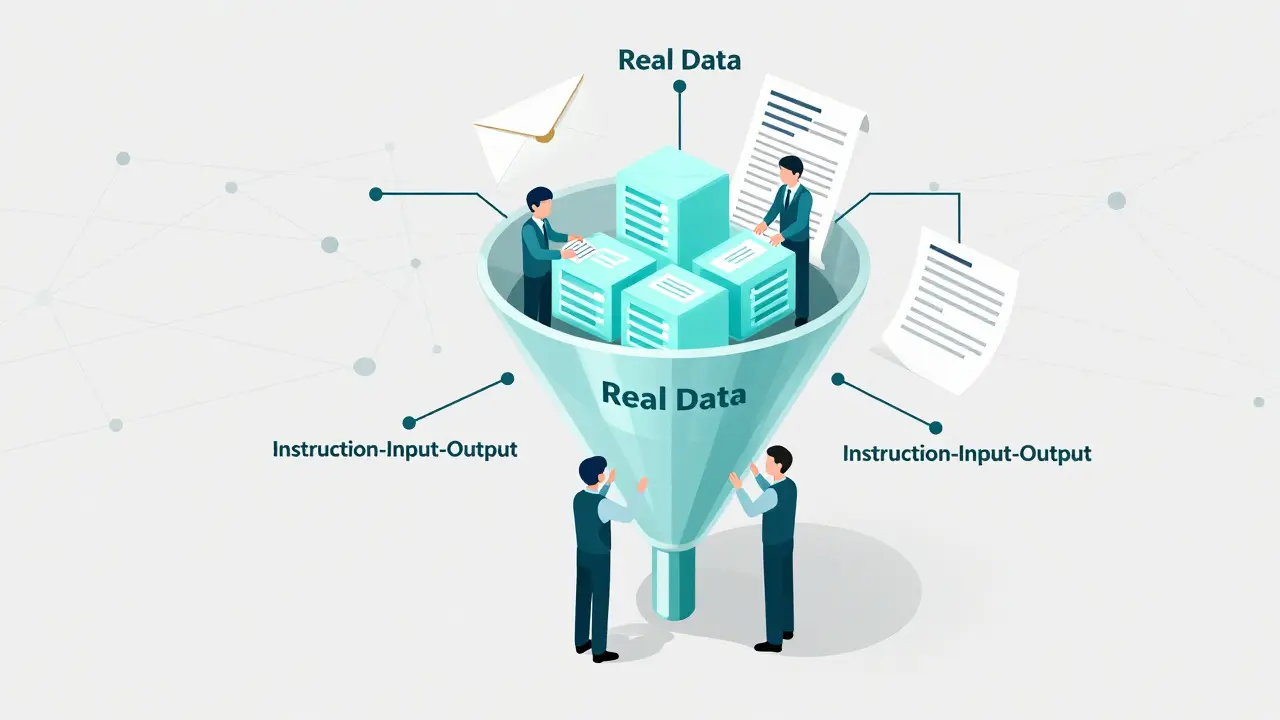
A custom benchmark is only as good as its data. You cannot create a meaningful enterprise benchmark using synthetic examples generated by an AI. You need real-world signals. Start by anonymizing your internal data-emails, support tickets, policy documents, and chat logs.
The goal is to create "instruction-input-output trios." This format standardizes evaluation. For example:
- Instruction: "Find the return policy for item #12345 shipped to Canada."
- Input: [Context from your CRM and Policy Database]
- Expected Output: "Returns for Canadian orders must be initiated within 14 days via our portal. Shipping costs are non-refundable unless the item is defective."
Moveworks utilized a dataset of 70,000 such instructions derived from real enterprise interactions. This volume matters. Label Studio recommends starting with 200 to 1,000 custom examples to capture corner cases and diverse user behaviors. At scale, aim for 1,000+ examples to ensure statistical significance.
Involve domain experts in this process. Have customer support leads, legal counsel, and engineers review the expected outputs. They will spot nuances that data scientists miss, such as subtle regulatory constraints or preferred communication tones. This collaborative approach ensures the benchmark reflects actual business success criteria, not just technical feasibility.
Evaluating Beyond Automation: The Role of LLM-as-a-Judge
Human evaluation is the gold standard but doesn't scale. Reading thousands of responses manually is impossible for continuous integration pipelines. This is where the "LLM-as-a-Judge" approach becomes vital. You use a powerful, trusted LLM to grade the outputs of your candidate models.
However, this method has pitfalls. Models can exhibit bias toward their own outputs or prefer verbose answers. To mitigate this, design robust rubrics. Instead of asking "Is this good?", ask specific questions:
- "Does the response adhere to the company's formal tone guidelines?"
- "Are all claims supported by the provided context snippets?"
- "Does the response avoid mentioning confidential internal project names?"
Platforms like Galileo AI have popularized this by enabling custom metrics at scale. They allow you to automate subjective assessments like "brand voice adherence" or "safety compliance." This hybrid approach-automated scoring guided by human-defined rubrics-provides speed without sacrificing depth. Remember to periodically validate the judge's decisions against human reviews to prevent drift.
Technical Metrics That Matter for Enterprise Readiness
Beyond content quality, your benchmark must assess technical readiness. An accurate model is useless if it crashes under load or takes 30 seconds to respond. TechTarget emphasizes evaluating flexibility, scalability, and risk dimensions alongside performance.
| Metric Category | Specific Measure | Why It Matters |
|---|---|---|
| Performance | Latency (Time to First Token) | Impacts user experience in real-time chat interfaces. |
| Scalability | Throughput (Requests per Second) | Determines cost-efficiency during peak usage periods. |
| Reliability | Error Rate on Structured Prompts | Critical for API chaining and automated workflows. |
| Security | Prompt Injection Resistance | Measures vulnerability to adversarial attacks. |
| Context Handling | Long-Context Recall Accuracy | Essential for summarizing lengthy contracts or logs. |
Include red teaming benchmarks in this phase. Test the model against adversarial prompts designed to extract sensitive data or generate harmful content. This isn't optional for enterprise deployment. Compliance frameworks like GDPR and HIPAA require demonstrable safety controls. Your benchmark should include a suite of attack vectors to verify that guardrails hold under pressure.

Implementing Continuous Benchmarking
Model performance degrades over time. New data emerges, regulations change, and user behavior evolves. A one-time benchmark is obsolete by the time production launches. You need a continuous evaluation loop.
Integrate your custom benchmark into your CI/CD pipeline. Every time you update your retrieval index, tweak your prompt templates, or switch underlying models, run the benchmark automatically. Set thresholds for acceptable performance drops. If the new version scores below 95% on your "Policy Accuracy" metric, block the deployment.
This approach aligns with the concept of ModelOps. It treats model evaluation as a living process. Monitor drift in usage patterns. If users start asking different types of questions, add those scenarios to your benchmark dataset. Regularly refresh your test cases to reflect current business priorities. This ensures your AI system remains aligned with organizational goals, not just historical data.
Cost Optimization Through Specialization
One surprising benefit of custom benchmarking is cost reduction. Many enterprises default to the largest, most expensive models available, assuming bigger is better. However, benchmarking reveals that smaller, fine-tuned models often outperform giants on specific tasks.
Moveworks found that their proprietary MoveLM, when tuned on enterprise data, matched GPT-4 levels of performance on internal tasks despite being significantly smaller. This means lower inference costs and faster response times. By identifying exactly which capabilities matter for your use case, you can select the most cost-effective model architecture. You might use a small open-source model for classification tasks and reserve a large commercial API for complex reasoning. This tiered strategy, informed by precise benchmarking, optimizes both budget and performance.
Next Steps for Implementation
Start small. Pick one high-ROI use case, such as internal IT support or customer FAQ handling. Gather 500 real interaction examples. Define three key success metrics (e.g., accuracy, tone, speed). Run your current model against this set. Document the failures. Use those insights to refine your prompts, improve your RAG retrieval, or consider fine-tuning. Iterate. The goal isn't perfection on day one; it's establishing a measurable baseline that connects AI performance directly to business outcomes.
How many test cases do I need for a reliable enterprise benchmark?
Aim for at least 200 to 1,000 custom examples to start. This range captures enough diversity to identify edge cases and user behavior patterns. For comprehensive coverage across multiple domains, scale up to 1,000+ examples. Ensure these cases are derived from real, anonymized enterprise data rather than synthetic generation.
Can I use standard metrics like BLEU for enterprise LLM evaluation?
Standard metrics like BLEU or ROUGE are insufficient for enterprise use. They measure surface-level text similarity and often fail to detect hallucinations, tone issues, or factual errors. Use them only for basic translation or summarization tasks. For broader evaluation, combine F1 scores for extraction with LLM-as-a-Judge approaches for qualitative assessment.
What is the role of RAG in custom benchmarking?
Retrieval-Augmented Generation (RAG) grounds LLM outputs in verified enterprise data. Your benchmark must evaluate not just the final answer, but the retrieval process. Check if the model retrieves the correct documents and cites them accurately. Poor retrieval leads to hallucinations, so benchmarking RAG compatibility and context window utilization is critical.
How do I ensure my benchmark stays relevant over time?
Implement continuous benchmarking integrated into your development pipeline. Update your test cases regularly with new real-world interactions. Monitor for performance drift as business contexts change. Periodically re-validate your evaluation rubrics with domain experts to ensure they still reflect current business priorities and regulatory requirements.
Is it worth fine-tuning a smaller model instead of using a large general-purpose one?
Yes, often. Research shows that smaller models fine-tuned on enterprise-specific data can match the performance of larger general-purpose models on specialized tasks. This approach reduces computational costs and latency while improving relevance. Custom benchmarking helps identify which tasks benefit from specialization versus those requiring general intelligence.