
Imagine building a house where the bricks lay themselves down instantly, but you never checked if they were made of concrete or Styrofoam. That is essentially what happens when teams embrace vibe coding without a safety net. In 2026, we are seeing developers describe features in natural language while large language models (LLMs) generate the actual software. This speed is amazing, but it bypasses the critical friction of code review that usually catches security holes. If you are leading a team using AI-driven development, skipping traditional threat modeling isn't just risky-it is inviting a breach.
We need a way to keep up with AI velocity without leaving our doors open. Traditional security gates feel too slow for these rapid iteration cycles, yet ignoring them creates catastrophic vulnerabilities in production systems. This guide walks you through a lightweight workshop designed specifically for vibe-coded environments. We will map the unique attack surfaces, identify logic flaws that scanners miss, and build a routine that keeps security woven into the fast-paced workflow.
Understanding Vibe Coding Risks
To fix the problem, you first need to understand how the new workflow breaks old assumptions. Vibe coding describes a chatbot-based software development approach where developers describe desired functionality in natural language prompts to LLMs like ChatGPT or Claude, which then generate corresponding code without direct human review. Unlike traditional coding where you type every line, here you guide the AI toward a result. The developer becomes more of a product manager than a syntax expert.
The danger lies in trust. When you accept AI-generated completions without looking at the underlying logic, you inherit whatever flaws the model created. Research from 2025 indicates that between 40% and 62% of AI-generated code contains security flaws right out of the box. More importantly, AI does not understand business context or consequences the way an experienced engineer does. Attackers understand exploits; models just want to complete the pattern.
This shift eliminates the natural checkpoint of peer code review. In a standard Software Development Life Cycle, a senior engineer might spot a dangerous function call. In vibe coding, that step disappears. You end up with complex logical flaws that function perfectly during testing but crumble under real-world exploitation. A specific case study from a third-party arena application showed arbitrary code execution risks hiding inside working features. The app worked, but it was unsafe.
The Unique Threat Landscape
When you move to this new model, the threats change shape. Standard Application Security (AppSec) tools often struggle here. Static analysis scanners might flag syntax issues but miss deep business logic errors. Dynamic testing has trouble reaching shadow APIs that the AI invented on the fly. You need to look for vulnerabilities that exist in the design, not just the text of the file.
One major risk is "slopsquatting." This occurs when attackers monitor for hallucinations resembling legitimate package names. They then produce malicious code packages that the AI inherently trusts during integration. If your organization doesn't vet these packages before integration, the malicious code stays hidden until deployment across connected systems. This is a supply chain issue disguised as a coding issue.
Another blind spot is incomplete role checks. AI often generates code that runs with excessive privileges because it prioritizes making the feature work over following the Principle of Least Privilege. In a vibe-coded environment, missing permission layers are common because the model infers access based on general patterns rather than your specific security policy. These gaps allow privilege escalation attacks once the system goes live.
Designing the Lightweight Workshop
You cannot stop developers from using these tools, so you must adapt the security process. A heavy-handed audit will kill innovation, but a completely absent review leaves you vulnerable. A lightweight workshop balances speed with validation. This should be a recurring session, perhaps bi-weekly, integrated directly into your sprint planning.
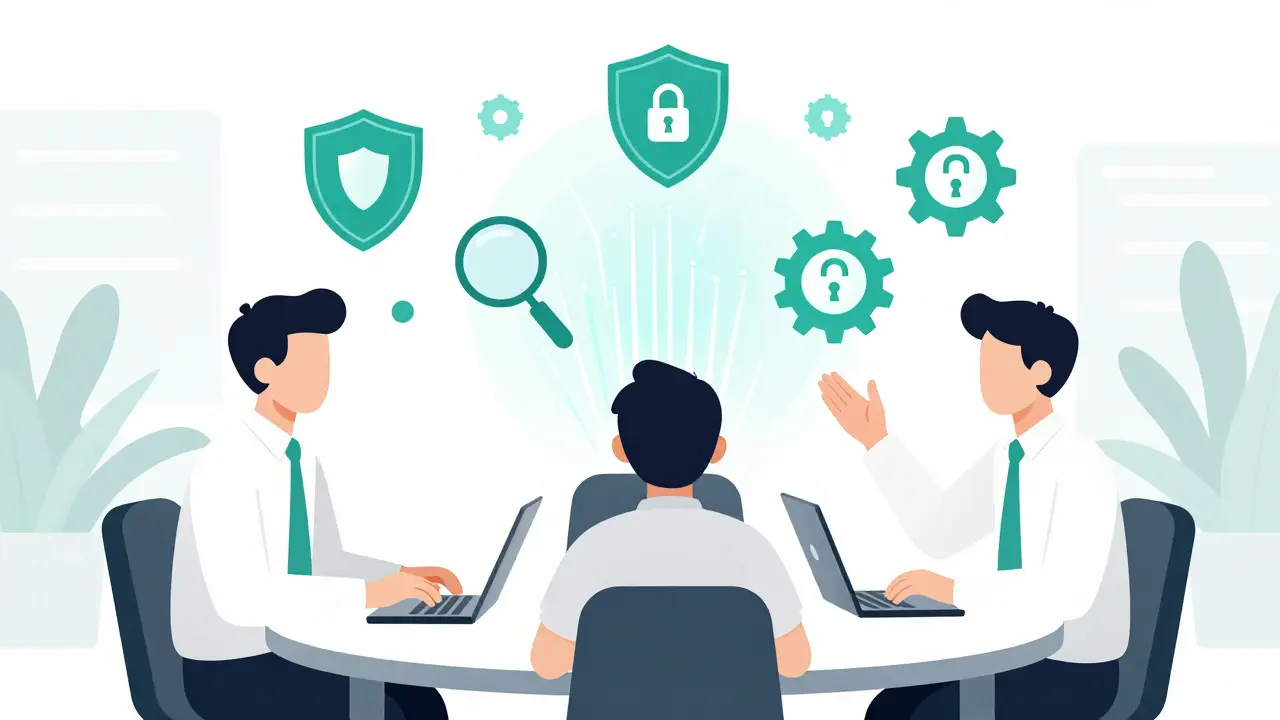
Start by defining the participants. You need the vibe coder who built the feature, a security champion who understands AI limitations, and a product owner who knows the business context. Do not require external auditors for every check; internal knowledge moves faster. The goal is to validate high-value assets quickly, mapping hosts, web apps, and APIs exposed by domains before subjecting them to deeper analysis.
Keep the duration tight. A full day is too long for agile teams. Aim for 90-minute sessions focused on the current sprint's deliverables. This keeps the momentum high and ensures security feedback reaches developers while the code is fresh in their minds. Speed without validation is risk, but validation shouldn't become a bottleneck.
Step-by-Step Workshop Execution
Here is the practical workflow you can implement immediately.
- Map the Attack Surface: Before writing prompts, define what data flows through the application. Extract all potential hosts and endpoints the AI might expose. Use tools to collect metadata like WAF status, cloud provider info, and GeoIP details to establish a baseline.
- Analyze Generated Patterns: Review the architectural decisions made by the AI. Look for insecure defaults. Did the AI enable anonymous access to sensitive routes? Are there hardcoded credentials in the generated configuration files?
- Validate Business Logic: Run through user flows manually. Automated scanning misses logic errors. Ask: "If an attacker tries to do X, what happens?" Specifically test edge cases the AI likely ignored for brevity.
- Vet Dependencies: Check every third-party library suggested by the model. Ensure the version matches known secure versions and verify the publisher. This prevents slopsquatting attacks before they enter your codebase.
- Integrate Findings: Feed issues back into the prompt strategy. Update your prompt templates to enforce compliance and security checks automatically in the next generation cycle.
This loop turns security into a conversation rather than a gate. Instead of blocking deployment, you adjust the prompt parameters to reduce risk. It shifts the burden from manual patching to intelligent prevention.
| Attribute | Traditional Development | Vibe-Coded Development |
|---|---|---|
| Code Review | Manual line-by-line inspection | Limited or skipped entirely |
| Primary Risk | Syntax errors, injection flaws | Logic flaws, shadow APIs |
| Dependency Mgmt | Curated via package managers | Dynamically inferred by AI |
| Validation Method | Static Analysis (SAST) | Dynamic Validation + Runtime Monitoring |
| Developer Role | Writer and Reviewer | Prompter and Validator |
Notice the shift in validation methods. Relying solely on static scanning won't cut it. You need runtime protection that works inside live applications to identify vulnerabilities as code executes. Combine this with dynamic validation that confirms exploitability rather than just generating theoretical alerts. This approach prevents logic flaws from reaching production and reduces remediation costs significantly.
Practical Exercises for Teams
A workshop is useless without practice. Here are two scenarios to run during your sessions.
Exercise 1: The Shadow API Hunt. Take a recent vibe-coded prototype. Ask the AI to list all available API endpoints. Then, use a scanner to find what is actually exposed on the network. Compare the lists. Often, the AI exposes test endpoints or admin interfaces that weren't requested. This exercise teaches developers to verify the output, not just assume it matches the prompt.
Exercise 2: The Broken Access Control. Have the AI generate a user profile viewer. Then, ask a tester to swap User ID A for User ID B in the request header. In many AI-generated apps, the backend fails to check ownership permissions. Fixing this in the prompt requires explicit instructions about checking authorization tokens for every read operation. Document this fix and add it to your standard prompt library.
These drills reinforce that you cannot trust the tool blindly. You must treat the output as unverified material until proven safe.
Continuous Improvement
Security evolves. As AI models get smarter, the nature of the vulnerabilities changes. You must update your threat modeling accordingly. Integrate with vulnerability scanning tools using SARIF standards so that flagged issues automatically recommend training labs. Create a continuous learning loop where solving one problem prevents similar mistakes in the future.
Remember, the logic of AI-generated code might not always be obvious right away. That means documentation is vital. Record why certain architectural choices were made by the model and what specific constraints you added to ensure safety. This builds institutional memory that survives staff turnover and model updates.
Can automated tools replace threat modeling for AI code?
No. Automated tools struggle with business logic flaws and complex vulnerabilities embedded deep within the code. Human-led threat modeling is essential to understand context, intent, and specific business rules that machines miss.
How often should we run these workshops?
For high-velocity teams, integrate a 90-minute session into every sprint. For slower cycles, monthly reviews suffice. The frequency depends on how frequently you deploy new AI-generated features.
What if developers refuse to participate?
Show them the cost of failure. Share examples like the 2025 SaaS platform attack where a vibe coder had no defense against a basic intrusion. Make security a blocker for deployment, but frame it as enabling safe release rather than slowing down work.
Do legacy security tools work for vibe coding?
Partially. Legacy static scanning helps with syntax but fails at logic. You need Dynamic Application Security Testing (DAST) combined with runtime monitoring to catch issues that manifest only during execution.
Is vibe coding secure enough for production?
It can be, but only with strict oversight. You cannot skip validation. If you accept code without reviewing it or running threat models, you introduce unacceptable risk levels regardless of the feature quality.
Angelina Jefary
March 30, 2026 AT 01:22I noticed they never mentioned how the models log our private prompts during the process. If the security team isn't auditing the model provider themselves we are leaving backdoors wide open. It is terrifying to think about the data pipelines flowing into third party servers without encryption standards. My local network gets scanned constantly and I see traffic spikes whenever I run generation scripts. We need to assume the tool is hostile until proven otherwise every single day. Stop trusting the output without sandboxing the environment completely. I saw a vulnerability report last month that looked exactly like what happens here. The grammar in this post was fine but the underlying message is still missing crucial details about telemetry. Everyone assumes the code is clean when the pattern completion engine decides the endpoint structure. Just because it runs does not mean the path is safe from surveillance.
TIARA SUKMA UTAMA
March 30, 2026 AT 14:58You worry too much about the logs and forget the real data theft right now.
Jasmine Oey
April 1, 2026 AT 02:12Oh my gosh people really thought vibe coding would ever be secure without heavy oversight. It is so obvious that most readers here do not understand the basics of supply chain attacks. I have seen enterprise teams fail repeatedly because they skipped the manual checks suggested in guides like this. The idea that you can prompt your way out of a logic flae is trule naive and dangerous for everyone involved.
Real security professionals spend weeks validating dependencies not ninety minutes in a sprint meeting. Trusting a generic bot with access to production credentials without extreme caution is a terrible idea. The cost of remediation is always higher than the cost of prevention initially. I remember fixing a massive breach caused by hallucinated libraries back in early 2026. It took three weeks to purge the malicius packages from the entire registery system. People complain about speed but ignore the catastrophic risk of moving too fast. Security theater is better than nothing but it is not enough for high value assets. You cannot automate human judgment when lives depend on the integrity of the software output. This guide suggests workshops but does not mention incident response planning for inevitable failures. It seems silly to think a checklist replaces actual architectural defense strategies completely. We need to stop romanticizing AI development before more systems collapse under their own complexity. Honestly the situation requires immediate attention from leadership levels.
Jennifer Kaiser
April 1, 2026 AT 03:18While your experience is valid the underlying issue is about human reliance on external validation. We surrender control when we delegate critical thinking tasks to algorithms designed for pattern matching. This shift changes the fundamental relationship between creator and creation in ways we have not considered. It creates a dependency that weakens our own ability to assess risk independently over time. We must prioritize understanding the why behind the code rather than just the output functionality. The workshop approach attempts to address this but feels superficial compared to deep cognitive engagement. I believe the community needs to focus more on ethical frameworks than technical compliance lists. Ignoring the philosophical implications leads to complacency in the industry as a whole. Technology should serve humanity not dictate the boundaries of our safety protocols.
Marissa Martin
April 2, 2026 AT 18:26It feels like another shortcut to avoid doing the hard work of securing infrastructure properly. Nobody wants to admit that old methods actually worked better for stability reasons. The push for velocity often comes at the expense of the vulnerable users interacting with these systems. Safety should not be treated as a feature to be optimized around deadlines and sprints. It is quiet sadness when I see teams celebrate shipping speed while ignoring potential harm. We all know there will be a price to pay eventually for this kind of negligence. Someone will get hurt when the automated defenses finally fail to recognize a new attack vector. It would be nice if we prioritized protection over innovation once in a while.