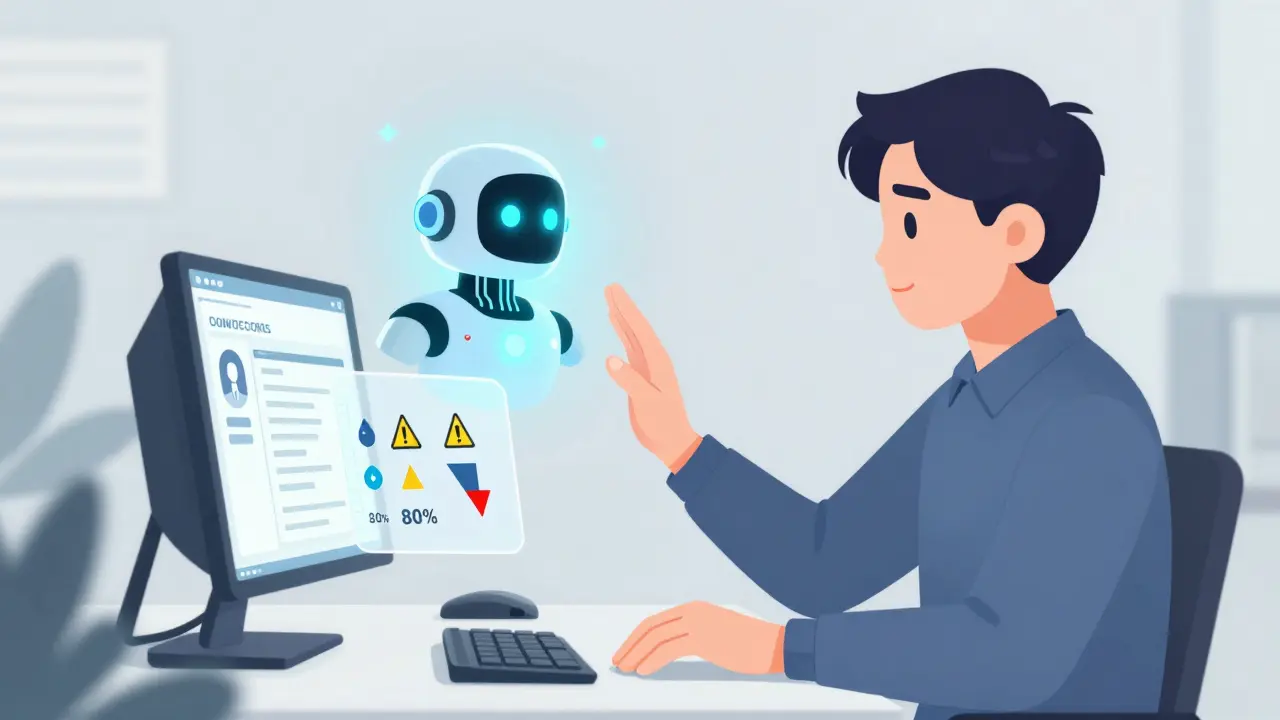
Large language model agents are everywhere now-chatting with customers, drafting legal contracts, even helping doctors draft patient notes. But here’s the problem: these models don’t always get it right. They can hallucinate facts, leak private data, or give dangerous advice without even knowing they’re wrong. That’s where human-in-the-loop control comes in. It’s not about replacing AI. It’s about putting a human in the middle to catch what the AI misses.
Why LLM Agents Need Human Oversight
Large language models are powerful, but they’re also unpredictable. A model trained on billions of text samples doesn’t understand context the way a person does. It might generate a perfectly grammatical response that’s completely false-or worse, harmful. In healthcare, an unmonitored LLM once suggested a patient skip insulin because it misread a lab result. In finance, another one drafted a contract clause that accidentally waived liability for fraud. These aren’t theoretical risks. They’ve happened. The solution isn’t to shut down LLMs. It’s to build in a checkpoint. Human-in-the-loop (HITL) means that before an LLM agent acts-whether sending an email, approving a loan, or recommending treatment-a human reviews the output. This isn’t just a safety net. It’s a way to combine machine speed with human judgment.How HITL Works in Practice
A typical HITL system for LLM agents works in four steps:- The LLM generates a response based on a user prompt.
- The system checks the response’s confidence score-how sure the model is that it’s correct.
- If the confidence is below a set threshold (usually 80-85%), the output is paused and sent to a human reviewer.
- The human can approve, edit, or reject the response. Their feedback is then used to improve the model over time.
Real-World Performance Gains
The numbers speak for themselves. According to IBM’s 2023 research, HITL reduces critical errors by 37% to 62% in high-risk applications. In healthcare, Humanloop’s case study showed a 92% drop in harmful medical advice when HITL was added. Financial institutions like JPMorgan Chase reported preventing $1.2 million in errors during their first year of using tiered human oversight for contract analysis. Compared to automated filters, HITL wins when it comes to edge cases. Automated systems rely on rules or toxicity detectors-patterns they’ve seen before. But humans can spot something new. A customer asking for advice on how to handle a rare side effect of a drug? An automated system might say, “I don’t know.” A human can look up the study, check the dosage, and respond accurately. Even better, HITL systems learn. Every time a human corrects an LLM’s output, that interaction becomes training data. This creates a feedback loop: the AI gets smarter, and the human’s job gets easier.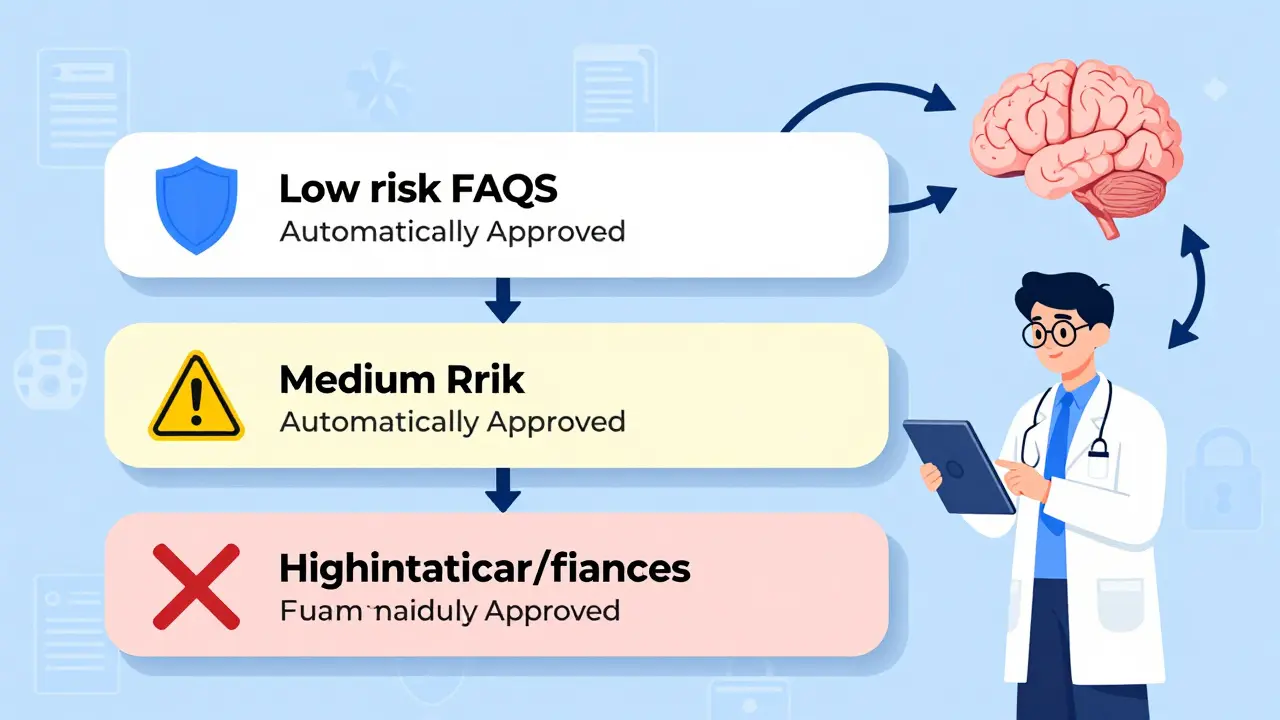
The Cost and the Catch
There’s no free lunch. Human review adds cost. Splunk’s 2023 analysis found each human-reviewed interaction costs between $0.02 and $0.05. For a company handling millions of requests, that adds up. Full human review of every output could raise operational costs by 300-500%. That’s why tiered systems are the standard now. High-risk tasks (like prescribing medication or approving loans) get full review. Low-risk ones (like answering FAQs) go through automated filters. This balance keeps costs down while keeping safety up. Another issue? Human fatigue. Studies show reviewers lose focus after 45 minutes of monitoring AI outputs. Their attention drops by 40%. That’s why rotation schedules are critical. Reviewers shouldn’t work more than two hours straight. And interfaces need to be clean-no clutter, no confusing buttons. SuperAnnotate’s 2024 survey found that 63% of developers complained about clunky review tools. There’s also the risk of data leakage. IBM’s security audit found that 28% of poorly designed HITL systems accidentally exposed sensitive user data during human review. That’s why encryption, access logs, and anonymization aren’t optional-they’re built into every professional system.How It Compares to Other Safety Methods
Some companies try to solve LLM safety with rules. “Don’t say anything about guns.” “Don’t give medical advice.” But these rules are brittle. They break when faced with creative phrasing or new contexts. Others use Reinforcement Learning from Human Feedback (RLHF). That’s great for shaping general behavior-but it’s done during training. Once the model is live, it can’t adapt. If a new type of harmful query appears, the model won’t know how to respond. Then there’s Constitutional AI, used by Anthropic. It teaches models to self-critique using ethical principles. But self-critique isn’t the same as human judgment. A model might say, “I shouldn’t suggest this,” but still output the harmful content. HITL stands out because it allows real-time, context-aware intervention. A human can say, “Wait-this patient has a known allergy. Don’t recommend this drug.” That’s not something a rule or algorithm can reliably do.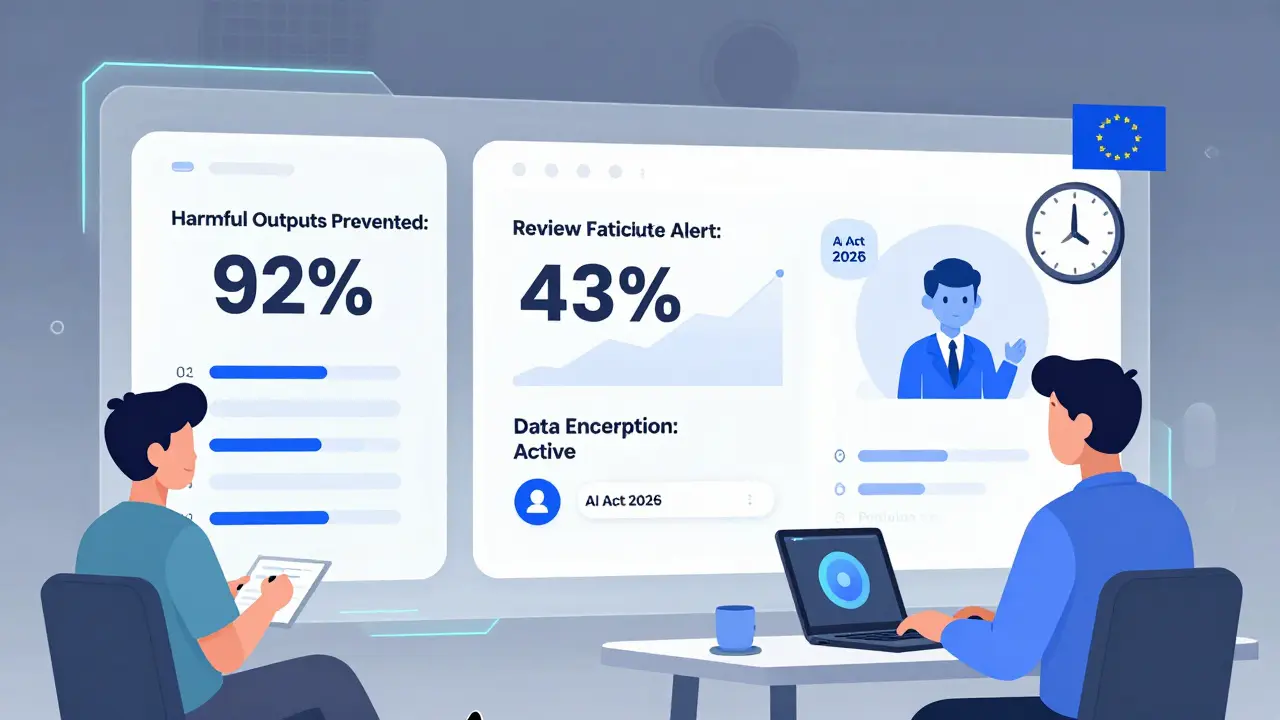
What’s Changing in 2025-2026
The EU AI Act, which takes effect in February 2026, now requires human oversight for any AI system used in healthcare, finance, or law enforcement. That’s not a suggestion. It’s the law. Google just released “Safety Layers” for Vertex AI, adding real-time human review triggers for sensitive topics like suicide prevention and child safety. Humanloop’s 2024 blog showed how their system now adapts review thresholds based on user location, language, and risk profile. The future isn’t more humans. It’s smarter systems. Gartner predicts “intelligent triage” will reduce human review needs by 65% by 2027-without lowering safety. How? By using AI to predict which outputs are most likely to be wrong. Only those get flagged.Getting Started
If you’re building or using LLM agents, here’s how to begin:- Start with a risk assessment. What tasks could cause harm if done wrong?
- Choose a confidence threshold. Start at 80% for high-risk tasks.
- Use open-source tools like LangChain’s HITL modules. There are GitHub examples with 2,450+ stars.
- Build a simple review dashboard. No need for fancy software yet.
- Train your reviewers. Teach them how to spot hallucinations, not just grammar.
- Measure results. Track how many harmful outputs were caught. Use that to adjust thresholds.
Final Thought
AI isn’t going away. But blind trust in it is dangerous. Human-in-the-loop isn’t about slowing things down. It’s about making sure the speed doesn’t come at the cost of safety. In the end, the best systems aren’t the ones that think like humans. They’re the ones that know when to let humans think.What exactly is human-in-the-loop (HITL) in AI?
Human-in-the-loop (HITL) is a system design where human reviewers are integrated into an AI workflow to review, approve, edit, or reject outputs before they’re acted on. It’s not about replacing AI-it’s about using human judgment to catch errors the AI can’t detect, especially in high-stakes situations like healthcare or finance.
Is HITL only for high-risk applications?
No, but it’s most valuable there. For low-risk uses like answering general questions, automated filters work fine. But when mistakes could lead to harm-like giving wrong medical advice, approving fraudulent loans, or leaking private data-HITL becomes essential. Many companies use a tiered approach: full human review for high-risk tasks, automated for low-risk ones.
How much does HITL increase operational costs?
Each human-reviewed interaction costs between $0.02 and $0.05, according to Splunk’s 2023 analysis. If you review every output, costs can jump 300-500%. But smart systems only trigger review when confidence is low or the topic is high-risk. With adaptive HITL, most companies see cost increases of only 8-15%, while preventing far more damage.
Can HITL prevent all harmful AI outputs?
No system is perfect. HITL reduces harmful outputs dramatically-by up to 92% in healthcare cases-but it can’t catch everything. Some errors are subtle, or happen too fast. That’s why HITL works best when combined with automated filters and regular model retraining. It’s one layer of defense, not the only one.
What tools are commonly used to implement HITL?
Most developers use Python-based frameworks like LangChain with middleware from Humanloop, IBM Watson OpenScale, or open-source libraries. These tools let you insert review points into LLM pipelines. You can set up approval workflows, track confidence scores, and log human feedback-all without rebuilding your entire system. GitHub has public examples with over 2,450 stars that show how to do this in under 100 lines of code.
Is HITL required by law?
Yes, in many places. The EU AI Act, effective February 2026, mandates human oversight for AI systems used in healthcare, finance, and law enforcement. Other regions are following. Even if not yet required, regulators are watching. Companies using LLMs without any human review are at legal and reputational risk.
Do human reviewers need special training?
Absolutely. Reviewers aren’t just editors. They need to recognize hallucinations, understand context, and spot subtle biases. Training should include examples of past AI errors, guidelines for ethical judgment, and techniques to avoid reviewer fatigue. Top-performing HITL teams rotate reviewers every 90 minutes and limit sessions to two hours.
What’s the biggest mistake companies make when implementing HITL?
Reviewing everything. Trying to manually check every output is expensive, slow, and leads to burnout. The best systems use smart triggers: only review when confidence is low, the topic is sensitive, or the user has a history of risky queries. Start with a small, high-risk use case. Scale up based on results, not assumptions.
Wilda Mcgee
February 5, 2026 AT 01:26Love this breakdown. I’ve been on HITL teams for healthcare LLMs and let me tell you - the difference between a model spitting out a dangerous suggestion and a human catching it is night and day. One time, the AI wanted to recommend a drug interaction that didn’t exist, but the reviewer spotted the lab result was mislabeled. We fixed the training data after. That’s the magic: humans don’t just block errors, they teach the AI to stop making them.
And yeah, the $0.03 per review adds up, but when you prevent one lawsuit or a patient getting harmed? Priceless. Start small. Pick one high-risk flow. Build the dashboard. Train your reviewers like they’re ER nurses - because they are.
Also - please stop using ‘AI’ like it’s a person. It’s a tool. A really fancy, hallucinating tool.
Chris Atkins
February 6, 2026 AT 22:17Jen Becker
February 8, 2026 AT 21:47Ryan Toporowski
February 9, 2026 AT 20:21Yessss 🙌 I’ve seen this firsthand. We rolled out HITL for our customer service bot and our complaint rate dropped 70%. Not because the AI got smarter - because humans got to step in before things went sideways.
Also - reviewers need snacks. Seriously. We started a little snack drawer. Focus improved. Morale improved. Weirdly, the AI started being less wrong too. Coincidence? Maybe. But I’ll take it 😄
Samuel Bennett
February 10, 2026 AT 12:26Rob D
February 11, 2026 AT 02:11Franklin Hooper
February 11, 2026 AT 12:20The notion that human review reduces errors by 37–62% is statistically dubious. The cited IBM study lacks peer review. Moreover, the $1.2 million saved by JPMorgan? Likely inflated by PR teams. And let’s not pretend ‘feedback loops’ improve models - they merely reinforce confirmation bias. Humans are not ground truth. They are noisy, inconsistent, and emotionally compromised.
Also, ‘SPLUNK’S 2023 ANALYSIS’ - you mean the one published on their blog? That’s not research. That’s a sales deck with footnotes.
Jess Ciro
February 12, 2026 AT 15:35They’re not telling you the truth. HITL isn’t about safety - it’s about liability shielding. Companies use it so when an AI messes up, they can say ‘a human approved it.’ That’s why they’re pushing it so hard. And the EU law? That’s not about protecting people - it’s about giving lawyers a new revenue stream.
And don’t get me started on the ‘feedback loop’ - every time a human edits an output, they’re training the AI to be more convincing, not more accurate. The AI learns to mimic human error. It’s not a fix. It’s a trap.
Also - who are these reviewers? Minimum wage temps on Upwork? They can’t even read a medical chart. This whole system is a house of cards built on optimism and corporate PR.