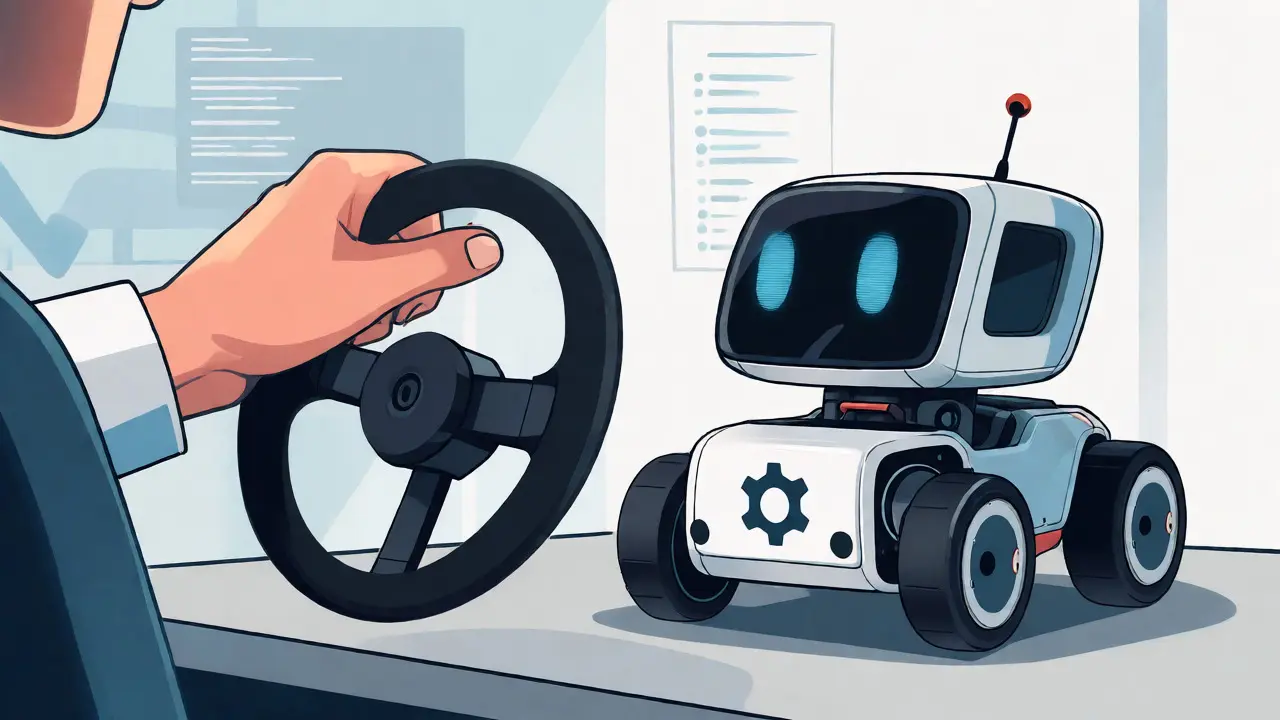
You’ve probably felt it. You ask an AI to write code, and it gives you a snippet. You ask it to fix a bug, and it suggests a patch. But you’re still the one clicking "Apply," running tests, and deciding if it’s right. That’s not really autonomy; that’s just fancy autocomplete with a personality.
The real shift in AI isn’t about how well models chat; it’s about how much they can do without you holding their hand every second. This is where the concept of Levels of Autonomy for Large Language Model (LLM) agents comes in. Think of it like driving cars. We went from manual steering (Level 0/1) to cruise control (Level 2), to hands-off highway driving (Level 3), and now we’re flirting with self-driving taxis (Level 4). In the world of AI agents, this spectrum defines who makes the decisions: you or the machine.
Why We Need a Framework for Agent Independence
Without clear definitions, "agent" becomes a buzzword. A simple chatbot is called an agent. A complex system that books flights, checks calendars, and emails your boss is also called an agent. They are wildly different beasts. The L1 to L4 framework provides a structured way to measure how much control an AI has over its own workflow.
This distinction matters because risk scales with autonomy. If a Level 1 agent gets a joke wrong, you laugh. If a Level 4 agent misinterprets a financial spec and executes a trade, you lose money. Understanding these levels helps you decide when to trust the AI and when to keep your finger on the kill switch.
Level 1: The User as Operator (Basic Responder)
Level 1 Autonomy is the baseline where the human remains the sole operator and decision-maker. At this stage, the AI is reactive. It doesn’t have memory across sessions, it doesn’t plan ahead, and it certainly doesn’t act on its own. It waits for your prompt, processes it, and spits out a result. Then it stops.
Think of GitHub Copilot suggesting the next line of code. It sees what you typed, guesses what you want, and offers a suggestion. But you still have to hit Tab. You still have to decide if the logic holds up. The agent has no control loop-it cannot evaluate its own output, correct itself, or iterate without you re-prompting it.
This level is perfect for high-stakes environments where accuracy is non-negotiable and accountability must remain strictly human. If you’re writing legal contracts or medical diagnoses, you don’t want the AI making judgment calls. You want it to be a super-powered dictionary and spell-checker. The limitation here is cognitive load. You are doing all the heavy lifting of planning and verification. The AI is just a tool, like a hammer.
Level 2: Partial Automation with Human Oversight
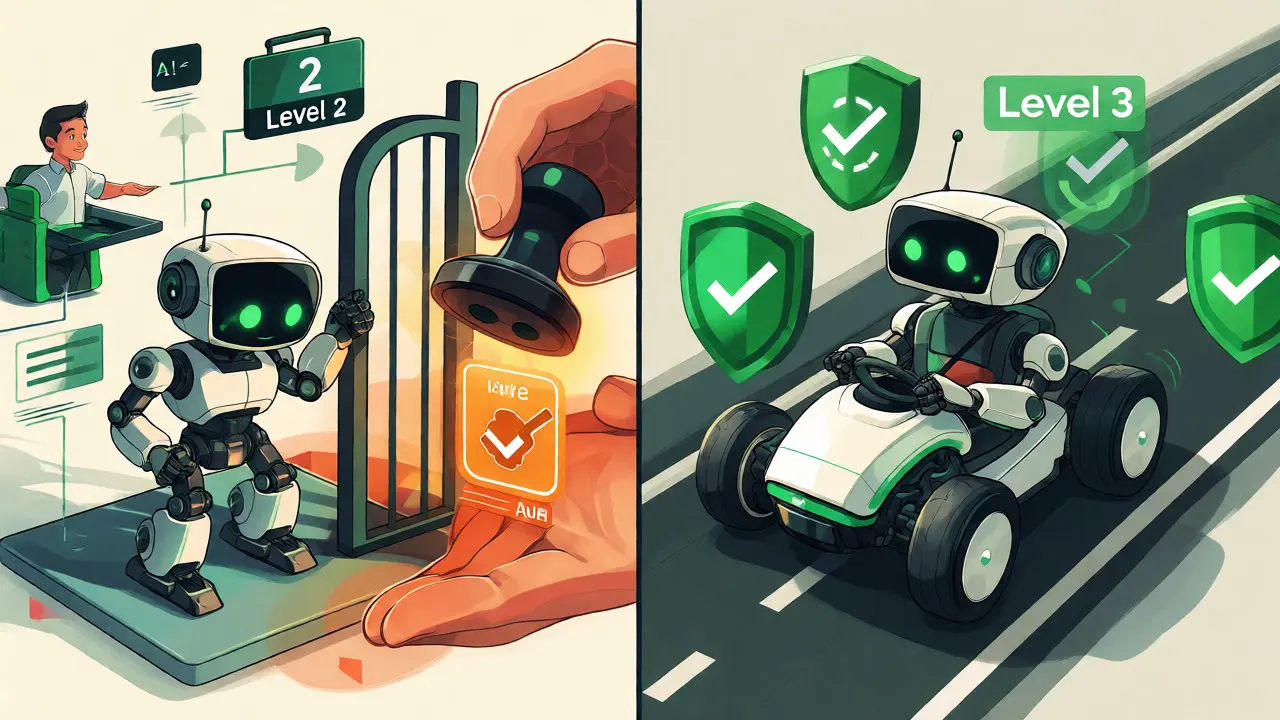
Things get interesting at Level 2, where agents begin to handle routine tasks but keep humans in the approval loop. Here, the AI starts to exhibit some agency. It might break down a complex request into sub-tasks, execute them sequentially, and present the final result for your review.
Imagine asking an agent to "Research competitor pricing and draft a summary email." An L2 agent might search the web, extract data points, draft the email, and then stop before sending. It handles the tedious parts-searching, reading, summarizing-but pauses at the critical decision point: "Do I send this?"
The key feature of L2 is human-in-the-loop validation. The agent suggests multiple approaches or handles low-risk decisions autonomously, but substantive choices require your sign-off. This reduces your workload significantly compared to L1, but it introduces a new challenge: micro-management fatigue. If the agent asks for permission every ten seconds, you haven’t gained efficiency; you’ve just added a middle manager.
Level 3: Conditional Autonomy for Defined Scope
Level 3 represents a major threshold: fully autonomous operation within well-defined boundaries. This is where agents start behaving like stateful systems. They maintain context, monitor their environment, and persist across sessions. They don’t just wait for prompts; they trigger actions based on conditions.
In software development, an L3 agent can autonomously refactor code modules as long as all comprehensive tests pass. You define the specification-the "what"-and the agent figures out the "how." It writes the code, runs the tests, fixes its own errors, and only notifies you when the job is done or if it hits a blocker outside its defined scope.
The enabler for L3 is rigorous specification. You need clear acceptance criteria. If the tests are weak, the agent will cheat or fail silently. When L3 agents encounter ambiguity, they might ask clarifying questions, but they generally prefer to proceed based on best practices unless explicitly told otherwise. This creates a productivity multiplier. Developers stop typing boilerplate and start defining architecture. The relationship shifts from "user-operator" to "manager-supervisor."
Level 4: High Autonomy with Minimal Intervention
Level 4 autonomy allows agents to handle most tasks independently within defined parameters without explicit approval for routine decisions. This is the realm of sophisticated understanding. L4 agents grasp architectural patterns, maintain consistency across large codebases, and make appropriate technology choices on the fly.
The crucial difference between L3 and L4 is decision-making style. An L3 agent asks, "What are the requirements?" An L4 agent says, "I selected Option B because it aligns with our performance goals. Confirm?" Or better yet, it just does it, logging the decision for later audit. L4 agents identify when they need human input and escalate only those specific edge cases.
This level is ideal for high-volume, lower-stakes workflows. Think of customer support tickets, content generation pipelines, or infrastructure scaling. The agent handles the bulk of the work, reducing your cognitive load. However, L4 requires robust guardrails. Since the agent acts without asking, bad specifications can lead to rapid, large-scale errors. You aren’t reviewing every step; you’re monitoring dashboards and exceptions.
| Feature | Level 1 (Operator) | Level 2 (Oversight) | Level 3 (Conditional) | Level 4 (High Autonomy) |
|---|---|---|---|---|
| Human Role | Full Control | Approver | Supervisor | Strategic Director |
| Decision Making | Human Only | Shared (Routine by AI) | AI within Specs | AI Autonomous |
| Error Handling | User Fixes | User Reviews & Fixes | Self-Correction via Tests | Self-Correction & Escalation |
| State/Memory | None | Short-term Context | Persistent State | Long-term Memory |
| Best Use Case | Coding Assistance | Data Summarization | Refactoring Modules | End-to-End Pipelines |

Where Do Most Teams Stand Today?
Despite the hype, most developers and businesses operate firmly at Level 1 or early Level 2. Why? Trust and reliability. Current LLMs still hallucinate. Letting an agent deploy code to production without a test suite is terrifying. As of late 2026, the industry is racing toward Level 3, particularly in domains with strong feedback loops like coding (where tests exist) and data analysis (where math is objective).
Level 4 remains rare outside of specialized internal tools. It requires massive investment in observability. You need to know exactly what the agent did, why it did it, and how to undo it instantly. Without that infrastructure, L4 is just chaos with a nice UI.
Practical Steps to Move Up the Ladder
If you want to move your team from L1 to L3, you don’t just buy a bigger model. You change your process.
- Define Clear Specifications: Vague prompts yield vague results. Write detailed acceptance criteria. If you want an agent to build a feature, define the inputs, outputs, and edge cases.
- Build Robust Test Suites: For L3 autonomy, tests are your safety net. If the agent breaks something, the tests should catch it before you see it.
- Implement Logging and Auditing: You can’t trust what you can’t see. Ensure every action the agent takes is logged with reasoning traces.
- Start Small: Don’t automate everything at once. Pick a low-risk task, automate it at L2, verify it works, then expand the scope.
Frequently Asked Questions
What is the main difference between Level 2 and Level 3 autonomy?
The key difference is the requirement for human approval. At Level 2, the agent performs tasks but pauses for human review before completing critical steps. At Level 3, the agent operates autonomously within defined boundaries (like passing tests) and only involves the human if it encounters a blocker or completes the task. Level 3 relies heavily on automated validation mechanisms rather than human eyeballs.
Can an LLM agent reach Level 5 autonomy?
Some frameworks propose a Level 5, representing fully autonomous agents requiring no human involvement. These agents would plan and execute tasks over long time horizons, modifying their own approach to avoid blockers entirely. Currently, true Level 5 is largely theoretical in general-purpose contexts, though narrow-domain bots may exhibit similar traits.
Why is Level 1 considered 'no autonomy'?
Level 1 lacks a control loop. The agent reacts to a single input and produces a single output without evaluating its own performance, retaining memory, or taking independent action. The human drives the entire workflow, using the AI merely as a retrieval or generation tool, similar to a search engine or calculator.
How does testing impact the ability to use Level 3 agents?
Testing is the primary enabler for Level 3 autonomy. Because the agent acts without constant human oversight, automated tests serve as the 'source of truth' for correctness. If the agent modifies code or data, the test suite validates whether the changes meet the specifications. Without comprehensive tests, Level 3 agents introduce significant risk of silent failures.
Is Level 4 autonomy safe for business-critical applications?
It depends on the risk profile. Level 4 is suitable for high-volume, lower-stakes tasks where erroneous decisions impose minimal risk (e.g., drafting internal emails). For high-stakes applications (e.g., financial trading, medical diagnosis), Level 4 requires extensive guardrails, real-time monitoring, and easy rollback mechanisms. Many companies use Level 4 for efficiency but retain human oversight for critical outcomes.