
Imagine you are building a customer service chatbot. You want it to be helpful, but you absolutely cannot have it mention your competitor's name. You could try telling the model not to do it in the system prompt. But we all know how models behave when they get creative-they might miss the instruction, or worse, find a loophole. That is where logit bias comes in. It is a technical lever that lets you nudge or block specific words at the very bottom layer of the model's decision-making process. You do not need to retrain the AI. You do not need to spend thousands on fine-tuning. You just adjust the math.
What Is Logit Bias and How Does It Work?
To understand logit bias, you first need to look under the hood of how Large Language Models (LLMs) generate text. When an LLM like GPT-4 decides what word to write next, it does not pick one randomly. It calculates a score for every possible next token in its vocabulary. These raw scores are called "logits." The model then converts these logits into probabilities using a mathematical function called softmax. The token with the highest probability gets picked.
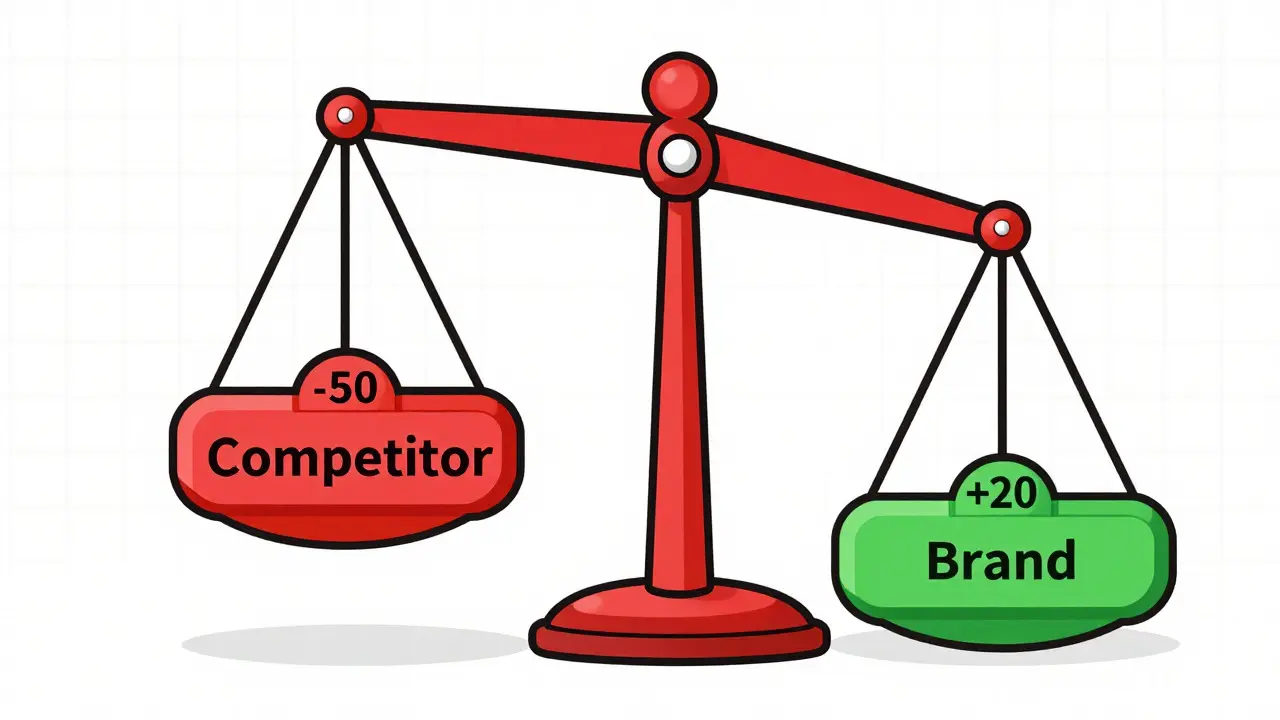
Logit bias allows developers to add or subtract value from those raw scores before the probability calculation happens. Think of it like adding weight to a scale. If you want the model to avoid the word "danger," you subtract points from the logits associated with tokens that make up "danger." If you want it to use the word "safe" more often, you add points. This manipulation happens instantly during inference, meaning no training data changes and no weights are updated permanently.
Does logit bias change the model's intelligence?
No. Logit bias only affects the sampling step. The model's underlying knowledge and reasoning capabilities remain exactly the same. It simply makes certain outputs more or less likely to appear in the final text.
The Critical Challenge: Tokens vs. Words
Here is where most developers stumble. LLMs do not see words; they see tokens. A token can be a whole word, part of a word, or even just punctuation. For example, the word "time" might be one token, but " time" (with a space in front) is often a different token with a completely different ID. If you ban the token for "time" but forget the token for " time," the model will happily keep writing "Once upon a time" because it never encountered the banned ID.
This fragmentation means you have to be surgical. Let's say you want to ban the word "stupid." In many tokenizers, this breaks down into multiple IDs. One tokenizer might split it into [267, 16263]. Another variation with a leading space might be ID 18754. To effectively ban the concept, you must identify every single token variant that represents that word in different contexts-start of sentence, middle of sentence, capitalized, lowercase-and apply the bias to all of them.
Mike X Cohen, a researcher who has broken down LLM architecture, explains that logits are essentially numbers associated with the probability of a binary event occurring. By overwriting one element of the output layer, you are directly manipulating the model's immediate choice. However, if you miss a variant, the model finds a workaround. It might switch to case variations like "Stupid" or add extra spaces to bypass your filter.
Setting the Right Bias Values
You might think setting a bias to -100 guarantees a ban. And technically, it does for that specific token. But it creates a new problem: awkward, broken sentences. When you hard-block a common word, the model is forced to choose the next best option, which might be semantically unrelated. Samuel Shapley, a developer at Weights & Biases, ran experiments showing that when key tokens were banned with extreme values, GPT-4 would generate poetic nonsense just to stay coherent, such as "midnight dreary, while I pondered, weak and weary" instead of the intended phrase.
Most experts recommend a softer approach. Values between -30 and -50 usually provide effective suppression without destroying the flow of conversation. Small values like -1 or 1 rarely make a noticeable difference. The scale is non-linear. A jump from 0 to -10 is subtle; a jump from -90 to -100 is drastic. Here is a practical guide based on community testing:
- -1 to -10: Slight discouragement. Good for nudging style preferences.
- -20 to -50: Strong suppression. The model will actively avoid these tokens unless forced by context.
- -100: Hard ban. Use sparingly, primarily for safety-critical terms like hate speech slurs, where any occurrence is unacceptable.
- +1 to +10: Slight encouragement. Useful for brand keywords.
- +50 to +100: High preference. The model will prioritize these tokens heavily.

Why Not Just Use Prompt Engineering?
You might ask, "Can't I just tell the model 'Do not use the word X' in the system message?" You can, but it is unreliable. System messages rely on the model's attention mechanism to remember and obey instructions. Models sometimes ignore negative constraints, especially if the user prompt is complex or adversarial.
Logit bias is prompt-independent. It works regardless of what the user says. If you ban a token via logit bias, the model physically cannot select it during the sampling phase. This makes it far superior for safety guardrails. In tests, GPT-4 placed high weight on system messages but still occasionally violated explicit instructions. Logit bias with a -100 value provides near-guaranteed suppression. However, logit bias lacks semantic understanding. It cannot ban "bad concepts," only specific token strings. If you want to stop the model from discussing violence, you cannot ban the word "violence" alone; you'd have to ban thousands of related terms, which is where fine-tuning or RAG (Retrieval-Augmented Generation) becomes necessary.
Implementation Workflow: From Word to JSON
Implementing logit bias requires a specific workflow. You cannot guess token IDs. You must tokenize your target phrases first. Here is how professionals do it:
- Identify Target Phrases: List the words or phrases you want to steer. For example, competitor names, offensive language, or filler words like "um" or "ah".
- Tokenize Variants: Use a tokenizer tool (like OpenAI's tiktoken library) to break each phrase into tokens. Remember to check for leading spaces, capitalization, and suffixes. For instance, "Apple" might tokenize differently than "apple" or "Apples".
- Assign Bias Values: Decide on the strength of the bias. For competitor names, -50 is often enough. For profanity, -100 is safer.
- Construct the JSON Object: Create a dictionary mapping token IDs to bias values. The structure looks like this: `{"267": -50, "16263": -50}`.
- Pass to API: Include this object in the `logit_bias` parameter of your API call.
Samuel Shapley created a Python class called `LogitBias` that automates the augmentation of phrases. It counters the model's workarounds by automatically identifying case variations and spaced versions of tokens. This saves hours of manual lookup. Developers typically spend 8-12 hours mastering this process initially, but once the script is built, it scales easily.
Comparison: Logit Bias vs. Other Control Methods
| Method | Precision | Cost | Reliability | Best Use Case |
|---|---|---|---|---|
| Logit Bias | High (Token-level) | Low ($0.0002 per 1k tokens) | Very High (For exact tokens) | Banning specific words, brand alignment |
| Prompt Engineering | Low (Semantic) | Free | Variable (Often fails) | General tone and style guidance |
| Fine-Tuning | Medium (Behavioral) | High ($15-$150 per iteration) | High (Domain-specific) | Changing overall model personality or domain knowledge |
| Output Filtering | Medium (Post-generation) | Low | High (But wastes compute) | Catching slips after the fact |
As the table shows, logit bias sits in a unique spot. It is cheaper than fine-tuning and more reliable than prompting. However, it is tedious. You have to manage the list of tokens yourself. If you want to ban 150 offensive words, you might end up managing over 1,200 token variants. Enterprise users report that this initial setup is painful, but the payoff is significant. One LinkedIn survey noted a 37% reduction in moderation violations for customer service bots after implementing comprehensive logit bias lists.
Real-World Applications and Pitfalls
Where is this actually used? Two main areas dominate: safety and brand protection. In safety, companies use logit bias to create hard blocks against illegal content, self-harm triggers, or severe profanity. Because it operates at the token level, it catches things that semantic filters might miss if the phrasing is obscure. In brand protection, companies like BMW or Apple might use positive bias (+20 to +50) to ensure their product names are spelled correctly or mentioned frequently, and negative bias (-50) to suppress competitor mentions.
However, there are pitfalls. The biggest one is "semantic blind spots." If you ban too many tokens, the model starts to sound robotic or evasive. An arXiv paper titled "The Limits of Token-Level Control" warned that over-reliance on logit bias can cause models to develop compensatory patterns that introduce new risks. For example, if you ban the word "kill," the model might start using euphemisms like "terminate" or "eliminate," which might be equally harmful depending on the context. You have to anticipate these workarounds.
Another issue is scalability across languages. Tokenizers are optimized for English. Handling multi-token words in Chinese or Japanese requires even more meticulous variant identification. As of late 2023, OpenAI improved tokenization consistency, reducing variant tokens by about 18%, but the challenge remains for non-English deployments.
Future Outlook: Context-Aware Bias
The current limitation of logit bias is that it is static. It treats the word "Apple" the same way whether you are talking about fruit or technology. The industry is moving toward "context-aware logit biasing." Imagine a system that analyzes the conversation history and dynamically adjusts biases. If the user is asking about nutrition, the bias for "Apple" (the company) drops, and the bias for "apple" (the fruit) rises. Klu.ai and other platforms are exploring this roadmap. Until then, developers must manually manage these distinctions, often by creating separate bias profiles for different intents.
Despite these limitations, logit bias is becoming a standard tool. With the EU AI Act mandating technical measures to prevent prohibited content, logit bias offers a compliant, auditable solution. It gives developers a direct line to the model's probability engine, offering control that prompts alone simply cannot match.
How do I find the token ID for a specific word?
You need to use the tokenizer library corresponding to your model. For OpenAI models, use the tiktoken library in Python. Run tokenizer.encode("your_word") to get the list of token IDs. Remember to check for variations like leading spaces or capital letters.
Can logit bias be used to force the model to lie?
Technically, yes, by heavily biasing towards false statements and biasing away from truth indicators, but this is ethically problematic and often results in low-quality, nonsensical output. The model's core training still pushes for factual accuracy, so extreme bias may cause coherence issues rather than clean deception.
Is logit bias supported by all LLM providers?
It is supported by major providers like OpenAI and Anthropic. However, open-source implementations like Llama.cpp may require custom code or plugins to implement logit bias, as it is not always a native API parameter in local deployment tools.
Why did my banned word still appear in the output?
You likely missed a token variant. Check if the word was capitalized, had a leading space, or was split into multiple tokens. Also, verify that you applied the bias to all IDs returned by the tokenizer for that string.
What is the cost impact of using logit bias?
There is virtually no additional cost. The computation happens during the standard inference process. It is significantly cheaper than fine-tuning, which can cost tens of dollars per iteration, whereas logit bias costs fractions of a cent per thousand tokens processed.