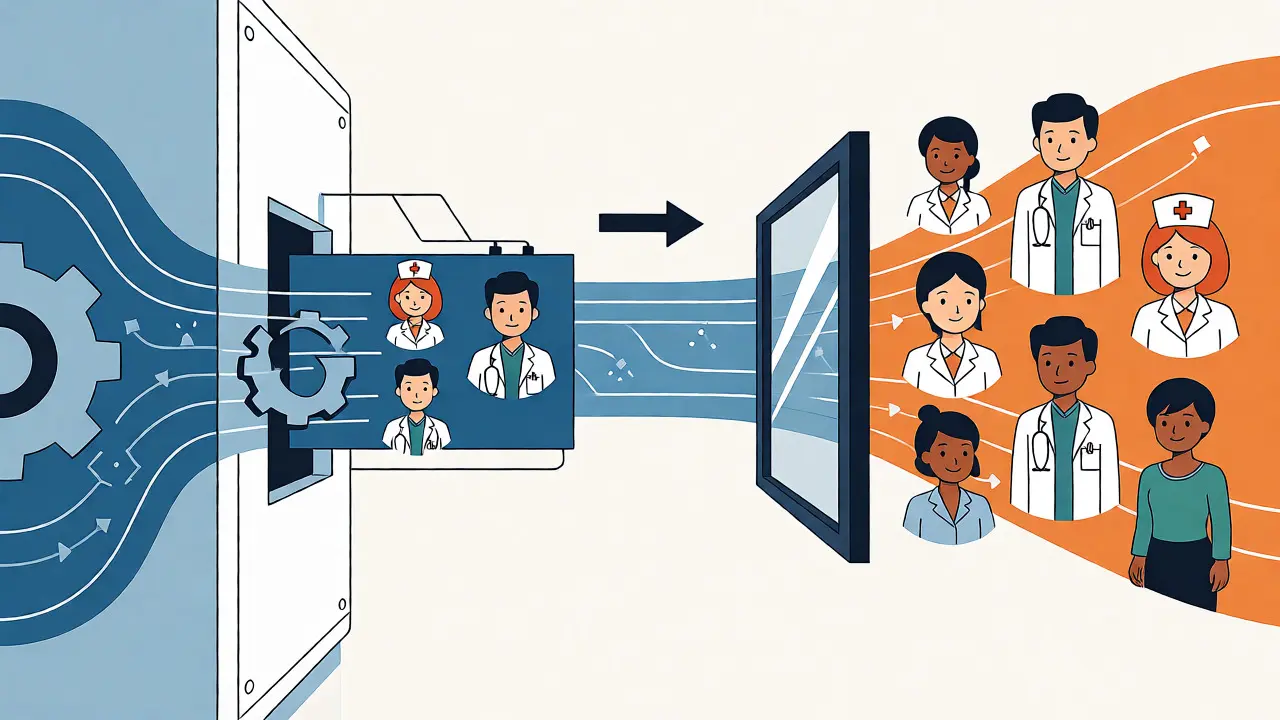
You’ve probably seen the headlines: an AI hiring tool that downgraded resumes from women, or a medical chatbot that gave worse advice to Black patients. It’s frustrating, right? But here’s the kicker-these biases aren’t bugs in the code; they’re mirrors reflecting our own societal flaws baked into the data. If you’re building or deploying Large Language Models (LLMs), you can’t just hope the bias disappears. You need active mitigation techniques during the data and training phases.
As of late 2024, there are over 87 distinct ways to tackle this mess. Some work before the model even starts learning, some while it’s training, and others after it spits out an answer. The stakes are high, too. IBM Research estimates that a single biased deployment incident in financial services can cost $3.2 million in legal liabilities. So, how do you actually fix it without breaking your model’s brain? Let’s break down the three main battlegrounds: Data, Training, and Output.
Cleaning Up the Input: Pre-Processing Techniques
The old saying goes, "Garbage in, garbage out." In AI terms, if your training data is full of stereotypes, your model will learn them as facts. This is where pre-processing comes in. You modify the data before the model ever sees it.
The most popular method here is Counterfactual Data Augmentation (CDA). Think of it as flipping the script. If a sentence says "The nurse was kind," CDA creates a twin sentence: "The doctor was kind" (assuming gender swap) or "The male nurse was kind." By forcing the model to see these swapped versions, it learns that roles aren’t tied to specific demographics.
| Technique | Bias Reduction | Resource Impact | Best For |
|---|---|---|---|
| Counterfactual Data Augmentation | 58.3% on gender bias | +40-60% storage | Gender & Role Stereotypes |
| Diverse Sampling | 41.2% overall | $14k+ cloud costs | Racial/Ethnic Balance |
| Word Embedding Debiasing | 35-45% | Low CPU load | Legacy Models |
But be careful. A study from MIT showed that while CDA crushes gender bias, it only reduces intersectional biases (like race + gender) by about 22%. Why? Because simply swapping words doesn’t always capture the complex social context. Also, storing all those extra sentences isn’t free. You’ll need 40-60% more storage space for your augmented datasets. Is it worth it? For many teams, yes. Dr. Margaret Mitchell from Google Research notes that when done right, it cuts bias by over 50% with minimal hit to performance.
Shaping the Brain: In-Training Mitigation
If cleaning the data isn’t enough, you have to change how the model learns. This is in-training mitigation. Instead of feeding the model clean data, you teach it to ignore sensitive attributes like race or age while it optimizes its weights.
The heavyweight champion here is Adversarial Debiasing. Imagine two networks fighting each other. One network tries to predict the correct output (like translating a sentence). The other, called the discriminator, tries to guess the sensitive attribute (like the speaker's gender) based on the first network's internal representations. If the discriminator can easily guess the gender, the main model is still relying on it too much. The system then penalizes the main model, forcing it to "forget" the gender signal while keeping the meaning intact.
This sounds elegant, but it’s expensive. Adversarial methods require the discriminator to hit at least 78% accuracy in guessing sensitive attributes to be effective. More importantly, they demand about 37% more computational resources than standard training. If you’re running small-scale experiments, this might blow your budget. However, for racial bias specifically, it’s one of the strongest tools we have, showing a 47.1% reduction on benchmarks like BOLD.
Another option is Reinforcement Learning from Human Feedback (RLHF) tailored for fairness. Here, human annotators score responses not just for helpfulness, but for fairness. This approach delivered a massive 62.4% bias reduction in recent studies. The catch? It’s labor-intensive. Annotating data for this level of nuance costs around $85 per hour. A single implementation cycle can run up bills totaling $10,795. Do you have that budget?

Polishing the Output: Post-Processing Strategies
Sometimes, you don’t want to retrain the whole model. Maybe you’re using a closed-source API like GPT-4 or Gemini, and you can’t touch the training process. Enter post-processing. This involves tweaking the output after the model generates it.
The simplest form is prompt engineering. Adding instructions like "Respond neutrally regarding gender" can help. But let’s be real: this only yields an 18-25% bias reduction. It’s okay for casual chatbots, but risky for healthcare diagnostics where you need 95% accuracy. For higher stakes, you might use filtering algorithms that scan outputs for problematic patterns and rewrite them.
However, post-processing adds latency. Every time you filter or rewrite a response, you add 12-15 milliseconds to the generation time. In real-time applications, that delay can feel sluggish. Also, there’s a danger of over-censorship. Users have complained that tools like Google’s Perspective API sometimes flag non-biased content as toxic because it’s overly cautious. Balancing safety with natural language flow is a tricky art.
The Hidden Trap: The Accuracy-Bias Trade-off
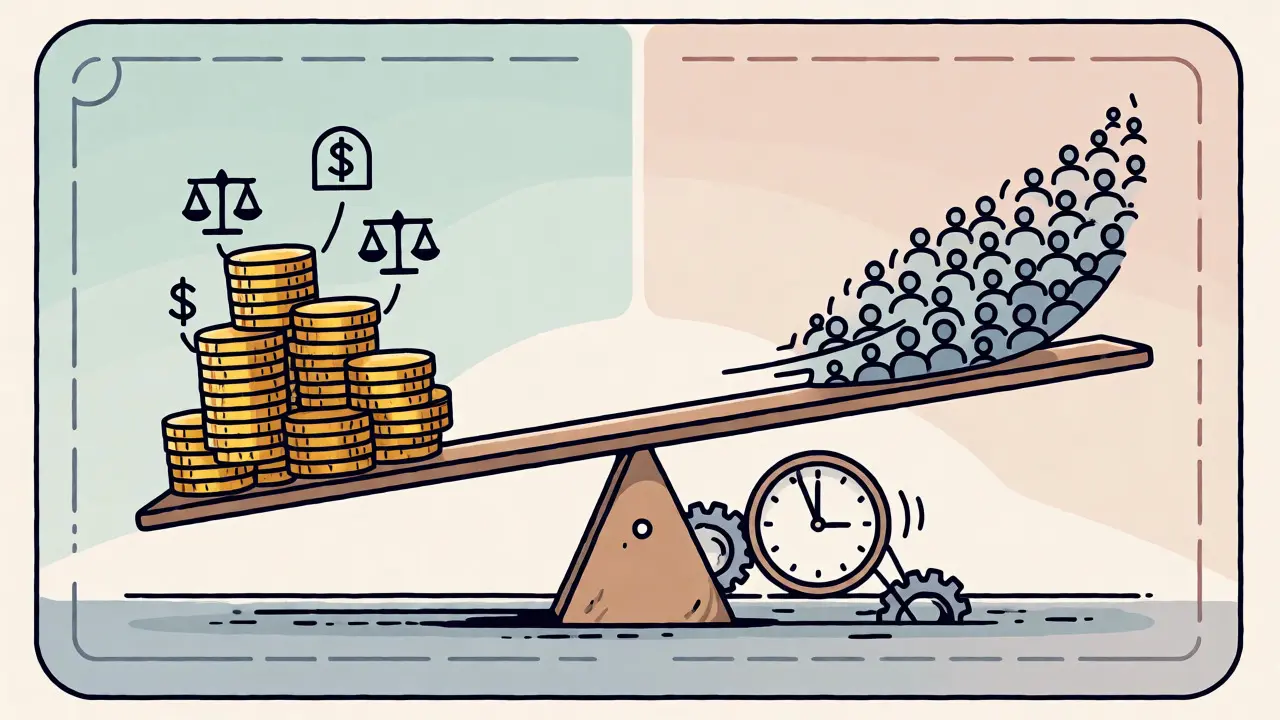
Here is the uncomfortable truth nobody likes to talk about: fixing bias often hurts accuracy. It’s not a myth; it’s math. When you force a model to ignore certain correlations (like assuming a CEO is likely male), you might lose predictive power in contexts where that correlation was actually useful.
Data from ACL Findings shows that mitigation techniques typically reduce bias scores by 35-62%, but incur a 2.3-5.7% drop in accuracy on standard NLP tasks. For a general-purpose chatbot, who cares? But for a legal document analyzer, losing 5% accuracy could mean missing a critical clause.
A Reddit user named 'NLP_Engineer_2023' shared a horror story where counterfactual augmentation reduced gender bias by 32% but caused an 18% accuracy drop in medical Q&A tasks. They had to spend three extra fine-tuning iterations and $2,150 in cloud costs just to get back to baseline performance. Always test your mitigated model against your original benchmark suite. Don’t assume fairness equals quality.
Choosing Your Weapon: A Decision Guide
So, which technique should you pick? It depends on your constraints.
- Low Budget / Fast Prototyping: Go with Prompt Engineering or simple Post-Processing filters. It’s cheap and quick, though less effective.
- High Gender Bias Concerns: Use Counterfactual Data Augmentation. It’s the gold standard for gender roles and has decent community support.
- Racial or Complex Intersectional Bias: Try Adversarial Debiasing or RLHF. These are resource-heavy but handle nuance better.
- Regulatory Compliance (EU AI Act): You need transparency. Document every step. As Dr. Timnit Gebru warns, mitigation without transparency creates accountability vacuums. Ensure you can explain *why* you chose a specific technique to regulators.
Remember, no single technique fixes everything. Meta’s recent FairGen framework reduced age bias by 62% but required significant compute. Google’s Gemini updates use dynamic decoding to adjust outputs in real-time. The field is moving fast. What works today might be outdated in six months.
Frequently Asked Questions
Does removing bias make LLMs less accurate?
Yes, usually. Most mitigation techniques result in a 2.3-5.7% trade-off in task accuracy. The model loses some ability to rely on statistical shortcuts that may have been biased but were statistically predictive in the training set.
What is Counterfactual Data Augmentation?
It is a pre-processing technique where you create new training examples by swapping demographic attributes (like changing "he" to "she" or "doctor" to "nurse") to teach the model that roles and traits are not inherently tied to specific groups.
How much does adversarial debiasing cost?
It requires approximately 37% more computational resources than standard training methods. Additionally, implementing Reinforcement Learning with human feedback for fairness can cost upwards of $10,000 per cycle due to expert annotation fees.
Can I fix bias after the model is trained?
You can mitigate it via post-processing, such as filtering outputs or adjusting probabilities, but you cannot fully eliminate deep-seated biases learned during training. Post-processing adds 12-15ms latency per response.
Why is intersectional bias hard to fix?
Techniques like Counterfactual Data Augmentation struggle with intersectionality (e.g., being both Black and female) because simple word swaps don't capture the unique social dynamics of overlapping identities. Reduction rates for intersectional bias often hover around 22%, compared to nearly 60% for single-axis gender bias.