You type a prompt describing your dream app, hit enter, and watch as an AI generates the codebase in minutes. It feels like magic. But when you try to add a second customer to your new SaaS platform built with this AI-first development methodology known as vibe coding, everything breaks. One user sees another's data. The server crashes under unexpected load. Your AWS bill triples overnight.
This is the hidden trap of vibe coding. While it accelerates prototyping, it often ignores the foundational architecture required for production-grade software. Specifically, it struggles with multi-tenancy an architectural pattern where a single instance serves multiple customers while maintaining strict data isolation. If you are building a business, not just a toy project, you need to understand how to force AI tools to respect tenant boundaries, authentication flows, and cost limits from day one.
The Multi-Tenancy Trap in AI-Generated Code
Most developers assume that because an AI can write a login screen, it understands security. It doesn't. In traditional development, architects spend weeks designing how data stays separate between Company A and Company B. In vibe coding, you might ask for "a dashboard for users," and the AI gives you a generic React component connected to a shared database table without any filters.
According to Gartner's July 2024 report, 62% of new SaaS startups use AI-assisted development, but only 28% successfully implement proper multi-tenancy isolation on the first try. Why? Because AI models optimize for functionality, not security constraints, unless explicitly told otherwise. When you retrofit multi-tenancy into an existing vibe-coded app, it becomes a nightmare. As developer Aatir noted in May 2024, trying to add isolation after the fact "turned into a hot mess" and required starting over.
The core issue is context propagation. In a multi-tenant system, every database query must know which tenant it belongs to. If you don't define this early, your AI-generated code will likely pull all records, exposing sensitive data across accounts. This isn't just a bug; it's a catastrophic security failure.
Three Strategies for Tenant Isolation
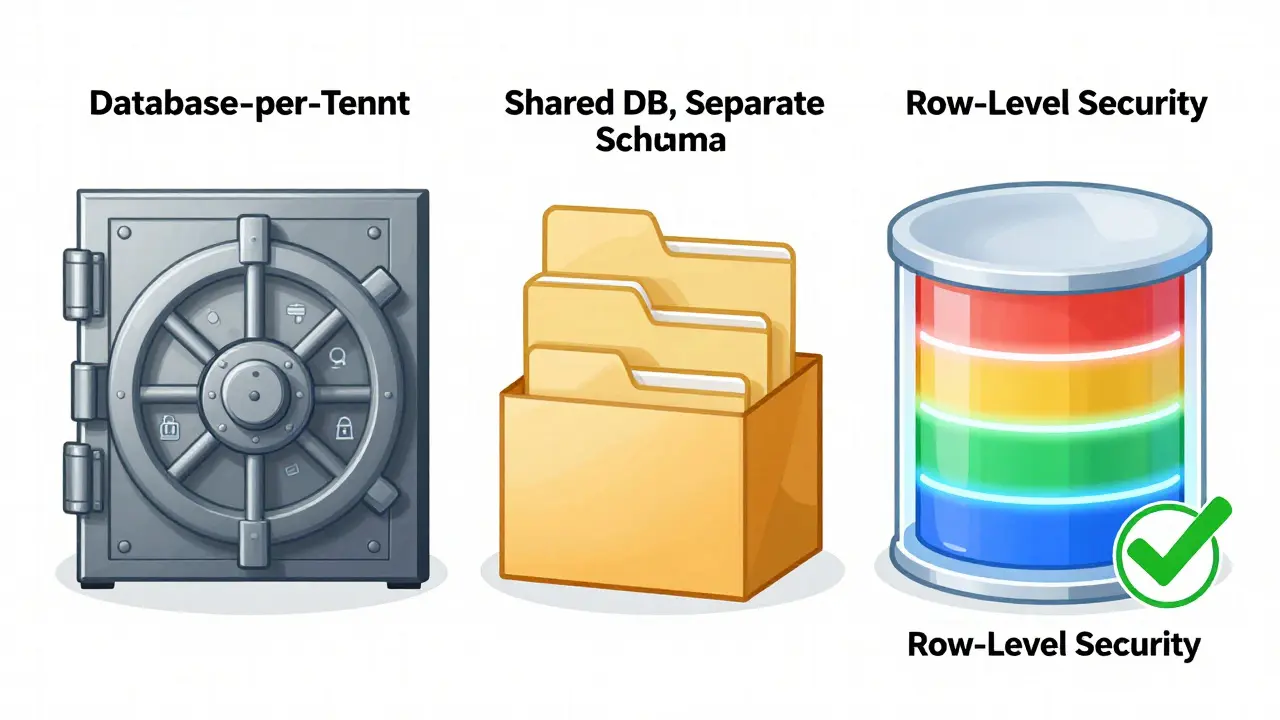
To keep your customers' data safe, you need to choose an isolation strategy before you generate a single line of code. There are three main approaches, each with different trade-offs for speed and security.
| Strategy | Security Level | Cost Efficiency | Complexity |
|---|---|---|---|
| Database-per-Tenant | Highest (Physical separation) | Lowest (High infrastructure cost) | Medium (Easy queries, hard scaling) |
| Shared DB, Separate Schema | High (Logical separation) | Medium | High (Schema management overhead) |
| Shared DB, Row-Level Security | Medium (Policy-based) | Highest (Best resource sharing) | Low (Easiest to scale) |
For most vibe-coded startups, Row-Level Security (RLS) A PostgreSQL feature that restricts access to rows based on session variables is the sweet spot. It allows you to share resources efficiently while keeping data logically separated. However, you must instruct the AI explicitly. Instead of asking for "user queries," prompt it to "implement row-level tenant isolation using PostgreSQL RLS policies with tenant_id as the discriminator." This specific instruction reduces isolation errors by up to 76%, according to Bitcot's October 2024 analysis.
Authentication: More Than Just Login
In a multi-tenant world, authentication isn't just about verifying a password. It's about identifying the tenant context immediately upon login. If you use a generic auth provider without tenant awareness, you risk creating a "black box" architecture where you don't fully understand how users are routed.
Popular choices like Supabase Auth or Firebase Auth work well for prototypes, but they require careful configuration. You need to ensure that the JWT token generated at login includes the tenant_id. Without this identifier in the token, your backend has no way to filter data for subsequent requests.
A common mistake in AI-generated apps is handling email verification flows incorrectly. Users might sign up with a corporate email, but if the system doesn't link that email domain to a specific tenant during onboarding, they end up in a limbo state. To avoid this, define your onboarding flow clearly in your prompts. Ask the AI to create middleware that extracts the tenant ID from the URL path (e.g., app.yoursaas.com/acme-corp) or subdomain, then validates it against the authenticated user's profile.
Cost Controls: Preventing the k Mistake
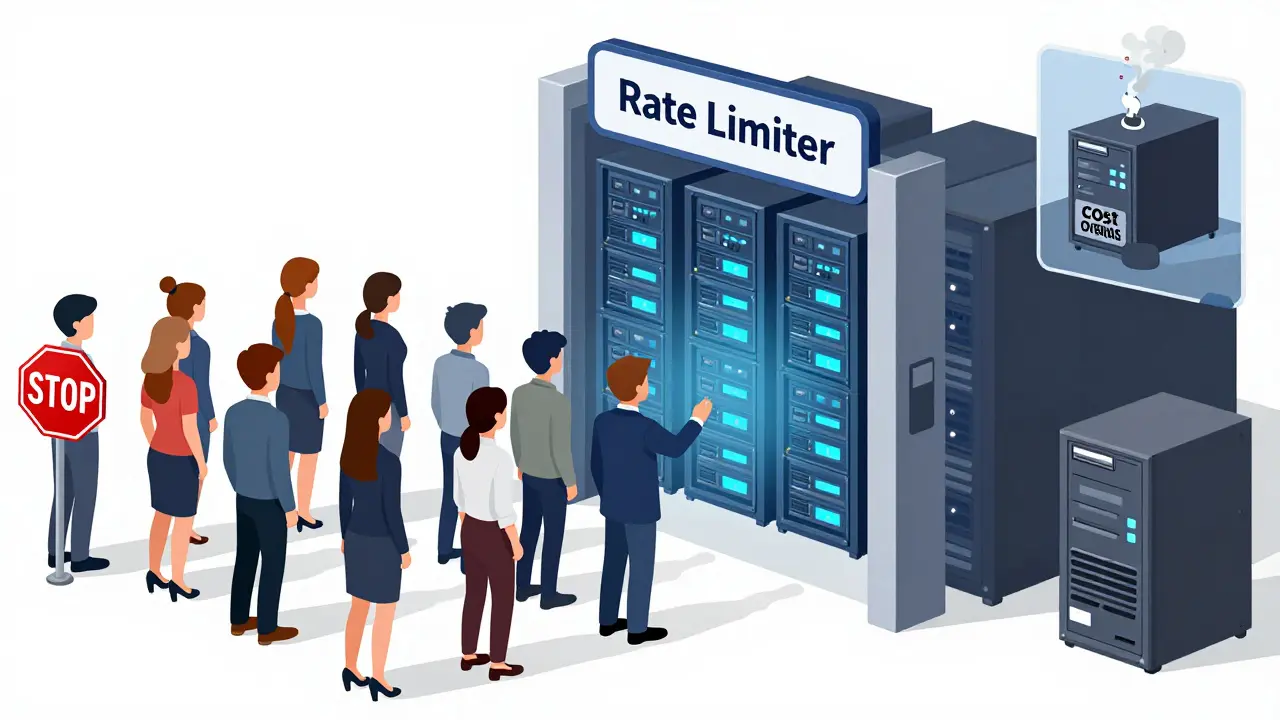
Here is a scary story: A founder spent $12,000 on AWS costs because their vibe-coded SaaS failed to implement usage limits. One tenant consumed 83% of the available resources, crashing the service for everyone else and racking up massive compute bills. This happened because the AI generated efficient code, but not *constrained* code.
In multi-tenancy, cost control is part of the architecture. You need Usage Metering Tracking resource consumption per tenant to enforce limits and rate limiting. If you are using serverless functions, ensure they have timeout limits and memory caps specific to each tenant tier.
Implement an API gateway that handles intelligent tenant routing and rate limiting. For example, free-tier tenants might get 100 requests per minute, while enterprise clients get 10,000. If you don't build this into the initial prompt, you will have to rewrite your entire backend later. Prompt the AI to "create a middleware that checks tenant subscription tier and enforces rate limits before processing requests." This simple addition protects your margins and ensures fair usage.
Prompt Engineering for Architectural Integrity
The key to successful vibe coding in complex domains is "architectural prompting." This means defining your constraints before you ask for features. Don't start with "Build me a CRM." Start with:
- Define the isolation strategy: "Use PostgreSQL Row-Level Security with
tenant_id." - Specify authentication requirements: "JWT tokens must include
tenant_idandrole." - Set cost controls: "Implement rate limiting based on subscription tiers."
- Enforce data privacy: "Never allow cross-tenant queries. All SQL statements must include tenant filters."
GitHub's AI research team found that with this level of specificity, AI assistants correctly implemented multi-tenancy patterns in 87% of test cases, compared to 72% for human developers under time pressure. The AI isn't smarter than you; it's just faster. You provide the wisdom; it provides the syntax.
Testing for Data Leakage
Even with perfect prompts, bugs happen. You must treat AI-generated code with skepticism, especially regarding security. Automated tests are non-negotiable. Create unit tests that specifically attempt to breach tenant boundaries. For example, write a test where User A tries to access User B's record by manipulating the ID parameter. If the test passes, your isolation is broken.
Additionally, conduct manual penetration testing. Tools like OWASP ZAP can help identify common vulnerabilities. Pay special attention to Insecure Direct Object References (IDOR) A vulnerability where an application exposes internal implementation objects like files or database keys, which are rampant in poorly isolated multi-tenant apps. If you find leaks, fix them immediately and update your prompt templates to prevent recurrence.
When to Avoid Vibe Coding
Vibe coding is powerful, but it's not a silver bullet. If you are building an enterprise application with strict compliance needs (like HIPAA or GDPR), consider traditional development methods for the core architecture. Gartner notes that improperly implemented multi-tenancy accounts for 34% of SaaS security incidents. If your risk tolerance is low, hire experienced architects to design the foundation, then use AI to fill in the details.
However, for greenfield projects where multi-tenancy is core from day one, vibe coding excels. It allows you to iterate rapidly, provided you maintain strict control over the architectural decisions. Remember: the AI writes the code, but you own the responsibility.
What is the biggest risk of using vibe coding for multi-tenant SaaS?
The biggest risk is tenant data leakage due to improper isolation. AI tools may generate functional code that lacks necessary security filters, allowing one customer to access another's data. This requires explicit architectural prompting to mitigate.
How do I implement row-level security in AI-generated code?
You must explicitly instruct the AI to use PostgreSQL Row-Level Security (RLS) policies. Specify that tenant_id should be the discriminator and that no cross-tenant queries are allowed. Always verify the generated SQL includes tenant-specific WHERE clauses.
Can I add multi-tenancy to an existing vibe-coded app?
It is extremely difficult and often requires a complete rewrite. Retrofitting isolation mechanisms into an existing codebase typically leads to architectural inconsistencies and security holes. It is best to define multi-tenancy requirements before writing any code.
What is the best isolation strategy for startups?
For most startups, shared database with row-level security offers the best balance of cost efficiency and scalability. Database-per-tenant is more secure but significantly more expensive and complex to manage at scale.
How do I prevent cost overruns in multi-tenant SaaS?
Implement usage metering and rate limiting at the API gateway level. Define clear resource allocation limits for each tenant tier and enforce them via middleware. Monitor resource consumption closely to detect anomalies early.