You signed the deal. The sales team celebrated. But three months later, your legal operations director is staring at a bill that’s 40% higher than projected, and the AI isn't catching the liability clauses it promised to flag. This isn't bad luck; it's bad contracting. When you buy access to a Large Language Model provider like OpenAI, Anthropic, or Google Cloud, you aren't just buying compute power. You are entering a complex partnership where performance guarantees, data security, and cost predictability are often buried in fine print designed to protect the vendor, not you.
Negotiating these agreements requires a shift in mindset. You can't treat an LLM provider like a standard SaaS vendor. The risks are different, the technical dependencies are deeper, and the regulatory landscape is shifting under our feet. If you're looking to implement AI in contract lifecycle management (CLM) or other high-stakes business processes, here is how to structure your agreement so you don't get burned.
The Hidden Costs of Token Usage
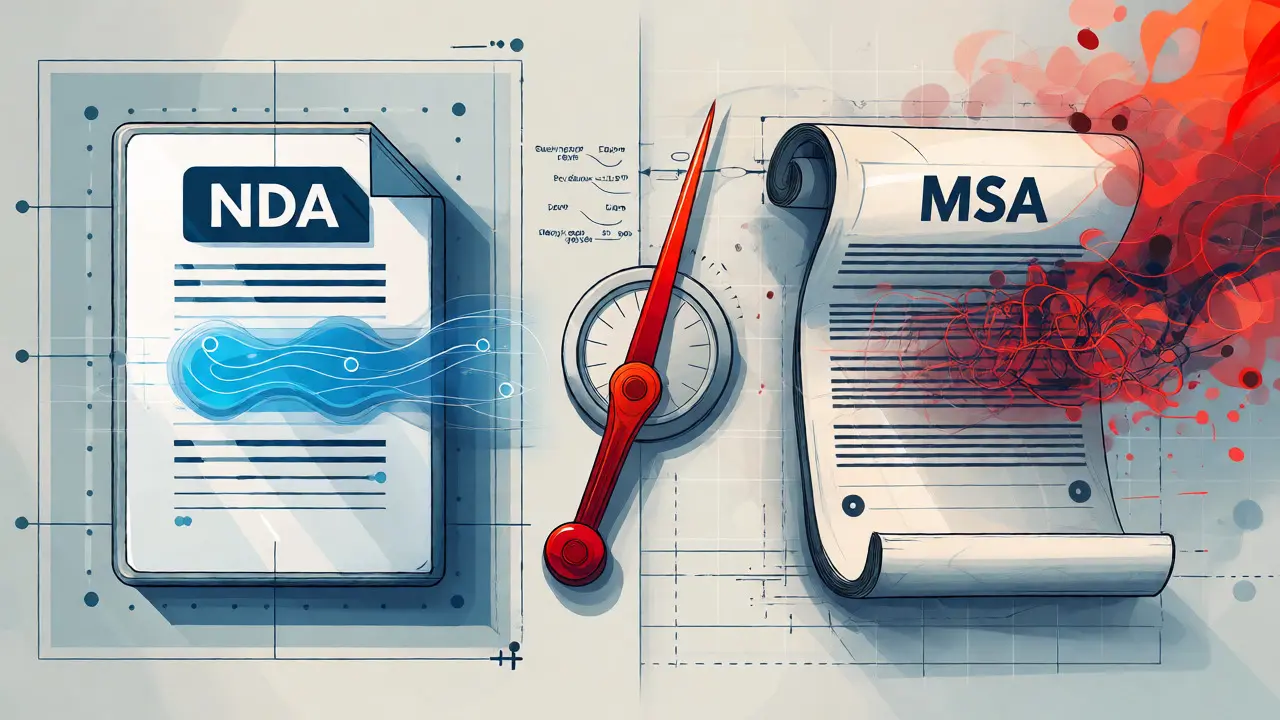
Most enterprises underestimate their token consumption. It’s easy to look at a price per million tokens and assume your usage will be linear. It won’t. In contract review scenarios, documents vary wildly in length. A simple NDA might take 500 tokens to process, while a complex MSA could hit 10,000. If your pricing model doesn't cap this variability, your budget blows up.
According to recent user reports on platforms like G2 Crowd, nearly 68% of negative reviews for AI contract tools cite "unexpected token usage costs" as a primary pain point. Users reported exceeding initial estimates by 30-65%. To avoid this, negotiate a tiered commitment structure rather than a pure pay-as-you-go model. For example, commit to a baseline annual spend (say, $250,000) that includes a specific volume of tokens, with overage rates capped at a fixed percentage above the list price. Also, insist on real-time usage dashboards that alert you when you hit 80% of your committed volume. You need visibility before the invoice arrives, not after.
Accuracy Floors and Performance SLAs
Standard uptime SLAs (99.9% availability) mean nothing if the model is hallucinating legal terms. An AI that is always online but wrong is worse than one that is occasionally down. You need accuracy floor clauses. These are contractual guarantees that the model must meet minimum performance metrics on specific tasks relevant to your business.
For instance, if you are using the LLM for clause extraction, demand a guarantee of at least 89% precision on a benchmark dataset provided by you. Professor Rebecca Wexler from UC Berkeley Law highlights that without these floors, vendors have little incentive to maintain quality once the sale is closed. Include financial penalties for consistent underperformance. If accuracy drops below the agreed threshold for two consecutive quarters, you should have the right to terminate the contract without penalty or receive service credits. Don't accept vague promises of "continuous improvement." Demand measurable baselines defined in the Statement of Work (SOW).
| Feature | General LLM Provider (e.g., OpenAI) | Specialized Legal AI Vendor (e.g., LexCheck) |
|---|---|---|
| Pricing Model | $0.0001-$0.002 per token; Min annual commit $150k+ | $45-$120 per user/month; Min 50 users |
| Contract Accuracy | 72-78% (higher hallucination rate: 18.7%) | 86-92% (lower hallucination rate: 6.3%) |
| Integration Depth | API-based; requires custom middleware | Native CLM integrations (92% of vendors) |
| Data Training | Broad internet data | 10-50M legal documents |
Addressing Model Drift and Retraining Obligations
LLMs are not static products. They evolve. Vendors frequently update their underlying models, which can cause "model drift"-a gradual degradation in performance on your specific use cases because the new version behaves differently. Gartner analysis shows that 78% of enterprise contracts fail to address this risk. Your contract must include a "model stability" clause.
This provision should require the provider to maintain performance within 5% of the baseline metrics established during the pilot phase. If they release a new model version, they must provide you with a sandbox environment to test it against your benchmarks before forcing the migration. Furthermore, specify who pays for retraining. If you are providing proprietary data to fine-tune the model, ensure the vendor covers the computational costs of maintaining that customization. Do not let them push a generic update onto your customized workflow without your consent.

Data Privacy and the "Black Box" Problem
Your contracts contain sensitive information: PII, trade secrets, and strategic terms. Standard data processing agreements (DPAs) are often insufficient for AI interactions. You need specific provisions regarding data retention and training rights. Many providers want to use your inputs to improve their general models. Negotiate this out. Insist on a "no-training" clause where your prompts and completions are not used to train the base model unless explicitly opted-in and anonymized.
Additionally, transparency is key. Stanford Law School’s AI Governance Project notes that 89% of enterprise contracts lack requirements for disclosing training data sources. While you may not see the raw data, you need assurance that no copyrighted material or competitor-specific data was improperly ingested. Require the vendor to provide quarterly audit trails showing how your data was handled. With regulations like the EU AI Act coming into full force, having an "AI Audit Trail" clause is no longer optional-it’s a compliance necessity.
Exit Strategies and Portability
What happens if you want to leave? Or if the provider changes their pricing structure dramatically? Forrester Research indicates that 63% of early adopters switch primary LLM providers within 18 months due to performance gaps. Your contract needs a clear exit strategy.
Ensure that any fine-tuned weights or embeddings created with your data are portable. Can you take your customized model configuration to another provider? Often, the answer is no, locking you in. Negotiate for data export rights in standard formats (like JSONL or Parquet) so you can migrate your historical interaction logs and training datasets easily. Also, include a "most favored nation" clause for pricing. If the vendor offers better rates to similar-sized clients, you should automatically qualify for those rates upon renewal. This prevents you from being penalized for being an early adopter.
Implementation Timelines and Change Management
Vendors often sell the dream of instant deployment. Reality is slower. Icertis reports that successful LLM integrations require 12-16 weeks, yet many contracts assume 4-8 weeks. Unrealistic timelines lead to rushed implementations and poor adoption. Tie final payment milestones to successful integration with your existing ERP or CLM systems, not just API connectivity.
Include change management support in the contract. Who helps your legal team write effective prompts? Who troubleshoots when the AI misinterprets a clause? Demand dedicated support from legal-AI specialists, not just general IT helpdesk staff. Aavenir’s customer data shows that implementations with specialized support achieve 38% higher user adoption. Specify response times for legal-specific issues (e.g., 24-hour SLA) separately from general technical bugs.
Frequently Asked Questions
How do I calculate realistic token usage for my enterprise?
Start by analyzing a sample set of your most common documents (e.g., NDAs, MSAs). Use the provider's tokenizer tool to count input and output tokens for typical queries. Multiply this average by your expected monthly document volume. Add a 20-30% buffer for edge cases and iterative refinement. Do not rely solely on vendor estimates; validate with your own data during the proof-of-concept phase.
What is "model drift" and why does it matter in contracts?
Model drift occurs when an LLM's performance degrades over time or changes unexpectedly due to updates in the underlying architecture or training data. In a contract, this matters because a model that was accurate during the pilot may become less reliable after six months. Contractual clauses should mandate that providers maintain performance within a certain percentage of the original baseline and allow you to test new versions before mandatory migration.
Should I choose a general-purpose LLM or a specialized legal AI vendor?
It depends on your scale and complexity. General-purpose LLMs (like GPT-4) offer flexibility and lower entry costs but require significant engineering to integrate and have higher hallucination rates in legal contexts (approx. 18.7%). Specialized legal AI vendors offer higher accuracy (86-92%) and native CLM integrations but often come with higher per-user costs and less scalability. For large enterprises with complex workflows, specialized vendors often provide better ROI despite higher upfront costs.
How do I protect my intellectual property when using LLMs?
Negotiate explicit IP indemnification clauses that cover claims arising from the model's output. Crucially, include a "no-training" provision stating that your proprietary data (prompts and outputs) will not be used to train the vendor's general public models without your consent. Ensure the vendor holds valid licenses for all training data used to build the model to mitigate copyright infringement risks.
What are the key regulatory considerations for 2026?
Key regulations include the EU AI Act (effective Feb 2025), which mandates transparency and risk assessments for high-risk AI applications, and the California AI Truth in Advertising Act. Contracts should include warranties that the vendor complies with these laws and provides necessary documentation (like model cards and impact assessments) to help you meet your own compliance obligations.