You’ve probably seen the headlines about AI being "expensive," but that’s a lazy generalization. The real story in 2026 is that unit economics for Large Language Models (LLMs) have fragmented into wildly different cost profiles depending on what you’re actually asking the model to do. If you treat every query like it needs a PhD-level reasoning engine, you’re burning cash. But if you route simple tasks to commodity models and reserve premium reasoning for complex problems, your margins look a lot healthier.
This isn’t just about picking a cheaper vendor. It’s about understanding that a sentiment analysis task and a multi-step strategic planning task are fundamentally different economic units. One costs fractions of a cent; the other can cost dollars per interaction. Let’s break down how to price these features by task type so you stop paying for intelligence you don’t need.
The Token Asymmetry: Why Output Costs More Than Input
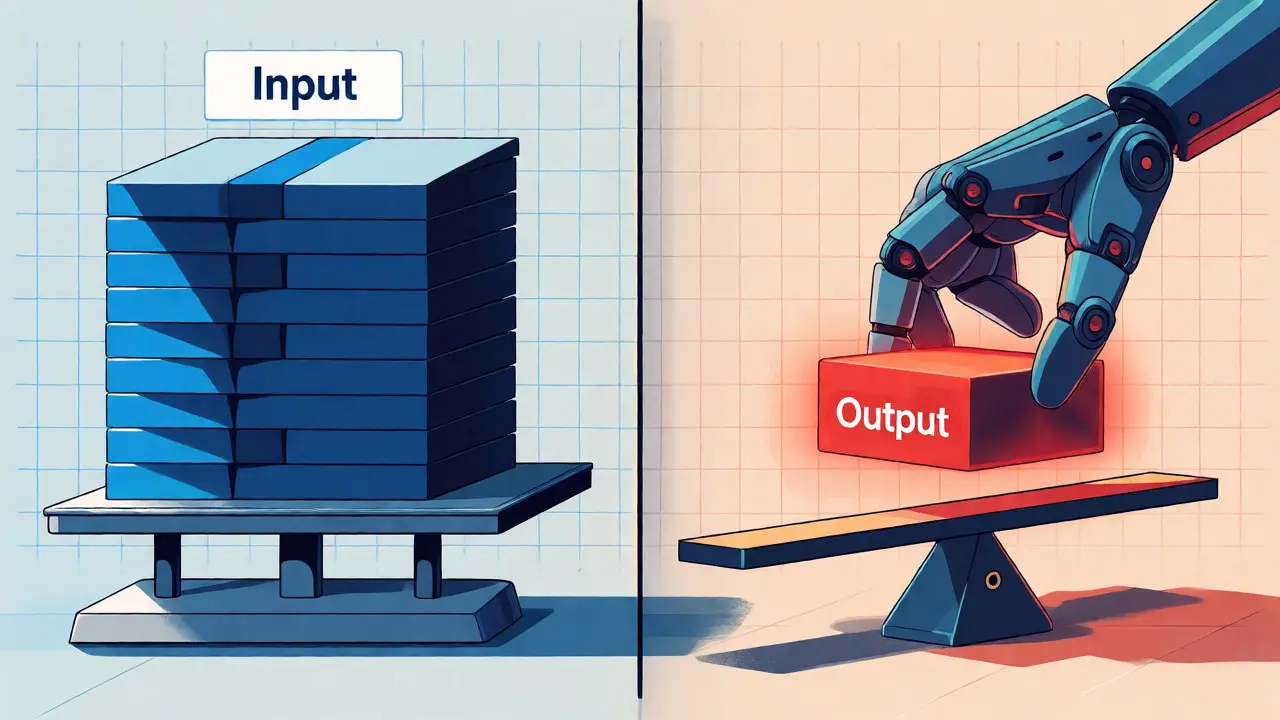
Most people misunderstand the basic billing structure. They see "$3 per million tokens" and assume it’s flat. It’s not. In almost every major provider-whether it’s OpenAI, Anthropic, or Google-the cost of generating text (output) is significantly higher than processing text (input). For example, Anthropic’s Claude Sonnet 4.5 charges $3 per million input tokens but $15 per million output tokens. That’s a 5:1 ratio.
Why? Because generating each next word requires the model to run a full forward pass through its neural network, whereas processing input can be parallelized and cached more efficiently. This asymmetry changes everything about your product design. A feature that produces short, punchy answers is cheap. A feature that writes 2,000-word blog posts is five times more expensive per word generated. If your business model relies on high-volume content generation, this output premium is your biggest line item.
Reasoning Models and the Hidden Cost of Thinking Tokens
Here’s where things get tricky. Newer "reasoning" models, like OpenAI’s o-series or Claude with extended thinking capabilities, introduce a third pricing dimension: thinking tokens. These are internal steps the model takes to solve a problem before it shows you the answer. You don’t see them, but you pay for them.
These hidden tokens can multiply your effective cost by 10x to 30x compared to standard models. A simple math problem might consume 50 visible output tokens but require 1,500 thinking tokens to solve correctly. If you use a reasoning model for a task that doesn’t need deep logic-like summarizing an email-you’re paying for computational effort that was wasted. The rule of thumb here is strict: only use reasoning models for tasks where accuracy hinges on multi-step logic, such as code debugging, scientific analysis, or complex financial modeling. For everything else, stick to standard instruction-tuned models.

The Commodity Tier: Cheap Models for Simple Tasks
While premium models hold their price, the bottom of the market has collapsed. By 2026, we’ve seen radical cost compression in the "commodity" tier. Providers like SiliconFlow offer models like Qwen2.5-VL-7B-Instruct at $0.05 per million tokens and Meta-Llama-3.1-8B-Instruct at $0.06 per million tokens. That’s two orders of magnitude cheaper than premium tiers.
These aren’t toy models anymore. For specific tasks, they perform nearly as well as the big players. Classification, basic extraction, and simple translation work perfectly fine on these budget-tier models. The key insight is that you shouldn’t buy a Ferrari to go to the grocery store. If your task is binary (yes/no), extractive (pull this date from this text), or low-context conversational, route it to a model costing less than a tenth of a cent per thousand words. This strategy alone can cut your inference bill by 80% without users noticing a drop in quality.
| Task Type | Recommended Model Tier | Est. Cost (per 1M Tokens) | Key Driver |
|---|---|---|---|
| Classification / Sentiment | Commodity (e.g., Llama 3.1) | $0.05 - $0.10 | Low complexity, short outputs |
| Summarization / Extraction | Mid-Tier (e.g., Haiku, Flash) | $0.50 - $2.00 | Balanced context/output ratio |
| Creative Writing / Code Gen | Premium (e.g., GPT-4o, Sonnet) | $5.00 - $15.00 | High output volume, quality reqs |
| Complex Reasoning / Analysis | Reasoning (e.g., o3, Extended Think) | $15.00+ (incl. thinking) | Hidden token multiplier |
Fine-Tuning vs. Prompting: When Does It Pay Off?
A common question is whether to spend money on fine-tuning a model or just engineer better prompts. The answer lies in volume. Fine-tuning reduces the amount of context you need to send in every prompt because the model already "knows" your style or domain rules. Industry data suggests fine-tuning can cut prompt length by 50% or more.
But fine-tuning costs money upfront. The break-even point typically hits around 5 million cumulative tokens of usage. Below that threshold, sophisticated prompting is cheaper. Above it, especially for repetitive tasks like customer support responses or technical documentation generation, fine-tuning lowers your per-query cost significantly. If you have a high-volume, narrow-domain application, investing in a custom model now pays dividends later. If you’re experimenting with new features, stay with general-purpose models until you prove the demand.
Optimization Levers: Caching and Batching
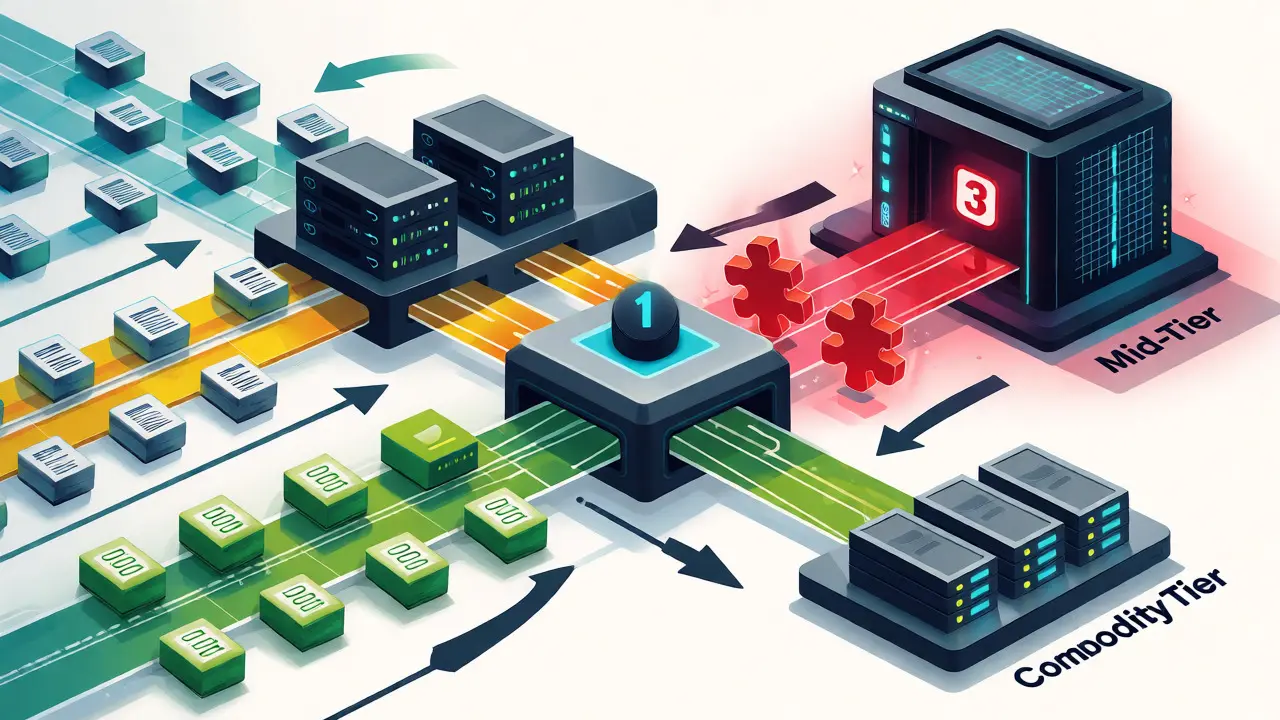
Even after choosing the right model, you can still squeeze out savings. Two techniques dominate 2026 best practices: prompt caching and batch processing.
Prompt Caching: Many applications send the same long system prompt or document context with every request. Instead of re-processing those static tokens every time, providers allow you to cache them. You pay once to process the context, then subsequent queries using that same context cost significantly less on the input side. This is huge for RAG (Retrieval-Augmented Generation) apps where you’re constantly querying against the same knowledge base.
Batch Processing: Not every user needs an instant answer. If you’re generating weekly reports, analyzing historical logs, or creating content for tomorrow’s newsletter, you don’t need real-time inference. Providers offer substantial discounts (often 50% off) for batch jobs that can wait 12-24 hours. Segmenting your workload into "real-time" and "batch" queues allows you to route non-urgent tasks to cheaper, slower pipelines automatically.
The Future: Hybrid Pricing and Dynamic Routing
We’re seeing a shift away from pure usage-based billing toward hybrid models. As infrastructure costs drop, SaaS companies are realizing that customers hate unpredictable bills. Some providers are introducing "capped usage" plans or fixed-seat pricing where the provider absorbs the variance in token costs, betting that their efficiency gains will protect their margin.
Simultaneously, dynamic routing is becoming standard. Tools like Google’s Vertex AI Model Optimizer let you specify an objective-"cheapest acceptable quality" or "best quality regardless of cost"-and automatically route each request to the optimal model. This abstracts the unit economics decision away from the developer and into the platform layer. For most businesses, this means you no longer manually pick models; you define quality thresholds, and the system handles the cost optimization.
Why are output tokens more expensive than input tokens?
Output tokens require sequential generation, where the model must compute the probability distribution for each next word one by one. Input tokens can be processed in parallel batches, making them computationally cheaper. Most providers charge 3x to 5x more for output tokens to reflect this higher compute intensity.
What are thinking tokens and why do they matter?
Thinking tokens are internal reasoning steps used by advanced models like OpenAI's o-series before generating a final answer. They are billed similarly to output tokens but are invisible to the user. They can increase total costs by 10x-30x for complex tasks, making them unsuitable for simple queries.
When should I use a commodity model instead of a premium one?
Use commodity models (costing ~$0.05/M tokens) for classification, extraction, and simple chatbots. Reserve premium models for creative writing, complex coding, and nuanced analysis where quality differences are noticeable to users. Benchmark both on your specific data to confirm quality parity.
How does prompt caching reduce costs?
Prompt caching stores the computed state of static parts of your prompt (like system instructions or large documents). Subsequent requests reuse this state, avoiding recomputation. This can reduce input token costs by up to 90% for applications with stable context.
Is self-hosting LLMs cheaper than using APIs?
Self-hosting eliminates per-token fees but adds GPU infrastructure and engineering costs. It becomes cheaper than API consumption only at very high volumes (millions of daily requests) or when strict latency/data privacy requirements exist. For most startups, APIs remain more cost-effective initially.