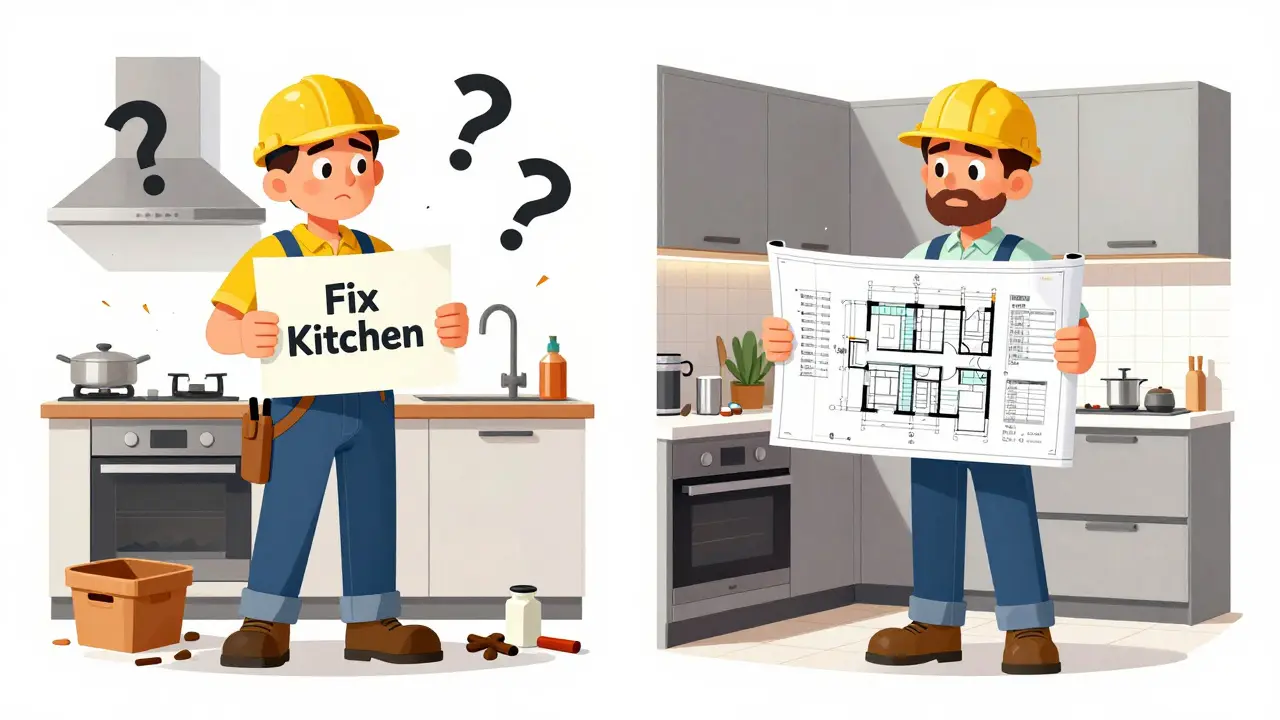
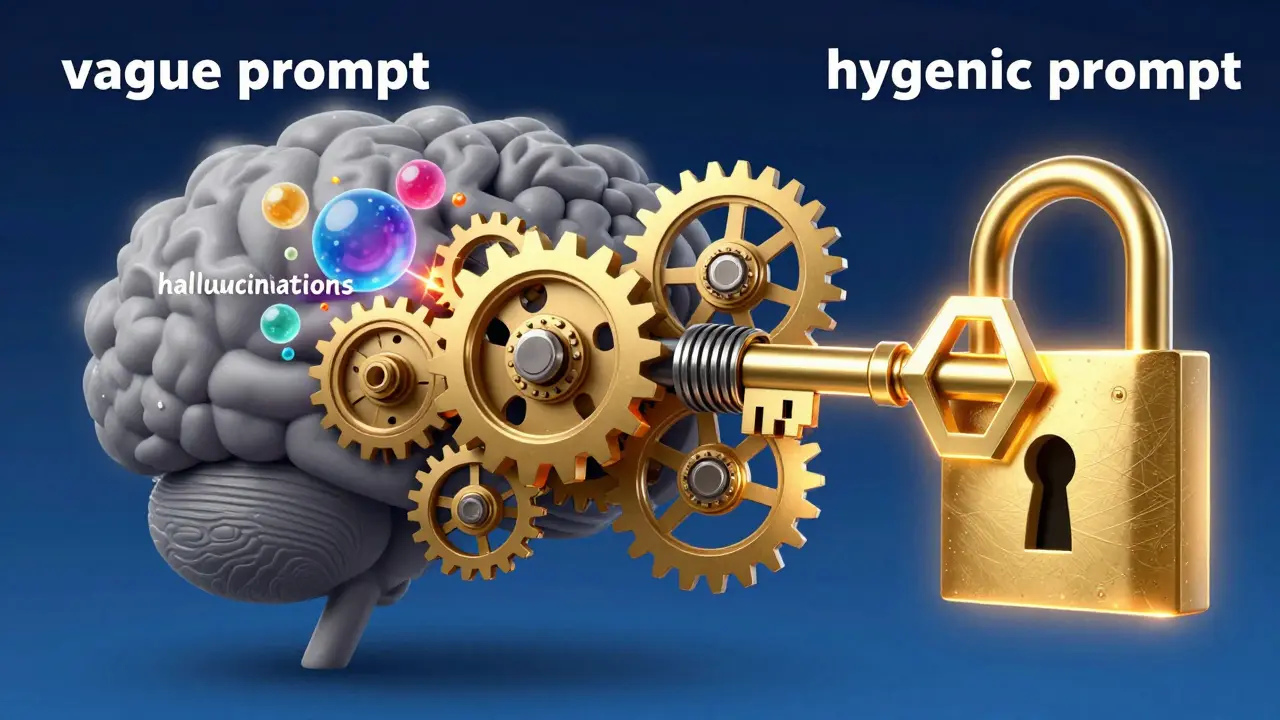
You've probably seen it happen: you give an AI a clear-cut task, but the response is either dangerously wrong or weirdly vague. For a casual chatbot, a small error is a quirk; for a doctor, a lawyer, or a financial analyst, it's a liability. The root cause isn't always the model's intelligence-it's often a lack of prompt hygiene is the systematic practice of crafting precise, unambiguous instructions for large language models (LLMs) to ensure accurate, reliable, and secure outputs. If you treat your prompts like casual conversation, you're leaving the door open for hallucinations and security leaks.
Think of prompt hygiene as the difference between telling a contractor to "fix the kitchen" and providing a detailed blueprint with specific materials and measurements. One leads to a surprise you might hate; the other leads to a predictable, professional result. According to a 2024 Stanford HAI benchmarking study, implementing these rigorous standards can slash hallucinations by as much as 63%. When the stakes are high, "good enough" prompts aren't enough.
The High Cost of Ambiguity
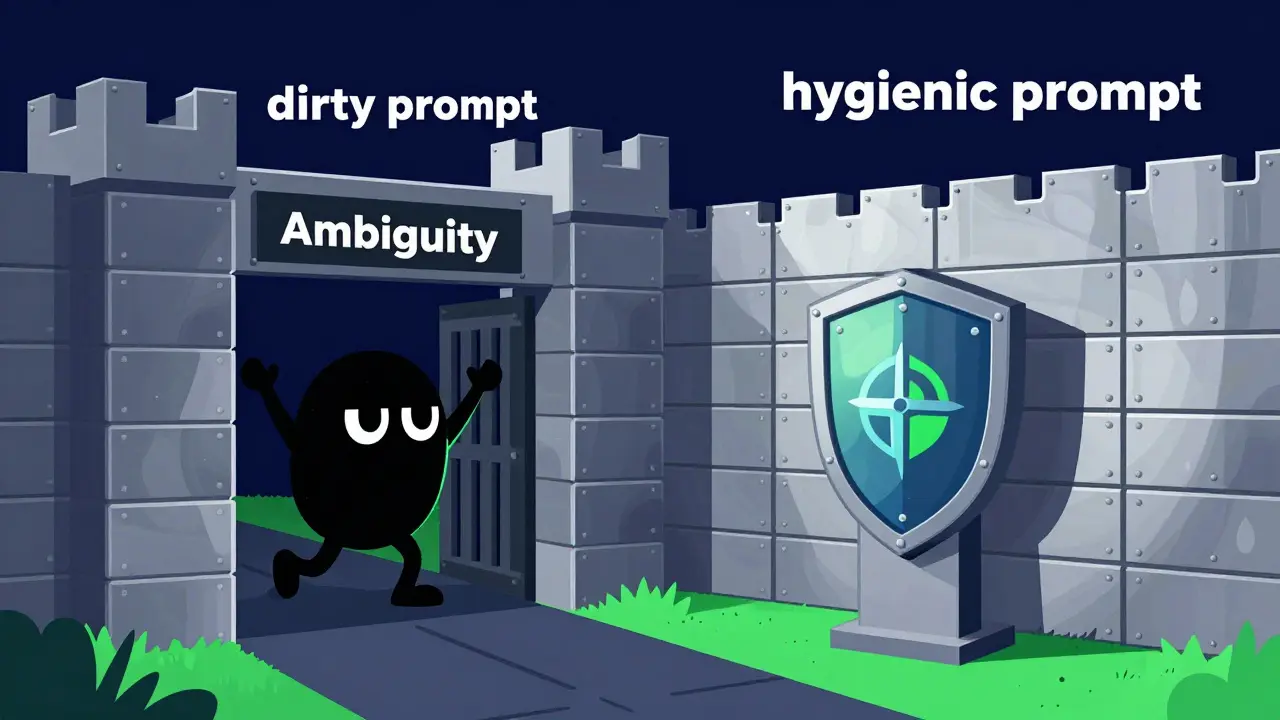
Why does this matter? Because LLMs are literal to a fault, yet they try to be helpful. When an instruction is vague, the model fills the gaps with probability, not facts. This is where "hallucinations" come from. For example, telling a model to "do not include irrelevant information" sounds logical, but the OpenAI Cookbook (2024) found that this specific phrase caused GPT-4.1 to omit critical details 62% of the time. The model becomes overcautious, deleting essential data because it can't be sure what you actually consider "relevant."
It's not just about accuracy; it's about security. Poor hygiene creates holes that hackers love. The OWASP Top 10 for LLM Applications notes that 83% of unprotected implementations are vulnerable to prompt injection. When instructions aren't strictly bounded, a user can easily "trick" the AI into ignoring its safety rules. In the world of cybersecurity, a vague prompt is essentially a wide-open port on a firewall.
Core Principles of Factuality Control
To move from experimental prompting to a formal methodology, you need to follow a few non-negotiable rules. A National Institutes of Health (NIH) study from 2024 highlighted five pillars for high-stakes environments:
- Explicitness and Specificity: Never assume the AI knows the context. Instead of "Summarize this patient's history," use "Summarize the patient's history focusing on comorbidities and medication changes from the last six months."
- Contextual Relevance: Provide the exact boundaries. Tell the AI which guidelines to use (e.g., "Refer to the 2023 ACC and AHA guidelines").
- Iterative Refinement: Your first prompt is a draft. Test it, find where it fails, and tighten the constraints.
- Ethical Considerations: Ensure the prompt doesn't nudge the AI toward biased conclusions.
- Evidence-Based Practices: Require the AI to cite its sources or validate its logic against a known dataset before giving a final answer.
When these are applied, the results are dramatic. The NIH found that prompts embedding specific details-like age and symptoms-reduced diagnostic errors by 38% compared to generic versions. It turns the AI from a guessing machine into a precision tool.
Technical Implementation: Treating Prompts as Code
If you want professional results, you have to stop writing prompts in a single paragraph. Treat your prompts like software code: they need structure, version control, and validation. One of the most effective ways to do this is through structured formatting. Ensure there is a clear, hard separation between the system instructions and the user input. Using multiline strings with at least two new lines before the user input helps the model maintain a strict boundary, preventing the user from "bleeding" into the system's logic.
| Feature | Basic Prompt Engineering | Comprehensive Prompt Hygiene |
|---|---|---|
| Primary Goal | Better output quality | Ambiguity reduction & security hardening |
| Error Rate (Clinical) | 57% incomplete responses | 18% incomplete responses |
| Security Approach | Basic input filtering | Prompt sanitization (e.g., Prǫmpt framework) |
| Computational Cost | Low overhead | Higher upfront dev time (127h vs 28h per workflow) |
For those dealing with sensitive data, the Prǫmpt framework is a game-changer. Released in April 2024, it uses cryptographic-style sanitization to protect sensitive tokens. In healthcare tests, it reduced data leakage by 94% while keeping the response accuracy at 98.7%. It's a way to keep the AI smart without giving it the keys to the kingdom.
The Workflow for Factual Accuracy
How do you actually build a "hygienic" prompt for a factual task? Don't just ask for the answer. Build a validation pipeline directly into the instruction. A high-performance factual prompt follows a three-step internal process:
- Fact Elicitation: Ask the model to first list the relevant facts it knows about the topic.
- Application: Instruct the model to apply those specific facts to the user's question.
- Validation: Force the model to cross-reference its conclusion against an authoritative source, such as PubMed or UpToDate.
For example, instead of asking "Is this medication safe for this patient?", a hygienic prompt would be: "1. List the contraindications for Drug X based on the 2025 FDA label. 2. Compare these contraindications to the patient's current comorbidities. 3. State whether a conflict exists and cite the specific section of the label that supports your answer."
Challenges and the Learning Curve
Let's be real: this takes work. You can't just "set and forget" your prompts. A study in JAMA Internal Medicine showed that healthcare implementations of prompt hygiene took an average of 127 hours per workflow, compared to just 28 hours for basic setups. There is a steep learning curve for non-technical experts. In fact, the NIH found that professionals needed about 23 hours of training to stop making common mistakes, like forgetting to provide enough context or referencing outdated guidelines.
Another hurdle is model drift. What works for one version of an AI might fail in the next. The OpenAI Cookbook noted that transitioning from GPT-3.5 to GPT-4.1 actually caused accuracy to drop from 89% to 62% for some users. Why? Because newer models often interpret instructions more literally. If you told a model to "be brief," it might cut out a critical warning just to satisfy your length requirement. You have to redefine your "relevance criteria" every time you upgrade your model.
The Future of AI Governance
We are moving toward a world where prompt hygiene isn't optional-it's a regulatory requirement. The EU AI Act already classifies medical LLMs as high-risk, requiring "demonstrable prompt validation processes" for certification. Similarly, HHS guidance from March 2024 suggests that prompt sanitization is a necessary safeguard for HIPAA compliance.
We're also seeing the tools catch up. Anthropic's Claude 3.5 now includes built-in ambiguity detection, and Google's Gemini 1.5 Pro uses prompt provenance tracking to keep track of where instructions are coming from in a long conversation. These tools make it easier to spot "dirty" prompts before they ever hit production.
What exactly is prompt hygiene?
Prompt hygiene is the professional practice of removing ambiguity and security vulnerabilities from AI instructions. Unlike basic prompt engineering, which focuses on getting a "good" result, prompt hygiene focuses on reliability, predictability, and security, especially for factual or high-stakes tasks.
Can prompt hygiene actually stop hallucinations?
Yes, significantly. By using explicit constraints, evidence-based validation steps, and clear context boundaries, researchers have seen hallucination rates drop by 47-63%. It forces the model to rely on provided facts rather than probabilistic guessing.
How does it improve AI security?
It prevents prompt injection attacks by creating strict boundaries between system instructions and user input. Using techniques like the Prǫmpt framework can block up to 92% of direct injection attempts by sanitizing tokens and preventing users from overriding the AI's core safety rules.
Why do I need to change prompts when I upgrade the LLM version?
Newer models often have different "interpretative tendencies." For example, GPT-4.1 is more literal than GPT-3.5. A prompt that worked by implying a need for detail might be ignored by a newer model that only does exactly what is written, leading to a drop in output completeness.
Is prompt hygiene useful for creative writing?
Generally, no. Prompt hygiene is designed for factuality and precision. In creative tasks, ambiguity and "randomness" are often desirable to produce unique or surprising results. Forcing a creative prompt to be strictly hygienic can make the output feel robotic and bland.
Ben De Keersmaecker
April 16, 2026 AT 23:55The part about treating prompts like code actually makes a lot of sense if you've ever dealt with version control in software dev. It's wild how a tiny change in a model version can totally wreck a prompt that was working perfectly a week ago.
Aaron Elliott
April 18, 2026 AT 17:13One must concede that the nomenclature of "hygiene" is somewhat reductive, yet it serves to illustrate the fundamental necessity of structural rigor in an era where intellectual laziness is often mistaken for efficiency. The dichotomy between a casual query and a formal specification is not merely a technical preference but an ontological distinction in how we interact with synthetic intelligence.
Chris Heffron
April 19, 2026 AT 10:19Totally agree on the structure part! :)
Paritosh Bhagat
April 19, 2026 AT 20:37It is truly a tragedy that so many people treat these powerful tools with such reckless abandon, though I suppose we cannot expect professional standards from a general public that barely understands basic syntax. I have spent countless hours correcting the prompts of my colleagues who seem utterly incapable of following simple instructions, and frankly, it is exhausting to be the only one upholding a shred of intellectual dignity in the workplace. I only wish the author would have paid more attention to the punctuation in the second paragraph, but I shall overlook it for the sake of a friendly discourse, even if it pains me deeply to see such carelessness.
Adrienne Temple
April 20, 2026 AT 09:32This is super helpful! 🌟 I've always wondered why my AI sometimes just ignores me or gets things wrong. I like the idea of making a list of facts first before asking for the answer. Does anyone know if this works for non-English languages too? 😊
Antonio Hunter
April 21, 2026 AT 17:04When we consider the broader implications of these methodologies, it becomes apparent that we are not just talking about technical optimization, but rather about fostering a culture of precision and accountability that can be extended to many other areas of mentorship and professional development, especially for those who are just starting their journey in the tech world and might feel overwhelmed by the sheer volume of contradictory advice available online. If we can guide the next generation to understand that the quality of the input directly dictates the reliability of the output, we are essentially teaching them a universal lesson in critical thinking that transcends the specific limitations of current large language models and prepares them for a future where human-AI collaboration is the standard operating procedure in every high-stakes industry from medicine to law.
Sandy Dog
April 23, 2026 AT 02:31OMG I literally cannot even deal with the fact that it takes 127 hours to set up a workflow!! 😱 Like, who has that kind of time in their life? I'm just trying to get my AI to help me organize my schedule and now I feel like I need a whole degree in "Prompt Hygiene" just to get a straight answer! It's actually insane that the models get dumber when they upgrade, like why am I paying for a subscription if the newer version is just going to be more literal and boring? This is a total nightmare! 😭💅
Nick Rios
April 24, 2026 AT 06:07I think it's fair to acknowledge that the learning curve is steep, but the payoff for security and accuracy is worth the effort for most professionals.
Amanda Harkins
April 24, 2026 AT 21:20Kind of funny how we're spending all this time learning to talk to machines in a way they understand, while humans are still terrible at communicating with each other. We're basically building a digital etiquette manual for a ghost in a box.