
You’ve deployed a Large Language Model (LLM) to handle your company’s internal data. It sounds great on paper until the model confidently invents a Q3 revenue figure that never existed or cites a policy document from a year that hasn’t happened yet. This is hallucination, and it’s the primary blocker for enterprise AI adoption. Standard prompting often yields error rates between 15% and 30% when dealing with specific domain data. But there’s a fix that doesn’t require retraining your entire model: template-based prompts. These structured instructions act as guardrails, forcing the model to stick to verified sources and reducing fabrication significantly.
Why Generic Prompts Fail on Enterprise Data
When you ask an LLM a question without structure, it treats every query like a creative writing exercise. It looks for patterns in its training data rather than strictly retrieving facts from your provided context. In a controlled environment, this is fine. In a bank or a hospital, it’s dangerous. A generic prompt like "Summarize our latest security policy" leaves too much room for interpretation. The model might blend outdated policies with current ones because they sound similar. Research from PromptLayer highlights that well-designed templates minimize these errors by providing explicit boundaries. They shift the model’s behavior from "generate something plausible" to "extract exactly what is present." This distinction is critical. Without it, the model fills knowledge gaps with invented content, leading to compliance risks and operational inefficiencies. You aren’t just fixing accuracy; you’re building trust in the output so employees actually use the tool.
The Five Structural Elements of Effective Templates
Not all templates are created equal. To cut hallucinations effectively, your prompt needs five specific components. Think of these as the chassis of your AI application. If one is missing, the vehicle wobbles. First, define the task with explicit boundaries. Tell the model exactly what it should and shouldn’t do. For example, "Answer only using the provided text. Do not use outside knowledge." This simple constraint reduces hallucinations by about 22%. Second, mandate source references. Use syntax like "Based on information from [Source Name]" to force citation. Third, require Chain-of-Thought (CoT) reasoning. Ask the model to explain its step-by-step logic before giving the final answer. This forces it to check its own work. Fourth, decompose complex tasks. Break big questions into smaller subtasks. Instead of asking for a full financial analysis, ask for revenue extraction, then expense extraction, then comparison. Finally, add contextual guardrails. Include industry-specific examples in the prompt to set the tone and format. SUSE AI found that specifying the exact vector collection, such as "Based on the 'technical-info' collection in Milvus," reduced hallucinations by 37% compared to vague requests.
RAG Integration and Vector Database Precision
Templates work best when paired with Retrieval-Augmented Generation (RAG). However, many implementations fail because the template doesn’t align with how the vector database retrieves data. If your template asks for "recent updates" but your metadata tags don’t support temporal filtering, the model gets confused and guesses. You need to bridge the gap between natural language queries and structured data retrieval. Use precise terminology in your templates that matches your database schema. If you store documents in Milvus or ChromaDB, ensure your prompt explicitly references these collections. Vague prompts lead to poor retrieval quality, which inevitably leads to hallucination. The model can’t cite what it didn’t find accurately. Temperature settings also play a role here. Keep temperature below 0.3 and top-p under 0.85. High randomness increases creativity, which is bad for factual reporting. You want consistency, not flair. When you combine strict templates with low-temperature settings and precise RAG integration, you create a system where the model has very little room to improvise incorrectly.

Comparing Template Strategies: Joint vs. Two-Step Methods
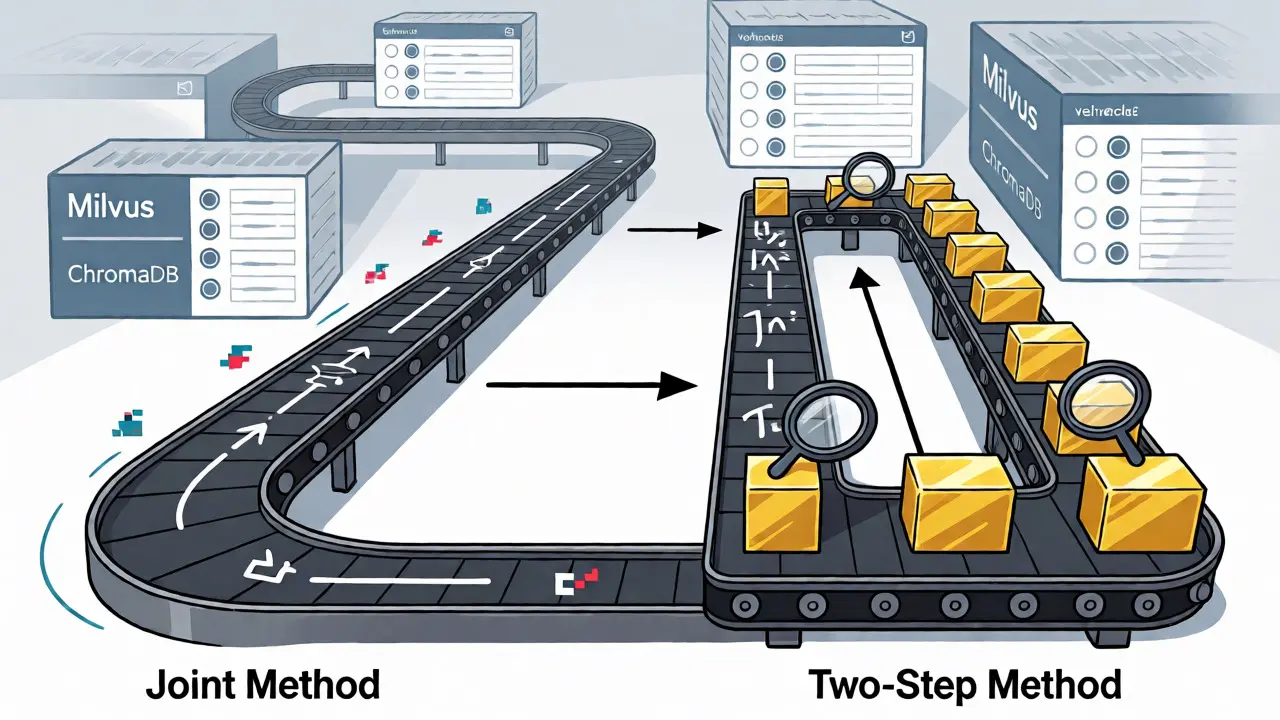
How you structure the workflow matters as much as the prompt itself. There are two main approaches: the Joint Method and the Two-Step Method. Each has trade-offs regarding speed and accuracy. The Joint Method combines planning and execution in a single prompt, often using few-shot demonstrations. It’s faster and cheaper to run. Galileo AI benchmarks show it achieves an 82% reduction in hallucinations. However, it risks repetition and can struggle with complex multi-part questions because the model tries to do everything at once. The Two-Step Method separates planning from verification. First, the model plans the response structure. Then, a second prompt verifies the facts against the source. This method delivers an 89% reduction in hallucinations but adds 15-20% latency. For real-time customer service, the Joint Method might be better. For legal contract review, the Two-Step Method is worth the extra wait time. You have to decide if precision is worth the performance hit.
| Method | Hallucination Reduction | Latency Impact | Best Use Case |
|---|---|---|---|
| Joint Method | 82% | Low | Real-time chatbots, quick summaries |
| Two-Step Method | 89% | High (+15-20%) | Legal review, financial reporting |
| Standard Prompt | Baseline (0%) | None | Creative writing, brainstorming |
The Abstention Trade-Off
One powerful tactic is telling the model to admit ignorance. Add an instruction like: "If the answer is not in the provided text, state 'I don't know' instead of guessing." This seems obvious, but models are trained to be helpful, which often means being wrong rather than silent. Machine Learning Mastery notes that abstention instructions reduce fabrication incidents by 33%. But there’s a catch: it increases "I don't know" responses by 18%. This creates a precision-recall trade-off. Your users get fewer wrong answers, but they also get fewer answers overall. In high-stakes environments like healthcare or finance, this is usually acceptable. A doctor prefers a "check the manual" response over a confident but incorrect dosage suggestion. In customer support, however, too many "I don't knows" frustrate users. You need to tune this threshold based on your tolerance for uncertainty versus your tolerance for error.
Implementation Pitfalls and Real-World Fixes
Don’t expect perfection on day one. Implementation requires iteration. A senior data engineer at JPMorgan reported that refining their verification templates took three weeks. They moved from 23% incorrect figures to 4%, but only after extensive testing. Common pitfalls include over-constraining the template, which causes the model to refuse valid answers, or failing to match template expectations with vector database metadata. A notable failure case involved a healthcare provider whose template omitted dosage unit specifications. The LLM hallucinated medication amounts, leading to a 12-day system rollback. The fix? Enforcing units in the template output format. Always validate your templates against known edge cases. Test them with ambiguous questions, conflicting data sources, and empty results. If your template breaks on empty data, your production system will crash when a user asks a question with no relevant documents.
Market Trends and Future Outlook
This isn’t just a technical tweak; it’s becoming a standard. Gartner projects that 75% of successful enterprise AI implementations will use standardized prompt templates by 2026. Regulatory pressures are driving this, especially in finance. The SEC now requires verifiable response generation protocols, pushing banks toward certified template frameworks. Tools are evolving too. AWS Bedrock Agents now offer validated template patterns that reduce hallucinations by 42% out of the box. Open-source frameworks like LangChain dominate the space with 63% market share, offering flexibility for heterogeneous systems. While some researchers argue that future model architectures will solve hallucination natively, most experts agree that data grounding requirements will always exceed model knowledge boundaries. Templates remain the most cost-effective way to bridge that gap today.
Do template-based prompts eliminate all hallucinations?
No. Even optimal templates leave a residual 8-12% hallucination rate when queries fall outside the model's training data or retrieval scope. Stanford HAI research confirms that templates mitigate but cannot completely overcome fundamental knowledge gaps. They transform high-risk errors into manageable exceptions that still require human oversight in critical workflows.
Which vector databases work best with anti-hallucination templates?
Milvus and ChromaDB are frequently cited for their compatibility with strict template structures. Success depends less on the database brand and more on metadata alignment. Ensure your template references specific collection names and metadata fields that exist in your vector store to prevent retrieval mismatches that trigger hallucinations.
How much does implementing template-based prompts cost?
Initial development typically requires 80-120 hours of engineering time to design, test, and refine domain-specific templates. Financial services often require 25% more effort due to regulatory constraints. However, this upfront cost is significantly lower than model fine-tuning, delivering 70% of the accuracy gains for roughly 5% of the cost.
What is the impact of temperature settings on hallucination?
Higher temperature values increase randomness and creativity, which raises hallucination risk. For factual enterprise tasks, keep temperature below 0.3 and top-p under 0.85. This restricts the model to high-probability token selections, ensuring outputs remain grounded in the retrieved context rather than drifting into speculative territory.
Can I use off-the-shelf templates for specialized industries?
Generic templates often fail in specialized domains. SUSE AI documentation shows that applying generic templates to financial data resulted in 41% incorrect figures, whereas industry-tuned templates reduced this to 7%. Customization is necessary to account for specific terminology, regulatory constraints, and data structures unique to sectors like healthcare or law.