You’ve got a budget, a deadline, and a mountain of data. You need an AI that actually works in production, not just one that looks good on a leaderboard. But here’s the trap: most benchmarking guides treat every model like it’s interchangeable. They aren’t. A model that crushes code generation might choke on long-document analysis. A lightning-fast classifier might miss subtle nuances in legal text.
Choosing the right transformer variant isn’t about picking the "smartest" model. It’s about matching architecture to workload. As of late 2026, the gap between theoretical performance and real-world utility is widening. Let’s cut through the noise and look at what actually happens when you deploy these models under pressure.
The Performance vs. Cost Reality Check
Let’s start with the elephant in the room: GPT-4 Turbo. Released back in November 2023, it remains the gold standard for complex reasoning. Why? Because it handles context windows up to 128,000 tokens. That’s roughly 300 pages of text processed in one go. For tasks like synthesizing deep research or drafting complex legal documents, nothing else comes close.
But there’s a catch. One documented case involving a Zendesk customer support chatbot showed that migrating from GPT-3.5 to GPT-4 boosted Customer Satisfaction (CSAT) scores by 12 percentage points. Sounds great, right? Except costs quadrupled. If your application involves high-volume, low-complexity queries, paying premium rates for reasoning power you don’t use is financial suicide.
GPT-4 is also a black box. You can’t inspect the weights, you can’t fine-tune the core architecture easily, and you’re subject to rate limits during peak hours. If you need transparency or control, this isn’t your lane.
BERT-Family Models: The Efficiency Kings
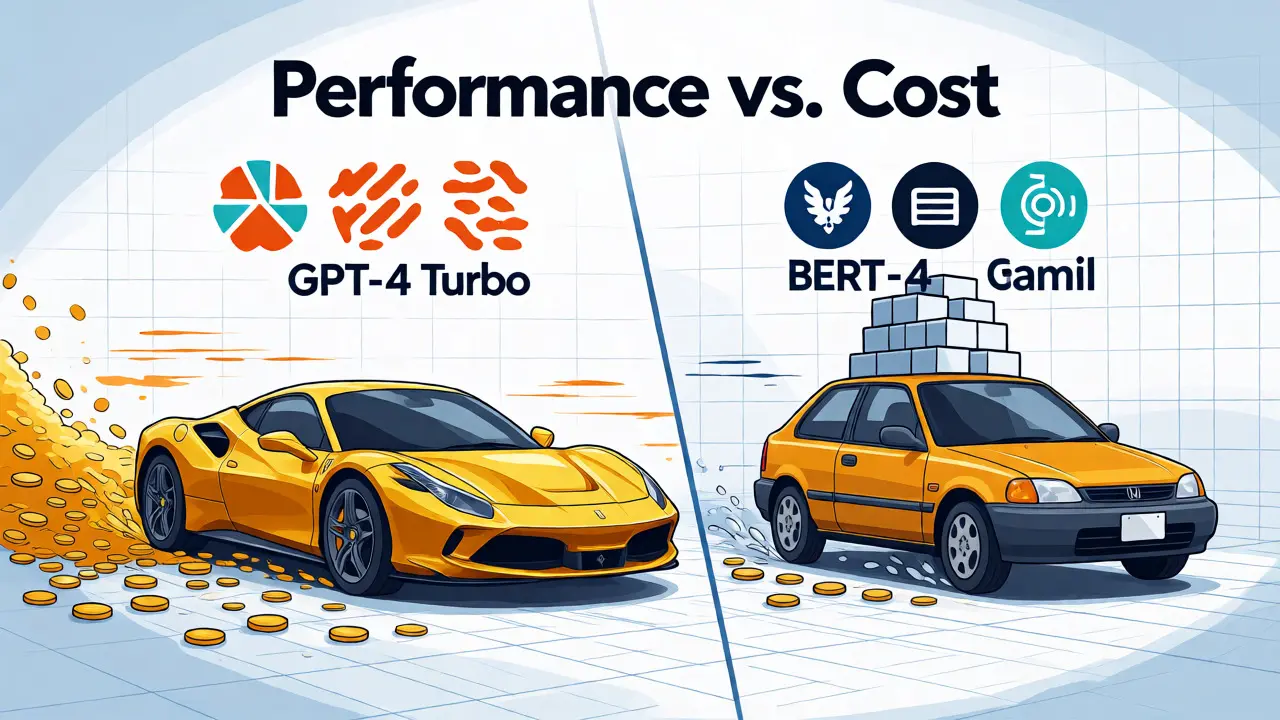
If GPT-4 is the Ferrari, BERT-family models are the reliable Honda Civics. They won’t win a drag race, but they get you there cheaply and predictably. Take RoBERTa-Large. With 355 million parameters, it scores an impressive 7.8 on accuracy benchmarks while maintaining a perfect 10 for price efficiency. Its 512-token context limit means it’s not built for reading whole books, but it excels at specific tasks like General Language Understanding Evaluation (GLUE) or question answering.
Then there’s DistilBERT. This variant uses knowledge distillation to shrink the original BERT model by 40% while keeping 97% of its accuracy. For resource-constrained environments-like mobile apps or edge devices where latency matters more than deep reasoning-this is often the smarter choice. You save on compute costs without sacrificing much quality.
ELECTRA offers another angle. Instead of masking words like BERT, it detects replaced tokens. This speeds up training significantly with only a marginal drop in performance. If you’re iterating quickly on a prototype, ELECTRA’s faster training cycles could save you weeks.
| Model Variant | Accuracy Score (1-10) | Speed Score (1-10) | Price Efficiency | Context Length | Best Use Case |
|---|---|---|---|---|---|
| GPT-4 Turbo | 9.5 | 6.0 | Low | 128k tokens | Complex reasoning, coding, long-doc synthesis |
| RoBERTa-Large | 7.8 | 8.0 | High | 512 tokens | Classification, QA, GLUE benchmarks |
| DistilBERT | 7.5 | 9.0 | Very High | 512 tokens | Edge devices, high-volume inference |
| Transformer XL | 7.6 | 6.0 | Medium | >3,000 tokens | Long-dependency modeling, music/DNA |
| T5 (11B) | 8.4 | 7.0 | Medium | 512 tokens | Text-to-text translation, summarization |
Handling Long Contexts Without Breaking the Bank
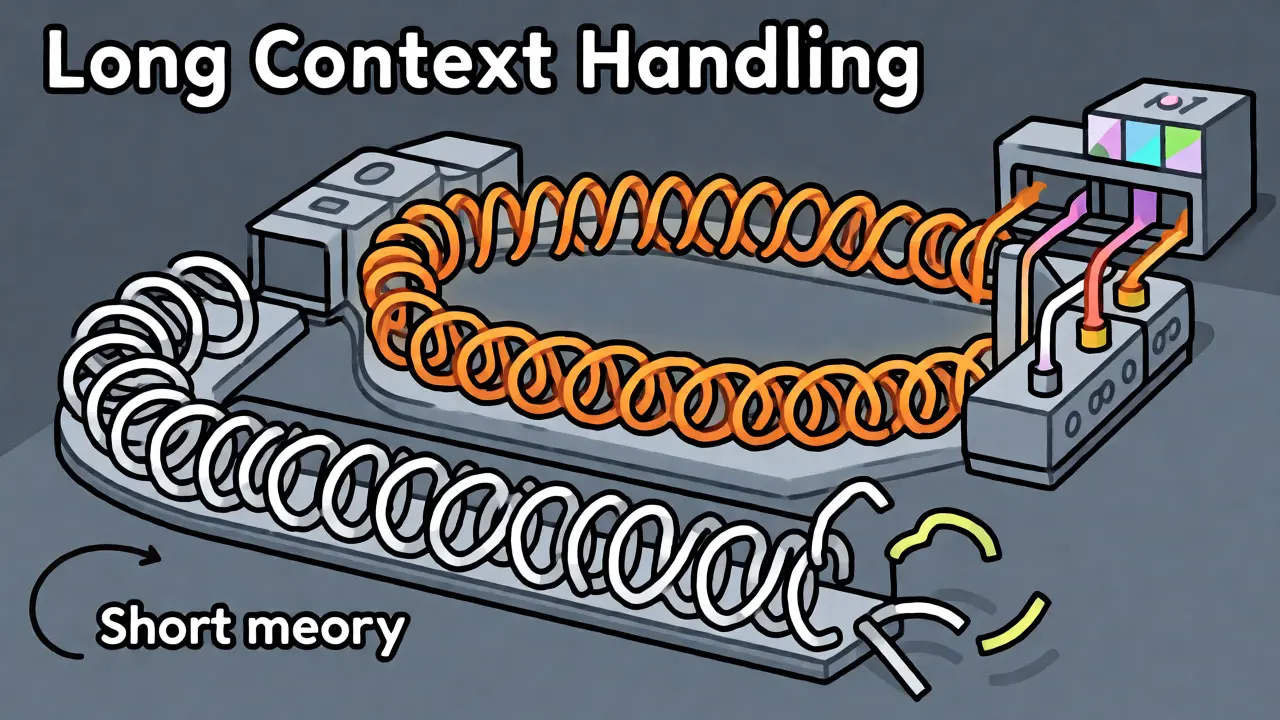
Standard transformers hit a wall at 512 tokens. That’s fine for tweets or short paragraphs, but useless for contracts or scientific papers. Enter Transformer XL. By using segment-level recurrence, it extends context windows beyond 3,000 tokens-a six-fold increase over baseline models. A 1.5-billion-parameter version scores a solid 7.6 in accuracy, though its speed drops to a 6 due to computational complexity.
Why does this matter? Think about DNA sequence modeling or music generation. These fields rely on long-term dependencies. If your model forgets the beginning of a sequence by the time it reaches the end, it fails. Transformer XL solves this, but be warned: it requires custom CUDA kernel implementations for optimal performance. Community support is sparse compared to mainstream models, so expect to do some heavy lifting in engineering.
For many enterprises, however, the solution isn’t Transformer XL-it’s Gemini 2.5 Flash. This emerging alternative offers massive context windows and multimodal capabilities (text plus vision) at a fraction of GPT-4’s cost. If you’re processing multimedia inputs and need speed, Gemini is increasingly hard to ignore.
The Low-Data Regime Trap
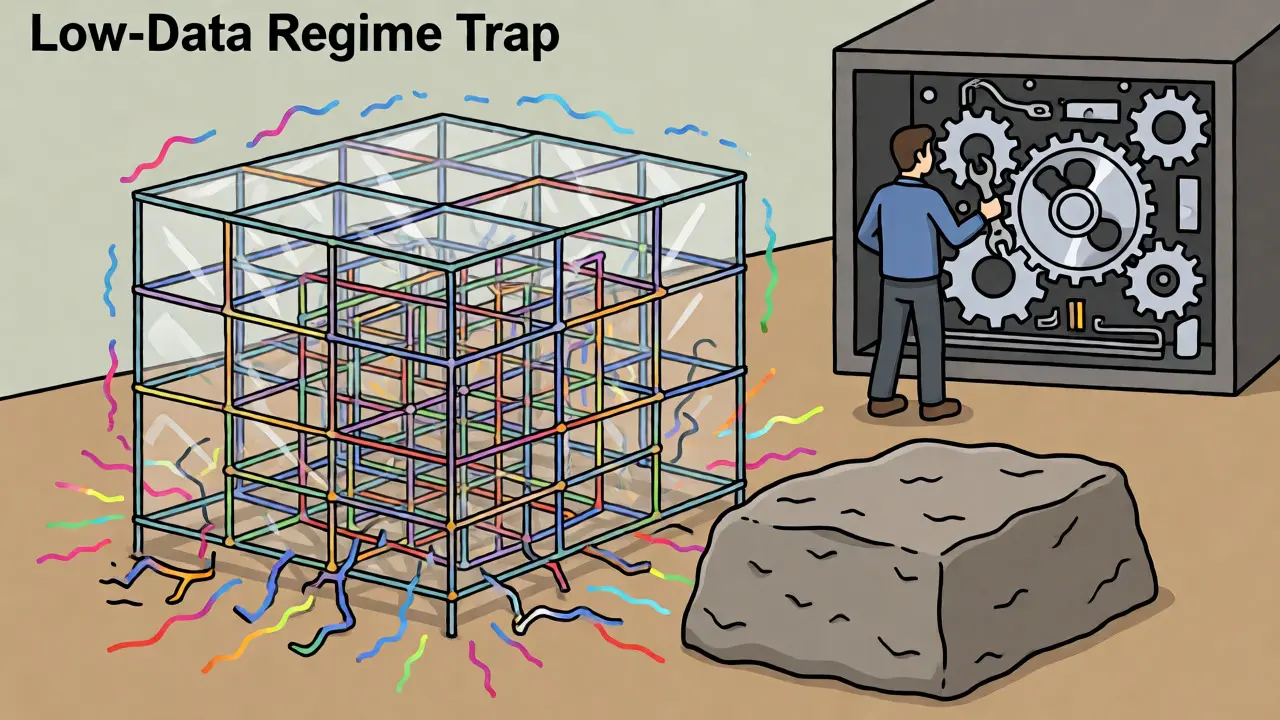
Here’s where things get counterintuitive. Transformers dominate in big-data scenarios, but they can crumble in low-data regimes. Recent statistical benchmarking compared transformers against traditional baselines like Ordinary Least Squares (OLS), Lasso regression, and Gradient Boosting.
In scenarios with strong linear correlations (correlation coefficient ρ = 0.50), transformers achieved a performance score of 0.693, beating MLP baselines (0.435). But under cross-sectional shift conditions-where data distribution changes unexpectedly-transformer performance plummeted to 0.118. Meanwhile, simpler models like MLP maintained relative stability at 0.089.
What does this mean for you? If your real-world workload involves unpredictable data shifts (common in finance or social media trends), a fancy transformer might actually perform worse than a simpler, robust model. Don’t assume bigger is always better. Validate your model against distribution shifts before deploying.
Open Source Alternatives: Control and Customization
Proprietary models are convenient, but open-source options have matured significantly. The Falcon series from the Technology Innovation Institute now offers multimodal capabilities in its 11-billion-parameter Falcon 2 variant. Larger versions like Falcon 180B compete directly with closed-source giants, giving you full access to weights for fine-tuning.
Nvidia’s Nemotron models are another game-changer. Built on Llama-3 foundations, Nemotron-4 spans scales from 15 billion to 340 billion parameters. Crucially, smaller Nemotron variants run efficiently on single GPUs, making local deployment feasible for businesses wary of cloud costs or data privacy issues. Unlike GPT-4, you own the weights. You can audit them, tweak them, and deploy them wherever you want.
How to Choose Your Model
Selecting a transformer variant boils down to three questions:
- Do you need top-tier reasoning? If yes, and budget allows, stick with GPT-4 or Claude Opus 4.5. They excel in legal, coding, and research tasks.
- Is speed and cost your priority? Look at Gemini 2.5 Flash or DistilBERT. They offer rapid inference with minimal overhead.
- Do you need transparency and control? Go with BERT-family models or open-source alternatives like Falcon or Nemotron. You’ll sacrifice some absolute accuracy for interpretability and ownership.
Remember, there is no universal winner. The "best" model is the one that meets your specific latency, accuracy, and budget constraints without introducing unnecessary complexity.
Frequently Asked Questions
Why is GPT-4 Turbo still recommended despite newer models?
GPT-4 Turbo remains a top choice because of its exceptional reasoning capabilities and massive 128,000-token context window. While newer models may offer better speed or lower costs, GPT-4 continues to lead in complex, accuracy-critical tasks like legal document drafting and sophisticated code generation where nuanced understanding is paramount.
When should I use DistilBERT instead of a larger model?
Choose DistilBERT when you need fast inference on limited hardware, such as mobile devices or edge servers. It retains 97% of BERT's accuracy while being 40% smaller, making it ideal for high-volume applications where latency and computational cost are critical constraints.
Can transformers handle long documents effectively?
Standard transformers struggle with long contexts, but architectures like Transformer XL and GPT-4 Turbo are designed for it. Transformer XL extends context beyond 3,000 tokens using recurrence, while GPT-4 Turbo supports up to 128,000 tokens, allowing it to process entire books or lengthy reports in a single pass.
Are open-source models competitive with proprietary ones?
Yes, especially for specialized tasks. Models like Falcon 180B and Nemotron-4 offer performance comparable to leading proprietary systems. Their key advantage is transparency: you can inspect weights, fine-tune locally, and avoid vendor lock-in, which is crucial for industries with strict data privacy requirements.
How do transformers perform in low-data scenarios?
Transformers can underperform in low-data regimes compared to traditional machine learning models like Gradient Boosting or MLPs, particularly when data distributions shift unexpectedly. In such cases, simpler models often provide more stable results, highlighting the importance of validating model robustness against distribution changes.