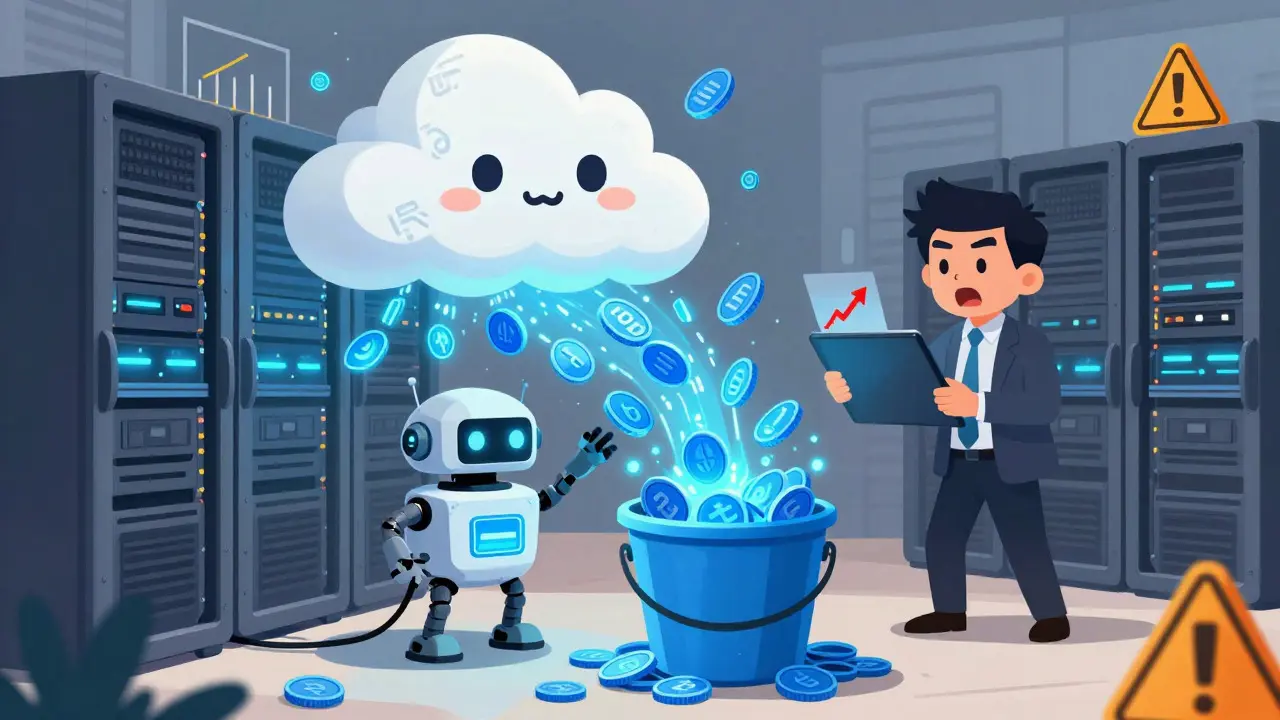
Imagine this: your team launches a new customer support chatbot on a Tuesday. By Friday, the finance department is asking why the cloud bill jumped from $2,000 to $15,000. You didn't change the code. You didn't add users. A single misconfigured agent looped through its context window, burning through millions of tokens in hours. This isn't a hypothetical scenario; it's a common reality for teams deploying Large Language Models without strict financial guardrails. The core problem is that LLM pricing is usage-based, not subscription-based. Every word sent to the model costs money, and every word generated back costs more. Without a system to track and limit this consumption, your operational expenses become a guessing game. Token budgets are the solution. They act as a circuit breaker for your AI spend, ensuring that no single feature, user, or experiment can drain your entire monthly allocation before you even notice. This guide breaks down how to implement these controls effectively. We will look at the technical mechanics, the strategic frameworks, and the specific thresholds that prevent budget surprises. Whether you are using OpenAI, Anthropic, or Alibaba Cloud, the principles remain the same: measure, limit, and alert.
Understanding the Economics of Tokens
To manage what you don't understand, you first need to grasp how billing works. Most major providers use a tiered pricing structure based on input and output tokens. Input tokens are the prompt you send (including system instructions and conversation history). Output tokens are the response the model generates. Crucially, output tokens are significantly more expensive than input tokens. For example, Alibaba Cloud’s Qwen-Flash model charges $0.05 per million input tokens but $0.40 per million output tokens for usage under 256K tokens. That’s an 8x difference. If your application sends long contexts but receives short answers, you are paying a premium for the "reading" part of the process. Conversely, if your model rambles on with verbose responses, your output costs skyrocket. The standard billing formula across most platforms is Fee = (Actual tokens consumed ÷ 1,000,000) × Unit price. This simple equation highlights why precision matters. A 10% increase in average response length directly translates to a 10% increase in your monthly bill. Understanding this differential is the first step in setting realistic budgets. You cannot just set a flat dollar cap; you need to account for the ratio of inputs to outputs in your specific use case.The Technical Architecture of Token Limits
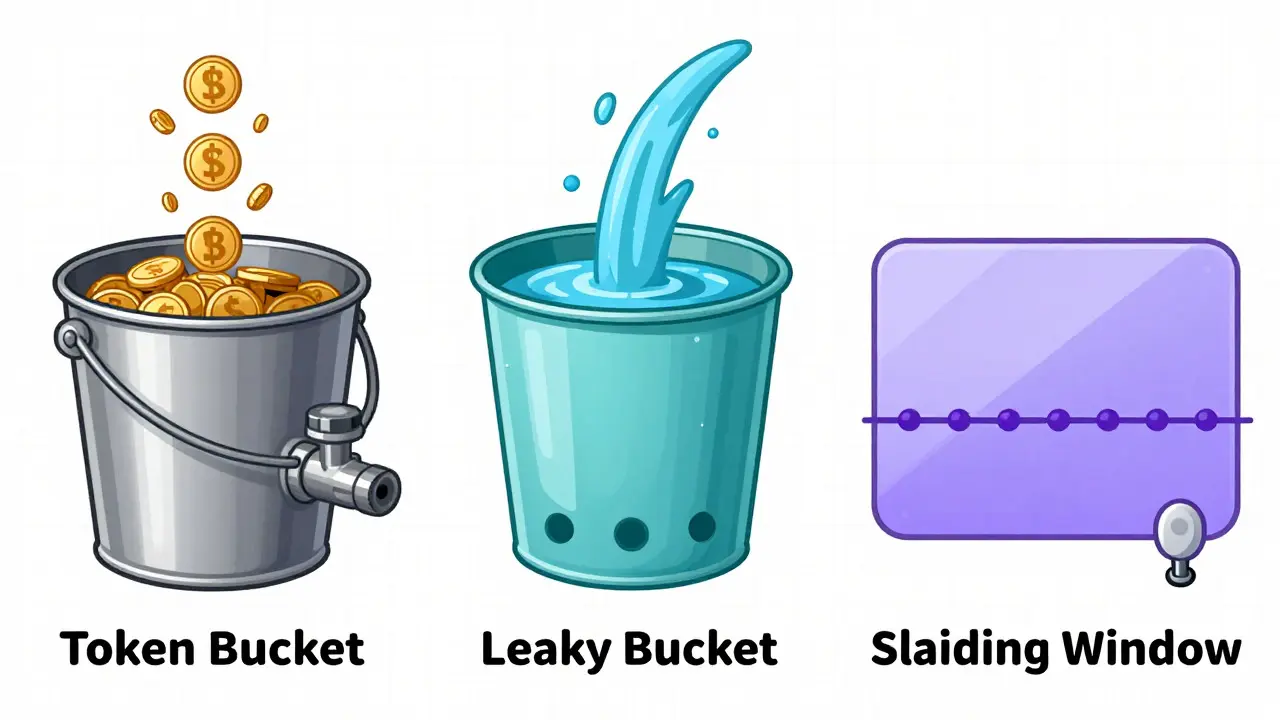
Implementing a token budget isn't just about setting a number in a dashboard. It requires a technical layer between your application and the LLM provider. This layer is typically handled by an API gateway or a specialized middleware service. There are three primary algorithms used to enforce these limits:- Token Bucket: The most common approach. Imagine a bucket that refills with tokens at a steady rate (e.g., 60,000 tokens per minute). When a request comes in, tokens are deducted from the bucket. If the bucket is empty, the request is throttled or queued. This allows for bursts of activity while maintaining an average rate.
- Leaky Bucket: Similar to the token bucket, but focuses on smoothing out traffic. Requests enter a queue and are processed at a fixed rate. This is useful for protecting backend resources from sudden spikes.
- Sliding Window: Tracks usage over a rolling period (like the last 1 hour) without sharp resets. This prevents the "midnight reset" phenomenon where users dump all their requests right before a quota resets.
Setting Smart Thresholds: The Graduated Approach
A binary switch-on or off-is rarely useful in production environments. Instead, effective cost management uses a graduated threshold system. This creates a safety net that escalates actions as you get closer to your limit. Here is a recommended framework for setting these triggers:- 50% Consumption: Send a low-level warning via email or Slack. This gives your team time to investigate if usage is higher than expected.
- 80% Consumption: Trigger a high-priority alert. At this stage, you should consider pausing non-critical batch jobs or background processes.
- 95% Consumption: Initiate throttling or dynamic model switching. Automatically route new requests to a cheaper, smaller model (like Qwen-Flash instead of Qwen-Max) to stretch the remaining budget.
- 100% Consumption: Block new requests or return a graceful error message to the user. This is your emergency brake.
Strategic Frameworks: Build, Run, and People
Technical limits only control the "Run" portion of your AI costs. To get a holistic view, you need to categorize your total expenditure into three buckets: Build, Run, and People.| Category | Description | Typical Allocation Strategy |
|---|---|---|
| Build | One-time setup costs: integration, data preparation, initial prototyping. | Cap at 20-30% of total project budget. Should be fully spent before scaling operations. |
| Run | Recurring operational costs: token fees, API calls, hosting. | Dynamic. Scales with usage. Requires real-time monitoring and token budgets. |
| People | Personnel costs: engineers, data scientists, support staff managing the AI. | Fixed salary costs. Often the largest component in mature deployments. |
Real-World Implementation Challenges
Theory is straightforward; implementation is messy. The biggest hurdle is accurate token counting across multiple models and providers. Different providers count tokens differently. What counts as one token in OpenAI might be two in another system due to differences in tokenizer libraries. A fintech company documented by Traceloop reduced their costs by 63% after implementing per-user token attribution. Their CTO noted that "granular attribution is the only way to control LLM costs." Before this change, they had a single global pool of tokens. When one power user consumed 80% of the budget, regular users experienced latency issues. By tagging every request with a user ID and feature flag, they could see exactly which features were driving spend. Another common pitfall is context window inefficiency. Marcus Chen, a Senior Analyst at Cloud Geometry, warns that many organizations ignore context window costs, leading to 30-40% higher expenses. If your chatbot keeps the entire conversation history in the prompt for every subsequent turn, you are paying for those old tokens repeatedly. The fix is aggressive summarization: periodically compress older conversation turns into a summary to reduce the input token count.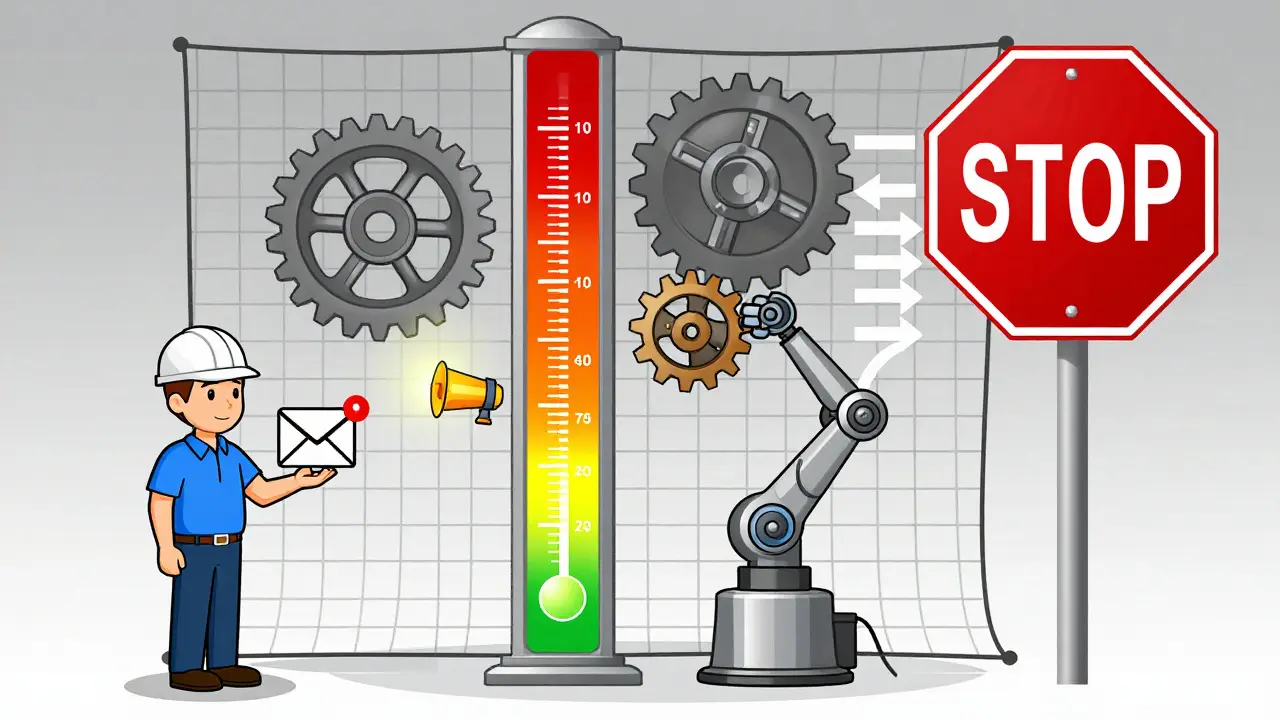
Market Trends and Future Outlook
The adoption of token budgeting is accelerating rapidly. In Q1 2024, only 29% of enterprises with active LLM implementations used some form of token budgeting. By January 2026, that figure has jumped to 83%. This shift is driven by the maturation of the market and the realization that unmanaged AI costs are unsustainable. Gartner predicts that token budgeting will become a standard feature in 95% of enterprise AI deployments by 2027. Currently, the average cost overrun in unmanaged implementations is 227%. As APIs become more sophisticated, we are seeing the rise of "dynamic model switching," where the system automatically routes requests to cheaper models as the budget depletes. This technology, now available in platforms like KrakenD, allows you to maintain service levels even when funds are tight, simply by sacrificing some model intelligence for cost efficiency.Frequently Asked Questions
How do I calculate my baseline token budget?
Start by running a prototype for two weeks. Track the average input and output tokens per request. Multiply this by your projected number of requests per month. Add a 20-30% buffer for growth and unexpected spikes. Use this figure to set your initial monthly quota. Adjust quarterly based on actual usage data.
What happens when a user hits their token limit?
It depends on your configuration. Common strategies include returning a 429 Too Many Requests HTTP status code, displaying a friendly "You've reached your daily limit" message in the UI, or automatically downgrading them to a slower, cheaper model. The key is to fail gracefully so the user experience doesn't break completely.
Is it better to limit tokens per user or per day?
Per-day limits are generally better for consumer-facing apps as they align with human behavior patterns. Per-user limits (total lifetime) are useful for trial periods or credit-based systems. For enterprise internal tools, per-department or per-project monthly caps are often more effective for financial accountability.
Do free tiers complicate token budgeting?
Yes. Free quotas are often shared between main accounts and sub-users (RAM users), making it difficult to attribute specific usage to individual projects. To avoid confusion, create separate API keys for different environments (dev, staging, prod) and apply distinct budgets to each key.
How does dynamic model switching work?
Dynamic model switching monitors your real-time budget consumption. When usage exceeds a certain threshold (e.g., 80%), the API gateway automatically reroutes incoming requests from a large, expensive model (like GPT-4 or Qwen-Max) to a smaller, cheaper model (like GPT-3.5 or Qwen-Flash). This extends your budget while keeping the service operational.
Iva Grekova
August 21, 2026 AT 08:22Love that the post mentions context window inefficiency. It is honestly the silent killer of budgets for most teams. We used to keep the full history in the prompt and then wonder why our costs were spiking. Once we started summarizing older turns, the drop was immediate. It feels like such a basic fix but so many people overlook it until the bill arrives. Great reminder to check your input vs output ratios too.
Onyinyechi Nwosu
August 23, 2026 AT 08:10this part about the token bucket algorithm made me think about how much simpler it is than what we are doing now. we are just checking usage manually every morning which is stressful. also the point about output tokens being way more expensive than input ones is wild. i never realized the gap could be that big like 8x. makes you want to tighten up those prompts immediately
Chandan Singh
August 24, 2026 AT 13:25To be fair, this article oversimplifies the reality of multi-model environments.
The assumption that you can just 'switch' to a cheaper model dynamically without significant latency or quality degradation is optimistic at best. In practice, the semantic drift between Qwen-Max and Qwen-Flash is noticeable in complex reasoning tasks.
Furthermore, the 'sliding window' approach mentioned has its own pitfalls regarding state management in distributed systems. If your API gateway loses state during a failover, you lose your quota tracking entirely unless you have an external store, which adds another layer of cost and complexity.
Also, the 227% overrun statistic from Gartner is likely skewed by early adopters who didn't even have basic logging enabled. For mature teams, overruns are usually closer to 10-15% due to seasonal spikes, not catastrophic failures. The real issue isn't the lack of a circuit breaker; it's the lack of proper unit economics modeling per feature. You need to know the LTV:CAC ratio adjusted for AI inference costs before you even set a budget. Otherwise, you are just guessing with slightly better tools.
Brannen Hall
August 25, 2026 AT 05:03Who needs budgets when you can just use open source models locally?
But seriously, this whole 'token budget' thing is just vendor lock-in dressed up as financial prudence. The real solution is to stop renting intelligence and start owning it. Also, the idea that you need a specialized middleware service for this is ridiculous. A simple Redis counter does the job. Stop buying software to solve problems that existed before the cloud.
And don't get me started on 'dynamic model switching'. That's just a fancy way of saying your product is now inconsistent. Users hate surprises. Just pick a model and stick to it. The cost difference is negligible compared to the engineering debt you create by maintaining two code paths. This article reads like it was written by someone who has never actually deployed a production system under pressure. It's all theory, no scars.
tiffany King
August 25, 2026 AT 10:17Really appreciate the breakdown of Build, Run, and People costs! It’s easy to get tunnel vision on the API bills and forget that the human element is often the biggest expense. I’m excited to try out the graduated threshold system we discussed in my last project. It feels so much more proactive than waiting for the finance team to call. Thanks for sharing these practical tips!