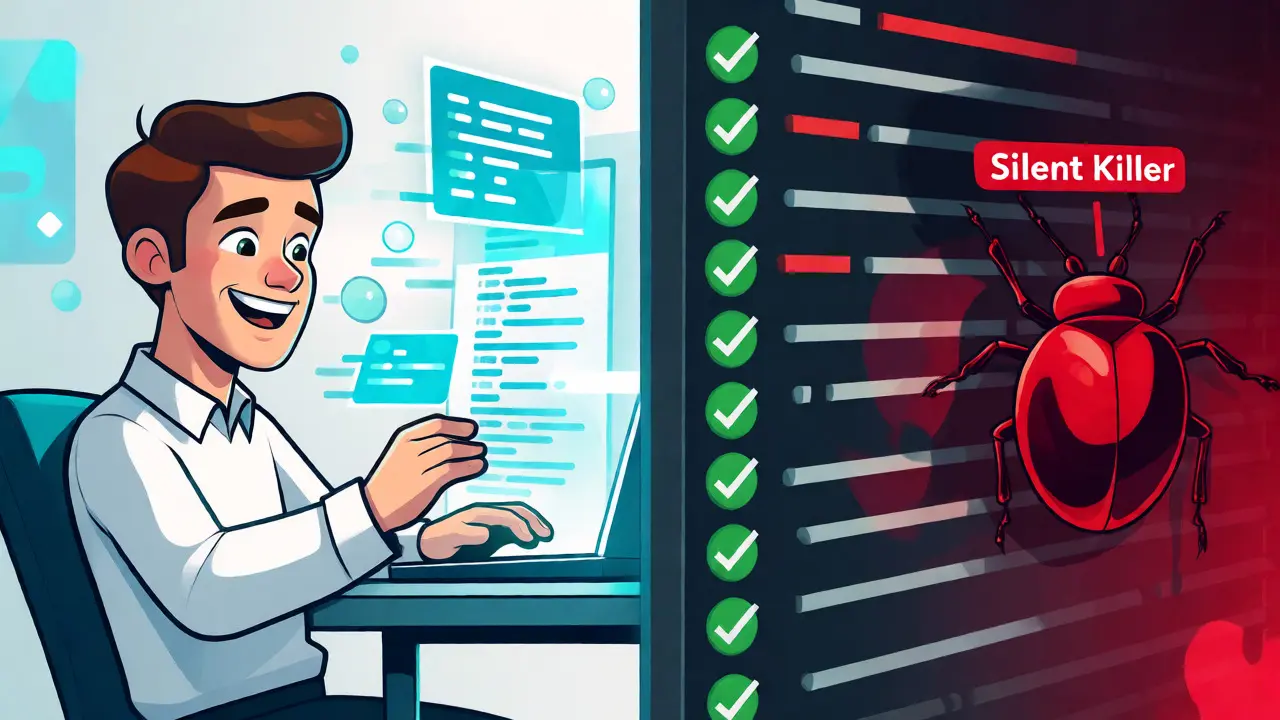
You just shipped a feature in record time. The vibe coding tool wrote the code from your natural language prompt, and it looked clean. But did you check if that AI-generated snippet accidentally hardcoded an AWS key into the source? If not, you might be staring at a $42,000 surprise bill next month, just like one developer reported on Reddit after their prototype leaked credentials.
Vibe coding-using AI to generate software through prompts rather than syntax-is exploding. Gartner projects this market will hit $4.7 billion by 2026. But here is the catch: speed doesn't equal safety. Most buyers assume AI tools are "secure by default" because they use popular models. That assumption is dangerous. This guide breaks down exactly what you need to assess before letting AI write your production code.
The Hidden Risks of AI-Generated Code
Traditional coding errors are obvious. You forget a semicolon; the compiler yells at you. Vibe coding errors are silent. They look perfect until they break in production or get exploited. Stanford University research from March 2025 confirmed that AI coding tools produce "silent killer" vulnerabilities. These bypass traditional static analysis tools and survive CI/CD pipelines to reach live environments.
Why does this happen? Large Language Models (LLMs) optimize for functionality and readability, not security context. A model might suggest a library that works great but hasn't been patched since 2019. Or it might implement authentication using a pattern that looks standard but fails under specific race conditions. Backslash Security’s July 2025 research found that common vibe coding stacks have gaps allowing secret leakage through git history and compromised cloud infrastructure when credentials are embedded directly in code.
Assessing Platform Security Postures
Not all vibe coding platforms are created equal. When evaluating tools like GitHub Copilot, Cursor, or Windsurf, you need to look beyond the autocomplete speed. Here is how they stack up against real-world security tests.
| Platform | Native Security Scanning | Secrets Detection | Dynamic Validation | Known Weaknesses |
|---|---|---|---|---|
| GitHub Copilot | No (Requires integration) | Limited | No | Suggests deprecated libraries; no runtime checks |
| Cursor | Basic checks only | Partial | No | Misses architectural flaws like auth bypasses |
| Windsurf | Integrated | Strong | Partial | Produces weak cryptographic functions |
| Backslash Security | Comprehensive | Advanced | Yes | Premium cost; requires workflow changes |
Notice the gap in dynamic validation. Bright’s testing showed that applications passing static analysis with zero vulnerabilities still contained critical issues when subjected to dynamic testing. These included authentication bypass paths and broken access controls. If a platform doesn’t validate code in motion, you’re flying blind.
The Three Pillars of Secure Vibe Coding
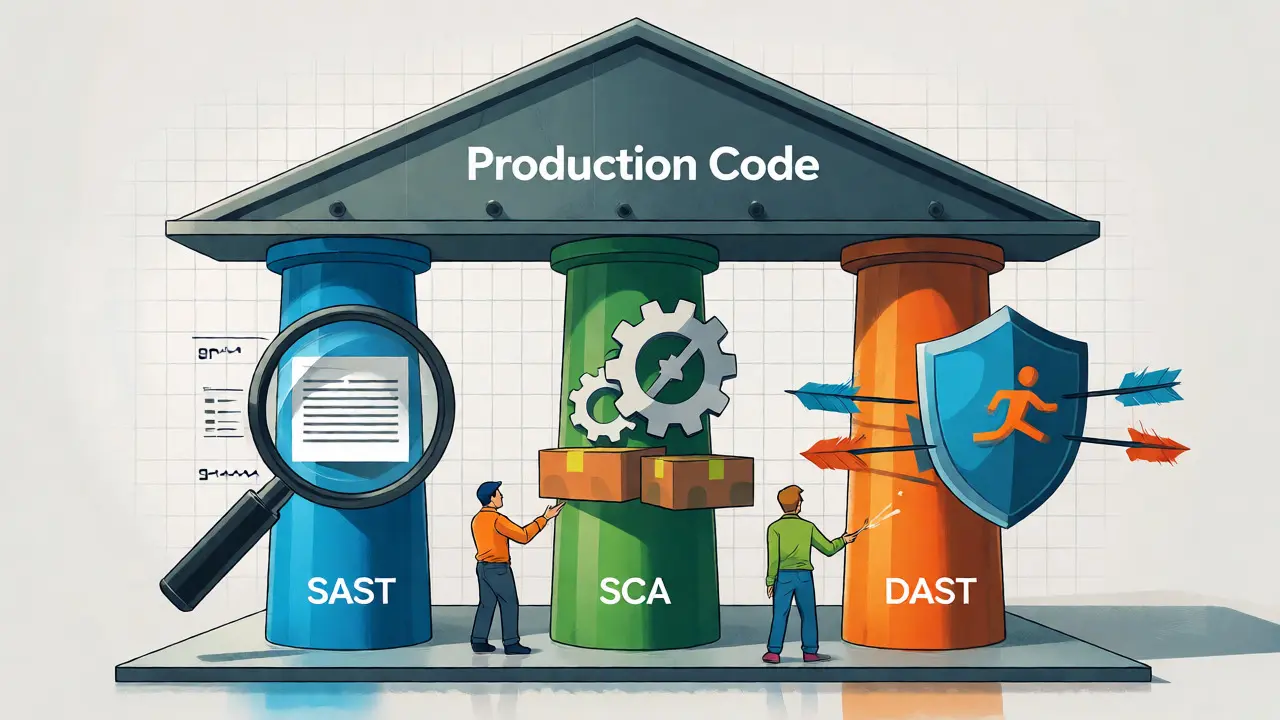
To mitigate these risks, your assessment framework needs three pillars. Skipping any one of them leaves you exposed.
- Static Application Security Testing (SAST): This scans the code at rest. It catches basic syntax errors and known vulnerability patterns. However, Apiiro’s 2025 guide notes that manual review cannot keep up with the volume of AI-generated code, so automated SAST is mandatory, not optional.
- Software Composition Analysis (SCA): AI loves to pull in dependencies. Often, these are outdated or vulnerable. SCA identifies if the AI suggested a library version that has known CVEs. In one Hacker News discussion, a security engineer noted that Copilot recommended Express.js 3.x-a version with known vulnerabilities-in 37% of API controller implementations.
- Dynamic Application Security Testing (DAST): This is the game-changer. DAST interacts with the running application, trying to exploit vulnerabilities. As Bright’s technical analysis states, "static scanning evaluates code at rest; attackers interact with systems in motion." DAST finds the logical flaws that static tools miss.
Secrets Management: The Silent Killer
The most immediate financial risk in vibe coding isn't a complex SQL injection-it's a hardcoded API key. Xygeni’s 2025 analysis documented cases where AI introduced critical AWS keys directly into source code. Because the code was generated quickly, developers often committed it without checking.
When assessing a platform, ask: Does it scan for secrets before commit? Does it integrate with your existing vault (like HashiCorp Vault or AWS Secrets Manager)? Backslash Security identified that many vibe coding stacks allow full access to cloud resources when credentials are embedded. If your tool doesn't flag `AKIA...` strings or private keys automatically, you need a separate secrets scanning layer in your CI/CD pipeline.
Integration and Workflow Friction
Security adds friction. Apiiro’s case studies show that mandatory human review of AI-assisted code creates a 22% productivity drag. This sounds bad, but it’s better than rolling back 14 production deployments due to insecure defaults, as one enterprise user reported about Cursor.
Look for platforms that reduce this friction through automation. The ideal setup integrates security checks directly into the IDE and CI/CD pipeline. GuidePoint Security estimates that implementing a secure vibe coding workflow takes 8-12 weeks. This includes configuring SAST, SCA, DAST, and secrets scanning. If a vendor claims you can be secure "out of the box," ask them to demonstrate how they handle false positives. 63% of teams report being overwhelmed by false alarms, which leads to alert fatigue and ignored warnings.

Regulatory and Compliance Implications
If you operate in regulated industries, vibe coding introduces new compliance hurdles. NIST’s July 2025 AI Security Framework Update specifically addresses "AI-generated code security." GDPR enforcement actions have already targeted companies using vibe coding that resulted in data exposures.
Buyers must assess whether the platform provides audit trails. Who prompted the code? What model version was used? Was the output reviewed? Without this metadata, proving compliance during an audit becomes nearly impossible. ISACA’s May 2025 survey found that only 29% of enterprises have specific security policies for vibe coding, leaving most organizations in a gray area.
Future-Proofing Your Investment
Gartner predicts that by 2027, 60% of vibe coding platforms without integrated runtime protection will be abandoned due to security incidents. Don’t buy a tool that solves today’s speed problem while creating tomorrow’s breach nightmare.
Prioritize vendors investing in runtime protection. Promon.io argues that "security doesn't auto-generate" with vibe coding. If AI-written features escape review, they must be protected at runtime. Look for platforms offering Web Application Firewalls (WAF) or mobile app shielding specifically tuned for AI-generated logic.
Is vibe coding less secure than traditional coding?
It depends on the process. Traditional coding allows for incremental security reviews. Vibe coding generates large chunks of code instantly, which can hide subtle logical flaws. However, with proper automated testing (SAST, DAST) and secrets scanning, vibe coding can be as secure as traditional methods. The risk lies in skipping these validation steps due to perceived speed.
Do I need extra tools if I use GitHub Copilot?
Yes. GitHub Copilot lacks native security scanning capabilities. You must integrate third-party tools for Static Application Security Testing (SAST), Software Composition Analysis (SCA), and secrets detection. Relying solely on Copilot's suggestions exposes you to deprecated libraries and hardcoded credentials.
What is the biggest security mistake with AI coding tools?
The biggest mistake is assuming static analysis reports mean the code is safe. Static tools often miss runtime vulnerabilities like authentication bypasses or broken access controls. Dynamic Application Security Testing (DAST) is essential to validate that the AI-generated logic behaves securely under attack conditions.
How much slower does security make vibe coding?
Apiiro’s case studies indicate a 22% productivity drag when mandatory human review and comprehensive automated testing are enforced. While this seems significant, it prevents costly rollbacks and security incidents that can stall development for weeks.
Are there specific regulations for AI-generated code?
NIST released an AI Security Framework Update in July 2025 addressing AI-generated code. Additionally, GDPR and other data privacy laws apply if AI code handles personal data. Enterprises should ensure their vibe coding platforms provide audit trails for compliance purposes.
Meagan Mueller
September 15, 2026 AT 06:04they are hiding the real cost from us
i told you all that ai is just a data harvesting machine with a fancy interface
the $42k bill isnt an accident its a feature designed to make you pay for their cloud services while they steal your proprietary logic
do not trust the table do not trust the vendors they are all in bed together selling you snake oil security
we need to go back to writing code by hand or we will all be owned
Dave Gibbeson
September 15, 2026 AT 13:02Listen up team this is exactly what I have been screaming about for months
We cannot let speed kill our security posture and these stats prove it
You need to implement SAST SCA and DAST immediately if you want to survive this wave
Do not buy anything until you see a demo of dynamic validation working on YOUR specific stack
Get your ducks in a row because Gartner is right those platforms without runtime protection will die
Let's get out there and secure this pipeline before the next breach hits
I am ready to help anyone who needs a push to get started today
Sabrina Newland
September 17, 2026 AT 06:54this makes me wonder 🤔 if the very nature of prompt based coding changes the definition of authorship and responsibilty 🧐
if i dont know why the code works can i really say i own the secuity risk 😅
its like asking a stranger to build your house but only looking at the paint color 🏠🎨
maybe we need a new philophy of dev where understanding matters more than shipping fast 💭✨
or maybe im overthinking it lol 😂
Brandon Olvera
September 18, 2026 AT 11:15Foreign models. That is the problem.
They train on global garbage.
Keep our code domestic.
Zach Loescher
September 18, 2026 AT 15:38The point about static analysis missing logical flaws resonates with me.
I've seen teams rely too heavily on linters and miss auth bypasses entirely.
DAST seems underutilized in most CI/CD setups I encounter.
Quintin Franzese
September 19, 2026 AT 02:36Oh great another article telling us we're doing everything wrong
Because clearly we didn't realize that AI might hallucinate a deprecated library
Sure let's add three more tools to the pipeline and slow down development by half just to feel safe
Can't wait for the meeting where we discuss how to integrate Backslash Security's premium cost into our budget
It's always something isn't it
Susan Cole
September 20, 2026 AT 01:32I appreciate the breakdown of the three pillars.
It helps to have a clear framework when discussing requirements with stakeholders.
I will keep this in mind for our upcoming vendor evaluation.
Tamara Miller
September 20, 2026 AT 11:26This is so poorly written!!! The grammar is atrocious!! And the tone is so condescending!!! Who writes "vibe coding" as if it's a real technical term??? It sounds like something a teenager would say!!! We should be using proper terminology!!! Like "AI-assisted development"!!! Not this lazy slang!!! It shows a lack of respect for the profession!!! Really disappointing reading experience!!!
Savara Gunn
September 21, 2026 AT 21:21hey everyone just wanted to say good luck navigating this
it feels overwhelming but taking it one step at a time helps
you got this