
Imagine handing in a perfectly written essay that you didn’t write. Or worse, imagine your students doing the same, but they don’t even realize it’s wrong. This is the reality many educators and organizations face as Generative AI becomes deeply embedded in daily work and study. It’s not just about catching cheaters anymore; it’s about teaching people how to use these powerful tools responsibly. That’s where user education comes in, specifically through two critical components: transparency notices and safe use guides.
Between 2023 and 2026, we’ve seen a massive shift. Governments, schools, and tech companies have realized that simply blocking AI isn’t enough. We need to teach users-students, teachers, and employees-how to navigate this new landscape safely. The goal? To protect privacy, maintain academic integrity, and ensure that AI serves us without compromising our values. Let’s break down what this looks like in practice and why it matters for anyone using or managing AI today.
The Core Framework: Why Transparency Matters
Transparency isn’t just a buzzword; it’s the foundation of trust in AI. When you use an AI tool, do you know exactly what data it’s using? Do you know if it might be biased? Most people don’t. That’s why global bodies like UNESCO have stepped in. In their first global guidance on generative AI in education, UNESCO emphasized a humanistic vision. They argued for mandatory protection of data privacy and setting age limits for independent conversations with AI platforms. Why? Because kids aren’t ready to handle the nuances of AI bias and misinformation alone.
At the same time, the World Economic Forum published seven practical principles for responsible AI use in education in January 2024. One key principle is "Purpose." This means explicitly connecting AI use to educational goals. Another is "Compliance," which requires adhering to existing policies on privacy, data security, and student safety. These aren’t abstract ideas; they’re actionable steps. For example, if you’re using AI to draft a memo, you need to know if it’s pulling from public data or private sources. Transparency notices help clarify this.
Think of transparency notices as the "nutrition label" for AI. Just as you check ingredients before eating, users should check the source, limitations, and potential biases of AI outputs. Without this, we risk spreading misinformation or violating privacy laws. The EDUCAUSE GenAI Use Transparency Framework, published in March 2026, takes this further. It offers a structured methodology to calibrate transparency based on the scope of AI’s influence. If AI writes 10% of your report, disclose it lightly. If it writes 90%, you need a full disclosure. This scaling approach makes sense because not all AI use is equal.
Safe Use Guides: Practical Rules for Daily Life
Knowing *what* AI does is half the battle. Knowing *how* to use it safely is the other half. Safe use guides provide clear, actionable rules for users. Take Adobe, for instance. Their Generative AI User Guidelines are strict. They prohibit depicting nude minors, promoting terrorism, or disseminating misleading content. But it’s not just about illegal stuff; it’s about ethical behavior. Adobe reviews prompts and generated results using both automated machine learning and manual oversight. This dual-layer system helps catch abuse that algorithms might miss.
In higher education, institutions like the University of Rochester have developed comprehensive guiding principles for responsible genAI use. Their Academic Integrity principle is straightforward: don’t compromise honesty or fairness. If you use AI to create work, you must disclose it. Specify how you used it and reflect on potential biases. Instructors also have responsibilities. If they use AI to develop teaching materials, they must document it. This models professionalism and sets a standard for students.
Let’s look at specific prohibitions from the University of Rochester’s guidelines:
- Avoid plagiarism: Don’t present AI-generated work as your own without attribution.
- Prevent cheating: Don’t use AI to complete assignments unless explicitly permitted.
- No data falsification: Don’t use AI to alter data or misrepresent findings.
- Prevent collusion: Don’t share AI-generated work without instructor authorization.

Privacy, Security, and Data Protection
One of the biggest risks of generative AI is data leakage. Many public AI tools train on user inputs. If you paste confidential company data or student records into a chatbot, that data might end up in future responses for other users. The SACSCOC (Southern Association of Colleges and Schools Commission on Colleges) highlighted this in June 2025. They stated that higher education institutions must ensure AI use aligns with human-centered principles like privacy and accountability. Specifically, they required institutions to assess algorithmic biases and safeguard student and faculty data.
The University of Rochester’s Privacy and Security principle is equally strict. It prohibits uploading confidential or proprietary information-including moderate or high-risk data-to public genAI platforms. This includes personal or sensitive student data. Instead, universities should provide approved, secure AI tools that meet institutional security standards. This creates a "walled garden" where innovation can happen without risking data breaches.
Content filtering and activity monitoring are technical cornerstones here. As noted in YouTube documentation on safe AI use, guidance must clearly delineate capabilities and features AI products should meet. Key areas include:
- Content filtering to prevent harmful outputs.
- Activity monitoring to detect unauthorized data collection.
- Security protocols to prevent breaches.
- Intellectual property protections to respect creators’ rights.
Bias and Equitable Access: The Human Element
AI isn’t neutral. It’s trained on vast datasets that often contain historical biases. The University of Rochester’s Bias principle acknowledges this directly. All genAI tools are trained on large, unmoderated datasets, which can lead to incomplete, incorrect, or biased outputs. Users must remain vigilant. Don’t just accept AI output; verify it. Check for stereotypes, limited perspectives, or factual errors.
This ties into equitable access. Not all students or employees have equal access to premium AI tools. Some rely on free, public versions that may be less secure or more prone to bias. Universities must ensure equitable access to genAI tools and resources. This means providing institutional licenses for secure tools and training everyone on how to use them effectively. Otherwise, you create a digital divide where only some benefit from AI’s advantages.
The U.S. Department of Education has also recognized this. Their federal AI guidance frameworks highlight practical applications like text generation for policy analysis and code generation for data visualization. But they emphasize that these tools must be used ethically. For example, when generating sample code, users should verify its functionality and security. Blindly copying AI code can introduce vulnerabilities.
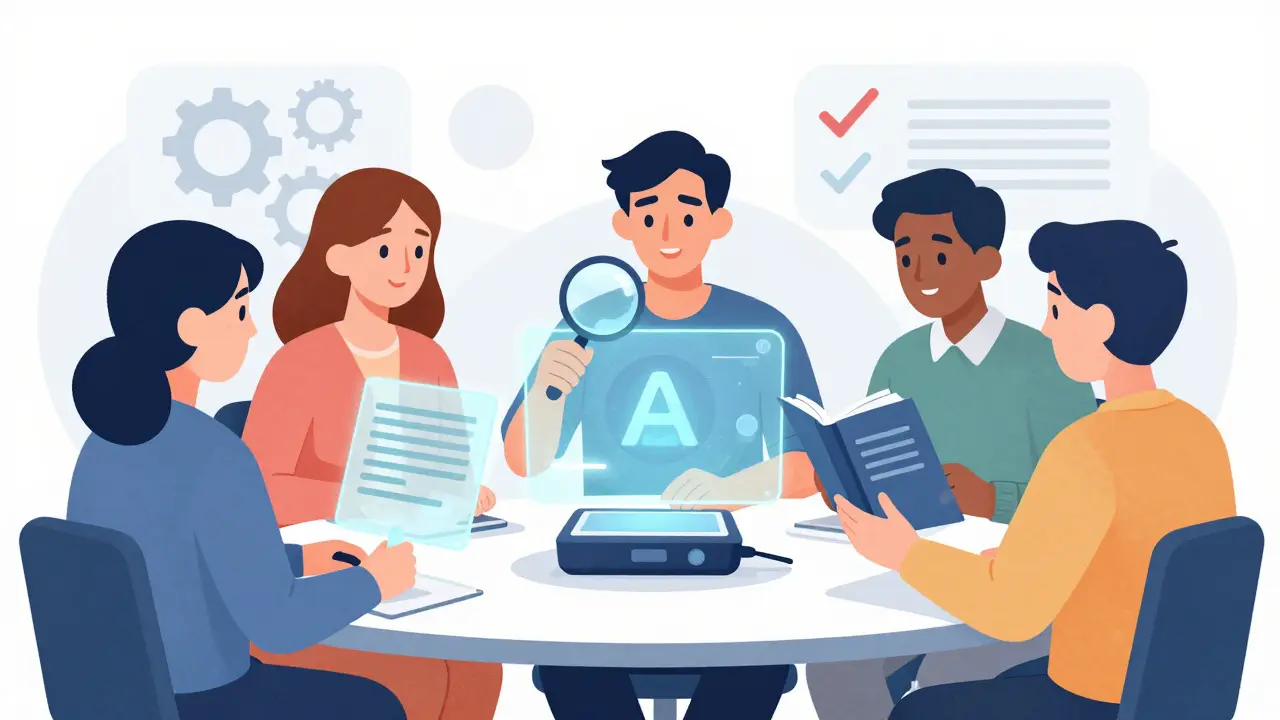
Building AI Literacy: A Long-Term Strategy
User education isn’t a one-time event; it’s an ongoing process. The World Economic Forum’s principle of "Knowledge" promotes AI literacy. This means teaching users not just how to click buttons, but how to think critically about AI. What questions should you ask? How do you evaluate output quality? What are the limitations?
Consider this scenario: A marketing team uses AI to generate ad copy. Without AI literacy, they might publish something offensive or inaccurate. With AI literacy, they know to review tone, check facts, and ensure alignment with brand values. This shifts AI from a black box to a collaborative partner.
Future developments point toward standardization. Organizations like SACSCOC and EDUCAUSE are working to create scalable templates and implementation guides. These will help institutions adapt best practices to their specific contexts while maintaining core principles like privacy and transparency. Age-appropriate education models are also emerging, following UNESCO’s recommendations. Younger users need simpler, guided interactions, while older users can handle more complex ethical dilemmas.
Implementation Checklist for Organizations
If you’re responsible for implementing AI education in your organization, start here:
- Review Existing Policies: Update information security, data governance, and academic integrity policies to address AI.
- Create Transparency Notices: Define clear disclosure requirements based on AI’s role in tasks.
- Develop Safe Use Guides: List prohibited behaviors, data handling rules, and verification steps.
- Provide Secure Tools: Offer institutional AI access that meets privacy standards.
- Train Users Regularly: Conduct workshops on bias detection, prompt engineering, and ethical use.
- Monitor and Adapt: Use activity monitoring to identify misuse and update guidelines accordingly.
What is the difference between a transparency notice and a safe use guide?
A transparency notice explains *what* AI is doing, including data sources, limitations, and potential biases. It’s informational. A safe use guide provides *rules* for behavior, such as what data you can upload, how to attribute AI work, and what actions are prohibited. It’s instructional.
Why are age limits important for generative AI use?
Younger users may lack the critical thinking skills to identify bias, misinformation, or privacy risks in AI outputs. Age limits, recommended by UNESCO, ensure that children interact with AI under supervision or through age-appropriate interfaces until they develop sufficient digital literacy.
Can I use public AI tools for confidential work?
Generally, no. Public AI tools often train on user inputs, meaning your confidential data could appear in future responses. Institutions like the University of Rochester prohibit uploading sensitive data to public platforms. Use approved, secure institutional tools instead.
How do I detect bias in AI-generated content?
Look for stereotypes, overgeneralizations, or missing perspectives. Cross-check facts with reliable sources. Ask yourself: Does this output represent diverse views? Is it fair to all groups mentioned? If unsure, consult human experts or use bias-detection tools.
Who is responsible for AI misuse in an educational setting?
Responsibility is shared. Students must follow course policies and disclose AI use. Instructors must create clear guidelines and model ethical behavior. Institutions must provide secure tools and training. Ultimately, the user bears direct responsibility for their actions, but the institution sets the framework.