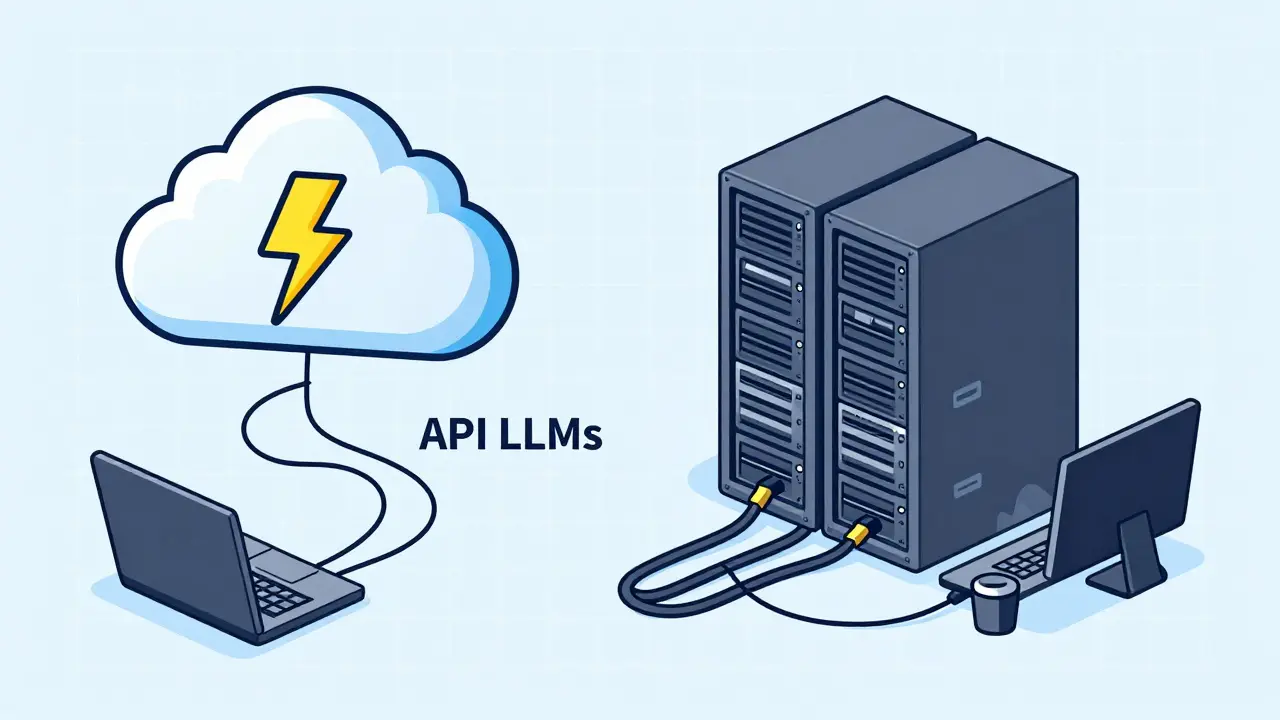
You are staring at a dashboard. Your application needs to process a complex query, but the response time is creeping up. Is it the network? The model size? Or did you just hit a rate limit? This is the daily reality for engineering teams integrating generative AI. You have two main paths: call an API LLM, which is a cloud-based service provided by vendors like OpenAI or Anthropic that handles all infrastructure management, or deploy the model yourself on your own hardware.
The choice isn't just about technical preference; it’s a strategic bet on latency, control, and long-term costs. In 2026, with models like Llama 4 and Qwen 3 reaching parity with closed-source giants, the gap between these options has narrowed significantly. But the tradeoffs remain sharp. Let’s break down exactly where you lose speed, where you gain control, and when the math flips in favor of buying servers instead of renting tokens.
The Latency Reality Check
Latency is often the first thing people think of when comparing these architectures, but the nuance matters more than the headline numbers. When you send a request to a cloud API, you are paying for more than just computation. You are paying for network round-trips.
On average, cloud LLM inference introduces a latency overhead of 1.4 to 1.8 seconds per request. This includes the time it takes for data to travel from your server to the provider’s data center, queue for processing, and return. For many enterprise applications-like summarizing documents or drafting emails-this delay is invisible to the user. However, if you are building real-time chatbots, interactive coding assistants, or live translation services, that extra second feels like an eternity.
On-premises deployment, defined as running LLM infrastructure locally within an organization's own data centers or edge environments, eliminates the network hop entirely. With appropriate hardware, such as modern GPUs with high memory bandwidth, local deployments can generate 50 to 100 tokens per second consistently. There is no waiting in line behind other customers’ requests. There is no geographical routing delay.
However, don’t assume local is always faster in terms of raw throughput. Cloud providers benefit from state-of-the-art GPUs and optimized model serving stacks. In some scenarios, cloud systems demonstrate up to 2.1x higher throughput compared to on-premises setups at similar price points because they can scale out horizontally across thousands of nodes instantly. Local deployment holds the distinct advantage only for ultra-low-latency workloads where even milliseconds matter, such as high-frequency trading or robotics control loops.
Control, Data Sovereignty, and Vendor Lock-in
If latency is about speed, control is about safety and flexibility. When you use an API, you are renting intelligence. You get access to powerful models, but you have limited say in how they behave beyond basic parameter tuning (temperature, top-p, etc.). You cannot inspect the weights. You cannot fine-tune the architecture deeply without retraining from scratch, which most APIs do not allow directly.
This lack of control leads to vendor lock-in. Switching from one API provider to another requires significant refactoring. Your prompts, evaluation metrics, and integration logic may need complete overhaul. More critically, your data leaves your environment. Even if providers claim strict privacy policies, sending sensitive customer records, financial data, or medical information to third-party servers creates compliance risks. Banks and hospitals typically mandate on-premises deployment precisely to satisfy regulations like HIPAA or GDPR, ensuring data never crosses organizational boundaries.
With on-premises deployment, you own the stack. You can perform deep domain-specific fine-tuning. You can modify the model’s behavior to align perfectly with your brand voice or operational constraints. You maintain maximum security over intellectual property. If a regulatory body demands proof of data handling, you can show them the logs and the physical servers. This level of transparency is impossible with black-box API services.

The Scalability Paradox
Here is where the tables turn. While on-premises wins on control and low-latency consistency, cloud APIs win hands-down on elasticity. Imagine your startup goes viral overnight. Your traffic spikes by 10,000%. With a cloud API, you simply pay for the increased usage. The provider scales their infrastructure automatically. You stay online.
With on-premises hardware, scaling is rigid. Adding capacity involves procurement cycles, shipping hardware, rack installation, cooling adjustments, and system integration. This process can take days or weeks. If your demand fluctuates wildly-seasonal spikes, occasional complex reasoning tasks-paying for idle hardware is wasteful. Cloud deployment provides near-infinite, on-demand elasticity, making it ideal for pilot projects or businesses with unpredictable workloads.
Cloud deployment also decreases time-to-market. You can validate an AI use case in hours, not months. For startups and SaaS companies, this agility is often worth more than the marginal gains in latency or control during the early stages.
Cost Analysis: Hidden Expenses Revealed
Many teams choose cloud APIs because the upfront cost is zero. But "zero upfront" does not mean "low total cost." At scale, the economics shift dramatically. Let’s look at the hidden expenses.
Cloud API hidden costs include:
- Prompt caching infrastructure, which can consume 20-40% of operational costs.
- Token-level monitoring and logging tools required to track spend.
- Rate limiting and queue management complexity.
- Vendor lock-in risks, which carry a high migration cost later.
On-premises hidden costs include:
- Electricity consumption: ranging from $0.10 to $0.30 per kilowatt-hour. A single B200 GPU can draw up to 1000W, while an Apple M3 Ultra uses around 215W.
- Cooling infrastructure, adding 15-30% overhead to power bills.
- MLOps engineering staff, averaging $135,000 per year per engineer.
- Compliance overhead, accounting for 5-15% of budgets in regulated industries.
- Ongoing maintenance and model updates.
The tipping point usually arrives when you process 2 million or more tokens daily with consistent usage patterns. At this volume, the variable cost of cloud APIs exceeds the fixed cost of owning hardware. On-premises deployment allows you to capitalize the asset, amortize costs over time, and depreciate the investment. For predictable, high-volume workloads, local deployment becomes economically attractive.
| Attribute | API LLMs (Cloud) | On-Prem Deployment (Local) |
|---|---|---|
| Average Latency | 1.4 - 1.8 seconds | < 0.5 seconds (local network) |
| Scalability | Near-infinite, on-demand | Rigid, requires planning |
| Data Control | Limited (vendor managed) | Full (organization owned) |
| Upfront Cost | Low (pay-per-use) | High (hardware + setup) |
| Best For | Variable workloads, startups | High-volume, sensitive data |
Building a Hybrid Strategy
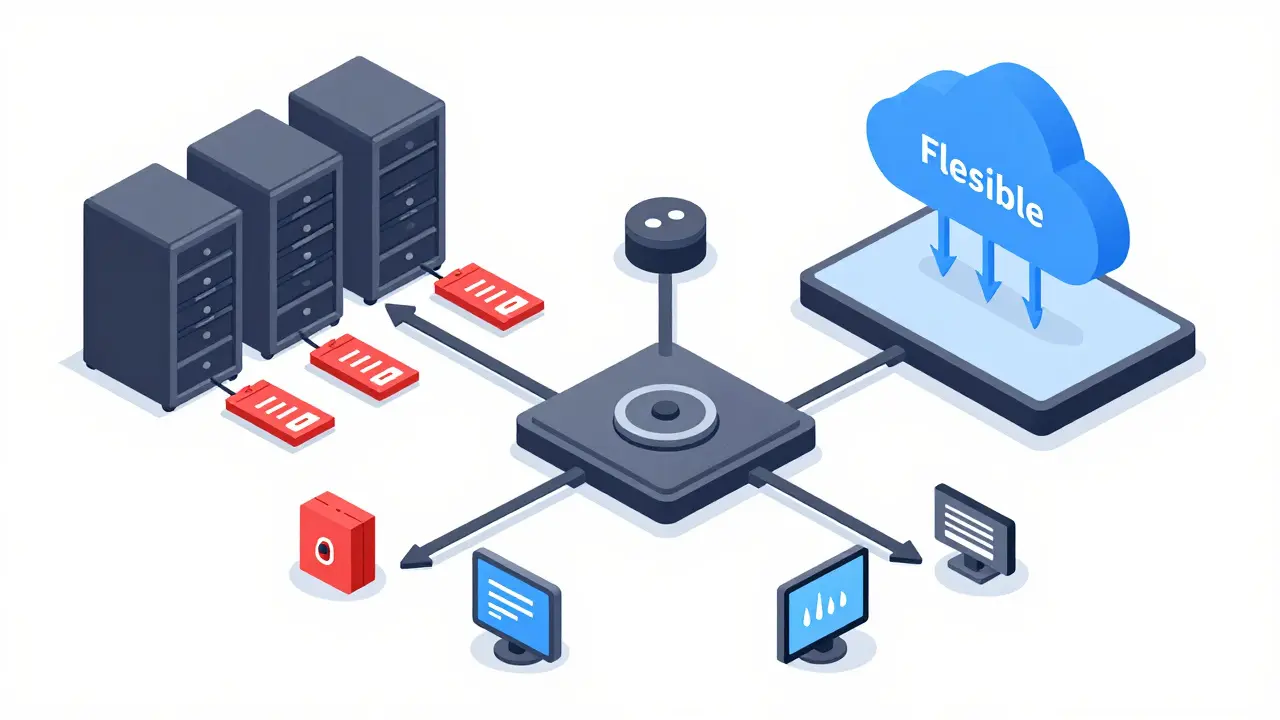
Why choose one when you can use both? Smart enterprises are adopting hybrid architectures that route workloads based on specific characteristics. This approach maximizes efficiency while minimizing risk.
Route high-volume, predictable tasks-such as daily document processing, internal knowledge base queries, and batch operations-to your local infrastructure. These tasks benefit from the lower per-token cost and consistent performance of on-premises hardware. Keep sensitive data processing, including customer records and financial analytics, local to ensure compliance and security.
Send variable or bursty workloads to the cloud. Seasonal spikes, occasional complex reasoning tasks, and exploratory projects are perfect candidates for API services. You avoid the capital expenditure of buying hardware that sits idle 90% of the time. General-purpose queries for public information lookups or creative content generation can also leverage cloud providers, freeing up your local resources for mission-critical applications.
This strategy requires robust orchestration layers. You need a middleware system that can evaluate each request’s sensitivity, urgency, and complexity, then direct it to the appropriate endpoint. It adds engineering complexity, but the payoff in cost savings and performance optimization is substantial for large organizations.
Decision Framework: Which Path Fits You?
To make the right choice, ask yourself these questions:
- Is data privacy non-negotiable? If you handle PII, PHI, or proprietary IP, on-premises is likely mandatory due to regulatory requirements.
- What is your daily token volume? If you process less than 2 million tokens daily, cloud APIs are almost certainly cheaper and easier to manage.
- Do you need sub-second response times? For real-time interactions where latency impacts user experience or operational safety, local deployment reduces jitter and delays.
- Do you have specialized IT staff? On-premises requires MLOps engineers to manage hardware, software updates, and troubleshooting. If you lack this team, the hidden costs will outweigh the benefits.
- Is your workload predictable? Consistent, high-volume usage favors on-premises. Fluctuating, unpredictable usage favors cloud elasticity.
Startups and small businesses should start with cloud APIs. They offer fast go-live times, lower initial resource investment, and immediate testing capabilities. As you grow and your needs become more specific, evaluate moving sensitive or high-volume workloads to local infrastructure. The landscape is dynamic, with open-source models continuing to improve and hardware becoming more efficient. Reassess your strategy annually to ensure you are getting the best balance of cost, performance, and control.
When does on-premises deployment become cheaper than API LLMs?
On-premises deployment typically becomes cost-effective when an organization processes 2 million or more tokens daily with consistent usage patterns. At this scale, the fixed costs of hardware, electricity, and staffing are lower than the cumulative variable costs of cloud API tokens. Additionally, the ability to capitalize and depreciate the hardware asset improves the long-term total cost of ownership.
Can I use open-source models with API providers?
Yes, many cloud providers now offer hosted versions of open-source models like Llama, Mistral, or Qwen via API. This gives you the ease of cloud management with the flexibility of open-weight models. However, you still face network latency and vendor dependency. True on-premises deployment offers greater customization and data sovereignty for these same models.
What are the biggest hidden costs of on-premises LLM deployment?
Beyond the initial hardware purchase, major hidden costs include electricity ($0.10-$0.30/kWh), cooling infrastructure (15-30% overhead), and specialized MLOps engineering staff (averaging $135,000/year). Compliance overhead in regulated industries can add another 5-15% to operational budgets. Ongoing maintenance and model updates also require dedicated technical resources.
How much latency does cloud API inference add?
Cloud LLM inference typically adds 1.4 to 1.8 seconds of latency per request due to network round-trips and queuing. While acceptable for background tasks, this delay can impact user experience in real-time applications like chatbots or live translation. On-premises deployment eliminates this network hop, offering significantly lower and more consistent latency.
Is a hybrid approach viable for most companies?
A hybrid approach is increasingly considered best practice for sophisticated enterprises. By routing sensitive and high-volume predictable workloads to on-premises infrastructure, and variable or exploratory tasks to cloud APIs, organizations can optimize for both cost and performance. This requires robust orchestration software but offers the flexibility to adapt to changing business needs.
Anand Pandit
May 14, 2026 AT 10:27Great breakdown of the tradeoffs here. I've been wrestling with this exact decision for our fintech startup, and the hybrid approach you mentioned makes a lot of sense. We're currently using cloud APIs for exploratory tasks but moving sensitive data processing on-prem to satisfy compliance requirements.
Sheetal Srivastava
May 15, 2026 AT 15:01The notion that open-source models have reached parity is laughable at best. You are ignoring the nuanced architectural optimizations that proprietary models possess, which are essential for high-stakes enterprise environments. Your analysis lacks the depth required to understand the true cost of inference latency in real-time systems. It's not just about tokens per second; it's about the deterministic behavior of the model under load, something most hobbyists fail to grasp.
Furthermore, your dismissal of vendor lock-in as merely a refactoring issue ignores the strategic implications of dependency on third-party infrastructure. The hidden costs you mention are trivial compared to the risk of supply chain disruptions in AI capabilities. This post is a superficial overview that fails to address the core issues of model sovereignty and intellectual property protection.
ujjwal fouzdar
May 16, 2026 AT 01:59We are but shadows dancing on the walls of Plato's cave, mistaking the flickering light of API responses for truth itself. To deploy locally is to step out into the harsh sunlight of reality, where the heat of the GPU burns and the silence of the server room echoes with the weight of responsibility.
Is it not better to suffer the tyranny of the rack than to be enslaved by the whims of the cloud gods? The latency is a mere illusion, a trick of the mind, while the control is the only tangible thing we can hold onto in this digital void. Let us build our own temples, even if they crumble under the weight of our ignorance.
Reshma Jose
May 17, 2026 AT 04:41I disagree with the idea that on-prem is always better for control. You still need to manage updates, security patches, and hardware failures. Cloud providers handle all that for you. Plus, the cost savings from not having dedicated MLOps staff can outweigh the token costs for many companies.
Sheetal Srivastava
May 18, 2026 AT 16:50Your assertion is fundamentally flawed. The operational overhead of maintaining local infrastructure is negligible compared to the existential risk of data exfiltration via third-party APIs. You are conflating convenience with security, which is a dangerous fallacy in regulated industries. The ability to audit every byte of data processed is not a luxury; it is a requirement for any serious enterprise. Your lack of understanding regarding compliance frameworks is evident.
mani kandan
May 20, 2026 AT 06:28Man, reading this feels like watching a slow-motion car crash between two tech ideologies. One side wants the shiny new toy without reading the manual, and the other wants to build the factory themselves. I guess I'll just keep my tokens flowing through the cloud until my credit card screams for mercy. At least then I know exactly what I'm paying for, unlike the mysterious 'hidden costs' of cooling servers in my basement.
Bhavishya Kumar
May 22, 2026 AT 05:47The grammatical structure of the original post is adequate however the use of informal language undermines the technical precision required for such a discussion. Furthermore the claim that Llama 4 has reached parity is unsubstantiated without rigorous benchmarking data. One must consider the implications of quantization errors when deploying large language models on consumer-grade hardware. The distinction between inference latency and training time is often blurred in these discussions leading to misconceptions about the true cost of ownership. Additionally the failure to account for depreciation schedules in the cost analysis renders the comparison incomplete.