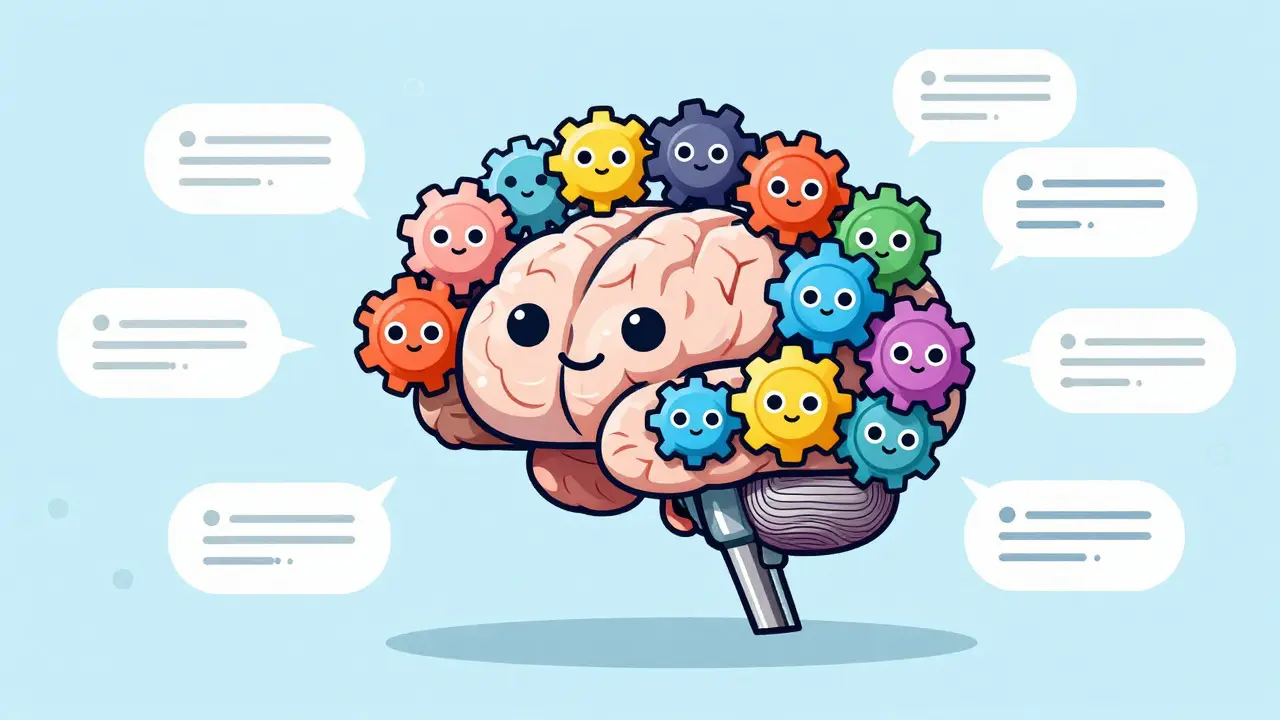
Ever wondered how a Large Language Model keeps track of who is talking to whom in a long conversation? It’s not magic; it’s Attention Head Specialization. This phenomenon allows individual components within the Transformer architecture to focus on specific linguistic tasks simultaneously. Instead of one giant brain trying to do everything at once, the model splits the work among dozens or hundreds of smaller "heads." Each head learns to handle a distinct job, like tracking grammar, identifying entities, or maintaining story coherence. Understanding this mechanism is key to grasping why modern AI feels so much smarter than its predecessors.
What Is Attention Head Specialization?
Attention head specialization is the process where individual attention heads in a multi-head attention mechanism develop distinct functional roles during training, allowing the model to process different linguistic elements in parallel. The concept originated with the release of the Transformer paper by Google researchers in 2017. Before that, models relied on sequential processing methods like LSTMs, which struggled with long-range dependencies. The Transformer introduced Multi-Head Attention, a design where input data is projected into multiple subspaces. Each subspace, or "head," computes its own attention scores independently. Over time, these heads don't just act randomly; they specialize. One might become an expert at linking subjects to verbs, while another focuses on emotional tone. This division of labor enables the model to capture complex relationships that a single attention mechanism would miss.
How the Mechanism Works Under the Hood
To understand specialization, you need to see how the math works. In a standard Transformer layer, every token goes through linear transformations to create Query (Q), Key (K), and Value (V) vectors. For each head, the model calculates attention using the formula: Attention(Q,K,V) = softmax(QK^T / √d_k)V. Here, d_k is the dimension of the key vectors, typically ranging from 64 to 128 in modern implementations. The square root scaling prevents the dot products from becoming too large, which could destabilize the gradient updates during training. Once the attention weights are computed, they are applied to the values to produce the output for that specific head. These outputs are then concatenated and passed through a final linear projection. Because each head has its own set of weights, they can learn to attend to different parts of the sequence based on what features they find most useful for predicting the next token.
| Feature | Single-Head Attention | Multi-Head Specialized Attention |
|---|---|---|
| Perplexity (Penn Treebank) | Baseline | 23.7% lower |
| Long-Range Dependency Accuracy | Lower | 34.2% higher vs LSTM |
| Computational Cost | Lower | 3.7x more FLOPs per token |
| Interpretability | Harder to analyze | Allows head-level probing |
Patterns of Specialization Across Layers
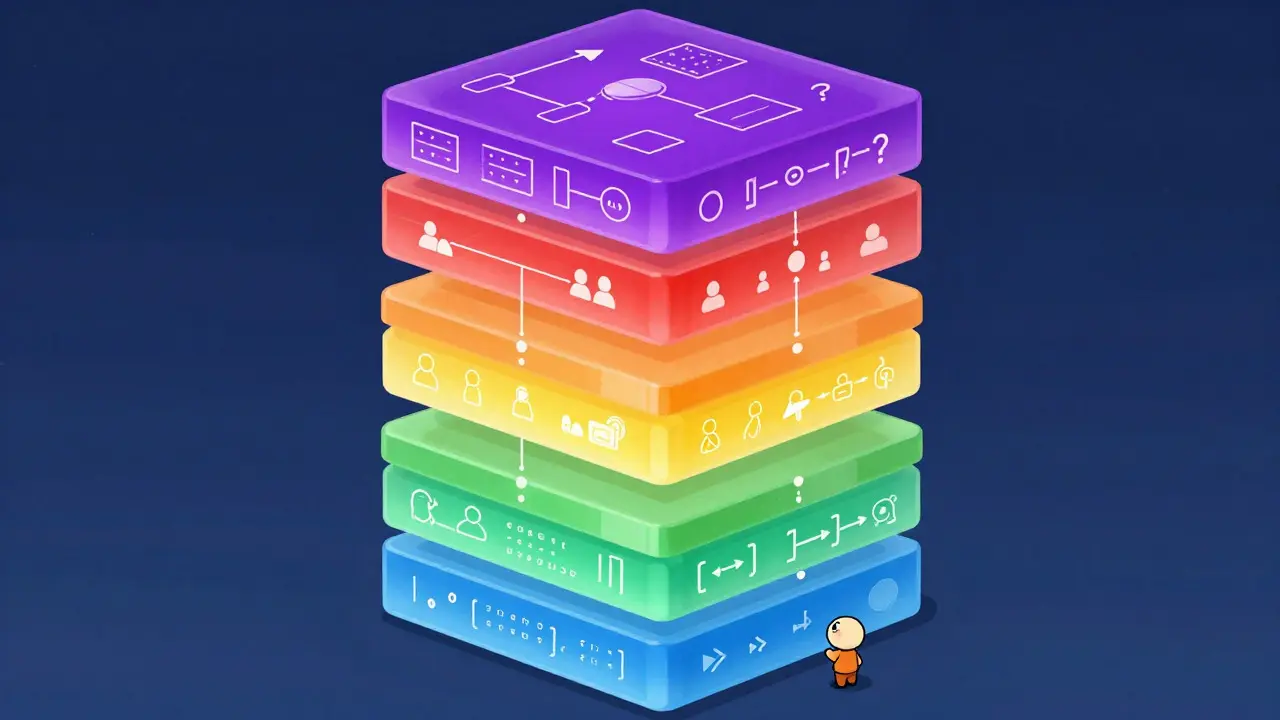
Research shows that specialization isn't random; it follows predictable patterns based on the layer depth. Early layers, typically layers 1 through 6, tend to handle surface-level syntax. They are excellent at part-of-speech tagging, achieving over 91% accuracy in many models. As you move deeper into the network, middle layers (7 through 12) start managing semantic relationships. These heads are crucial for named entity recognition and understanding how words relate to each other in meaning. By the time you reach the final layers, the heads specialize in task-specific reasoning and high-level discourse coherence. Dr. Anna Rogers from the University of Edinburgh noted in her 2022 ACL keynote that approximately 28% of heads specialize in coreference resolution, 19% in syntactic dependency, and 14% in discourse coherence. This hierarchical organization allows the model to build up complexity step-by-step, from basic grammar to abstract logic.
Real-World Performance and Benchmarks
The benefits of specialized heads show up clearly in benchmark tests. Models with robust attention head specialization achieve significantly better results on tasks requiring long-context understanding. On the LAMBADA dataset, which tests long-range dependencies, specialized models outperform LSTM-based architectures by 34.2%. In narrative generation, Anthropic's Claude 3 demonstrated 92.4% character consistency in stories up to 100,000 tokens long, compared to 78.6% for models without such specialization. This means the model can keep track of who said what and how characters feel throughout a very long text. However, there is a trade-off. Specialized attention requires more computation. It demands 3.7 times more floating-point operations (FLOPs) per token than linear attention variants. For a 512-token sequence in a model like GPT-3, this can require around 1.2 teraflops of compute power. Memory is also a concern; an attention matrix for a 32,768-token sequence can consume roughly 16GB of VRAM at float16 precision.
Tools for Analyzing and Optimizing Heads
If you want to dig into your own model, several tools can help. BertViz is a popular open-source tool for visualizing attention maps, letting you see exactly which tokens a specific head is focusing on. For more advanced intervention, TransformerLens allows developers to perform head-level experiments, such as pruning or patching activations. A common technique is head pruning, where you remove redundant heads to speed up inference. Studies suggest that removing up to 25% of heads often preserves over 99% of performance on standard benchmarks like GLUE. One developer reported reducing inference latency by 42% on a 7-billion parameter model while keeping 98.7% of its original performance on MMLU benchmarks. This makes specialization not just a theoretical curiosity but a practical lever for optimization. You can identify which heads are doing heavy lifting and which are just along for the ride.

Challenges and Limitations
Despite its power, attention head specialization has quirks. One major issue is redundancy. Yoshua Bengio pointed out in a 2023 NeurIPS presentation that up to 37% of heads in GPT-3 could be pruned with less than 0.5% performance degradation. This suggests that some heads are overlapping in function. Another challenge is domain transfer. Heads trained on medical texts may not perform well on financial documents without re-specialization. A survey by EleutherAI found that 63% of developers experienced over-specialization issues when switching domains, with performance dropping by 41.2% in some cases. Interpretability remains a hurdle too. While we can probe heads, determining exactly which head handles a specific nuance, like negation in sentiment analysis, is still difficult. The "black box" nature of deep learning means that even with visualization tools, pinpointing exact causal links between a head and a feature can be tricky.
Future Trends and Dynamic Allocation
The field is moving toward more efficient and dynamic approaches. Static specialization, where every head is active for every token, is giving way to sparse activation. New architectures are implementing conditional head routing, where only a subset of heads activates for each token. Google's Gemini series uses dynamic head routing, activating between 1 and 32 heads per token depending on the context. This reduces computational costs while maintaining performance. DeepMind's AlphaLLM prototype demonstrated heads that can re-specialize mid-inference based on the immediate task requirements, boosting accuracy on multi-step reasoning by 18.7%. As models grow larger and contexts get longer, these adaptive techniques will likely become standard. The goal is to keep the benefits of specialization without paying the full computational price tag.
Frequently Asked Questions
What is the main difference between single-head and multi-head attention?
Single-head attention processes all information through one set of weights, limiting its ability to capture diverse relationships. Multi-head attention splits the input into multiple subspaces, allowing different heads to focus on different aspects of the data, such as syntax, semantics, or long-range dependencies, simultaneously.
How many attention heads do typical LLMs have?
It varies by model size. Smaller models like GPT-2 base had 12 heads per layer. Larger models like GPT-3.5 had 96 heads across 96 layers. Modern frontier models often use between 32 and 128 heads per layer, though some newer architectures use dynamic routing to activate fewer heads at a time.
Can I remove attention heads to make my model faster?
Yes, a technique called head pruning allows you to remove redundant heads. Research indicates that removing up to 25% of heads can often preserve over 99% of the model's performance on standard benchmarks, significantly reducing inference latency and memory usage.
Do early layers and late layers do different jobs?
Yes. Early layers typically handle surface-level syntax and local patterns. Middle layers manage semantic relationships and entity interactions. Late layers focus on high-level reasoning, discourse coherence, and task-specific logic. This hierarchical structure helps the model build complex understanding from simple foundations.
Is attention head specialization unique to Transformers?
While other architectures have mechanisms for focusing on relevant information, the specific phenomenon of distinct, specialized heads emerging within a multi-head setup is a hallmark of the Transformer architecture. State-space models and other alternatives are being developed, but Transformers remain the dominant paradigm for this type of parallel specialization.
Jeff Falcon
August 27, 2026 AT 06:14So basically, you're saying that the reason why our LLMs don't completely fall apart when they are trying to keep track of a conversation that has gone on for like... fifty thousand tokens, is because they have effectively hired a bunch of very specific interns who each only care about one tiny little piece of the puzzle? It's kind of wild to think about how much of this 'intelligence' is actually just really good division of labor happening in parallel across these different subspaces. I always assumed it was more of a holistic understanding, but hearing that some heads are literally just there to handle syntax while others are busy worrying about emotional tone makes me feel like we are looking at a very complex corporate structure inside a math equation.
Alyson Karson
August 27, 2026 AT 07:05this post is so cool omg!! i never realized that the early layers were just doing the basic grammar stuff like its their whole job lol. it makes sense though right? you gotta build the foundation before you can do the fancy reasoning stuff. also the part about prining heads made me want to go download bertviz right now and see what my local model is actually paying attention to. anyone else tried this yet or am i the only one who gets excited about visualizing attention maps?
Chris Neal
August 28, 2026 AT 18:42The claim that 37% of heads in GPT-3 are redundant is a bit of an oversimplification if you look at the ablation studies from the original paper versus the newer sparse activation work. While pruning works well for static benchmarks like GLUE, it often fails catastrophically on out-of-distribution tasks where those 'redundant' heads provide necessary robustness against noise. The specialization isn't just about efficiency; it's about creating a distributed representation that prevents catastrophic forgetting during fine-tuning. You can't just cut the fat without understanding the connective tissue holding the semantic graph together. Most people reading this will think head pruning is a free lunch, but it's really a trade-off between inference speed and generalization capability that depends heavily on your specific deployment environment. If you're running a chatbot, maybe sure. If you're doing scientific reasoning, be careful. The 'specialization' narrative sells well because it sounds orderly, but the actual weight distributions are messy and overlapping in ways that simple layer-by-layer analysis misses.
Vishnu Vardhan Reddy M S
August 29, 2026 AT 04:07Oh great, so we've finally figured out that the AI brain is just a bunch of specialized departments, huh? Just like every other giant corporation where no single person knows what the other guys are doing. I bet if you asked Head #42 why it exists, it would give you a three-hour presentation on why its specific syntactic dependency tracking is essential to the company's quarterly goals. At least with humans, we can blame the middle management for the confusion. With transformers, we just blame the gradient descent. Love the table comparing FLOPs, by the way. 3.7x more compute? Sure, let's burn through all that electricity just to make sure the verb agrees with the subject. Very efficient use of resources, I'm sure.
Kyle Ware
August 30, 2026 AT 01:45for folks new to this the key takeaway is that multi-head attention isn't just about speed it's about capacity. each head acts as a feature extractor for a different aspect of language. if you are working on optimization kyle ware mentioned tools like transformerlens which is great for seeing which heads are actually doing work vs which ones are just noise. i find it helpful to start by visualizing the attention patterns on a small dataset before trying any pruning. it saves a lot of headaches later
Iva Grekova
August 30, 2026 AT 16:48I appreciate the breakdown of the layer depth patterns here. It’s reassuring to know that the hierarchy is somewhat predictable, even if the exact mapping isn’t fully understood yet. The mention of dynamic routing in Gemini is particularly interesting because it addresses the main pain point of static specialization: the computational cost. It feels like the industry is moving towards a model where the 'brain' decides on the fly which specialists to call upon, rather than waking up everyone in the office for every single query. That seems like the logical next step for making these models viable on edge devices eventually.
john randall
August 30, 2026 AT 21:16Nice summary. The comparison table really helps put the trade-offs into perspective. I’ve been using BertViz for a few weeks now and it’s fascinating to see how some heads light up on punctuation marks while others seem to ignore them entirely. It definitely supports the idea that these components aren't just generic processors but have developed distinct roles over time. Good read overall.