
Imagine a bank that doesn't just hold your money but knows exactly when you're ready for a home loan before you even start browsing Zillow. This isn't a futuristic dream; it's the current reality of Generative AI in banking is a transformative application of large language models and machine learning designed to personalize customer experiences and automate complex risk management. By analyzing everything from your daily coffee spend to global market shifts, banks are moving away from generic services toward a model of hyper-personalized financial partnership.
Hyper-Personalization: Moving Beyond Generic Advice
For years, "personalized banking" usually meant a generic email that addressed you by your first name. Generative AI changes that by synthesizing vast amounts of data-transaction histories, life events, and behavioral patterns-to offer advice that actually fits a person's life. It's the difference between a bank saying "Save more" and saying "You've consistently saved $200 more than usual this month; if you move that into this specific retirement fund, you'll hit your goal two years early."
Banks now use these systems to spot "life triggers." For example, if a customer's rent payments are increasing and their savings deposits remain steady, the AI doesn't just notice the trend; it can trigger a personalized mortgage pre-qualification message at the exact moment the customer is likely thinking about buying. This level of precision extends to credit card offers based on real spending habits and tailored savings advice derived from actual cash-flow data, which significantly boosts customer satisfaction and the bank's return on marketing spend.
Redefining Credit Risk and Lending
The old way of assessing credit was rigid, relying on static credit scores and a handful of historical data points. Credit risk assessment is now evolving into a dynamic process where AI analyzes social data, economic indicators, and complex transaction patterns that a human analyst might overlook. This allows banks to be more inclusive, extending credit to underserved segments who might have a low traditional score but show strong behavioral evidence of reliability.
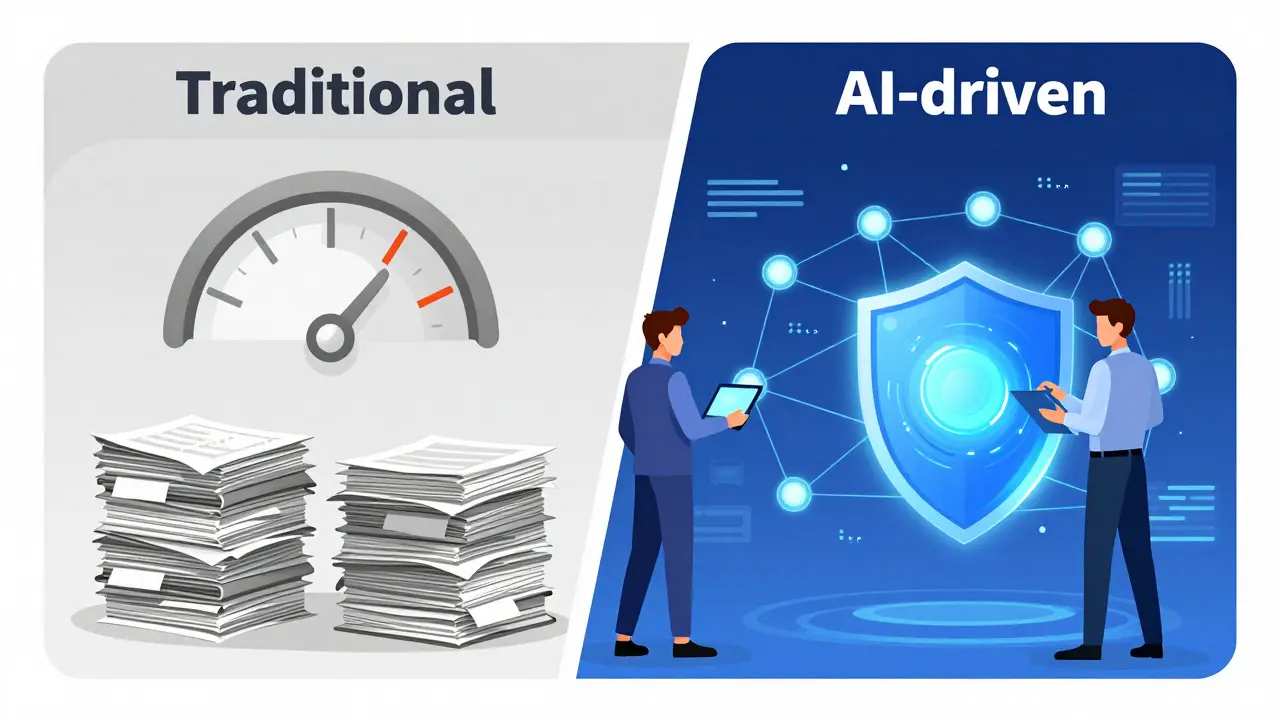
The efficiency gains here are massive. AI doesn't just analyze the data; it writes the reports. Risk professionals now use generative tools to summarize customer interactions, draft credit memos, and generate loss probability estimates. By automating the "paperwork" side of lending, banks can make decisions faster and with more confidence, transforming the credit process from a slow, manual hurdle into a streamlined digital experience.
| Feature | Traditional Banking | Generative AI Banking |
|---|---|---|
| Customer Advice | Generic product-based offers | Hyper-personalized, event-driven guidance |
| Risk Analysis | Static scoring and historical data | Dynamic patterns and real-time indicators |
| Compliance | Manual audits and periodic reviews | Real-time fraud detection and automated drafting |
| Workforce Focus | Task-oriented data gathering | Strategic advisory and risk prevention |
Automating Compliance and Fraud Prevention
In the world of banking, compliance isn't just a checkbox-it's a survival requirement. Compliance in the AI era involves deploying systems that can process billions of transactions in real-time to spot fraud. Unlike older systems that relied on simple "if-then" rules, generative AI can recognize the subtle, evolving signatures of a cyberattack or a sophisticated fraud scheme as it happens.
Beyond fraud, AI is tackling the growing demand for climate risk reporting. Banks are now using generative tools to automate the initial drafts of climate risk assessments and create "green" financial products tailored to a customer's specific environmental footprint. This reduces the burden on compliance officers and ensures that the bank stays ahead of shifting regulatory requirements without needing to double its headcount.
The "Shift Left" Strategy for Risk Professionals
One of the most interesting changes is how the actual jobs inside the bank are shifting. There is a movement called the "shift left" approach, where risk management happens at the very beginning of the customer journey rather than as a final check at the end. Instead of spending 80% of their time gathering data and writing summaries, risk professionals are becoming strategic partners.
With AI assistants handling the heavy lifting-such as surfacing client-specific insights or earnings data before a meeting-relationship managers can focus on the human side of the business. Risk officers are now spending more time exploring emerging trends and designing proactive controls for new products, effectively moving from a "detective" role (finding what went wrong) to an "architect" role (preventing things from going wrong).
The Dark Side: Hallucinations and Systemic Risks
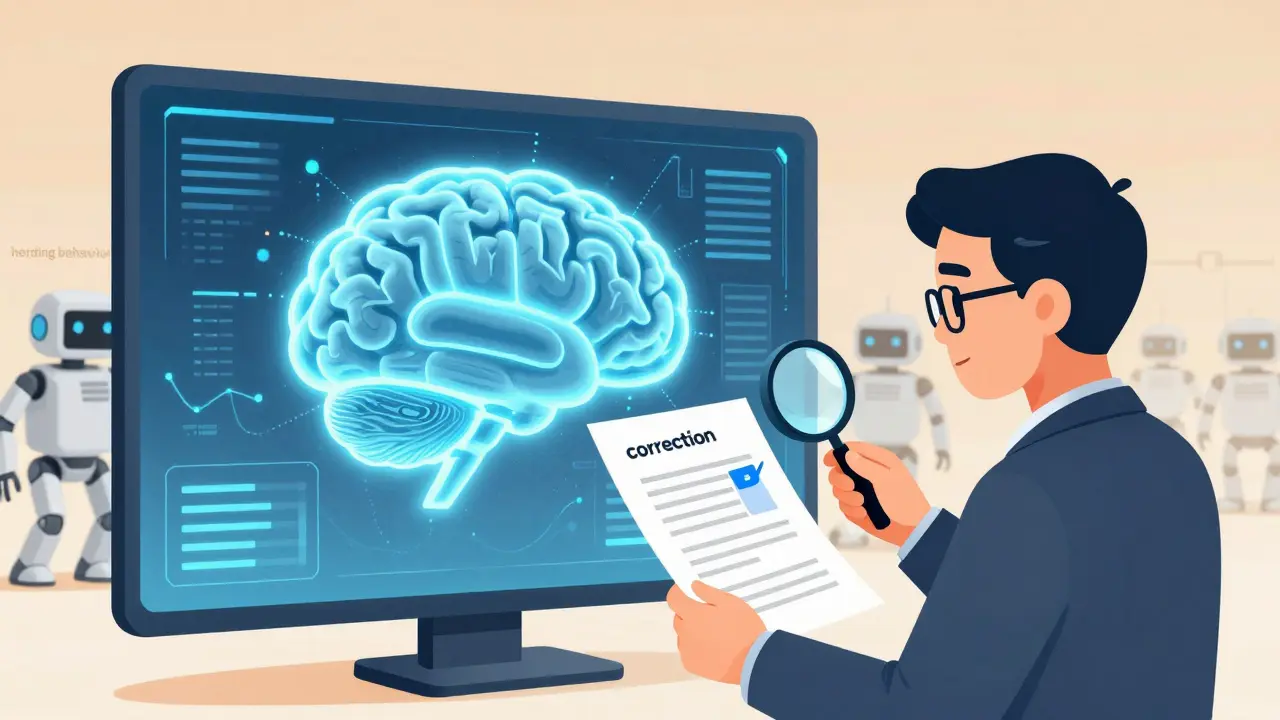
It's not all smooth sailing. The same technology that provides great advice can also produce "hallucinations"-confident but completely false statements. In a financial context, a hallucination isn't just a glitch; it's a potential legal disaster or a financial loss. The Commodity Futures Trading Commission (CFTC) has already flagged these risks, noting that misleading AI outputs can harm both the customer and the institution.
There is also a deeper, systemic worry known as "herding behavior." If every major bank uses the same few AI providers to make credit or investment decisions, they might all suddenly decide to sell the same asset or tighten lending at the exact same time. This correlation could lead to flash crashes or bank runs, creating a level of instability that the global financial system isn't currently built to handle.
Governance and the Human-in-the-Loop
To stop these risks, banks are sticking to a "human-in-the-loop" model. This means that while the AI might draft a loan approval or a risk report, a human expert must review and sign off on it before it ever reaches a customer. Some institutions are using the AI to check itself-requiring the model to provide source citations for every claim it makes-which makes the human review process much faster.
As banks move toward real-time AI interactions without human intervention, the "guardrails" have to be built into the code from day one. This requires a tight collaboration between the developers who build the models and the compliance officers who understand the law. Without these rigorous controls, the efficiency gained from AI is quickly wiped out by the cost of regulatory fines and lost customer trust.
How does Generative AI actually personalize banking advice?
It analyzes a combination of your spending habits, income fluctuations, and life events (like a change in employment or a rent increase) to offer specific, timely suggestions. Rather than generic tips, it provides actionable advice, such as suggesting a specific mortgage product exactly when your financial profile suggests you are ready to buy a home.
What is the "hallucination" risk in financial services?
Hallucinations occur when an AI model generates a response that sounds confident and professional but is factually incorrect. In banking, this could mean an AI giving wrong interest rate information or miscalculating a risk score, which could lead to financial loss or regulatory penalties.
What is "herding behavior" in the context of AI banking?
Herding behavior happens when multiple financial institutions rely on the same few AI model providers. If these models all produce the same biased or skewed output, banks may all take the same action simultaneously, potentially causing market volatility or systemic crashes.
How do banks ensure AI doesn't make mistakes with customer money?
Most banks use a "human-in-the-loop" system where AI generates the work, but a qualified professional reviews it before it is finalized. They also implement strict guardrails and require the AI to provide citations from proprietary data to verify its claims.
Will AI replace risk managers and compliance officers?
Not exactly. Instead, it's changing their roles. By automating data collection and report drafting, AI frees these professionals to focus on strategic advisory work, new product development, and high-level risk prevention-a transition known as the "shift left" approach.
Kendall Storey
April 13, 2026 AT 10:39The alpha on this is insane if they can actually nail the UX. Most banks are just legacy stacks wrapped in a pretty UI, so if they actually implement a real-time LLM layer for hyper-personalization, it's a total game changer for the LTV of the customer. We're talking about moving from a basic utility to a full-on financial co-pilot. The real bottleneck is gonna be the latency of these models and how they handle the token costs at scale. If they can optimize the inference, they'll absolutely crush the competition that's still using basic decision trees. It's all about that seamless integration into the daily workflow. Let's get it!
Richard H
April 14, 2026 AT 09:26Great, so now the banks get to spy on my coffee habits even more. We need to keep this tech strictly within our own borders and stop relying on globalized garbage. If we don't dominate this AI space, some other country will use it to wreck our economy while we're busy 'personalizing' our savings accounts. Get the US to lead or get out of the way!
Pamela Tanner
April 15, 2026 AT 23:18The shift toward a more inclusive credit assessment model is a significant step forward. By leveraging behavioral data instead of relying solely on antiquated credit scoring systems, financial institutions can provide opportunities to marginalized communities who have historically been excluded from traditional lending. It is imperative that the implementation of these tools remains transparent and unbiased to ensure that the promise of financial inclusion is actually realized for everyone.
Ashton Strong
April 17, 2026 AT 14:32It is truly heartening to see how technology can be utilized to empower the average consumer through tailored financial guidance. The ability to automate the more tedious aspects of compliance and risk reporting will undoubtedly allow professionals to dedicate their expertise to more meaningful, strategic endeavors. I believe we are entering an era of unprecedented efficiency that will benefit both the institution and the client. The human-in-the-loop safeguard is a most prudent approach to mitigating the risks of hallucinations, ensuring that stability and accuracy remain the primary objectives. It is a wonderful time for the evolution of financial services.
Steven Hanton
April 18, 2026 AT 02:24I wonder how the regulators will actually handle the herding behavior issue.
ravi kumar
April 18, 2026 AT 18:06Very interesting read. It will be a long journey to fully implement this but the potential is there for a much better customer experience.
Kristina Kalolo
April 20, 2026 AT 01:51The systemic risk mentioned regarding the same AI providers is the most concerning part. If three major LLMs control the risk narratives for 90% of the global banks, the lack of diversity in decision-making could create a massive blind spot. One wrong output from a primary provider could trigger a cascade of failures across different institutions that think they are making independent decisions. It creates a single point of failure for the entire global financial architecture. We've seen what happens with algorithmic trading flash crashes, and this feels like a much larger, slower-moving version of that same problem. The concentration of power in a few AI labs is a risk that doesn't get enough attention in these optimistic summaries. We need a way to ensure model diversity across the sector. Without it, the 'guardrails' are just a thin layer over a very dangerous foundation. The human-in-the-loop is a start, but humans often defer to the AI when the volume of data is too high. This could lead to a situation where humans just rubber-stamp the AI's errors. Real stability requires fundamentally different models looking at the same data. If everyone uses the same lens, they all miss the same flaws. This is how bubbles form and then pop spectacularly. I suspect we will see some major regulatory pushback on model concentration soon. It's just too big of a gamble for the global economy. Hopefully, the 'architect' role mentioned will prioritize diversity of thought over simple automation efficiency.