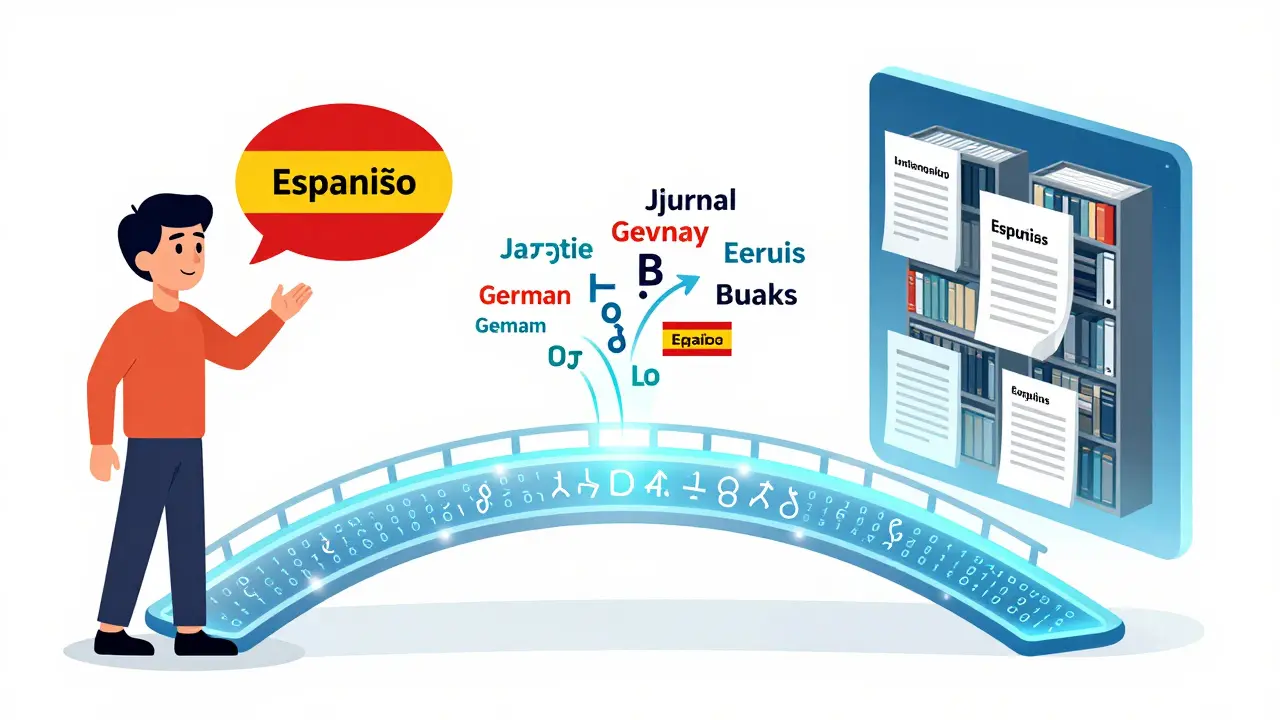
Imagine you're building a global customer support bot. A user asks a complex technical question in Spanish, but your most detailed troubleshooting guide is written in English. In a standard setup, the bot might stumble or hallucinate. But with Multilingual RAG is a framework that combines information retrieval with generative AI to pull facts from documents in any language and answer the user in their own, this isn't a problem. The system can find that English guide and explain the solution perfectly in Spanish.
While it sounds like magic, getting a Multilingual RAG system to actually work is tough. You aren't just translating words; you're trying to map concepts across different linguistic structures. When the query is in one language and the source data is in another, you hit a wall called cross-language retrieval. If the system can't "bridge" the gap between how a concept is described in Japanese versus German, the LLM gets the wrong context and gives a confident, yet completely wrong, answer.
How Multilingual RAG Actually Works
At its core, a multilingual RAG pipeline consists of three main parts: a query processor, a retriever, and a generator. When a user submits a question, the system doesn't just look for keyword matches. Instead, it uses an Embedding Model to turn the text into a mathematical vector-basically a point in a high-dimensional map. If the model is truly multilingual, a Spanish sentence and its English translation will land very close to each other on that map.
The process usually follows these steps:
- The system converts the user's query into a vector.
- It searches a Vector Database for document chunks that are mathematically similar, regardless of the language they are written in.
- The retriever pulls these "best match" chunks (which might be in three different languages).
- These chunks are fed into a Large Language Model (LLM) as context.
- The LLM synthesizes the information and writes the final answer in the user's language.
The Big Problem: Language Bias and Preference
Here is the catch: not all languages are treated equally. There is a massive imbalance in how these systems perform based on how much data the model saw during its training. This is often measured using the MultiLingualRankShift (MLRS) metric, which tracks how much a retriever prefers one language over another.
English is the "heavyweight" here. Because the vast majority of pre-training data is English, retrievers often show a strong preference for English documents. Even if a relevant document exists in the user's native language, the system might rank an English document higher simply because the model "understands" English vectors better. This creates a bias where the system relies too heavily on English sources, potentially missing cultural nuances or region-specific facts found in local-language documents.
Strategies to Solve Retrieval Challenges
Depending on your budget and performance needs, there are a few ways to tackle these cross-lingual hurdles. You can't just "hope" the embedding model handles it; you need a specific strategy.
| Strategy | How it Works | Pros | Cons |
|---|---|---|---|
| Multilingual Embeddings | One model handles all languages in a single vector space. | Fast, simple architecture. | Can lose precision in low-resource languages. |
| Query Translation | Translates the user query into all available doc languages. | Very high recall; finds everything. | Slow and expensive (more API calls). |
| Hybrid Fusion | Combines translated text with internal LLM knowledge. | Reduces hallucinations and bias. | Complex to implement and maintain. |
For those who need extreme precision, Query Translation is the safest bet. By translating a query into five different languages and searching five different indexes, you ensure nothing slips through the cracks. However, for a real-time app, using a high-quality multilingual embedding model (like those from Cohere) is usually the better balance of speed and accuracy.
Cutting-Edge Frameworks: D-RAG and DKM-RAG
Researchers are moving beyond simple retrieval to "reasoned" retrieval. Two new approaches from early 2025 have changed the game:
First, there's Dialectic RAG (D-RAG). Instead of just grabbing a fact, D-RAG uses a multi-step reasoning process. It extracts information, looks for conflicting arguments between different languages, and then "consolidates" them. If an English source says one thing and a French source says another, D-RAG weighs the evidence before answering. This has led to a nearly 13% jump in accuracy for models like GPT-4o on multilingual benchmarks.
Then there is Dual Knowledge Multilingual RAG (DKM-RAG). This method fights language bias by fusing translated external passages with the LLM's own internal knowledge. By rewriting the retrieved content to align better with the model's internal "understanding," it has boosted character-level recall by up to 55% for non-English queries. It basically acts as a bridge, making sure the external data doesn't feel "foreign" to the generator.
Practical Implementation Stack
If you're building this today, you don't have to start from scratch. A typical modern stack for a multilingual system looks like this:
- Embeddings: Cohere Multilingual Embeddings (supports 100+ languages).
- Vector Store: LanceDB or Pinecone for high-speed similarity searches.
- Orchestration: LangChain to glue the retriever and LLM together.
- Translation: Argos Translate for open-source, local translation needs.
- UI: Gradio or Streamlit for quick prototyping.
The real trick is in the "chunking" phase. When dealing with multiple languages, standard character-count chunking can break words in the middle (especially in languages like Chinese or Japanese). You need to use language-aware tokenizers to ensure the meaning of the text remains intact before it hits the vector database.
Why not just translate everything into English first?
While "translate-to-English" is easy, it's risky. Translation often loses nuance, technical terminology, or cultural context. If the translation is slightly off, the RAG system will retrieve the wrong documents, leading to an inaccurate final answer. Native multilingual retrieval preserves the original meaning of the source text.
What is the biggest cause of hallucinations in multilingual RAG?
The primary cause is "context misalignment." This happens when the retriever pulls a document in Language A that is only vaguely related to the query in Language B. The LLM, trying to be helpful, "fills in the gaps" with its own training data rather than the provided context, resulting in a hallucination.
How do low-resource languages affect performance?
Low-resource languages (those with less web data) generally have lower MLRS scores. This means the embedding model isn't as good at placing these languages in the correct vector space. In these cases, query translation or specialized fine-tuning is almost always necessary to get usable results.
Does the choice of LLM matter if the retriever is multilingual?
Yes, absolutely. The retriever finds the data, but the LLM must be able to synthesize it. If you use a weak model, it might struggle to read the retrieved non-English text or fail to translate the final answer accurately. Using a frontier model like GPT-4o or Claude 3.5 is recommended for the generation phase.
How does D-RAG improve accuracy?
D-RAG introduces a "dialectic" process, meaning it looks for contradictions. By explicitly weighing different perspectives found in multilingual documents, it filters out noise and resolves disagreements, which prevents the model from simply picking the first relevant-sounding document it finds.