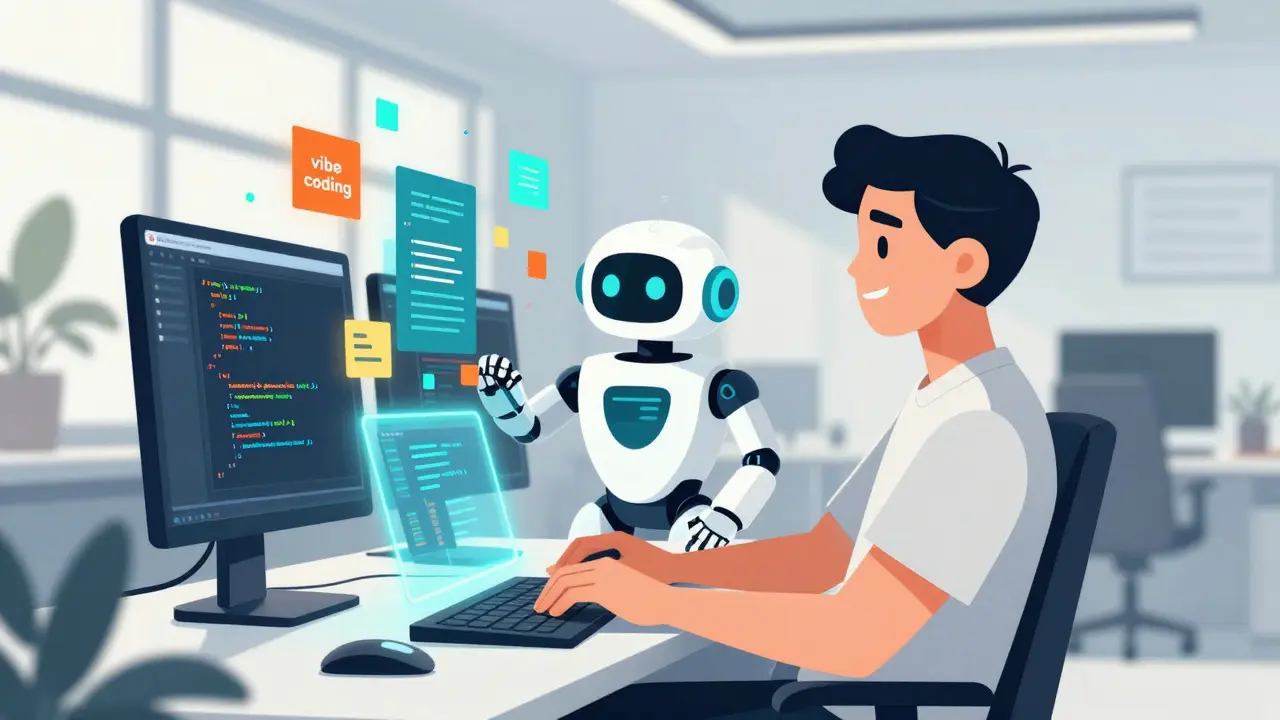
Imagine your competitor shipping features twice as fast while keeping the same headcount. They aren't just working harder; they are likely leveraging vibe coding is a software development practice where developers describe tasks in natural language to large language models that generate code, shifting effort from manual writing to directing and reviewing AI output. Coined by Andrej Karpathy in early 2025, this approach has evolved from a casual experiment into a structured discipline known today as vibe engineering or agentic engineering. If your organization is still treating AI assistants as mere autocomplete tools, you might be leaving significant productivity on the table. This guide helps you measure where you stand against industry leaders and identify the specific gaps slowing down your adoption.
Understanding the Maturity Spectrum
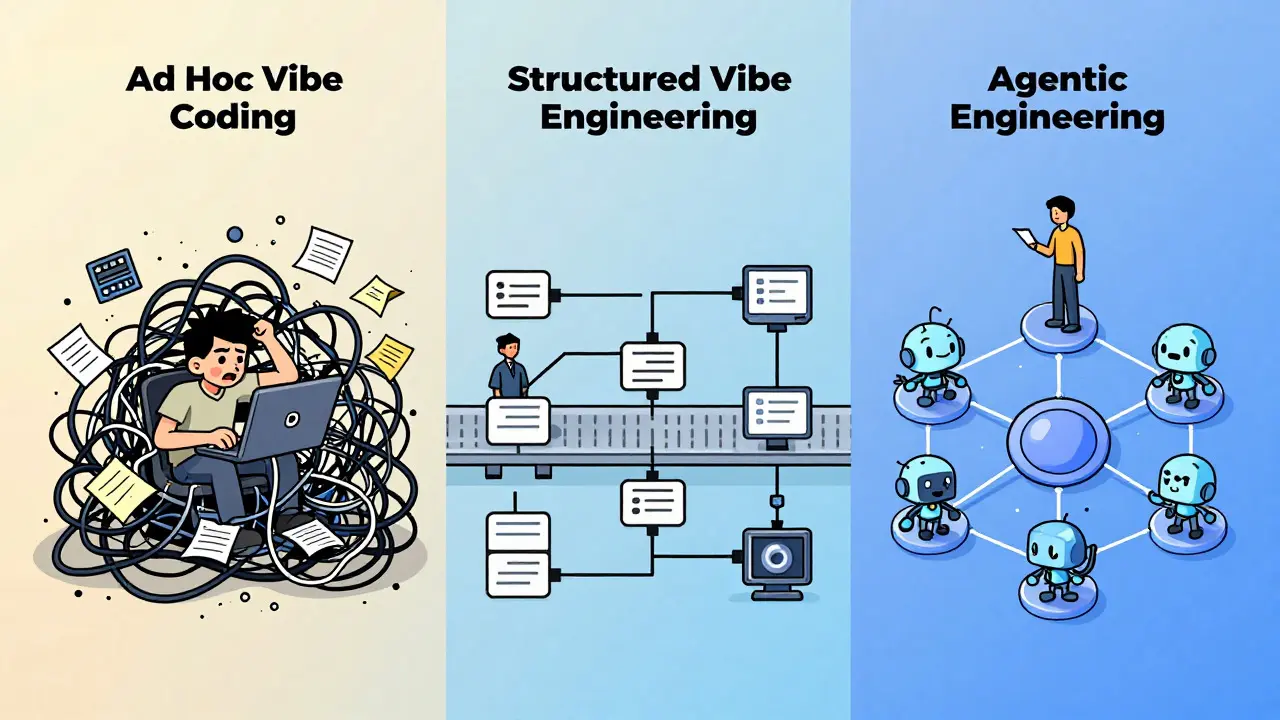
To benchmark effectively, you first need to define what "leading" looks like in 2026. The landscape has shifted away from pure code generation toward orchestrated workflows. Most organizations fall somewhere on a continuum between ad hoc prompting and fully integrated agentic systems. Leaders are no longer asking "How much code does the AI write?" but rather "How well do we govern, test, and integrate AI-generated code into our production pipelines?"
- Ad Hoc Vibe Coding: Developers use chatbots for snippets. Little review of internal structure. High risk of subtle bugs.
- Structured Vibe Engineering: Standardized prompts, integrated IDEs, and mandatory human review of architecture. AI handles boilerplate; humans handle logic.
- Agentic Engineering: Multi-agent pipelines handle planning, coding, testing, and deployment. Humans act as high-level architects and risk managers.
The key differentiator for top performers is not the raw percentage of AI-generated code, but the robustness of the safety net surrounding it. If your team accepts AI output without rigorous testing, you are lagging behind regardless of how fast you type.
Quantitative Metrics That Matter
You can't manage what you don't measure. By mid-2026, several concrete metrics have emerged as standard proxies for evaluating AI-assisted development performance. These numbers provide a baseline for comparing your internal data against industry standards.
| Metric | Industry Leader Benchmark (2026) | Lagging Indicator |
|---|---|---|
| Average Task Duration | ~22 minutes (down from 45 min baseline) | >35 minutes per standard task |
| Feature Throughput per Sprint | +20% increase | No measurable change vs. pre-AI baseline |
| Assistant Accuracy | 87-96% (depending on tool/model) | <80% acceptance rate by developers |
| Suggestion Latency | 0.9-2.8 seconds | >4 seconds average response time |
| Debugging Time Reduction | ~50% reduction | Minimal change in debugging hours |
Notice that accuracy varies significantly by tool. For instance, specialized agents like Claude Code often achieve higher precision (~96%) compared to general-purpose assistants like Amazon Q (~79%). When benchmarking your stack, compare your chosen tools against these specific ranges. If your developers report that suggestions feel slow or wrong more than half the time, your tool selection or integration likely needs re-evaluation.
Qualitative Capabilities of Leaders
Numbers only tell half the story. Leading organizations distinguish themselves through structural and cultural practices that enable safe, scalable AI adoption. Here is what separates the top tier from the rest:
- Platform Standardization: Leaders select a primary AI coding platform and integrate it deeply into their CI/CD pipelines. They avoid a fragmented landscape where every developer uses a different chatbot. Tools like GitHub Copilot or Cursor are embedded directly into the workflow, minimizing context switching.
- Multi-Agent Orchestration: Instead of a single assistant, leading teams deploy specialized agents for planning, coding, and testing. This mirrors human team dynamics and allows for parallel processing of complex tasks.
- Dedicated Training Curricula: Prompt engineering and context management are now core skills. Organizations invest in formal training programs-similar to those offered by Coursera or Udacity-to ensure engineers understand how to direct AI effectively, not just how to write Python or Java.
- Rigorous Governance: Leaders maintain strict boundaries on what AI can decide autonomously. System design, data modeling, and security reviews remain firmly in human hands. AI outputs are treated as drafts, not final truths.

Common Pitfalls in Adoption
Many organizations stumble during the transition because they focus on the technology rather than the process. The most common mistake is "naïve vibe coding," where developers accept generated code without inspecting its internal structure. This creates technical debt that is invisible until a critical failure occurs.
Another frequent error is ignoring the learning curve. Moving from manual coding to intent-driven development requires a shift in mindset. If your engineers feel frustrated because the AI misses context, it’s rarely the model’s fault-it’s usually a lack of proper prompt engineering or context management. Leaders mitigate this by providing templates, pre-prompts, and clear guidelines on when to use AI versus manual coding.
Finally, failing to integrate AI with deployment workflows limits the upside. Concepts like "vibe deploying"-where an application moves from prompt to production with minimal friction-are becoming standard among leaders. If your team still manually configures containers and environments after generating code, you are missing out on significant cycle-time reductions.
How to Build Your Benchmarking Framework
Start by establishing a baseline. Measure your current average task duration, sprint velocity, and bug rates over the last three months. Then, introduce or expand your AI coding tools in a controlled pilot group. After one quarter, compare the pilot group’s metrics against the baseline and the industry benchmarks listed above.
Use open-source platforms like JetBrains’ Developer Productivity AI Arena to validate your internal tests. This arena provides standardized multi-language and multi-workflow benchmarks, allowing you to see how your stack performs relative to public standards. Aligning your internal metrics with these external references ensures your data is comparable and credible.
Remember, the goal isn't to reach 100% AI autonomy. It's to maximize efficiency while maintaining control. If you see a 50% reduction in task duration and a 20% boost in feature throughput, you are on track. If the gains are marginal, look at your integration depth and training efforts before blaming the technology.
What is the difference between vibe coding and vibe engineering?
Vibe coding refers to the initial, often casual practice of using natural language to generate code with minimal review. Vibe engineering is the mature, disciplined version of this practice, incorporating rigorous system design, testing, and human governance. Leaders operate at the vibe engineering level, ensuring AI output is reliable and maintainable.
Which AI coding tools offer the highest accuracy in 2026?
Based on recent comparative studies, specialized agents like Claude Code and Cursor (using Claude) tend to offer higher accuracy, ranging from 94% to 96%. General-purpose tools like GitHub Copilot hover around 87%, while others like Amazon Q sit lower at approximately 79%. The best choice depends on your specific workflow and latency requirements.
How much faster can vibe coding make my team?
Industry data suggests a potential 51% reduction in average task duration, dropping from 45 minutes to 22 minutes. Additionally, teams often see a doubling of overall output and a 20% increase in features delivered per sprint. However, these gains depend heavily on proper integration and training.
Is vibe coding safe for production applications?
Yes, but only when practiced as vibe engineering. Naïve vibe coding, which skips detailed code review, poses risks of hidden bugs and security vulnerabilities. To make it safe for production, organizations must enforce strict testing protocols, human architectural review, and integrated CI/CD checks.
What skills do developers need to master vibe coding?
Developers need strong prompt engineering skills, the ability to manage context effectively, and a solid grasp of system architecture. While coding syntax becomes less central, the ability to evaluate AI output, debug runtime behavior, and design robust systems remains critical.
Dave Gibbeson
August 16, 2026 AT 14:00Let's be real for a second. The "vibe coding" label is doing heavy lifting here to make what is basically just prompt engineering sound like a mystical art form.
If your team isn't treating the AI output as a junior developer's first draft that needs rigorous code review, you are building a house on sand. The metrics in this post about 87-96% accuracy are great, but they assume you have a solid CI/CD pipeline already in place. Most mid-sized companies I talk to don't even have consistent unit tests for their legacy code, so adding an AI layer just amplifies the existing chaos.
The real gap isn't the tooling, it's the discipline. You can buy Cursor or Copilot tomorrow, but if your engineers aren't trained to decompose problems effectively before prompting, you're just getting faster bugs. Focus on the process first, the tech second.
Sabrina Newland
August 17, 2026 AT 19:15I think there’s a deeper philosophical shift happening here that gets lost in the benchmarking numbers 🤔
When we move from writing code to directing agents, we aren’t just changing tools, we’re changing the nature of software authorship itself. It’s less like writing a novel and more like conducting an orchestra where the musicians (the LLMs) are incredibly talented but sometimes interpret the score differently than you intended.
The "naive vibe coding" pitfall mentioned in the article is basically the Dunning-Kruger effect applied to AI. People think because the code runs, it’s correct, but they haven’t interrogated the logic deeply enough. We need to cultivate a culture of skepticism toward generated artifacts, not blind trust. It’s a fascinating transition period for our industry, honestly 😅
Amara Akbar
August 18, 2026 AT 08:55One must consider that the human element remains paramount in this equation.
While the quantitative metrics provided are certainly useful for establishing a baseline, the qualitative aspect of team cohesion cannot be ignored. In my experience, organizations that succeed with agentic engineering are those that invest heavily in cross-functional communication between product managers and engineers.
If the intent is not clearly articulated, even the most sophisticated multi-agent pipeline will produce suboptimal results. Therefore, I would suggest that leaders prioritize clear documentation standards alongside technical training. This ensures that the context provided to the AI is rich and accurate, thereby maximizing the potential benefits of these new workflows.
Mark Harvey
August 20, 2026 AT 02:07totally agree with the point about training curricula being core skills now. its wild how fast the landscape has changed. i started using these tools last year and felt like a wizard at first but then realized i was just guessing at prompts. once we got some structured templates going our velocity actually jumped. its not magic its just better habits
Art HND
August 20, 2026 AT 16:18Another buzzword cycle.
We had "Agile." We had "DevOps." Now it's "Vibe Engineering." The underlying problem remains: software is hard, and humans are bad at estimating time. AI doesn't fix estimation; it just makes the wrong features arrive faster. Don't get too excited about the latency numbers; they mean nothing if the product roadmap is garbage.
Brandon Olvera
August 20, 2026 AT 18:18These benchmarks feel very US-centric. I work in a smaller shop here and our infrastructure costs are higher relative to our headcount. Trying to implement "multi-agent orchestration" when you are fighting for basic cloud budget is a different beast entirely. The advice holds up in theory but the practical application varies wildly depending on your local market constraints and regulatory environment.
Elizabeth Brooks
August 22, 2026 AT 07:53Great breakdown! Just wanted to add that the "Suggestion Latency" metric is often overlooked until it becomes a bottleneck. If your devs are waiting 4+ seconds for a response, their flow state breaks immediately. We switched from a general-purpose model to a specialized one specifically to cut that down to under 2 seconds and the difference in daily productivity was night and day. It’s a small config change with a huge impact on morale and speed.
Deb Kortyna, MBA
August 23, 2026 AT 02:45It is quite audacious to suggest that "vibe" is a professional engineering discipline without first addressing the liability issues inherent in unvetted AI code.
In a regulated industry, the cost of a single subtle security vulnerability introduced by an LLM could far outweigh the productivity gains cited in this guide. One must ask: who is responsible when the agent hallucinates a dependency? The engineer? The platform provider? The legal framework is lagging significantly behind the technological adoption curve, and ignoring this creates a precarious situation for any organization aiming for "leadership" status.
alex kobri
August 24, 2026 AT 00:57interesting take on the governance part. i’ve always thought that trying to control every line of AI-generated code is a losing battle. instead of strict boundaries maybe we should focus on outcome verification. if the tests pass and the system behaves as expected does it matter if the code looks weird? probably not. the philosophy shifts from "how did it write this" to "does it do what i asked". that mindset change is harder than the tech setup
Zach Loescher
August 24, 2026 AT 14:56I've been reading through various reports on this topic recently and the consensus seems to be that the initial hype is settling into a more pragmatic phase. The distinction between ad-hoc usage and structured engineering is critical. Many teams fail because they skip the intermediate step of standardized prompts and jump straight to complex agentic workflows, leading to confusion and inconsistent results. A phased approach, starting with simple boilerplate generation and gradually increasing autonomy, tends to yield more stable long-term improvements in both speed and code quality.