
You’ve probably heard that Transformers are the backbone of modern AI, but have you ever wondered how a model actually translates "Hello" into "Bonjour" without getting lost? It’s not magic; it’s cross-attention. This specific mechanism is the bridge that allows an encoder to talk to a decoder, enabling large language models (LLMs) and translation systems to condition their output on input context. Without it, your decoder would be generating text in a vacuum, completely blind to what you asked it to translate or summarize.
The Core Problem: Information Isolation
Imagine trying to write a summary of a book while wearing noise-canceling headphones and reading the original text in a different room. You can see the words, but you can’t hear the nuances. In standard neural networks before Transformers, this was a real bottleneck. The encoder compressed the entire input sentence into a single fixed-length vector-a sort of "summary blob." The decoder then had to unpack this blob to generate the output. If the input was long, details got crushed. Cross-attention solves this by letting the decoder look back at the specific parts of the input it needs, right when it needs them.
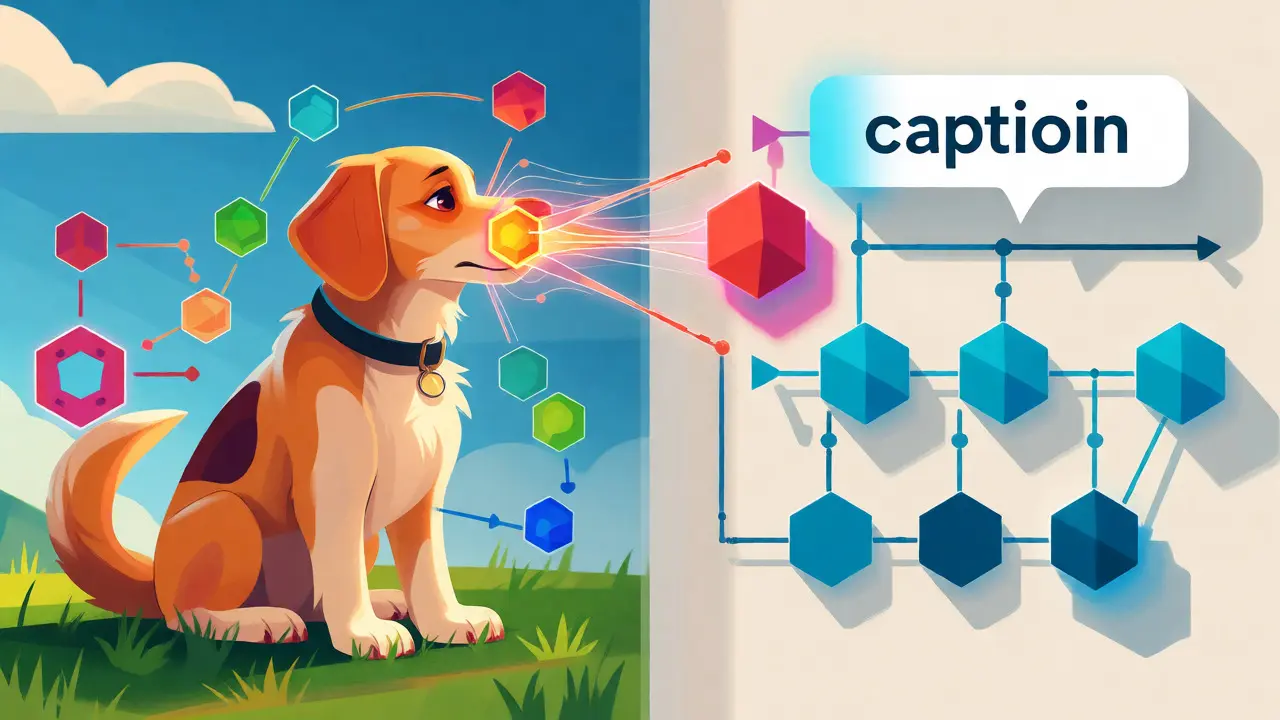
This isn't just about translation. Think about image captioning. The encoder processes the visual features of an image, and the decoder generates words. Cross-attention lets the word "dog" in the caption attend specifically to the pixel region containing the dog, ignoring the sky or the grass. It’s a targeted lookup system, not a general guess.
How Cross-Attention Actually Works
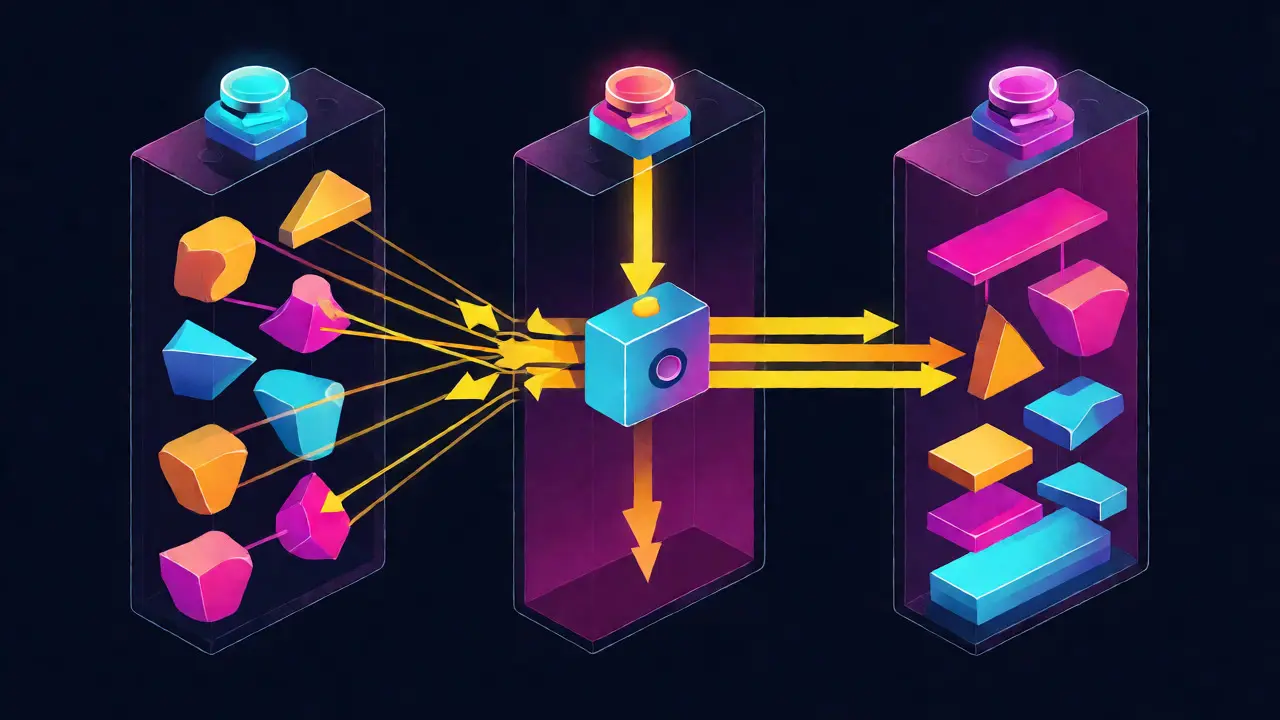
To understand cross-attention, you first need to grasp the basic components: Queries (Q), Keys (K), and Values (V). In self-attention, which happens within the encoder or within the decoder itself, Q, K, and V all come from the same sequence. The model asks, "How relevant is token A to token B in this same sentence?"
Cross-attention changes the source of these vectors. Here is the breakdown:
- Queries (Q): Come from the decoder. These represent what the current generation step is looking for.
- Keys (K) and Values (V): Come from the encoder. These represent the available information from the input sequence.
When the decoder is generating the third word of a translation, it creates a Query vector based on its current state. It then compares this Query against every Key vector produced by the encoder. The result is a set of scores indicating how much each input token matters for the current output token. These scores are normalized using softmax, creating a probability distribution. Finally, the Value vectors are weighted by these probabilities and summed up. This sum becomes part of the decoder's input for the next step, effectively injecting relevant source context directly into the generation process.
Architecture: Where Does It Fit?
In the original "Attention Is All You Need" paper, the Transformer decoder layer has a very specific order of operations. Getting this wrong breaks the model. Each decoder block contains three sub-layers in this exact sequence:
- Masked Self-Attention: The decoder looks at previous tokens it has already generated. The mask ensures it doesn't peek at future tokens during training.
- Cross-Attention: The decoder looks at the encoder outputs. This is where the conditioning happens.
- Feed-Forward Network: Standard processing applied to each position independently.
Why this order? First, the decoder establishes its own internal consistency via self-attention. Then, it enriches that understanding with external context via cross-attention. Finally, it processes the combined representation. If you swapped these, the model would struggle to align its internal grammar with the source content.
| Feature | Self-Attention | Cross-Attention |
|---|---|---|
| Source of Queries | Same sequence (Encoder or Decoder) | Decoder sequence |
| Source of Keys/Values | Same sequence | Encoder sequence |
| Primary Function | Contextualize within one modality | Align two different modalities/sequences |
| Use Case Example | Understanding syntax in a sentence | Translating English to French |
Beyond Translation: Multimodal Conditioning
While machine translation is the classic example, cross-attention shines brightest in multimodal tasks. Consider a model like BLIP or Flamingo. These systems take images and text as inputs. The image encoder produces a set of feature vectors. The text decoder uses cross-attention to query these image features.
There are two main ways engineers implement this:
- Concatenation: You stack the image features and text embeddings into one long sequence. The decoder attends to both. This is simple but can be computationally expensive if sequences get long.
- Separate Layers: You dedicate specific cross-attention layers to the image features and others to the text features. This gives the model finer control over how much weight to give each modality.
This flexibility is why cross-attention remains relevant even as we move toward purely decoder-only models like GPT-4. Even in those architectures, mechanisms inspired by cross-attention (like retrieval-augmented generation) serve similar purposes: bringing external knowledge into the generation loop.
Practical Implementation Pitfalls
If you’re building a Transformer from scratch or fine-tuning one, watch out for masking errors. In cross-attention, you must apply padding masks to the encoder outputs. If your input sentence was short but padded to length 512, the decoder shouldn't waste attention on those empty padding slots. Failing to mask these leads to noisy gradients and poor convergence.
Another common issue is numerical instability. The attention scores are calculated as dot products of Q and K. If the dimension size ($d_k$) is large, these dot products can grow huge, causing the softmax function to saturate. This kills the gradient flow. That’s why we scale by $1/\sqrt{d_k}$. Don’t skip this step; it’s crucial for stable training.
Why LLMs Are Moving Away (But Still Need It)
You might wonder, "If cross-attention is so great, why do most modern LLMs use only decoders?" The answer lies in efficiency and data scaling. Encoder-decoder models require maintaining two separate stacks of weights. For pure text generation, a causal decoder (which only sees past tokens) is often sufficient because the 'input' is just the prompt history. However, for tasks requiring strict alignment between distinct inputs and outputs-like code completion with documentation, or video summarization-cross-attention provides a structured way to condition generation on non-sequential or heterogeneous data.
Furthermore, recent research into efficient Transformers is exploring sparse cross-attention patterns. Instead of attending to every encoder token, the decoder might only attend to a subset, reducing computational cost from quadratic to linear. This makes cross-attention viable for longer contexts, keeping it alive in cutting-edge research.
Key Takeaways
- Cross-attention bridges the gap between encoder and decoder, allowing the output to depend on specific input details.
- It uses Queries from the decoder and Keys/Values from the encoder, unlike self-attention which uses all three from the same source.
- Order matters: In decoder blocks, cross-attention typically follows masked self-attention and precedes the feed-forward network.
- Multimodal AI relies on it to inject visual or other sensory data into text generation.
- Watch your masks: Always mask padding tokens in the encoder output to prevent attention leakage.
What is the difference between self-attention and cross-attention?
Self-attention operates within a single sequence, allowing tokens to relate to each other (e.g., pronouns referring to nouns in the same sentence). Cross-attention relates two different sequences, typically allowing a decoder to attend to encoder outputs. In cross-attention, queries come from the decoder, while keys and values come from the encoder.
Why is cross-attention important for machine translation?
Machine translation requires mapping words from one language to another. Cross-attention allows the decoder to look at specific words in the source language (processed by the encoder) when generating each word in the target language. This ensures that the translation respects the context and structure of the original sentence.
Can cross-attention be used in decoder-only models?
Traditional decoder-only models like GPT use self-attention throughout. However, concepts similar to cross-attention appear in techniques like Retrieval-Augmented Generation (RAG), where external documents are injected into the context window. Some hybrid architectures explicitly add cross-attention layers to allow the model to attend to static memory or external knowledge bases.
How does padding affect cross-attention?
Padding tokens are added to make sequences uniform in length. In cross-attention, you must apply a mask to the encoder outputs so that the decoder ignores these padding tokens. If you don't, the decoder will assign attention weight to meaningless zeros, diluting the signal from actual content and harming performance.
Is cross-attention computationally expensive?
Yes, standard attention is quadratic in complexity relative to sequence length. Since cross-attention involves comparing decoder positions to encoder positions, the cost is proportional to the product of their lengths. For very long sequences, this can be heavy, which is why researchers are developing sparse attention variants to reduce this burden.