You just shipped a feature that relies on an Large Language Model to summarize customer support tickets in real-time. It works perfectly. Then, three months later, the summary quality drops by 15%, or worse, the API endpoint returns a "404 Not Found" because the provider deprecated the specific version you were using without much warning. This isn't a hypothetical nightmare; it's the daily reality for engineering teams managing Model Lifecycle Management the systematic oversight of an AI model from development through deployment to eventual retirement.
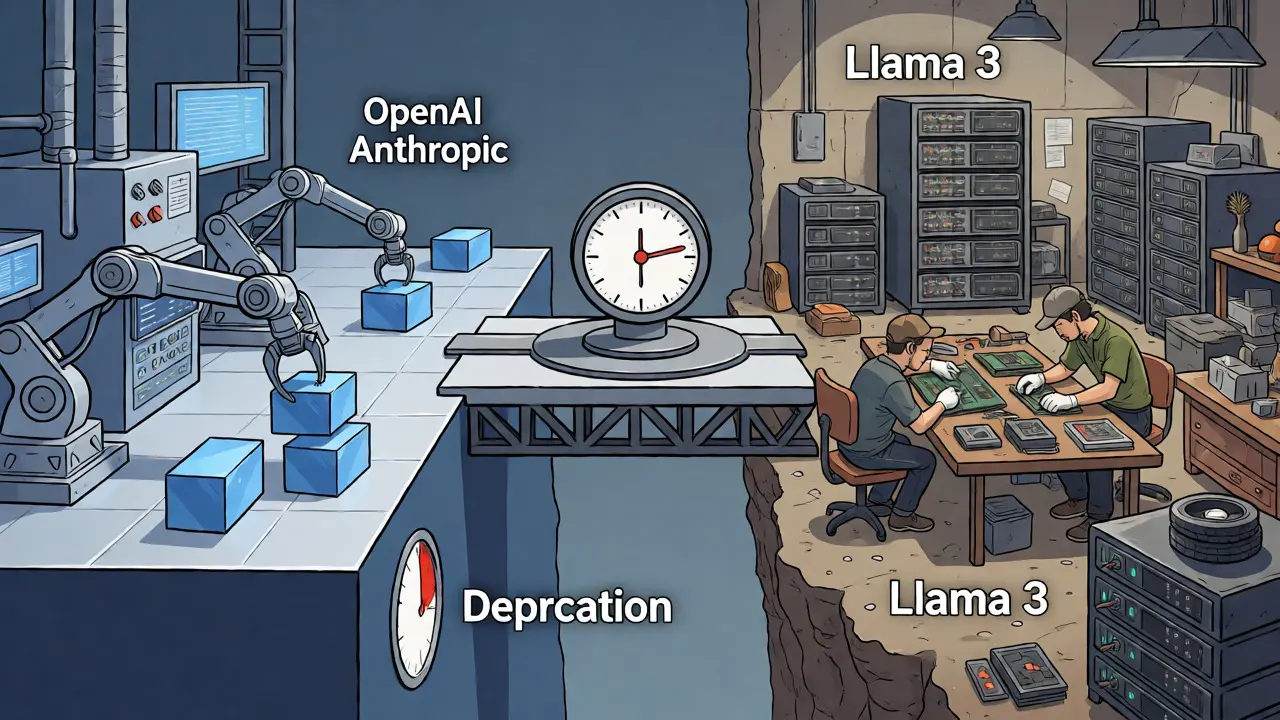
The difference between a stable product and a chaotic one often comes down to how well you handle updates and deprecations across different LLM Options ranging from proprietary APIs like OpenAI to open-source models like Meta's Llama. If you're choosing between building your own infrastructure or relying on third-party APIs, understanding the lifecycle rules is non-negotiable. Let's break down what actually happens when models age, why providers kill them off, and how you can keep your application alive.
Why Model Lifecycles Are Different From Software Updates
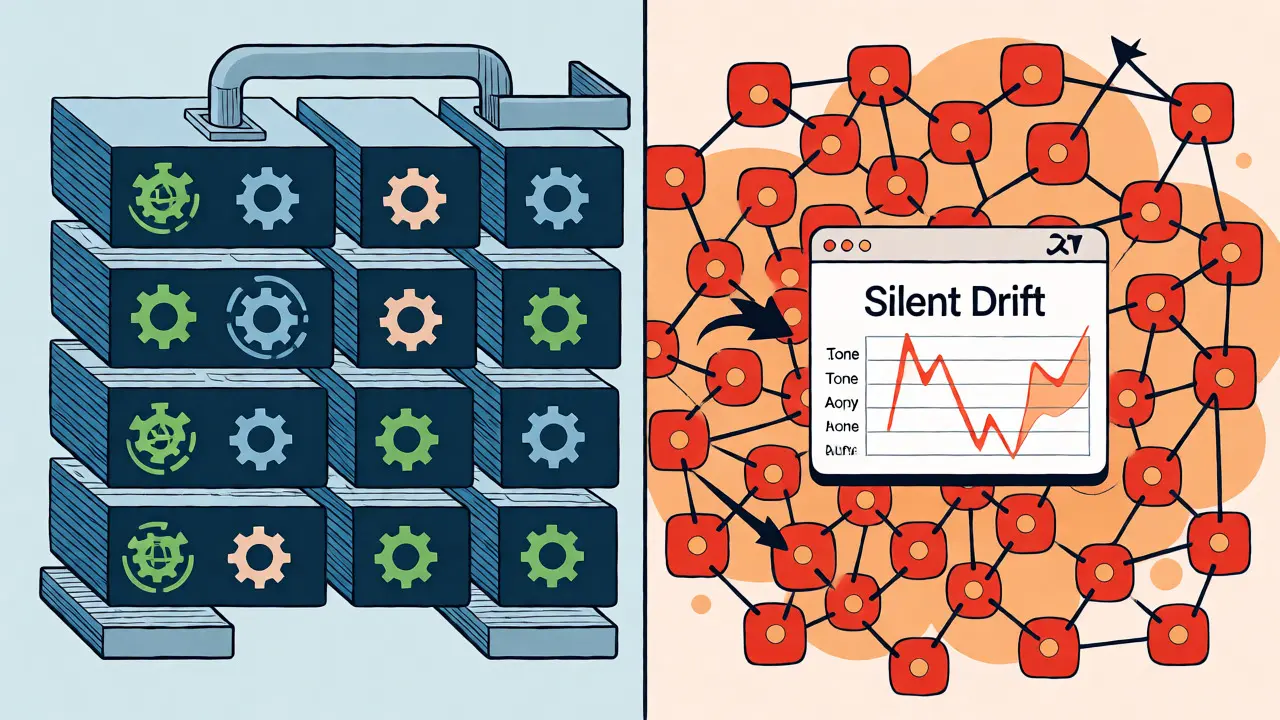
Think about updating a standard web library like React or jQuery. You update the package, run your tests, and deploy. The behavior is deterministic. Code does what code says. LLMOps a specialized discipline evolved from MLOps to manage the unique scale and complexity of large language models operates differently. Models are probabilistic. When a provider pushes an update to their underlying weights or inference engine, they might not change the version number, but the output changes. This phenomenon, known as silent drift, is a major headache.
In traditional software, you control the version. In the LLM world, especially with proprietary APIs, you are renting access to a moving target. Providers like OpenAI the developer of the GPT series and a leading provider of proprietary LLM APIs have historically updated models like `gpt-3.5-turbo` without changing the model name, meaning your production code suddenly behaves differently overnight. This lack of immutability forces companies to implement rigorous monitoring strategies that don't exist in traditional DevOps. You aren't just watching for crashes; you're watching for subtle shifts in tone, accuracy, or hallucination rates.
The Proprietary API Approach: Stability vs. Control
When you use an API, you trade control for convenience. The provider handles the heavy lifting-training, scaling, and security. But they also dictate the lifecycle. Each major provider has a distinct philosophy regarding updates and deprecations, which directly impacts your technical debt.
| Provider | Deprecation Policy | Update Transparency | Best For |
|---|---|---|---|
| OpenAI | Staged deprecation: 18 months security updates, then 6 months read-only. | Moderate. Recent v2025 updates introduced 180-day notice periods. | Startups needing rapid iteration who can tolerate some instability. |
| Anthropic | Continuous evolution. Models update incrementally without always bumping versions. | High notification compliance (87%), but low version granularity. | Enterprises prioritizing safety and consistent communication style. |
| Google Cloud | Hybrid. Major versions get 24 months full support; minor iterations get 9 months. | High. Vertex AI provides detailed health scores and lineage tracking. | Organizations already deep in the Google Cloud ecosystem. |
| AWS Bedrock | Strict 90-day warning policy for model retirements. | Very High. Clear documentation and automated rollback triggers. | Regulated industries requiring strict audit trails and predictability. |
Notice the pattern? AWS and Google tend to offer more structured timelines, appealing to enterprises that need to sign off on changes weeks in advance. OpenAI moves fast, breaking things sometimes, but offering cutting-edge capabilities sooner. Anthropic sits in the middle, focusing on steady improvements rather than disruptive jumps. Your choice depends on your risk tolerance. If your app fails when the model changes its mind about a legal clause, you probably want the stricter guarantees of AWS or Google. If you're building a creative writing tool where slight variations are fine, OpenAI's pace might be acceptable.
Open-Source Models: The Burden of Ownership
Going open-source, like using Llama 3 Meta's open-weight large language model series available for commercial use, flips the script entirely. You gain total control over the deprecation timeline. No vendor will ever shut off your access. However, you inherit the entire lifecycle burden. There is no SLA. If the model performs poorly, it’s your job to fix it, retrain it, or swap it out.
According to GitHub's 2025 State of AI report, organizations running open-source models spend 37% more engineering hours on lifecycle management compared to those using proprietary APIs. Why? Because you have to build your own registry, your own monitoring dashboard, and your own rollback procedures. You become your own LLMOps team.
This doesn't mean open-source is bad. It means it's expensive in terms of human capital. A fintech company I know switched from a proprietary API to a fine-tuned Llama 3 model to save on token costs. They saved $40,000 a month in API fees but had to hire two additional ML engineers to maintain the pipeline. The net savings were positive, but only after eighteen months. If you don't have the engineering depth to handle model drift, data leakage during retraining, and hardware scaling, open-source can quickly become a liability.
Handling Deprecations Without Breaking Production
So, how do you survive a deprecation? You need a strategy that treats model versions like database migrations. Here is a practical checklist derived from successful implementations at companies like Shopify and major banks:
- Pinning Versions: Never use "latest" endpoints in production. Always pin to a specific date-stamped version (e.g., `gpt-4o-2024-05-13`). This ensures reproducibility.
- Shadow Testing: Before switching to a new model version, run it in shadow mode against live traffic. Compare outputs with the current model. Look for regressions in key metrics like latency and factual accuracy.
- Automated Rollbacks: Set up alerts that trigger if performance metrics drop below a baseline (e.g., 92% of historical average). If the new model fails, automatically revert to the previous stable version within minutes.
- Documentation Audit Trails: Keep a log of every model version used, including training data sources and hyperparameters. This is crucial for regulatory compliance, especially under frameworks like the EU AI Act.
One common pitfall is ignoring "soft" deprecations. Sometimes a provider won't delete the model but will stop optimizing it. Latency increases, costs stay flat, and quality dips. MIT researchers found that 68% of production LLMs experience significant degradation within six months if not actively monitored. You can't just set it and forget it.
The Cost of Technical Debt in AI
Gartner estimates that poor lifecycle management creates a $2.1 billion annual technical debt problem for enterprises. This isn't just about broken code; it's about lost opportunities. Imagine a trading algorithm that loses edge because the underlying model stopped recognizing certain financial jargon patterns after a silent update. That’s real money lost.
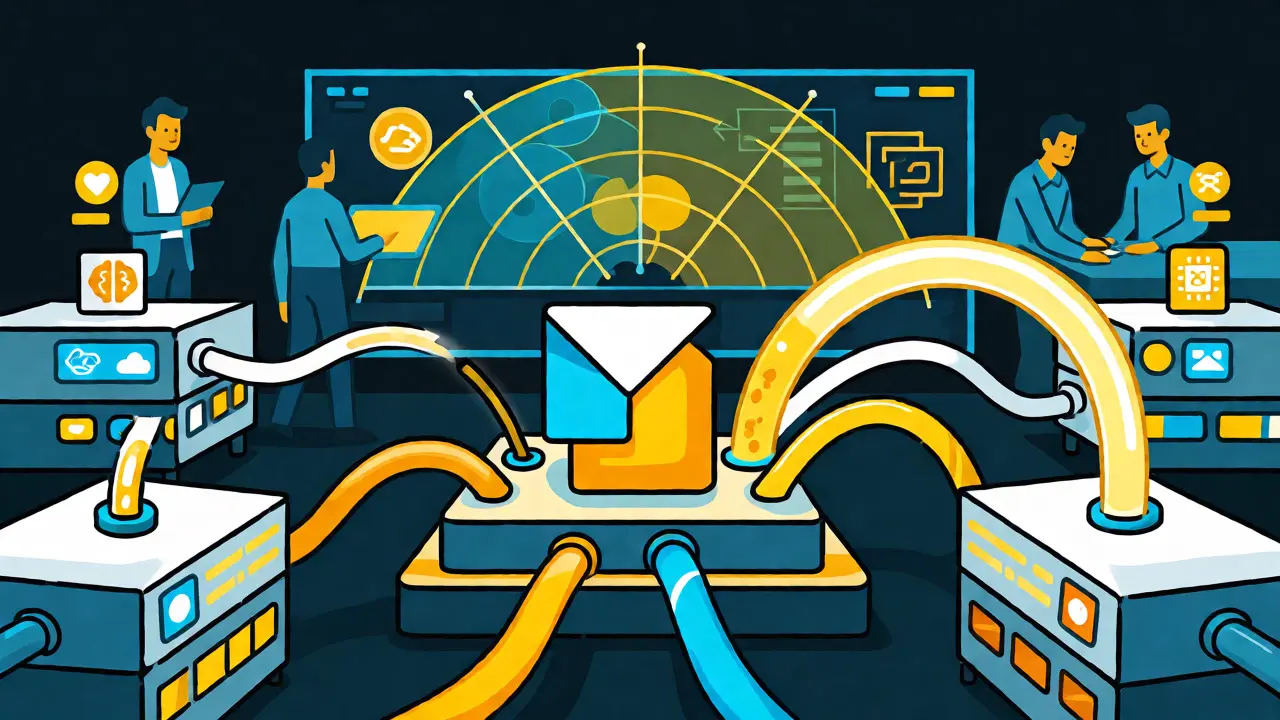
Standardization is coming, albeit slowly. The newly formed LLM Lifecycle Management Consortium is working on protocols to make deprecation notices universal. Until then, you must assume that everything will change. The most resilient systems are those that decouple the application logic from the specific model implementation. Use an abstraction layer-a router-that can switch between providers or models based on health checks. If OpenAI goes down or deprecates a model, your router should seamlessly failover to Anthropic or a local Llama instance without user intervention.
Frequently Asked Questions
What happens if I don't migrate before a model is deprecated?
Typically, you enter a grace period. For example, OpenAI offers 6 months of read-only access after the initial deprecation announcement. During this time, you can still query the model, but you cannot create new keys or access advanced features. After the grace period ends, the endpoint usually returns a 404 error, causing immediate service failure if you haven't migrated.
Is open-source LLM lifecycle management cheaper than API usage?
Not necessarily. While you save on per-token API costs, you pay in infrastructure (GPUs) and engineering time. Studies show open-source users spend 37% more engineering hours on maintenance. It becomes cost-effective only at high volumes where API fees exceed the fixed cost of running your own cluster and staff.
How do I detect silent model updates from a provider?
You can't rely solely on version numbers. Implement continuous evaluation pipelines that run a standardized test suite against your model daily. Track metrics like perplexity, response length, and semantic similarity to expected outputs. Significant deviations indicate a backend change, even if the model name hasn't changed.
Which provider has the most predictable deprecation schedule?
AWS Bedrock currently scores highest for predictability, with a strict 90-day warning policy and clear documentation. Google Cloud Vertex AI is also highly transparent with its hybrid approach. OpenAI has improved recently with standardized 180-day notices, but historically has been less predictable.
Do I need to retrain my fine-tuned model when the base model updates?
Yes, generally. Fine-tuning adapters are often tied to specific base model architectures and weight distributions. If the provider updates the base model significantly, your fine-tuned adapter may degrade or become incompatible. Always test fine-tuned models against new base versions before deploying.
Next Steps for Your Team
If you're currently using a single LLM provider, start by auditing your dependencies. Identify every place where you call an API. Pin those versions. Set up a simple dashboard that tracks latency and error rates. If you see anomalies, investigate immediately. Don't wait for the email announcing deprecation. By then, it's too late to plan a smooth migration. Treat your LLM integration like a critical database connection-something that requires constant care, testing, and a backup plan.