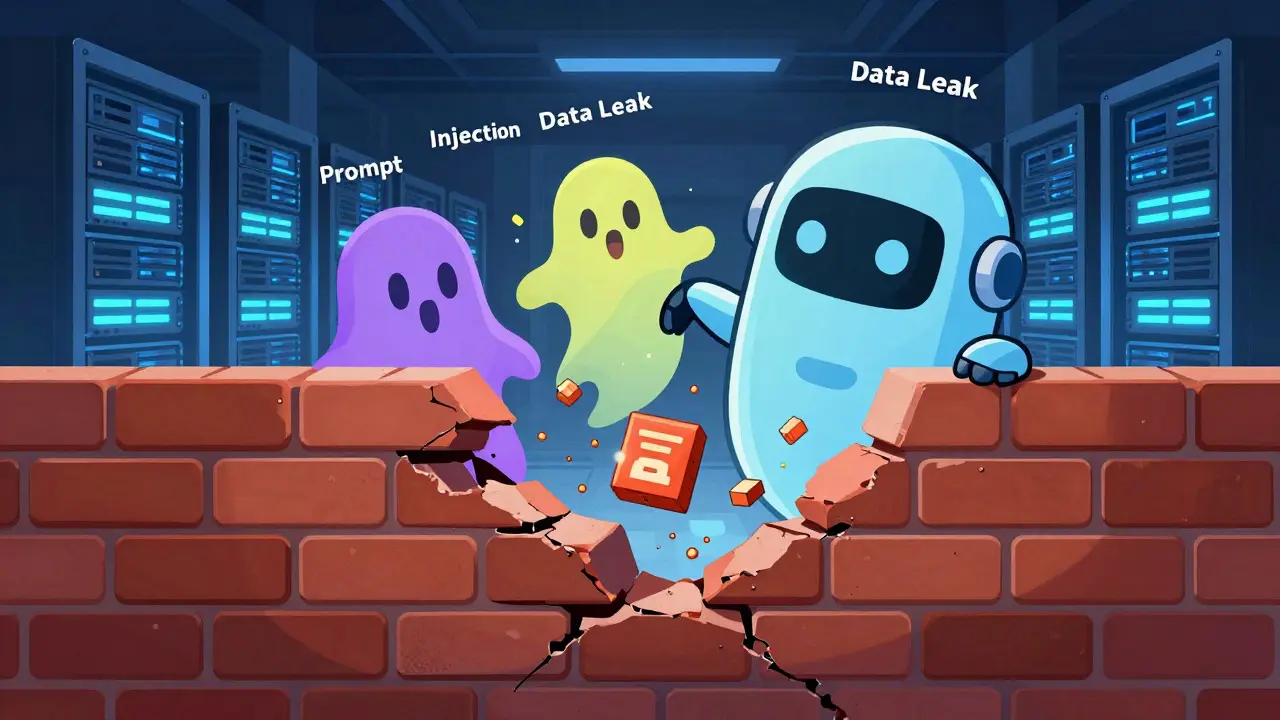
You probably thought your firewall was enough. It isn't anymore. Since the explosion of Large Language Models (LLMs) in 2022, traditional cybersecurity tools have been left chasing ghosts. They miss nearly three-quarters of the vulnerabilities specific to AI systems. If you are running LLMs in your business today, you are likely exposed to risks that a standard antivirus or network perimeter simply cannot see.
This is not just about preventing hackers from stealing your database. It is about stopping your own AI models from accidentally leaking customer data, hallucinating dangerous advice, or being manipulated by prompt injection attacks. The stakes are real. In 2023, a major financial institution paid a $2.3 million GDPR fine because an LLM inadvertently exposed personally identifiable information (PII) in its outputs. That kind of mistake can bankrupt a startup or destroy a brand's reputation overnight.
To keep your operations secure and compliant in 2026, you need more than just good intentions. You need structured compliance controls. These are the systematic governance frameworks, security protocols, and monitoring systems designed specifically for the unique behavior of AI. Let’s break down what these controls look like, why they matter, and how to implement them without slowing your team to a crawl.
Why Traditional Security Fails Against LLMs
The core problem is that LLMs are different beasts compared to traditional software. As noted by the Cloud Security Alliance in their September 2024 guide, LLMs "approximate the human layer." They process natural language, understand context, and generate creative outputs. Traditional security tools are built to block known bad actors or malicious code signatures. They do not know how to evaluate whether a sentence generated by an AI is semantically safe or if it contains hidden sensitive data.
Consider the difference between a SQL injection attack and a prompt injection. A SQL injection tries to break the database structure with code. A prompt injection tricks the model into ignoring its safety instructions by embedding malicious commands within seemingly harmless text. According to Ryan Berg, Lead of the OWASP Foundation's LLM Security Project, traditional API security controls miss 73% of these LLM-specific vulnerabilities. You need protections that operate at the semantic level, understanding meaning rather than just syntax.
This gap is why specialized frameworks like the OWASP Top 10 for Large Language Model Applications, published in December 2023 and updated in January 2026, have become essential reading. They identify risks like training data poisoning, insecure output handling, and excessive agency-threats that don't exist in legacy IT environments.
The Core Components of LLM Compliance Controls
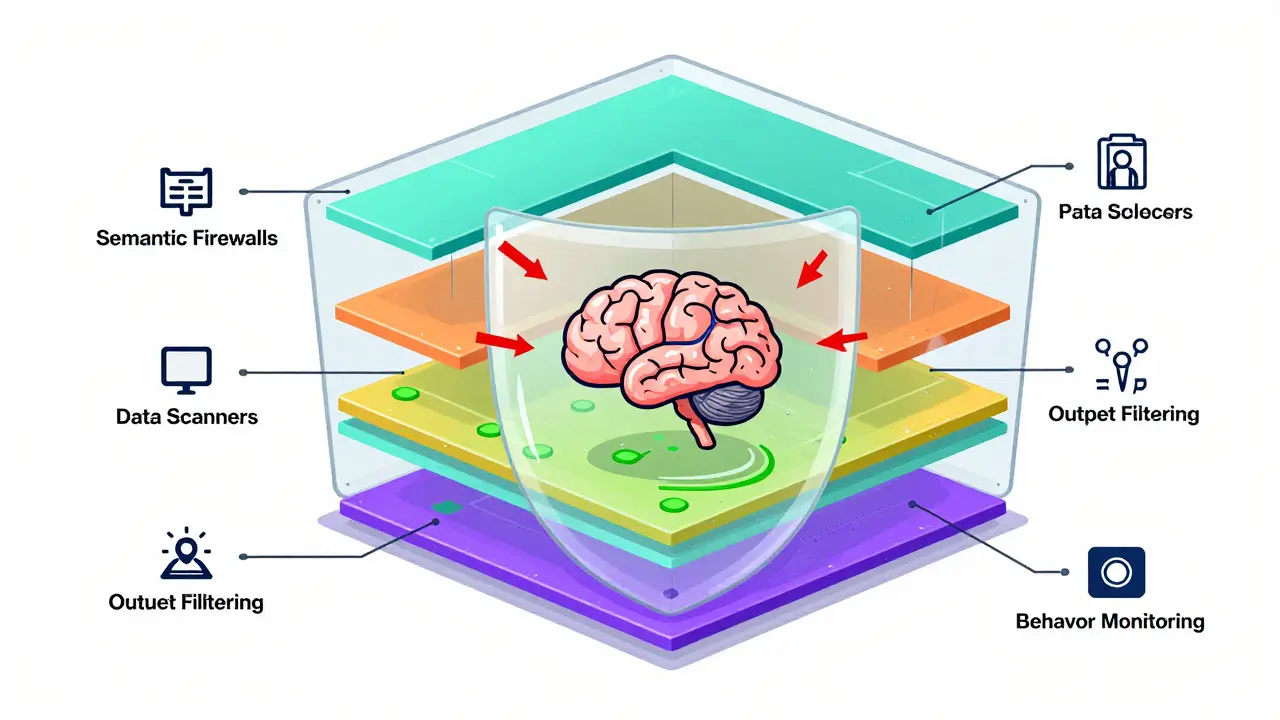
Effective compliance isn't a single tool; it is a layered defense strategy. Think of it like building a house: you need a foundation, walls, locks, and an alarm system. For LLMs, this translates into five critical technical layers identified by frameworks like Witness.ai and the Cloud Security Alliance.
- Semantic Firewalls: These act as proxies between users and the LLM. They filter and sanitize all interactions before they reach the model and after the response is generated. They prevent sensitive data from entering the model and stop harmful outputs from reaching the user.
- Data Store Scanners: Before you even train or fine-tune a model, you must scan your data stores. Using Data Security Posture Management (DSPM) tools, you identify and remove PII, PHI, and other regulated data. You cannot protect what you don't know exists.
- Input Validation and Filtering: This layer detects malicious embedded commands, such as jailbreak attempts or prompt injections. It ensures that the input sent to the model aligns with expected formats and safety guidelines.
- Output Handling and Content Filtering: The model’s response is never trusted blindly. Output handlers check for schema validation, toxicity, and policy violations. If the model starts generating code that deletes databases or text that violates copyright, this layer blocks it.
- Model Behavior Monitoring: Continuous, real-time analysis of the model’s performance. It looks for anomalies, such as sudden changes in response style or unusual access patterns, which could indicate a compromise or model drift.
F5’s glossary adds another crucial piece: privilege management. LLM agents should operate under strict least-privilege principles. Just because an AI assistant can write code doesn’t mean it should have root access to your production servers.
Regulatory Drivers: Why You Can't Ignore Compliance
In 2026, compliance is no longer optional. It is mandated by law in many jurisdictions. The primary driver for most enterprises is the EU Artificial Intelligence Act, which began enforcing risk management, logging, and human oversight requirements for AI systems in February 2024. Organizations deploying high-risk AI systems face severe penalties for non-compliance.
In the United States, sector-specific regulations are tightening. The New York Department of Financial Services (NYDFS) Regulation 500.148 requires AI risk management plans for financial institutions. Healthcare providers must adhere to HIPAA, which now extends to AI processing of protected health information (PHI). According to a January 2026 survey by ISACA, 82% of enterprises now use the NIST AI Risk Management Framework as their compliance foundation.
The cost of getting this wrong is steep. Beyond regulatory fines, there is the reputational damage. A single incident where an LLM leaks customer data can erode trust instantly. The 2023 financial institution fine mentioned earlier is just one example. As regulations proliferate globally-with 147 distinct AI governance frameworks active worldwide according to the Brookings Institution-organizations need adaptive compliance systems that can adjust controls based on data residency and user location.
Comparing Approaches: Specialized vs. Traditional Security
Not all security solutions are created equal when it comes to LLMs. A comparative analysis reveals significant differences in effectiveness. Traditional cybersecurity tools achieve only 38% effectiveness against LLM-specific threats, according to OWASP’s December 2023 benchmarking. In contrast, specialized LLM security frameworks demonstrate up to 87% effectiveness in preventing data leakage incidents.
| Approach | Effectiveness Against LLM Threats | Key Strengths | Weaknesses |
|---|---|---|---|
| Traditional Cybersecurity Tools | 38% | Strong enterprise integration, familiar interfaces | Misses semantic-level threats, poor prompt injection detection |
| Specialized LLM Security (e.g., Lakera.ai) | 94% coverage of OWASP Top 10 | High innovation, dedicated AI focus | Higher cost, newer market presence |
| Open Source Frameworks (e.g., Guardrails.ai) | 78% | Zero licensing cost, customizable | Requires 40% more implementation time, needs AI expertise |
| Hybrid Semantic Firewalls (Cloud Security Alliance approach) | 87% | Prevents data leakage, balances security and performance | Can increase query latency by ~180ms |
Gartner’s Q3 2025 Magic Quadrant highlights this divide. Dedicated LLM security vendors like Lakera.ai lead in innovation, while established firms like Palo Alto Networks trail with only 67% coverage of LLM-specific risks, despite having stronger general enterprise integration. Open-source options like Guardrails.ai offer a middle ground but demand significant internal expertise to maintain.
Implementing Controls Without Breaking Your Workflow
The biggest complaint from engineers implementing these controls is complexity. Gartner Peer Insights reports that 63% of users found LLM compliance systems took 3-6 months longer to deploy than vendors estimated. However, skipping proper implementation leads to "compliance theater"-systems that pass audits but fail in real-world attacks.
Here is a practical, step-by-step approach to implementation that balances security with usability:
- Conduct Shadow LLM Discovery: You can’t protect what you don’t know exists. Use tools like LLM Scanner Pro to inventory every instance of AI usage in your organization. Enterprises average 147 shadow LLM instances per 10,000 employees. Map out who is using them, for what purpose, and what data they touch.
- Start with Simple Policies: Don’t try to boil the ocean. Begin with clear, simple rules for data handling and output filtering. The Cloud Security Alliance recommends starting with basic policies and adjusting them frequently based on threat intelligence.
- Deploy Semantic Firewalls: Implement proxy-based filtering for all external LLM interactions. This provides immediate protection against data leakage and prompt injection. Expect a slight increase in latency (around 180ms), but the trade-off is worth it for security.
- Enforce Least Privilege Access: Integrate your LLM platforms with existing Role-Based Access Control (RBAC) systems. Ensure that AI agents have only the permissions necessary for their specific tasks. Snowflake’s implementation of unified data-centric RBAC is a good model to follow.
- Enable Continuous Monitoring: Set up real-time alerts for anomalous behavior. Monitor for spikes in error rates, unusual token usage, or outputs that deviate from expected patterns. Obsidian Security’s dynamic policy evaluation system flags unusual access patterns with 89% accuracy.
- Perform Regular Red Team Exercises: Adversarial testing is crucial. Simulate prompt injection attacks and jailbreak attempts to test your defenses. Update your policies biweekly based on findings.
Training is also key. Security teams need 120-160 hours of specialized training to effectively manage LLM compliance controls. Invest in upskilling your staff early to avoid costly mistakes later.

Performance Metrics and Operational Realities
Security cannot come at the expense of usability. If your compliance controls slow down your AI applications too much, users will find ways around them. Performance metrics matter.
According to Obsidian Security’s 2024 assessments, comprehensive compliance systems should process 95% of queries within 200 milliseconds while maintaining 99.95% accuracy in detecting policy violations. Enterprise deployments typically require minimum hardware specs of 16GB RAM and 4-core processors per security node to handle the computational load of real-time semantic analysis.
User feedback indicates that while initial setup is painful, the long-term benefits are clear. A senior AI engineer at a Fortune 500 financial services company reported that implementing semantic firewalls reduced PII leakage incidents by 92%. Another healthcare organization blocked 2,347 attempted PHI exposures over six months using dynamic policy evaluation. These numbers show that robust controls work-they just need to be tuned correctly.
Future Trends: What’s Coming in 2026 and Beyond
The landscape is evolving rapidly. The global LLM compliance market is projected to grow from $1.2 billion in 2025 to $8.7 billion by 2028, a 93% compound annual growth rate. This growth is driven by both regulatory pressure and increasing sophistication of AI threats.
Several trends are shaping the future:
- Mandatory Conformance Testing: NIST’s January 2026 roadmap specifies mandatory conformance testing for all government-contracted LLMs by December 2027. Private sector adoption will likely follow.
- Standardization Efforts: The Cloud Security Alliance announced its Semantic Firewall Certification Program in January 2026, establishing baseline requirements for compliance solutions. This will help reduce vendor lock-in and improve interoperability.
- Adaptive Compliance: With 147 distinct AI governance frameworks worldwide, static compliance is impossible. Future systems will automatically adjust controls based on data residency, user location, and local regulations.
- Dedicated Roles: Forrester predicts that 65% of enterprises will require dedicated LLM compliance officers by 2027. This role will bridge the gap between legal, security, and engineering teams.
As Bruce Schneier noted in his January 2026 Wired article, there is a risk of "over-engineering" compliance controls, creating false security while hindering innovation. The goal is not to build an impenetrable fortress but to create resilient systems that can adapt to new threats without stifling productivity.
Final Thoughts on Building Resilient AI Systems
Securing LLM operations is no longer a niche concern for AI researchers. It is a critical business imperative. By adopting specialized compliance controls, understanding the limitations of traditional security, and implementing layered defenses, organizations can harness the power of AI while mitigating significant risks.
Start small. Inventory your AI usage. Deploy semantic firewalls. Enforce least privilege. And remember: compliance is not a one-time project. It is a continuous process of monitoring, testing, and adapting. The companies that get this right will not only avoid fines and breaches-they will build deeper trust with their customers and gain a competitive edge in the AI-driven economy.
What is a semantic firewall in the context of LLM security?
A semantic firewall is a proxy system that sits between users and the Large Language Model. It filters and sanitizes inputs to prevent prompt injection and data leakage, and it checks outputs for policy violations, toxicity, or sensitive information before they reach the end-user. Unlike traditional firewalls that block IP addresses or ports, semantic firewalls understand the meaning and context of the language being processed.
How does the OWASP Top 10 for LLMs differ from the traditional OWASP Top 10?
The traditional OWASP Top 10 focuses on web application vulnerabilities like SQL injection and cross-site scripting. The OWASP Top 10 for LLMs addresses risks unique to generative AI, such as prompt injection, training data poisoning, insecure output handling, and excessive agency. It recognizes that LLMs introduce new attack vectors related to natural language processing and model behavior.
What are the main regulatory drivers for LLM compliance in 2026?
Key regulations include the EU Artificial Intelligence Act, which mandates risk management and human oversight for high-risk AI systems. In the US, sector-specific rules like NYDFS Regulation 500.148 for financial services and HIPAA for healthcare are increasingly applied to AI. Additionally, the NIST AI Risk Management Framework has become a de facto standard for many enterprises.
Is open-source LLM security better than commercial solutions?
It depends on your resources. Open-source frameworks like Guardrails.ai offer zero licensing costs and high customizability, achieving about 78% effectiveness against threats. However, they require 40% more implementation time and specialized AI security expertise. Commercial solutions like Lakera.ai or Obsidian Security offer higher coverage (up to 94%) and easier integration but come with licensing fees. For most enterprises, a hybrid approach or dedicated commercial tool is more efficient.
How can I detect shadow LLM usage in my organization?
Use automated discovery tools like LLM Scanner Pro or similar network monitoring solutions that identify traffic to known LLM APIs. Conduct employee surveys and review cloud spend reports for unexpected AI service charges. Establish a clear policy that requires registration of any AI tool used for business purposes, and integrate this with your IT asset management system.
Laura Davis
July 5, 2026 AT 05:40Lisa Nally
July 5, 2026 AT 14:23Edward Gilbreath
July 7, 2026 AT 01:27kimberly de Bruin
July 8, 2026 AT 16:29Edward Nigma
July 9, 2026 AT 10:36Francis Laquerre
July 9, 2026 AT 17:32michael rome
July 11, 2026 AT 16:15