
Imagine shrinking a massive library into a pocket-sized notebook. You save space, you carry it easily, but did you lose the footnotes? That is the core dilemma facing developers working with Large Language Model (LLM) compression, a process that reduces model size and computational needs while trying to keep performance intact. As of mid-2026, we are past the hype phase. We know compression works for basic tasks. But when you push these compressed models into multilingual environments or specialized fields like law and medicine, things get messy fast.
The goal is simple: run huge models on consumer hardware without losing their brainpower. The reality is nuanced. Recent data shows that while standard benchmarks might look fine, real-world utility often degrades in unpredictable ways, especially for low-resource languages and niche domains. If you are planning to deploy a compressed model, you need to understand exactly where the cracks appear before they break your application.
How Compression Actually Works Under the Hood
To understand the impact, you first need to grasp the mechanics. LLM compression isn't one single trick; it's a toolkit. The three main techniques dominating the landscape in 2025 and 2026 are quantization, which lowers the precision of numbers used in calculations, pruning, which removes less important connections, and knowledge distillation, where a smaller "student" model learns from a larger "teacher".
Quantization has seen the most aggressive advances. Early methods stuck to 8-bit precision. Now, techniques like QuIP allow for 2-bit to 4-bit precision. This means a weight that once took 32 bits of memory now takes just 4. For a 7-billion-parameter model, this slashes GPU memory requirements from roughly 14GB down to about 6GB. Suddenly, an NVIDIA RTX 3090 can run what previously required enterprise-grade A100 clusters.
Pruning aims for sparsity. Methods like SparseGPT and Wanda can remove 50% to 60% of the weights in a network. The theory is elegant: if a connection doesn't matter much, cut it. However, as researchers Khanal and Capone noted in 2024, achieving high sparsity often leads to a disconnect between theoretical metrics and practical results. You might see negligible changes in perplexity (a measure of prediction uncertainty), but downstream task accuracy can plummet by over 20%.
The Multilingual Trap: Why Low-Resource Languages Suffer Most
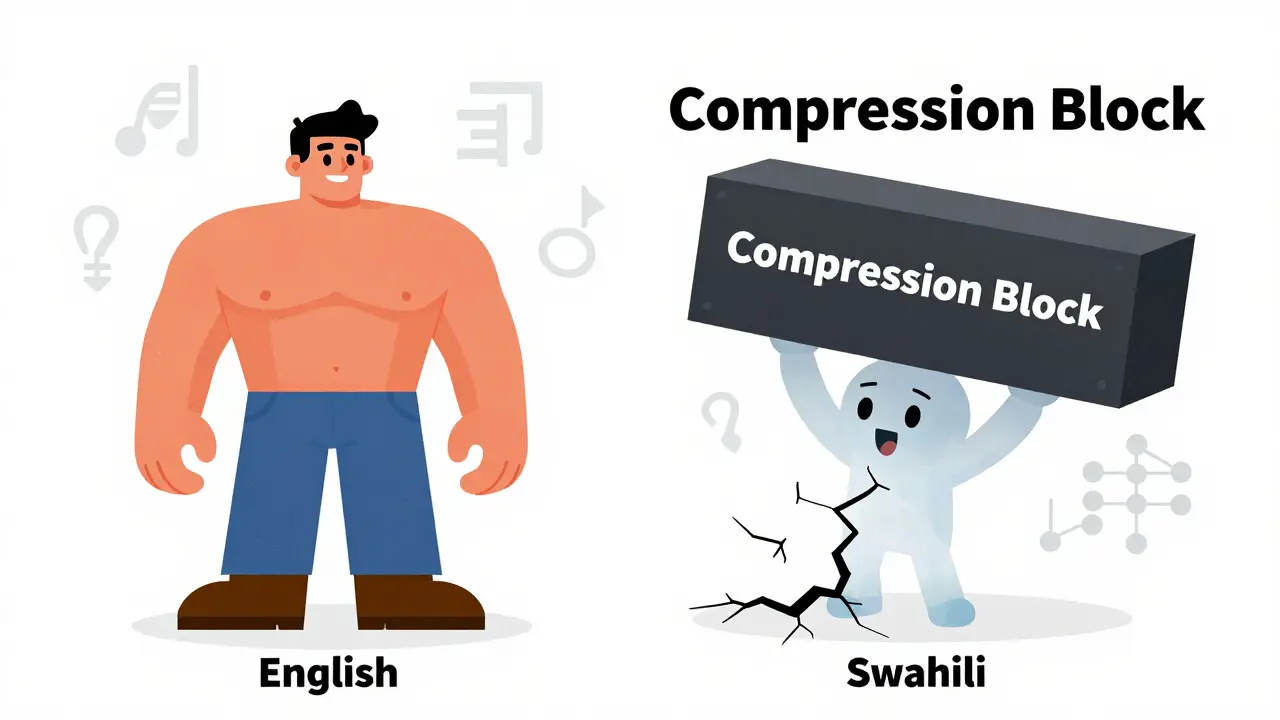
If you think compression affects all languages equally, you are mistaken. This is perhaps the most critical finding for global applications. High-resource languages like English, Chinese, and Spanish have vast amounts of training data. Their patterns are robust enough to survive some compression noise. Low-resource languages do not have that luxury.
Studies by Liu et al. (2024) documented a stark disparity. When applying 4-bit quantization to multilingual models, performance for Swahili dropped by 14.3%, while English only dipped by 3.2%. The gap widens further with more aggressive compression. For languages with fewer than 1 million Wikipedia articles, you can expect an 8-12% performance drop compared to a 2-4% drop for major languages.
Why does this happen? Compressed models rely heavily on statistical regularities found in the majority of their training data. When you reduce precision, you smooth out the details. For a language with rich, diverse training examples, those details are redundant. For a low-resource language, every bit of precision matters because the model has fewer examples to generalize from. User feedback from Hugging Face forums confirms this: complaints about "degraded multilingual performance" account for 57% of negative reviews for compressed LLMs.
Domain-Specific Risks: Medicine, Law, and the Knowledge Gap
Multilingual issues are bad enough, but domain-specific applications face a different kind of danger: knowledge degradation. General-purpose models are trained on everything. Domain-specific models are fine-tuned on precise, factual data. Compression tends to erode that specificity.
Research using the LAMA and LM-HARNESS benchmarks reveals that domain-specific models experience up to 30% greater knowledge degradation than general-purpose models when compressed to 4-bit precision. The stakes are highest in regulated industries:
- Medical domains: Accuracy drops of 27% have been observed after compression. A hallucinated diagnosis is not just an error; it’s a liability.
- Legal domains: Accuracy falls by 22%. Misinterpreting a clause due to quantization noise can invalidate legal advice.
- General knowledge: Drops are milder, around 12%, making general chatbots more resilient than professional tools.
This suggests a hard rule: do not compress medical or legal models below 8-bit precision without extensive, domain-specific calibration. The savings in compute time are rarely worth the risk of catastrophic failure in these verticals.
The Perplexity-Performance Paradox
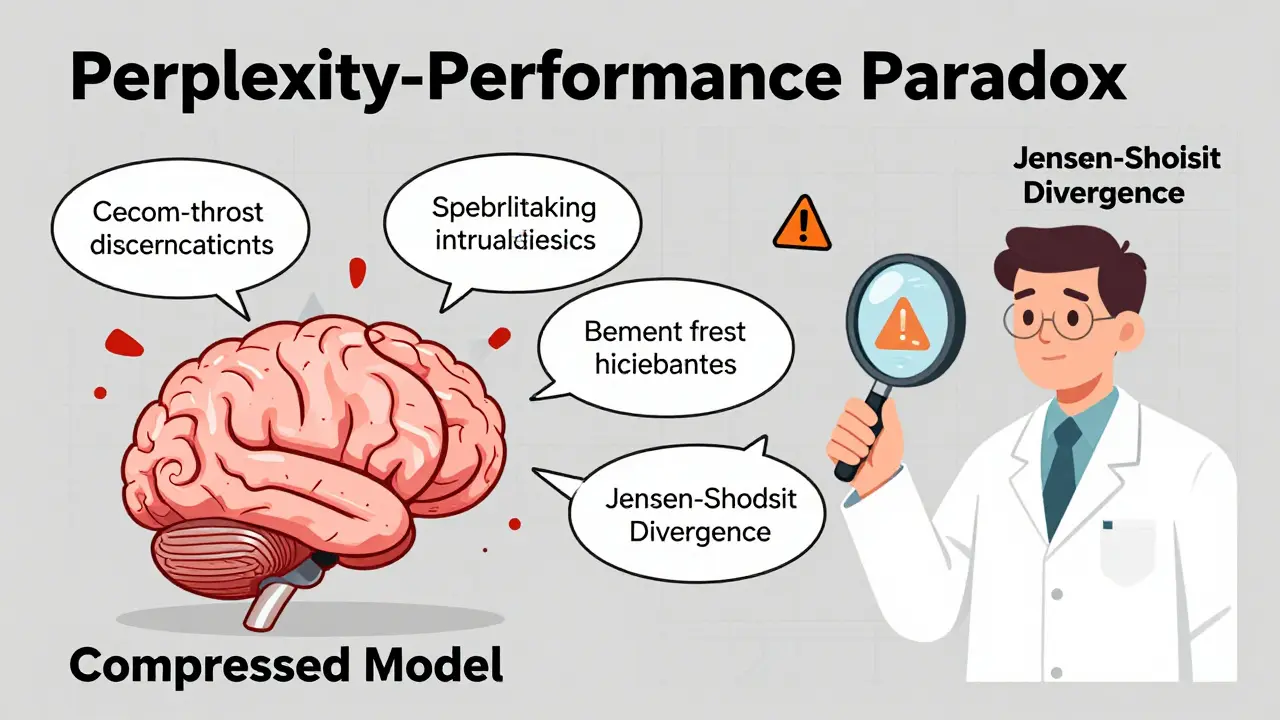
Here is where many engineers get burned. They look at perplexity scores, see them remain stable, and assume the model is healthy. This is the "perplexity-performance paradox" identified by Khanal and Capone. Perplexity measures how well the model predicts the next token in a sequence. It is a local metric. It does not measure logical reasoning, factuality, or instruction following.
In tests on LLaMA-2-7B with 50% sparsity, perplexity increased by only 0.8%. It looked perfect. Yet, on the TyDi QA multilingual benchmark, accuracy dropped by 22.4%. The model was still fluent, but it was no longer correct. To catch this, experts recommend using Jensen-Shannon (JS) Divergence as a supplementary metric. JS Divergence correlates with downstream task performance at r=0.87, whereas perplexity only correlates at r=0.32. If you are evaluating compressed models, stop relying solely on perplexity.
Bias Amplification: An Unintended Side Effect
There is another shadow side to compression: bias amplification. You might assume that simplifying a model would simplify its biases. Instead, recent findings suggest the opposite. Kim et al. (2025) found that decoder-only models like Llama3.1-8B exhibit 18.7% greater bias amplification post-compression compared to encoder-decoder architectures like T5.
Specifically, quantization increased demographic bias by 28.4% in certain Llama variants. The mechanism is subtle. Compression acts as a form of regularization, smoothing the loss landscape. In doing so, it may amplify dominant stereotypes present in the training data while suppressing nuanced, counter-stereotypical examples that were already rare. For multilingual applications in diverse cultural contexts, this raises serious ethical concerns. The EU AI Act draft (November 2024) now requires bias impact assessments for compressed models in high-risk applications, a regulation that will affect 63% of enterprise deployments.
| Category | Impact Metric | High-Resource / General | Low-Resource / Specialized |
|---|---|---|---|
| Language Performance | Accuracy Drop (4-bit) | 2-4% | 8-14.3% |
| Domain Knowledge | Degradation Rate | 12% (General) | 22-27% (Law/Med) |
| Bias | Amplification | Baseline | +28.4% increase |
| Evaluation | Perplexity Correlation | r=0.32 (Weak) | r=0.32 (Weak) |
Practical Strategies for Safe Deployment
So, should you avoid compression? No. The market is moving toward it, with enterprise adoption surging to 47% in 2025. But you must be strategic. Here is how to mitigate the risks identified above.
1. Use Domain-Specific Calibration Data Khanal and Capone demonstrated that using domain-specific calibration data improves downstream task performance by 18.7% compared to general data. Do not use random web text to calibrate your medical model. Use de-identified patient records or medical journals. This anchors the compressed weights to relevant patterns.
2. Choose the Right Architecture If bias is a major concern, consider encoder-decoder models like T5 or Mistral variants, which showed 23% greater robustness to quantization than comparable Llama models. Decoder-only models are faster but more prone to bias amplification under pressure.
3. Adopt Better Metrics Implement Jensen-Shannon Divergence in your evaluation pipeline. If your perplexity looks good but JS Divergence spikes, your model is lying to you. Also, always test on downstream tasks relevant to your specific use case, not just generic benchmarks like GLUE.
4. Layer-Aware Pruning Avoid uniform pruning. Some layers in a neural network are more sensitive than others. Techniques that identify and protect critical layers during pruning can prevent "layer collapse," which occurs in 32% of aggressive compression attempts. Look for libraries that support structured pruning rather than unstructured magnitude pruning.
5. Monitor for Language Drift In multilingual models, report "language drift"-the phenomenon where the model starts defaulting to English or other high-resource languages. This happens in 45% of compression attempts on non-English benchmarks. Regularly audit outputs in target low-resource languages to ensure consistency.
Future Outlook: Task-Aware Compression
The industry is shifting away from one-size-fits-all compression. Google’s 2025 release of 'CompressLLM' introduced language-aware quantization groups, achieving 2.5-bit precision with minimal multilingual degradation. Meta’s 'Llama-3-8B-Compressed' uses domain-adaptive compression. These tools recognize that a financial query needs different preservation strategies than a creative writing prompt.
By 2027, Gartner predicts compression will be standard for 95% of enterprise LLM deployments. However, Stanford HAI researchers warn of fundamental limitations in preserving nuanced linguistic capabilities. The key takeaway for 2026 is clear: compression is viable, but it is not free. You pay for speed and memory with precision, equity, and sometimes, truth. Measure carefully, calibrate specifically, and never trust perplexity alone.
What is the biggest risk of compressing multilingual LLMs?
The biggest risk is disproportionate performance degradation in low-resource languages. While English may only drop 3-4% in accuracy, languages like Swahili can drop over 14%. This creates an equity issue where the model becomes significantly less useful for non-dominant language speakers.
Can I safely compress a medical or legal LLM?
Proceed with extreme caution. Domain-specific models suffer up to 30% more knowledge degradation than general models. Medical domains have seen 27% accuracy drops. It is recommended to stay at 8-bit precision or higher and use extensive domain-specific calibration data to mitigate errors.
Why is perplexity a bad metric for compressed models?
Perplexity measures next-token prediction probability, not logical correctness. Compressed models often maintain low perplexity (fluent speech) while suffering massive drops in factual accuracy and reasoning. This is known as the "perplexity-performance paradox." Use Jensen-Shannon Divergence instead for better correlation with real-world performance.
Does compression increase bias in AI models?
Yes. Research indicates that quantization can amplify demographic bias by up to 28.4% in certain decoder-only models. Compression smooths the model's decision boundaries, which can inadvertently strengthen dominant stereotypes while erasing nuanced, counter-stereotypical examples.
What is the best compression technique for consumer hardware?
4-bit quantization using libraries like bitsandbytes or llama.cpp is currently the sweet spot for consumer GPUs like the RTX 3090. It reduces memory usage by ~75% while maintaining acceptable performance for general tasks. Avoid going below 4-bit unless you use advanced techniques like QuIP with careful calibration.