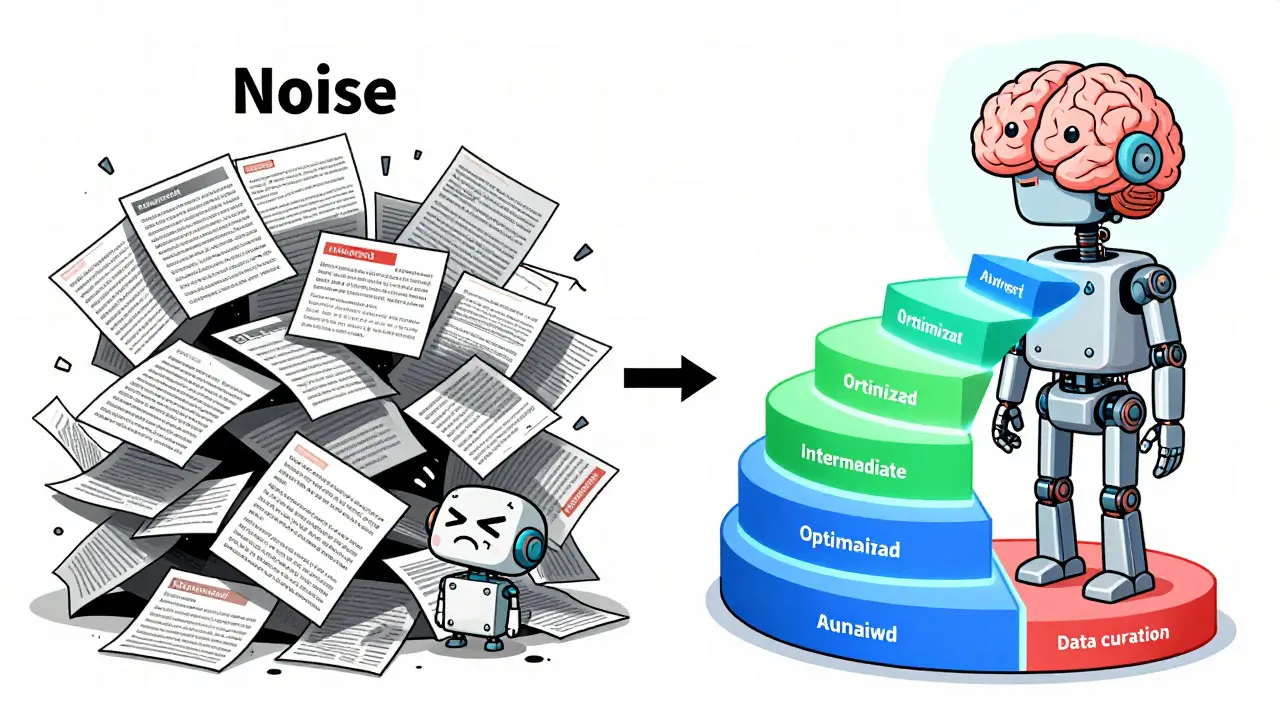
For years, the industry’s obsession with large language models has been simple: throw more parameters at the problem. If a model wasn’t smart enough, we made it bigger. If it was slow, we added more compute. But by late 2025, that brute-force approach hit a wall. The costs were skyrocketing, and the performance gains were shrinking. Enter a quieter, more sophisticated revolution: curriculum and data mixtures. This isn’t just about feeding models more text; it’s about feeding them the *right* text, in the *right* order. Think of it as the difference between giving a child a dictionary to memorize versus teaching them to read through stories, starting with simple words and gradually moving to complex narratives.
The shift toward optimized data strategies represents a fundamental change in how we understand scaling laws. While traditional scaling focused on the relationship between model size, dataset size, and compute power, new research reveals that data composition is a "hidden variable" capable of delivering massive efficiency jumps without adding a single parameter. In this article, we’ll break down why data mixtures matter, how curriculum learning works for transformers, and what you need to know to implement these strategies effectively in 2026.
The Hidden Variable in Scaling Laws
You’ve likely heard of Chinchilla-optimal scaling, which suggests there’s a sweet spot for balancing model size and training tokens. But recent findings from the MIT-IBM Watson AI Lab, published in Nature Machine Intelligence in 2025, suggest we’ve been ignoring a critical piece of the puzzle. Researchers Chen et al. identified that optimizing data mixture can yield up to 15% performance gains without increasing parameter counts. That’s huge. It means you could achieve the same intelligence level with a smaller, cheaper model if you curate your data correctly.
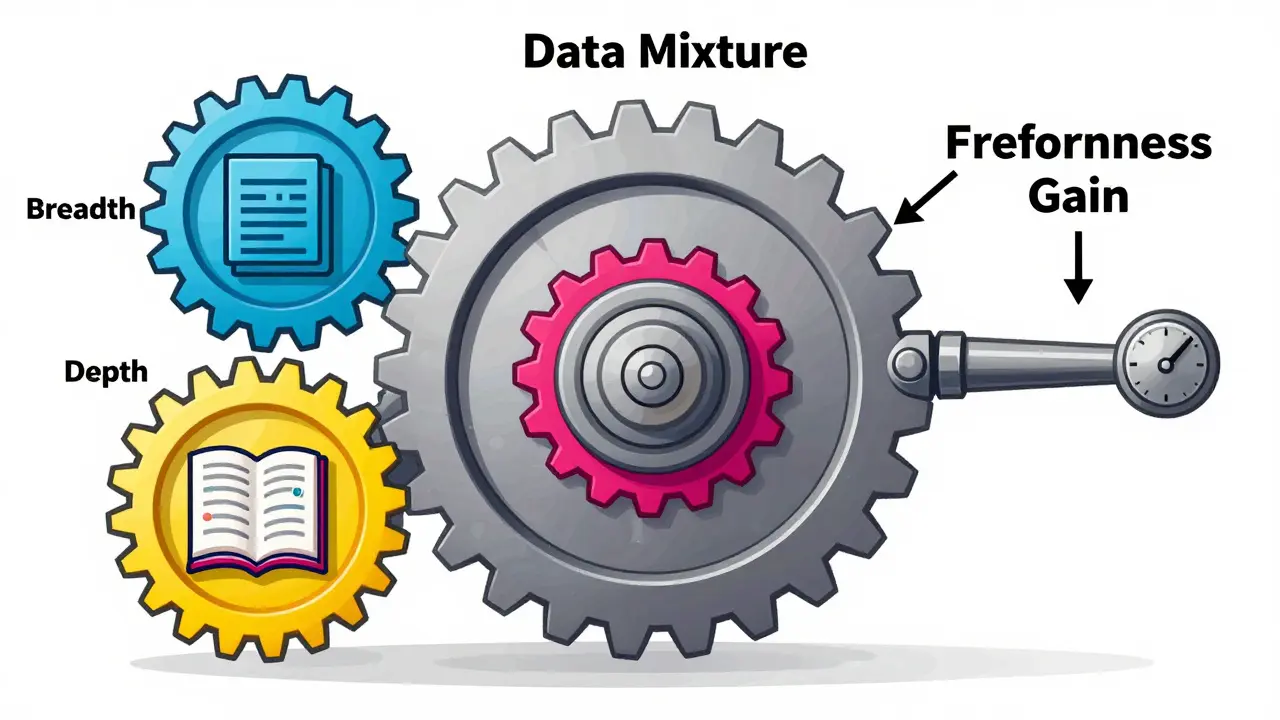
Why does this happen? Because not all tokens are created equal. A random sample of the internet contains noise, repetition, and low-quality content that wastes compute cycles. By contrast, a carefully curated mixture balances domain coverage, linguistic complexity, and factual accuracy. NVIDIA’s 2025 scaling framework broke this down into three critical dimensions:
- Breadth: Coverage across diverse domains (code, science, literature, etc.).
- Depth: Complexity levels within those domains (basic syntax vs. advanced reasoning).
- Freshness: Temporal recency of the information.
NVIDIA quantified the impact of freshness alone, noting it contributes roughly 3.2% to overall model performance when optimized. For technology content, an ideal recency window might be six months, while historical data can stretch back 24 months. Ignoring these nuances means your model spends valuable energy learning outdated or irrelevant patterns.
What Is Curriculum Learning for LLMs?
Curriculum learning isn’t a new concept in machine learning. It dates back to early neural network experiments where researchers found that training on easy examples first helped models converge faster. However, applying this to large language models is tricky. Transformers process data in parallel batches, and the sheer scale of trillions of tokens makes manual curation impossible. So, how do we adapt it?
The key lies in automated tagging and scheduling. Instead of human editors sorting books by difficulty, we use algorithms to score text based on syntactic depth, concept density, and domain relevance. Research from the ACL Anthology’s 2025 EMNLP proceedings (Wang et al.) showed that models trained with difficulty-graded curricula achieved 5.8% lower loss at equivalent compute budgets compared to random data ordering. Essentially, the model learns the basics of language structure before tackling complex reasoning tasks, leading to more stable and efficient training.
MIT-IBM’s meta-analysis recommended a specific power-law distribution for optimal mixtures:
- 60% Foundational Knowledge: Basic language structures, common facts, and high-frequency vocabulary.
- 30% Intermediate Complexity: Specialized domains, nuanced reasoning, and moderate technical jargon.
- 10% High-Difficulty Content: Abstract concepts, multi-step logical reasoning, and rare edge cases.
This structure mimics human education. You don’t start calculus before algebra. By following this progression, models build a robust foundation that supports higher-level reasoning, rather than guessing patterns from chaotic data.
Performance Gains: What the Data Says
If you’re wondering whether the effort is worth it, the benchmarks say yes. MIT-IBM conducted controlled experiments across 12 model families, comparing standard random data ordering against optimized curriculum approaches. The results were stark. Models with optimized mixtures achieved 22.4% higher accuracy on complex reasoning tasks, measured via MATH and GSM8K benchmarks. Even more impressive, they required 18.7% less training compute to reach equivalent performance levels.
| Metric | Random Data Ordering | Optimized Curriculum | Improvement |
|---|---|---|---|
| Reasoning Accuracy (MATH/GSM8K) | Baseline | +22.4% | Significant |
| Training Compute Required | 100% | -18.7% | Efficiency Gain |
| Mathematical Reasoning | Baseline | +28.3% | High Impact |
| Scientific Knowledge Retention | Baseline | +24.1% | High Impact |
| Basic Language Understanding | Baseline | +<3% | Minimal |
Note that the gains aren’t uniform. Curriculum learning shines in mathematical reasoning, scientific knowledge, and multilingual capabilities (up to 19.8% improvement). However, for basic language understanding-like grammar or simple sentence completion-the benefits are minimal (under 3%). This tells us something important: curriculum learning is best suited for pushing models beyond their baseline competence, not for teaching them the basics.
Implementation Challenges and Real-World Friction
If the benefits are so clear, why isn’t everyone doing it? The short answer: complexity. Implementing a curriculum system requires sophisticated data annotation pipelines and careful hyperparameter tuning. Meta’s engineering team reported a 37% increase in preprocessing time when implementing their curriculum system for Llama 3.1 in Q2 2025. They had to tag every piece of data by complexity, domain, and quality before training even began.
This creates a bottleneck. On Reddit’s r/MachineLearning forum, a popular thread from November 2025 highlighted that while 63% of practitioners saw positive results, many struggled with the infrastructure. One user, ‘tensor_slinger,’ noted that their data annotation pipeline became the project’s bottleneck, requiring three full-time engineers to maintain. For smaller teams, this overhead is prohibitive. A December 2025 survey by the AI Infrastructure Alliance found that only 28% of organizations with fewer than 50 ML engineers had successfully implemented curriculum approaches, compared to 76% of larger organizations.
There’s also the risk of bias. A GitHub issue on Hugging Face’s Transformers library documented failures when applying standard curriculum approaches to multilingual models. The curriculum worked well for English but caused a 15% performance degradation in low-resource languages because the complexity distributions were uneven. If your data mixture doesn’t account for linguistic diversity, you might inadvertently penalize non-dominant languages.
Tools and Frameworks for 2026
Luckily, the ecosystem is maturing. You don’t have to build everything from scratch. Several tools have emerged to simplify curriculum implementation:
- DataComp (MIT-IBM): Released in August 2025, this open-source tool provides pre-annotated datasets and curriculum templates. Users report a 40% reduction in implementation time.
- AutoCurriculum (Google): Launched in November 2025, this system uses reinforcement learning to dynamically adjust data mixtures during training. It showed 9.3% performance gains on complex tasks without manual intervention.
- AWS DataMixer: Capturing 31% market share in Q4 2025, this cloud service offers managed curriculum optimization for enterprise users.
For most teams, the recommendation is to start simple. Google’s Gemma 3 release demonstrated that basic difficulty sorting could achieve 85% of the benefits of complex multi-dimensional curricula while requiring only 15% of the implementation effort. Don’t try to boil the ocean. Start with a clear distinction between foundational and advanced data, and iterate from there.
Future Outlook: Beyond Parameter Scaling
Where is this heading? Industry analysts project that by 2027, optimized data mixtures will contribute 25-30% of the performance gains in new LLM releases. We’re moving away from the era of pure parameter scaling toward an era of data efficiency. Dr. Anna Huang of MIT-IBM described this as the "next frontier in scaling efficiency," suggesting it could unlock effective model size increases of 2-3× through smarter data selection alone.
However, skepticism remains. OpenAI researcher Noam Brown argued in a November 2025 preprint that the marginal benefits of sophisticated curriculum design diminish at trillion-parameter scales, where simple data quantity and quality dominate. Stanford’s Center for Research on Foundation Models offered a balanced view: curriculum learning provides significant benefits for models up to 500B parameters, but beyond that, returns diminish unless combined with architectural innovations.
Regardless of the debate, one thing is clear: data is no longer just fuel; it’s the engine. As compute costs rise and environmental concerns grow, the ability to train smarter, not harder, will separate the leaders from the laggards. Whether you’re a startup with limited resources or a tech giant, paying attention to your data mixture isn’t optional anymore-it’s essential.
What is the optimal data mixture ratio for LLM training?
According to MIT-IBM's 2025 meta-analysis, the recommended power-law distribution is approximately 60% foundational knowledge (basic structures), 30% intermediate complexity (specialized domains), and 10% high-difficulty content (abstract reasoning). This balance ensures models build a strong base before tackling complex tasks.
Does curriculum learning work for small models?
Yes, and often more effectively than for massive models. Stanford's research indicates that curriculum learning provides significant benefits for models up to 500B parameters. For smaller models, the structured progression helps maximize limited capacity by focusing on high-value patterns first.
How much does implementing a curriculum system cost?
Meta reported an 11.3% average increase in training costs due to computational overhead in data processing. Additionally, preprocessing time can increase by up to 37%. However, these costs are often offset by 18.7% reductions in total training compute required to reach target performance levels.
Are there risks to using curriculum learning?
Yes. Poorly designed curricula can lead to bias, particularly in multilingual settings. Hugging Face users reported 15% performance degradation in low-resource languages when complexity distributions were uneven. Careful validation and diverse data tagging are essential to mitigate these risks.
What tools are available for automatic curriculum generation?
Key tools include MIT-IBM's DataComp (open-source templates), Google's AutoCurriculum (reinforcement learning-based dynamic adjustment), and AWS DataMixer (enterprise cloud service). These tools reduce implementation time by up to 40% compared to manual curation.